
1% Listing Fees vs Upfront Flat-Fee MLS in Nashville: Which Saves You More in 2026?
If you're weighing a 1 percent listing fee vs flat fee MLS in Nashville, here's what most brokerages won't put in bold: that "1%" almost never means 1%. Nearly every discount listing brokerage in Middle Tennessee enforces a minimum commission floor — often $3,000 to $4,500 — so on a lower-priced home, your effective rate climbs well above the advertised number.
Most Nashville sellers are weighing exactly this trade-off: hand-holding from a 1% brokerage, or a few hundred bucks to get your listing straight onto RealTracs yourself. The answer depends on two things — your sale price and how much service you actually want — and this page gives you the math to decide in minutes.
The Quick Answer
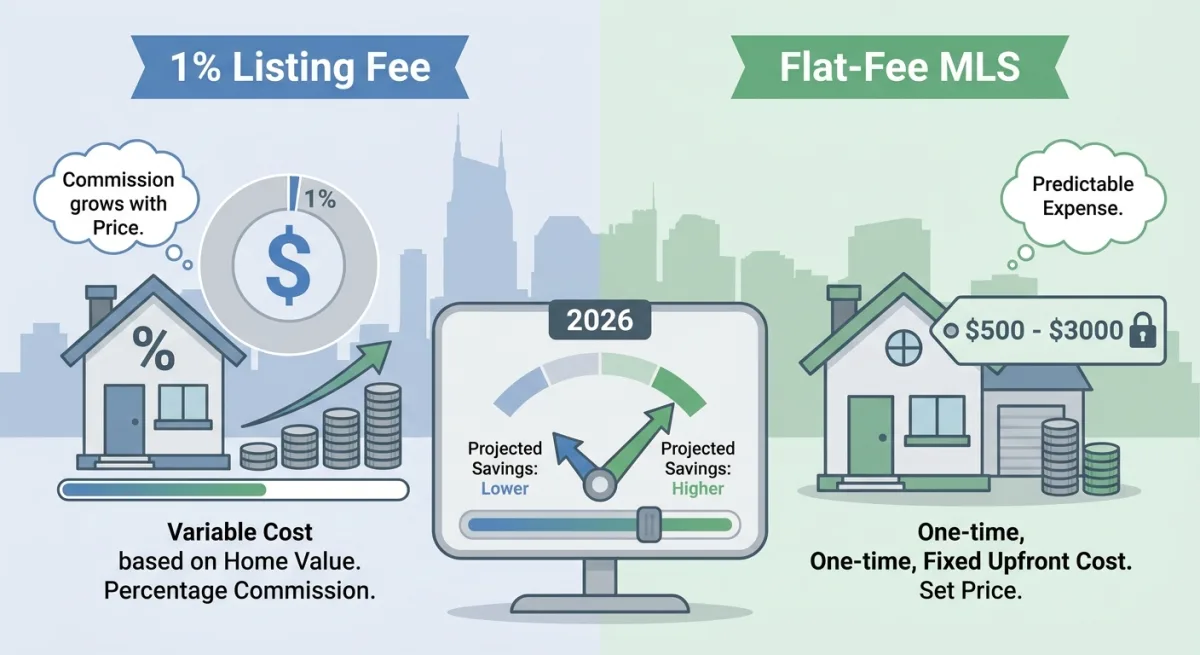
For most Nashville and Middle Tennessee homes, an upfront flat-fee MLS listing ($299–$999) saves you more than a 1% listing brokerage — often by several thousand dollars on the listing side. The floor is the reason: on a home under about $450,000, you rarely pay a true 1% — you pay the floor, which pushes your effective rate well above it.
On a $450,000 Nashville home — right around the current Middle Tennessee median — a 1% listing fee runs about $4,500. The flat-fee MLS listing covering the same RealTracs exposure costs a few hundred dollars. That gap is real money, and it grows as your price climbs.
- Flat-fee MLS wins when your home is under ~$500K, you're comfortable handling showings and negotiation, and you want maximum control over costs.
- A 1% listing brokerage can be worth it when you want hands-on service — pricing help, photos, a transaction coordinator — and your home is priced high enough that 1% genuinely stays near 1%.
Neither figure includes what you choose to offer a buyer's agent. That's now fully negotiable after the 2026 NAR settlement rules — more on that below.
How Each Model Works
The 1% listing brokerage (think 1 Percent Lists, Felix Homes, or Clever's partner agents) is a discount full-service model. A TREC-licensed broker lists your home on RealTracs and typically handles pricing guidance, professional photos, showing coordination, offer negotiation, and closing paperwork. You pay a listing commission of 1% of the final sale price — at closing, not upfront.
The upfront flat-fee MLS listing (also called an entry-only or limited-service listing) is the DIY lane. You pay a fixed price upfront — in Nashville, typically $299–$999 depending on the package — to get your property onto RealTracs, which syndicates to Zillow, Realtor.com, and the rest. From there, you run the sale: set the price, field inquiries, schedule showings, review offers, and manage the contract to closing.
The core distinction: 1% is a percentage of your sale price paid for service; flat-fee is a fixed dollar amount for access. One scales with your sale price. The other doesn't move no matter how much your home sells for.
The Hidden Catch: The 1% Minimum Commission Floor
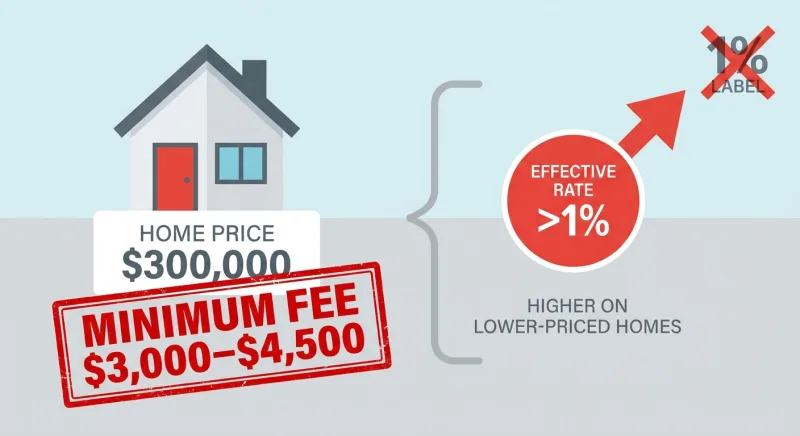
Nearly every 1% brokerage buries this in the fine print: most enforce a minimum commission of $3,000–$4,500. The listing agreement specifies you pay the higher of 1% or the floor — and on lower-priced homes, you almost always hit the floor.
Think in effective rate, not advertised rate:
- On a $450,000 home, 1% is $4,500 — the floor doesn't bite.
- On a $300,000 home, a true 1% would be $3,000. But a $4,500 floor means you pay 1.5%.
- On a $225,000 starter condo, that same floor is an effective 2% — double the headline.
The lower your price, the more the "1%" label misleads you. A flat-fee listing has no floor and no percentage. $499 is $499 whether your home sells for $225K or $950K — a smaller slice of your proceeds as the price climbs.
The contrarian takeaway: 1% listing fees are sold as the budget option, but their floor makes them most expensive, proportionally, on the least expensive homes — exactly the Clarksville and Murfreesboro sellers who need savings most.
Nashville Cost Math at 2026 Median Prices
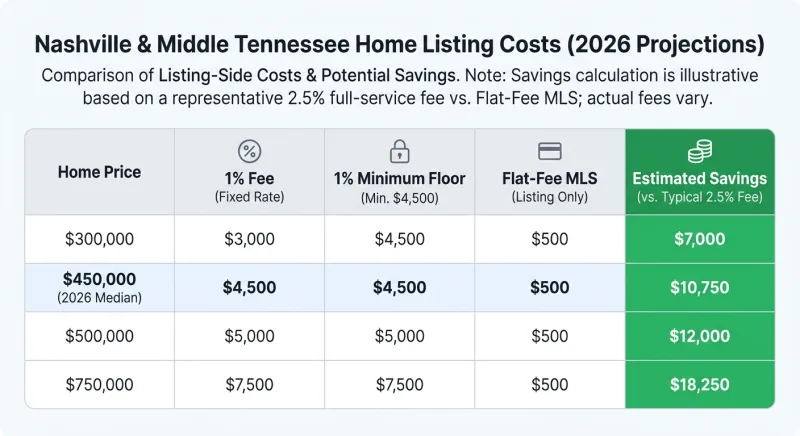
Figures below cover the listing fee only. Figures use a 1% rate with an assumed $4,500 minimum floor and a representative $499 flat-fee listing. Confirm your specific program's floor and package.
| Sale Price | 1% Fee (raw) | 1% Floor Applied | Flat-Fee MLS | You Save with Flat-Fee |
|---|---|---|---|---|
| $300,000 | $3,000 | $4,500 (floor) | $499 | $4,001 |
| $450,000 (≈ Middle TN median) | $4,500 | $4,500 | $499 | $4,001 |
| $500,000 | $5,000 | $5,000 | $499 | $4,501 |
| $750,000 | $7,500 | $7,500 | $499 | $7,001 |
The flat-fee listing saves you $4,000 or more at every price point, and the gap widens as your home gets more expensive.
The $300,000 row is the one to sit with. The raw math says $3,000, but the floor makes you pay $4,500 — the same as the median-priced home. A seller in a lower-priced market pays the identical fee as someone with a far pricier home. That's not 1%. That's a fixed charge dressed up as a percentage.
The arithmetic is reproducible: take your expected sale price, multiply by 0.01, compare to the program's floor, take the higher number, then subtract the flat-fee price. Do it with your own number.
A fair caveat: the 1% fee buys service the flat fee doesn't. Whether that service is worth $4,000–$7,000 to you is the real question.
Where's the Breakeven? When 1% Actually Makes Sense
The breakeven isn't a single sale price — it's a trade-off between dollars saved and service needed. Flat-fee almost always wins on pure cost. A 1% brokerage can still be smarter when the service closes a gap you can't close yourself.
Choose the 1% listing brokerage when:
- You don't have time to run showings or field buyer calls.
- Your deal is likely to get complicated. Appraisal gaps, repair negotiations, inspection fallout — this is where a licensed listing broker earns the fee.
- You're genuinely unsure how to price. Mispricing by 3% on a $500K home costs $15,000, far more than any listing fee.
- Your home is priced high enough that 1% stays near 1% — say $600K+, where you're not overpaying against the floor — and you want full coordination.
Choose the flat-fee MLS listing when you're confident on price, comfortable negotiating, available for showings, and your home is under roughly $500K where the floor inflates your effective rate.
Edge Cases That Break the Simple Comparison
The price-reduction trap. With flat-fee, your cost never moves — you paid once. With a percentage program, every reduction shrinks the brokerage's take until you drop under the floor, at which point your cost freezes at the minimum while your proceeds keep falling. The flat fee is reduction-proof.
The self-sourced buyer. If a cash or unrepresented buyer comes directly off your RealTracs exposure, you may owe no buyer-side concession at all. Under a 1% agreement, you still owe the listing side regardless. For sellers who expect investor interest in East Nashville or Germantown, the flat-fee model captures the full upside of a self-sourced buyer.
The cancellation clause. Percentage programs typically include a protection period — if a buyer who toured during the listing closes within a specified window after you cancel, you may still owe the commission. Flat-fee entry-only listings are generally paid-and-done. If there's any chance you'll pull the listing, that fine print matters more than the headline rate.
The 2026 Factor: Buyer-Agent Concessions After the NAR Settlement
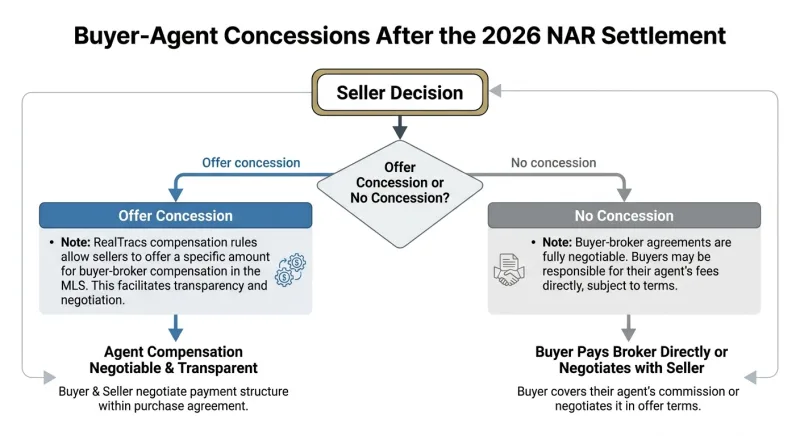
Following the NAR settlement (effective August 17, 2024), buyer-agent compensation can no longer be advertised on the MLS, and buyer's agents must have a signed buyer-broker agreement before touring homes. Buyer-agent commission is now a fully separate, negotiable line item — in both models. It's not baked into the 1% fee, and it was never part of the flat-fee listing.
The two models interact with that concession differently. With a 1% listing, the broker typically advises a competitive 2%–3% concession to attract showings. With flat-fee, you control the decision with no built-in pressure — you can field buyer-broker requests case by case and negotiate each against your net.
On a $450K home, the difference between reflexively offering 2.5% ($11,250) and negotiating down to 2% dwarfs the listing-fee comparison. The flat-fee seller who holds the line on concessions often saves more on the buyer side than on the listing side.
So the complete comparison is "(1% or the floor) + whatever concession the brokerage steers you toward" versus "$499 + whatever concession you choose." Always confirm current RealTracs display rules and TREC disclosure requirements before you list.
The Decision Grid
| Your situation | Below ~$400K | ~$400K–$600K | Above ~$600K |
|---|---|---|---|
| Confident, DIY-capable, clean deal | Flat-fee wins clearly | Flat-fee wins | Flat-fee wins by widest margin |
| Want pricing help + coordination | Flat-fee still cheaper; weigh the floor | Close call — run your number | 1% service may justify its cost |
| Complex deal (estate, contingency, unrepresented buyer) | Flat-fee + à-la-carte helper | Honest toss-up | 1% hand-holding has real value |
The flat-fee advantage is strongest exactly where the 1% floor bites hardest — the lower and middle price bands that make up most of Middle Tennessee. The 1% model only earns its premium at the top of the Williamson County range, and only when you genuinely want full coordination.
Frequently Asked Questions
Do 1% listing brokerages have a minimum commission fee?
Yes. Most 1% programs enforce a minimum commission floor of roughly $3,000–$4,500, which means on lower-priced homes you pay well above a true 1%. On a $300,000 Clarksville or Murfreesboro home, a $3,500 floor works out to about 1.17%, not 1%.
How much does it cost to list on the MLS in Nashville without a full-service agent?
An upfront flat-fee MLS listing in Tennessee typically runs from $199 to $999 depending on the level of broker support, paid once to get your home onto RealTracs. That's the listing-side cost only — any buyer's agent commission you choose to offer is separate and negotiable.
What's cheaper in 2026: a 1% listing fee or a flat-fee MLS listing in Nashville?
On most Middle Tennessee homes the flat-fee MLS listing is cheaper on the listing side. At the 2026 Nashville-area median of roughly $450,000, a 1% fee is about $4,500 versus a few hundred dollars flat — but the 1% model includes hands-on service the flat-fee model doesn't.
Do I still have to pay the buyer's agent commission after the 2026 NAR settlement?
No — buyer-agent compensation is no longer required and can no longer be advertised on the MLS as of the August 17, 2024 settlement rules. You can still offer a concession to attract buyer agents, but it's now fully negotiable and handled off-MLS.
Does a flat-fee MLS listing put my home on Zillow and Realtor.com?
Yes. A RealTracs listing syndicates to Zillow, Realtor.com, and most major portals, so your exposure matches what a traditional or 1% brokerage listing gets. The difference is the service around the listing, not the visibility of it.
Which Should You Pick?
If your Nashville-area home sells near or below the Middle Tennessee median, a 1% listing fee almost always triggers the $3,000–$4,500 floor — and an upfront flat-fee MLS listing at $299–$999 saves you thousands on the listing side. The gap only widens in Clarksville and Murfreesboro, where the floor pushes your effective rate above 1%. It shrinks as your price climbs into Franklin and Brentwood territory, where a true 1% can undercut a flat fee and buy genuine hand-holding on a more complex deal.
Run your own number: take your expected sale price, multiply by 1%, and compare it against both the quoted minimum and a flat-fee listing. If the 1% math beats the floor and you want a licensed broker managing showings and negotiations, the percentage model earns its keep. If you're confident handling offers and selling at $300K or above, the flat-fee path keeps more of your equity in your pocket.
After the 2026 NAR settlement, buyer-agent compensation is negotiable and off-MLS — that's your lever either way. Know your sale price, know the floor, and you already know your answer.