
A Legally Binding FSBO Contract in Tennessee Without TAR Forms
Here's the short version: you can write a legally binding FSBO contract in Tennessee without ever touching a Tennessee REALTORS® form. The forms most agents use — RF401, RF201, RF203 — are copyrighted and restricted to members. They are not required by law. What the law requires is a written agreement that satisfies the Statute of Frauds under T.C.A. § 29-2-101 and carries a handful of essential terms. Get those right, and a non-TAR purchase agreement holds up the same as any broker-drafted one.
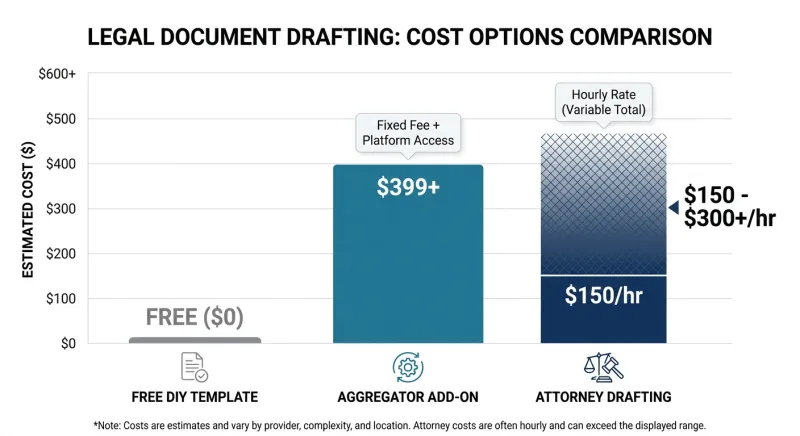
That distinction matters because most pages selling you a "Tennessee FSBO contract" hand you a thin, state-generic PDF or route you toward a $399+ upsell. We built ResultsMLS for sellers who want to do this the lean way, so we'll give you the framework free and on-page — no gate, no paywall.
One honest caveat: this is an educational resource, not legal advice. On a financed deal with inspection, appraisal, and title contingencies, having a Tennessee real estate attorney review your contract is money well spent.
Quick answer: A FSBO contract is legally binding in Tennessee without any TAR form, as long as it's written, signed by buyer and seller, identifies the property and price, and reflects a genuine agreement — the requirements under T.C.A. § 29-2-101, not Tennessee REALTORS® membership.
What Makes a FSBO Purchase Agreement Legally Binding in Tennessee?
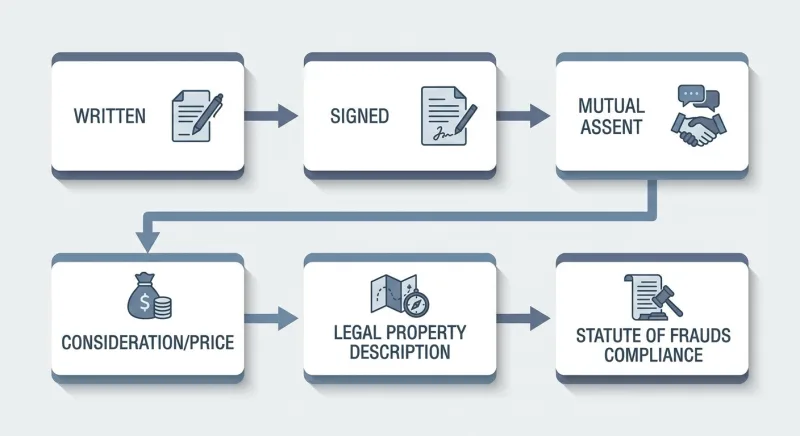
Six things, and all six must be present. Miss one and you may have a conversation, not a contract.
Tennessee enforceability combines one statute with long-settled common-law principles. T.C.A. § 29-2-101 handles the "put it in writing" part; the rest come from contract law Tennessee courts have applied for generations.
- A written document. Under the Statute of Frauds, a real estate sale contract must be in writing to be enforceable.
- Signatures from both parties. Buyer and seller — and every owner on the deed — must sign.
- Mutual assent. One side makes an offer; the other accepts the same terms. A counteroffer is a new offer, not an acceptance.
- Consideration. The purchase price in exchange for the property.
- Legal capacity. Both parties must be adults of sound mind with authority to sign. An estate sale or LLC-owned property adds a signing-authority wrinkle.
- A definite, lawful subject. The agreement must identify the property clearly and describe a legal transaction.
Items 2–5 come from Tennessee common law; item 1 is the statutory anchor.
Why You Don't Need (and Can't Legally Copy) TAR Forms
Tennessee REALTORS® publishes the standardized forms agents use — RF401 (Purchase and Sale Agreement), RF201 (Residential Property Condition Disclosure), and RF203 (Property Condition Exemption Notification). Those forms are copyrighted and licensed only to members. Copying one you found online is infringement.
Those forms are a membership benefit, not the law. No Tennessee statute requires a particular brand of purchase agreement. The legal requirements live in T.C.A. § 29-2-101 and the disclosure statutes, and you can satisfy every one with a document you (or your attorney) write from scratch. A judge in Davidson, Williamson, or Rutherford County doesn't check for a copyright footer — they check for mutual assent and a legally sufficient writing.
Essential Clauses Every Tennessee FSBO Contract Must Include
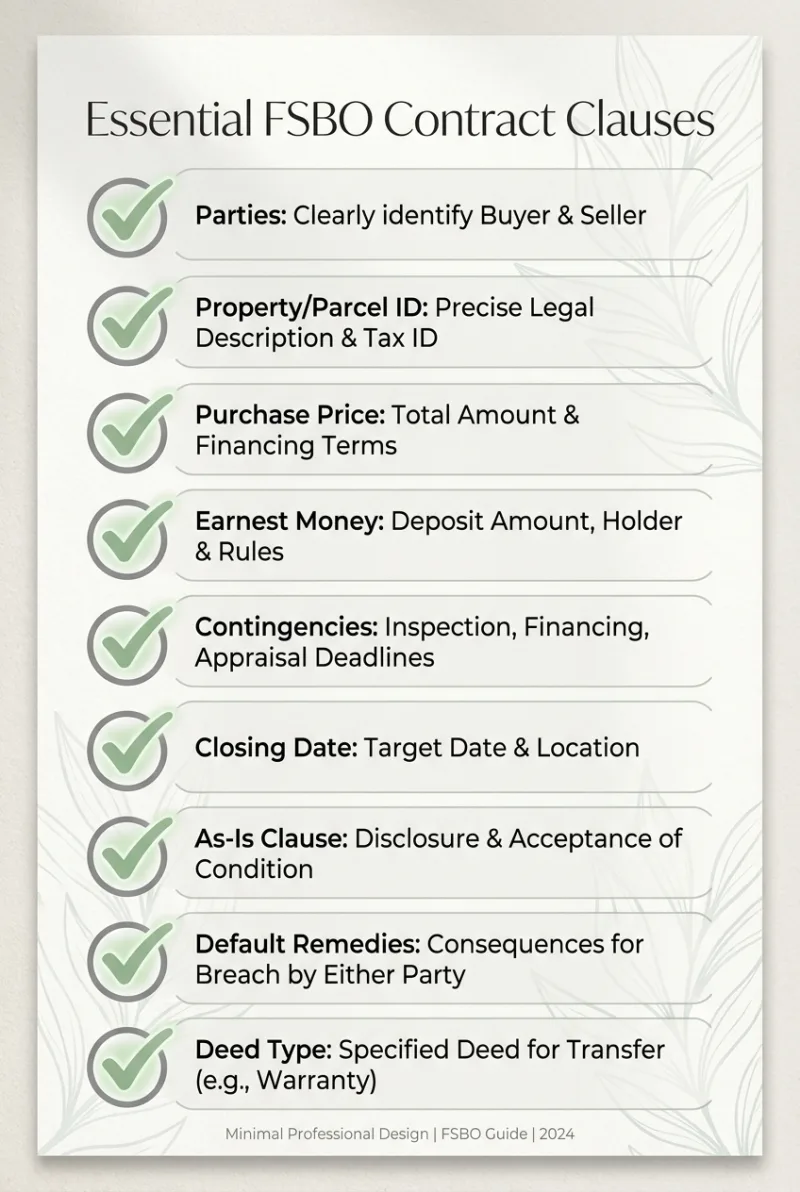
A cash sale can survive a one-page agreement; a financed deal with contingencies cannot.
Parties and signatures
Full legal names of every buyer and seller, and a signature line for each. If two people are on the deed, both sign — a contract signed by one co-owner may not convey clean title.
Property description
Street address plus the parcel ID and, ideally, the legal description from the current deed. "The house on Oak Street" fails; pull the legal description from your recorded deed.
Purchase price and earnest money
State the full purchase price in figures. Name the earnest money amount, who holds it, and the deposit deadline. Earnest money commonly runs 1–2% of the price in Tennessee. Spell out whether it applies toward the price at closing.
Closing date and possession
A specific closing date, the closing location, and when the buyer takes possession. Tennessee closings are typically handled by a real estate attorney or licensed title company — name who's closing.
Contingencies
These are the buyer's exits, and where thin templates collapse:
- Financing contingency — releases the buyer if their loan falls through.
- Appraisal contingency — addresses a low appraisal on a financed deal.
- Inspection contingency — a window to inspect and renegotiate or walk.
If the buyer is financing and these are missing, you're setting up a dispute.
Title, deed, costs, and remedies
State that the seller conveys marketable title by general warranty deed (the Tennessee norm), and who pays for the title search and owner's title policy. Allocate closing costs, prorate property taxes to the closing date, and include a default/remedies clause — often liquidated damages tied to the earnest money.
As-is and condition
If you're selling as-is, say so in writing. An as-is clause limits post-closing repair claims, but it does not cancel your disclosure obligations.
Mandatory Seller Disclosures That Keep Your Contract Enforceable
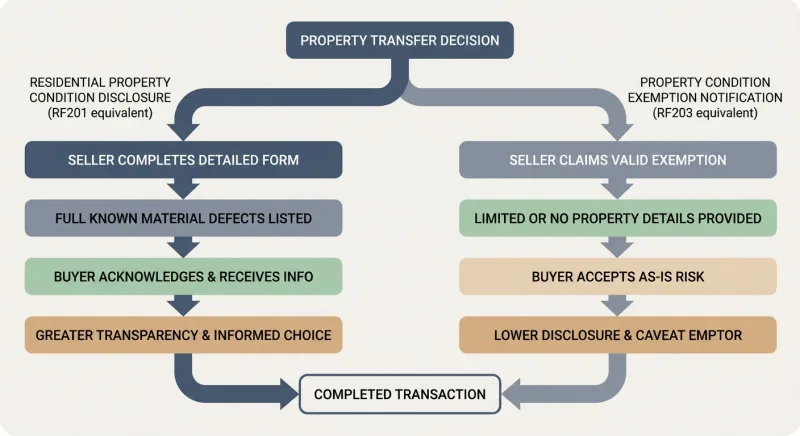
Tennessee is a modified caveat emptor state. The Residential Property Disclosure Act (T.C.A. § 66-5-201 et seq.) requires most sellers of residential property with one to four units to give the buyer a written disclosure of the property's condition before the contract is final.
| Path | What it is | When you use it |
|---|---|---|
| Property Condition Disclosure (RF201 equivalent) | Written statement disclosing known defects and conditions | Default for most residential sellers |
| Property Condition Exemption Notification (RF203 equivalent) | Notice that you're exempt and selling without a condition disclosure | Only when a statutory exemption applies |
The disclosure can't ride on a TAR form, but the content is set by statute — so your own compliant document satisfies it.
T.C.A. § 66-5-207 limits liability for conditions a seller didn't actually know about. T.C.A. § 66-5-209 lists exempt transactions — certain court-ordered sales, transfers between co-owners, some estate transfers. Confirm you qualify before relying on an exemption.
Most important: an "as-is" sale does not erase the disclosure duty. A known material defect must still be disclosed. Skip the disclosure thinking your as-is clause covers you, and you've handed a future buyer a rescission or damages argument.
Lead-based paint
If your home was built before 1978, federal law requires a lead-based paint disclosure and the EPA "Protect Your Family" pamphlet under 42 U.S.C. § 4852d — even when a state exemption would otherwise apply. Give the buyer the disclosure, the pamphlet, and a 10-day window to test.
Earnest Money and Escrow: The Rule FSBO Sellers Get Wrong
You, the seller, should not hold the buyer's earnest money. The risk is commingling, breach, and litigation if the deal falls apart. Best practice is that earnest money sits with a neutral licensed title company, the closing attorney, or a broker's trust account governed by the Tennessee Broker License Act (Title 62, Chapter 13). Name that party in your contract.
One Tennessee-specific detail national templates miss: we're an attorney-closing state far more often than an escrow-agent state. The closing attorney handling your title search is frequently the natural place for those funds to live.
When Standard Contracts Break: The Financed-Deal Trap
A cash sale is forgiving. A financed deal is a different animal — your contract gets read by an underwriter, an appraiser, and sometimes a title examiner.
The appraisal gap is where deals die
Say your Williamson County buyer offers $525,000 with 10% down. The appraisal comes back at $505,000. The lender finances only against the lower number. A bare-bones template says nothing about who fills the $20,000 hole. A contract built for a financed deal spells it out:
- Buyer covers the difference
- Price renegotiates to appraised value
- Split at a stated ratio (e.g., seller drops $10,000, buyer brings $10,000)
Without that clause, a low appraisal gives the buyer an exit under the financing contingency, and you're back on the market.
Financing-contingency timelines carry teeth
A well-drafted financing contingency ties to dates and documents: a deadline to apply (often 5–7 days from binding), a loan-commitment deadline (frequently 21–30 days), and language on what happens to earnest money if the loan is denied through no fault of the buyer. If their financing falls through after a good-faith effort, they typically get the deposit back. If they tanked their own approval, a sharp default clause lets you argue forfeiture.
Inspection Mechanics and Default Remedies
Repair-request vs. right-to-terminate
| Structure | How it works | Who it favors |
|---|---|---|
| Resolution period | Buyer requests repairs; parties negotiate; deal dies only if they can't agree | Seller |
| Pure option / right to terminate | Buyer can walk for any reason within the window | Buyer |
Drop a generic "subject to inspection" line without specifying which applies, and you've handed the buyer the strongest version by default — courts read ambiguity against the drafter.
Default remedies
Liquidated damages means the earnest money is the seller's full remedy for buyer default — clean, predictable, capped at the deposit. Actual damages keeps your right to sue for real losses. For a liquidated-damages clause to hold, the amount must be a reasonable estimate of anticipated harm, not a penalty. A 1–2% deposit is defensible; a $500 deposit on a $600,000 Brentwood home is not.
Default runs both directions. If you back out as the seller, a buyer can sue for specific performance — a court order forcing the sale, because every parcel of real property is legally unique. A strong contract addresses both parties' remedies symmetrically.
Title, Deeds, and Proration
A general warranty deed warrants title against all defects, including ones predating your ownership. Your contract should give you a cure period to clear defects before the buyer can terminate; templates that skip this put you in instant default over a lien you didn't know existed.
Tennessee property taxes are paid in arrears, so at closing they're prorated between you and the buyer as of the closing date. Name the proration method and allocate costs explicitly — deed-recording fee, transfer tax, title policy, attorney's fee. Silence doesn't make costs disappear; it means you'll argue about them at the closing table.
Edge Cases That Need Custom Language
Seller financing / owner carry. You need a promissory note, a deed of trust, interest terms, and compliance with federal lending rules. Get an attorney.
Property in an LLC, trust, or estate. A contract signed by one member of a multi-member LLC without authority can be voidable. For a trust, the trustee signs; for an estate, the personal representative — sometimes only with court approval.
Multiple offers. A backup-offer addendum secures the second-best buyer the moment the first deal collapses. Few free templates include it.
Free Tennessee FSBO Purchase Agreement Framework (Non-TAR)
Below is the framework for a Tennessee FSBO purchase agreement built to meet the statutory elements above — no TAR form, no copyright problem, no paywall. Have a Tennessee attorney review it before you sign.
Tennessee Residential Purchase and Sale Agreement (non-TAR)
- Parties — Full legal names of all buyers and sellers.
- Property — Street address, county, parcel ID, legal description from the recorded deed.
- Purchase Price — Total price, in figures.
- Earnest Money — Amount, deposit deadline, and neutral escrow holder.
- Financing — Cash or financed; financing contingency terms and deadline.
- Contingencies — Inspection, appraisal, and financing windows and rights.
- Title and Deed — General warranty deed; who pays for title search and owner's policy.
- Closing — Date, location (attorney or title company), possession date.
- Closing Costs and Prorations — Cost allocation; property taxes prorated to closing.
- Seller Disclosures — Property Condition Disclosure (or exemption notification) and lead-based paint disclosure for pre-1978 homes.
- Default and Remedies — Liquidated damages / earnest money forfeiture terms.
- As-Is Clause (optional) — Condition terms, without waiving required disclosures.
- Signatures — Dated signature lines for every buyer and seller.
Fill in every blank. An unfinished contingency section or a missing co-owner signature is where these agreements fail.
Is Your Tennessee FSBO Contract Legally Binding? (Checklist)
- ☐ In writing — required under T.C.A. § 29-2-101.
- ☐ Signed by every buyer and every owner on the deed.
- ☐ Offer and acceptance match — a counteroffer resets it.
- ☐ Purchase price and earnest money stated — with a named neutral escrow holder.
- ☐ Property clearly identified — address, parcel ID, legal description.
- ☐ Property Condition Disclosure given — under T.C.A. § 66-5-201, unless exempt under § 66-5-209.
- ☐ Lead-based paint disclosure — for pre-1978 homes, under 42 U.S.C. § 4852d.
- ☐ Closing, contingencies, and default terms spelled out — no blanks.
When Free Is Fine vs. When It Isn't
| Deal profile | Free non-TAR template | Attorney-drafted |
|---|---|---|
| Cash sale, clear title, straightforward disclosure | ✅ Strong fit | Optional |
| Conventional/FHA/VA financing with contingencies | ⚠️ Risky without added clauses | ✅ Recommended |
| Seller financing / owner carry | ❌ Don't | ✅ Required |
| Property in LLC, trust, or estate | ❌ Don't | ✅ Required |
| Known defects, easements, boundary disputes | ⚠️ Disclose carefully | ✅ Recommended |
| Out-of-state buyer or remote closing | ⚠️ Add specific terms | ✅ Recommended |
Tennessee attorneys typically charge roughly $150–$300/hour, and a straightforward review often takes an hour or less — far cheaper than the $399+ aggregator "contract package," which sells you packaging, not Tennessee-specific legal depth.
Frequently Asked Questions
Is a FSBO contract legally binding in Tennessee without a TAR form?
Yes. Tennessee law does not require any Tennessee REALTORS® form. A written purchase agreement signed by buyer and seller is enforceable as long as it meets the Statute of Frauds under T.C.A. § 29-2-101 and the common-law elements of a valid contract.
Does a Tennessee real estate contract have to be in writing?
Yes. Under T.C.A. § 29-2-101, any contract for the sale of land or real property must be in writing and signed by the party to be charged, or it cannot be enforced in court.
Can I copy a TAR purchase agreement for my own sale?
No. Forms like RF401 are copyrighted and restricted to members. Copying one is infringement. Draft your own compliant non-TAR agreement instead — it's just as enforceable.
Do I still have to give seller disclosures if I sell by owner?
Usually, yes. The Tennessee Residential Property Condition Disclosure Act (T.C.A. § 66-5-201 et seq.) applies to FSBO sellers too, unless a statutory exemption under § 66-5-209 lets you provide an exemption notification instead.
Who should hold the earnest money in a Tennessee FSBO sale?
A neutral third party — a licensed title company, closing attorney, or broker's trust account — rather than the seller directly, to avoid commingling and disputes if the deal falls through.
How much does it cost to have a FSBO contract reviewed by an attorney in Tennessee?
Tennessee real estate attorneys typically charge roughly $150–$300 per hour, and a straightforward review often takes an hour or less — far cheaper than the $399+ some online form services charge.
Is lead-based paint disclosure required for a Tennessee FSBO sale?
Yes, if the home was built before 1978. Federal law (42 U.S.C. § 4852d) requires sellers of most pre-1978 housing to provide a lead-based paint disclosure and the EPA pamphlet, regardless of whether an agent is involved.
Your Contract Is Ready — Now Get the Offers
A for-sale-by-owner contract in Tennessee is every bit as binding as one on a copyrighted TAR form — provided it's in writing, signed, and built on the statutory and common-law elements above. Match the document to the transaction: a template that works for a clean cash sale can buckle under appraisal and inspection contingencies. Have a Tennessee real estate attorney review your agreement before you sign, especially on a financed deal.
A solid contract only closes a deal once you have an offer to sign. A flat-fee MLS listing puts your Tennessee home in front of the buyers and buyer's agents actually searching — Nashville, Franklin, Knoxville, Memphis, wherever your house is — without a listing commission. List flat-fee with ResultsMLS, generate the offers, and turn this contract into a closing.
Sources & statutes referenced: T.C.A. § 29-2-101 (Statute of Frauds); T.C.A. § 66-5-201 et seq., § 66-5-207, § 66-5-209 (Tennessee Residential Property Disclosure Act); 42 U.S.C. § 4852d (federal lead-based paint disclosure); Title 62, Chapter 13 (Tennessee Broker License Act). Tennessee REALTORS® form numbers (RF401/RF201/RF203) referenced as context only. Educational resource, not legal advice — consult a licensed Tennessee real estate attorney.