
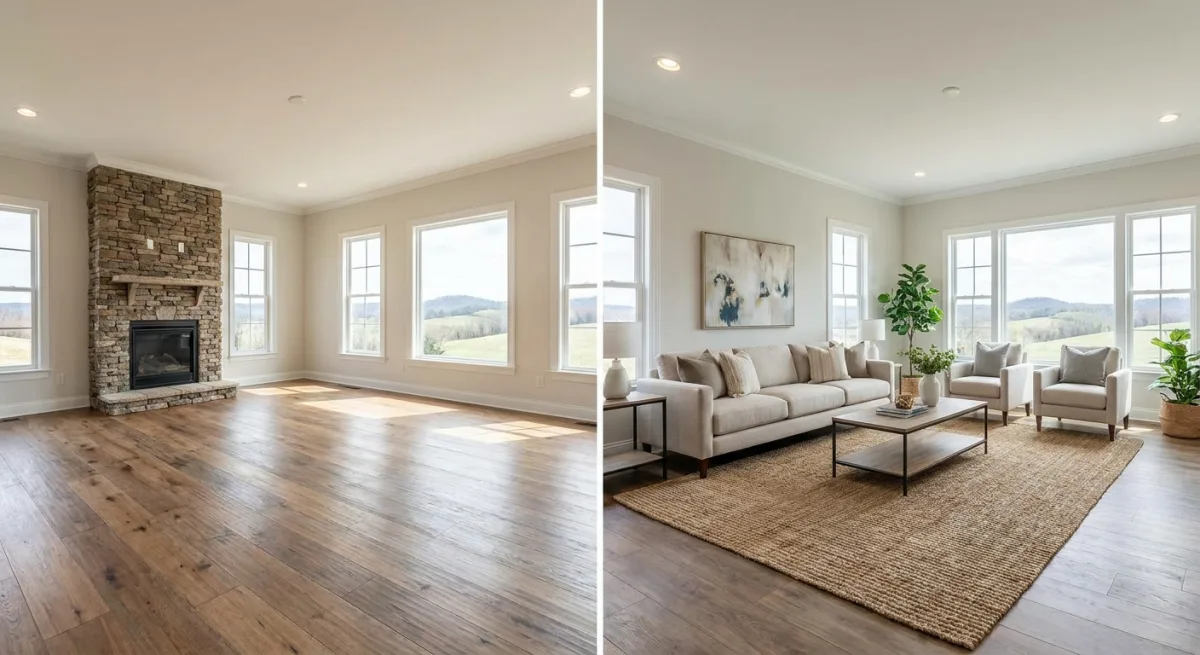
Digital vs. Physical Staging for Tennessee FSBO Sellers: The ROI Bottom Line
For most Tennessee FSBO sellers with a vacant home, professional virtual staging wins on ROI. You'll spend about $150–$300 total versus $1,500–$4,000 for physical staging in month one — plus $500–$1,000 a month to keep the furniture. Both drive the first-scroll traction that moves a listing. Digital just does it for roughly 10x less.
That gap matters more when you're listing yourself. You're already keeping the listing-side commission by going flat-fee — call it $9,900+ on a median Tennessee sale. Spending $200 to protect that math is an easy call. The catch: Tennessee MLS rules require you to disclose virtually staged photos, and skipping that step can get your listing flagged.
This is an ROI analysis, not a sales pitch. Below you'll find the honest cost spread by metro, the net-proceeds model we actually use, the TN MLS disclosure rules most national guides ignore, and a decision framework for whether digital or physical staging is right for your home — including the cases where physical still earns its keep.
What's the Difference Between Digital and Physical Home Staging?
Buyers decide in seconds on the first scroll on Zillow, and staged listing photos are what stop the thumb. There are three ways to stage, and the cost gap between them is enormous.
Physical staging means real furniture in the real house. You rent sofas, beds, rugs, art, and accessories; a stager arranges them; and the home shows dressed in person and in photos.
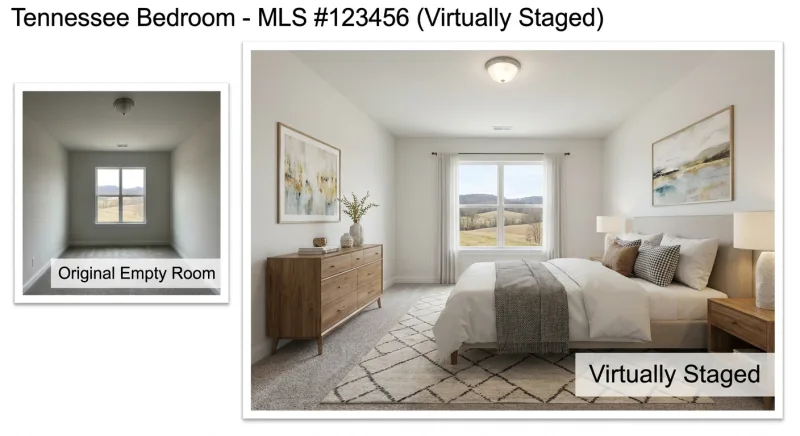
Virtual (digital) staging means a pro adds realistic furniture and decor to your photos — not the actual rooms. You photograph the empty home, send the images off, and get back polished shots that look furnished.
AI staging tools are the DIY cousin. You upload a photo to an app, pick a style, and software generates furnished versions in seconds for a few dollars or less.
Professional virtual staging vs. cheap AI tools
AI tools (roughly $0.30–$25 per image, as of 2026) are fast and cheap, but they botch the hard parts — windows that warp, furniture that floats, shadows that fall the wrong way. Buyers notice.
Professional virtual staging uses a human editor who matches lighting, scale, and perspective to your actual room. Providers such as BoxBrownie and Stuccco charge in the $20–$75-per-photo range — about $150–$300 to stage the 5–6 rooms that carry a listing.
According to the National Association of REALTORS® Profile of Home Staging, a large majority of buyers' agents report that staging makes it easier for buyers to visualize a property as their future home. That's the whole game for a FSBO listing: your photos have to do the visualization work before anyone walks through the door.
One honest caveat: digital staging only dresses the photos. The house itself is still empty when buyers show up. That mismatch is manageable — we'll cover exactly how — but it's the trade-off national guides tend to skip.
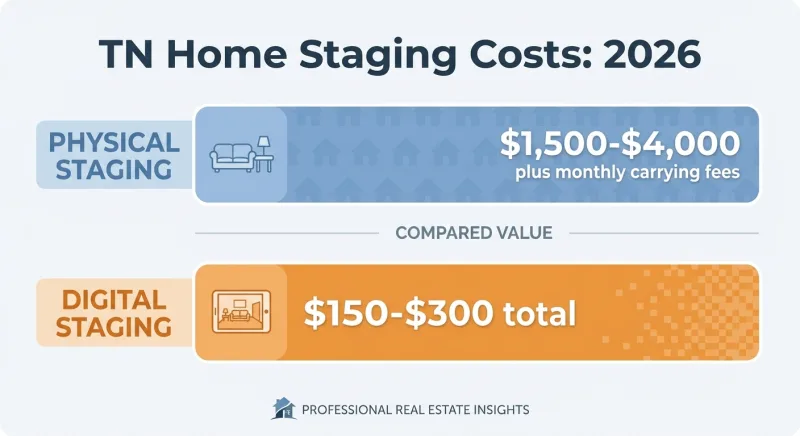
Digital vs. Physical Staging Cost Comparison in Tennessee (2026)
Physical staging carries two costs people forget to add together: the upfront setup and the monthly rental while your home sits. Virtual staging is a one-time fee.
| Cost factor | Physical staging | Digital / virtual staging |
|---|---|---|
| Upfront / first month | $1,500–$4,000+ | $150–$300 total |
| Monthly carrying cost | $500–$1,000+/mo | $0 |
| Cost per listing photo | Bundled into rental | $20–$75/photo |
| Turnaround | Days to schedule + install | 24–48 hrs typical |
| Cost if home sits 60 days | ~$2,500–$6,000+ | $150–$300 (unchanged) |
| TN MLS disclosure required? | No | Yes — see rules below |
What it runs by metro
- Nashville / Franklin / Brentwood: Physical staging tends toward the top of the range, especially in higher-price Williamson County neighborhoods. Virtual staging costs the same here as anywhere.
- Memphis: Physical rental rates generally run lower than Nashville, but you're still paying setup plus monthly carry.
- Knoxville: Mid-range physical costs; a growing bench of local photographers who bundle virtual staging into photo packages.
- Chattanooga: Similar mid-range pricing to Knoxville.
The pattern holds in every market: physical staging gets more expensive the longer your home sits, and digital staging never does. If your listing sits 60 days, physical staging can quietly double. Treat these as planning estimates, not quotes — always get a real bid before you budget.
Staging ROI Inside the FSBO Flat-Fee Net-Proceeds Equation
The median Tennessee home sale price sat around $330,000 in 2025. A traditional listing agent typically charges around 2.5%–3% of the sale price.
On a $330,000 sale:
- Listing-side commission at 3%: ~$9,900
- Listing-side commission at 2.5%: ~$8,250
On higher-priced homes in Brentwood or Franklin, that figure climbs well past $12,000. That's the money you keep by marketing the home yourself.
The net-proceeds model we run for sellers
| Line item | Physical staging | Digital (virtual) staging |
|---|---|---|
| Listing-side commission kept (~$330K sale) | ~$9,900 | ~$9,900 |
| First-month staging cost (vacant home) | $1,500–$4,000+ | $150–$300 |
| Monthly carrying cost if it sits | $500–$1,000+/mo | $0 |
| Net staging spend after 2 months on market | $2,500–$6,000 | $150–$300 |
| Commission savings remaining | ~$3,900–$7,400 | ~$9,600–$9,750 |
Physical staging on a vacant home can eat $2,500 to $6,000 of the commission you worked to keep — and that's if it sells in two months. Virtual staging costs about one-tenth of the first-month physical number and carries nothing month over month.
Where the ROI actually lives
Staging ROI isn't the furniture. It's the first scroll. An empty room photographs as a question mark; a dressed room photographs as a home. That shift drives clicks, saves, and showing requests — and faster showings mean fewer days on market.
Every month a vacant home sits, you're paying mortgage, taxes, insurance, and utilities with no marketing working for you. Digital staging gets you the same first-scroll traction without adding its own monthly bill. The conventional advice — "stage your home, it pays for itself" — was written for full-service sellers who already gave up their commission. You didn't. Spending $3,000 to physically stage a vacant home when a $200 digital alternative drives the same first-scroll traction means spending down the exact savings you listed flat-fee to protect.
The Spend Curve: Why More Money Stops Buying More
Staging returns are not linear. The first $200 does the heavy lifting. The next $2,000 mostly buys comfort, not clicks.
- $0 → $200 (vacant to virtually staged): large jump in first-scroll engagement
- $200 → $2,500 (virtual to physical): modest incremental gain, mostly realized in person
- $2,500+ (premium physical + carrying): diminishing — you're paying to hold furniture, not win clicks
The curve inverts at the top of the market. On a $1.2M Brentwood or Belle Meade listing, buyers expect to walk into a furnished home, and an empty mansion triggers "what's wrong with it" suspicion. Physical staging stops being a photo tactic and becomes a trust signal during the showing itself.
The Time-to-Photo Cost Competitors Never Model
Physical staging has a lead time virtual staging doesn't. You schedule the stager, they source and deliver furniture, they dress the home, then your photographer shoots — typically a 1–2 week gap in most TN metros.
Virtual staging reverses the order. You shoot the empty rooms day one, send the raw images off, and get staged photos back in 24–48 hours. Every day before you're live is a day of carrying cost with zero marketing working for you. A two-week physical-staging lead time can quietly add several hundred to over a thousand dollars in carrying costs before the listing even goes live.
If a room photographs smaller than expected, a virtual redo is an email and another 24-hour turnaround. With physical staging, it means furniture is still on-site or has to come back. Low cost of iteration is part of the ROI, and it's invisible in a static price comparison.
When Hybrid Beats Either Option Alone
The anchor-room hybrid. Physically stage one or two rooms that sell the lifestyle — usually the primary bedroom and main living space — and virtually stage the rest. You get genuine in-person impact where buyers linger at a fraction of a full physical stage. Best on mid-to-upper-tier listings where full physical staging is overkill.
The sequence hybrid. List with virtual staging to go live fast and capture early traffic. If the home sits past your market's typical days-on-market window, bring in physical staging as a re-launch lever — new photos, a "price improvement + freshly staged" refresh. You only spend physical-staging dollars if the data says you need them.
One compliance trap: if some rooms are real furniture and some are virtually staged, every digitally altered photo still needs its disclosure label. You can't let real-furniture photos launder the staged ones into looking authentic by association.
How to Tell If Your Staging Is Actually Working
Saves-to-views ratio (first 10 days). Zillow and Realtor.com show you views and saves. If views are strong but saves are flat, your photos are losing people — a staging or photography problem, not a price problem. If both are weak, it's price or exposure, and more staging money won't fix it.
Showing-to-offer conversion. Strong online interest that dies after in-person showings is the classic virtual-staging backfire: the photos promised warmth the empty rooms couldn't deliver.
| Online engagement | In-person conversion | What it's telling you |
|---|---|---|
| High | High | Staging is working — hold course |
| High | Low | Photo-to-reality gap — bridge the showing or physically stage key rooms |
| Low | n/a | Price or exposure problem — staging won't fix it |
| Low | High (few showings) | Photos undersell a home that shows well — reshoot/restage |
The Occupied-Home Exception
A home full of the seller's personal furniture, clutter, and taste often photographs worse than a clean virtually staged version. For an occupied home, the real choice is:
- Shoot with your current furniture — free, but risks the personalization penalty
- Declutter and shoot as-is — cheap, best when your furniture is neutral and current
- Move furniture out, shoot empty, virtually stage — costs the move-out hassle plus ~$150–$300, but resets the room to a neutral baseline
Option 3 quietly outperforms when the seller's existing furniture is dated or heavy. You're not comparing virtual staging to an empty room — you're comparing it to a cluttered room. The caveat: you have to actually show the home emptied, or close to it. Full furniture at the showing plus a different virtually staged look online recreates the backfire you were trying to avoid.
Frequently Asked Questions
Is digital staging better than physical staging for Tennessee FSBO sellers?
For most vacant Tennessee homes, yes. Professional virtual staging runs about $150–$300 total versus $1,500–$4,000 for physical staging plus $500–$1,000 a month in carrying costs — and delivers the same first-scroll visualization buyers need.
How much does digital staging cost for Tennessee sellers in 2026?
Professional virtual staging typically costs $20–$75 per photo, so staging five or six key rooms generally runs about $150–$300 total. Cheap AI tools can drop to $0.30–$25 per image, but quality and realism vary widely.
Do I have to disclose virtually staged photos on the MLS in Tennessee?
Yes. RealTracs, MAAR, KAAR, and the Greater Chattanooga AOR each require that digitally altered listing photos be clearly labeled, and TREC advertising rules prohibit misrepresenting a property. Verify the current policy with your specific MLS before you upload.
Will virtual staging get me in trouble at showings when the house is empty?
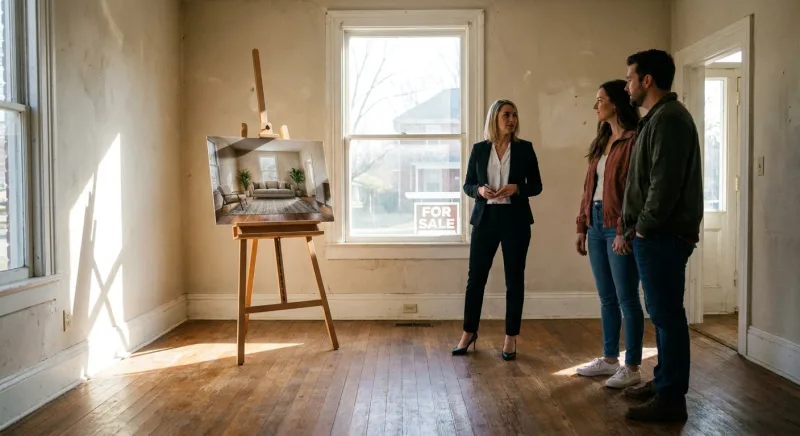
Not if you bridge the gap. Print your staged photos as 8x10s on easels in each empty room so buyers can connect the online images to the real space — that prevents the letdown of walking into bare rooms after seeing dressed-up photos.
When is physical staging still worth it for a TN FSBO seller?
Physical staging can pay off on higher-priced homes in competitive metros like Franklin or Brentwood, or when a home is occupied and cluttered. For an empty mid-market house, carrying costs usually eat into the commission you kept by listing flat-fee.
Does staging actually reduce days on market?
Survey data from NAR suggests staging can cut time on market and support offer price, though results are directional, not guaranteed. Strong listing photos drive the early clicks that shape how fast a listing moves.
The Bottom Line
Professional virtual staging at ~$150–$300 does nearly everything physical staging does for the first scroll — at roughly a tenth of the cost, with no monthly furniture bill. That spend protects the commission you kept by listing flat-fee.
The trade-off is real: staged photos set an expectation. Print your staged shots, put them on easels in each room, and the gap closes.
Two rules before you upload a single image. Disclose every virtually staged photo the way your MLS requires — RealTracs, MAAR, KAAR, and Greater Chattanooga each have their own standards, and TREC expects honest advertising. Verify those rules yourself, because they change.
Physical staging still earns its keep on occupied homes that need decluttering and on higher-end Franklin or Brentwood listings where presentation moves the price. Know which situation you're in, then spend accordingly.
Figures reflect 2026 ranges and vendor terms that change — confirm current pricing with providers and current photo-disclosure policy directly with your Tennessee MLS (RealTracs, MAAR, KAAR, or Greater Chattanooga AOR) before you list.