
Tennessee doesn't tax the profit from selling a house. The state has no income tax, and the Hall tax on investment income ended for tax years beginning January 1, 2021. Federal tax can still apply. Under Section 121, most owners who lived in the home 2 of the last 5 years can exclude up to $250,000 of gain, or $500,000 if married filing jointly.
That answer covers most sellers. The rest of this article covers the exceptions, the closing taxes people confuse with capital gains, and the Form 1099-S question FSBO and flat-fee sellers often ask.
This is general information, not tax or legal advice. Confirm your situation with a CPA or enrolled agent.
Does Tennessee Have a State Capital Gains Tax?
No. Tennessee doesn't tax capital gains from a home sale, whether the property is your primary residence, a rental, or a second home.
The confusion usually comes from the Hall Income Tax. It applied only to certain interest and dividend income and never reached wages or real estate gains. The Tennessee Department of Revenue states it was fully repealed for tax years beginning on or after January 1, 2021. The 2014 constitutional amendment (Amendment 3) is different. It bars a state tax on payroll and earned income, and it isn't a ban on capital gains tax. In practice, no Tennessee tax currently reaches your home-sale gain.
Tennessee won't touch it. The IRS might.
Which Taxes Actually Apply When You Sell a House in Tennessee?
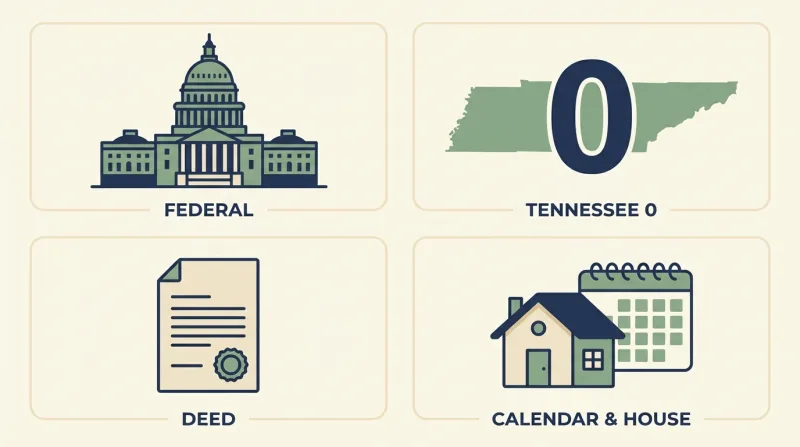
Up to four charges can appear around a Tennessee closing. Only one depends on your profit.
| Tax | Jurisdiction | Applies in TN? | Typical rate | Who usually pays | Source |
|---|---|---|---|---|---|
| Capital gains tax | Federal (IRS) | Yes, but only on gain above the §121 exclusion | 0%, 15%, or 20% long-term, plus possible 3.8% NIIT | Seller | 26 U.S.C. §1(h), §1411; IRS Topic 409 |
| State capital gains / income tax | State of Tennessee | No | 0% | Nobody | TN Dept. of Revenue (Hall Income Tax repeal) |
| Realty transfer tax | State, collected by county Register of Deeds | Yes | $0.37 per $100 of value | Buyer by custom, but negotiable | T.C.A. §67-4-409 |
| Property tax (prorated) | County, plus city where applicable | Yes | Varies by county | Split by days of ownership | County trustee |
The statute doesn't say who pays the transfer tax. Buyers usually pay it by local custom, and a seller can agree to cover it. On a $465,000 sale it comes to about $1,720.50. Tennessee property taxes are generally paid in arrears, so the seller typically credits the buyer at closing for the part of the year the seller owned the home.
Federal bracket thresholds change every year. Check IRS Topic 409 for your sale year.
How Does the Section 121 Exclusion Work?
Under 26 U.S.C. §121, you can exclude up to $250,000 of gain on your main home, or $500,000 on a joint return. Because Tennessee has no income tax, this federal rule alone decides whether you owe anything on your profit.
According to IRS Publication 523, you qualify if:
- You owned the home at least 2 years during the 5 years ending on the sale date.
- You lived in it as your main home at least 2 years in that window. The years don't have to be consecutive.
- You haven't claimed the exclusion on another sale in the prior 2 years.
Married couples get the full $500,000 when either spouse meets the ownership test, both meet the use test, and neither has used the exclusion in the prior 2 years. If only one spouse qualifies, the limit is generally $250,000.
If you fall short of 2 years, you may still get a partial exclusion. Treasury Regulation §1.121-3 allows one when the main reason for selling is a job change, a health issue, or an unforeseen circumstance. The IRS prorates the limit, not your gain. Take the shortest of your ownership time, use time, or time since your last exclusion, divide by 24 months, and multiply by $250,000 or $500,000. In a hypothetical case, a single Nashville owner who lived there 14 months before taking a job in Atlanta gets a limit of 14 ÷ 24 × $250,000 = $145,833.
The safe harbors include:
- A new job at least 50 miles farther away than the old one.
- A doctor-recommended move.
- Events such as death, divorce, job loss with unemployment compensation, multiple births from one pregnancy, or a damaged or condemned home.
The $250,000 and $500,000 caps aren't indexed to inflation and haven't changed since the Taxpayer Relief Act of 1997. Long-time owners in fast-appreciating Nashville or Williamson County neighborhoods can exceed the cap without realizing it.

How Do You Calculate Your Gain? (Worked Example)
Your gain is the amount realized minus your adjusted basis (26 U.S.C. §1001; IRS Pub 523). The calculation has three steps:
- Subtract selling expenses (commissions, listing fees, seller-paid closing costs) from the sale price to get the amount realized.
- Add capital improvements and certain purchase closing costs to your purchase price to get your adjusted basis.
- Subtract the basis from the amount realized. Anything above your exclusion is taxable.
A new roof, an added bathroom, or a finished basement adds to your basis. Repainting a bedroom doesn't, unless it's part of a larger remodel.
Hypothetical example. The numbers are illustrative, not a quote or ResultsMLS pricing. A single seller bought a Nashville home for $280,000, added $35,000 in improvements, lived there six years, and sells for $465,000 with $4,000 in other closing costs.
| Line item | A: 5% total commission | B: $500 flat fee + 2.5% buyer-agent comp |
|---|---|---|
| Sale price | $465,000 | $465,000 |
| Listing/commission costs | $23,250 | $12,125 |
| Other seller closing costs | $4,000 | $4,000 |
| Amount realized | $437,750 | $448,875 |
| Adjusted basis | $315,000 | $315,000 |
| Gain | $122,750 | $133,875 |
| Section 121 exclusion (single) | Up to $250,000 | Up to $250,000 |
| Taxable gain | $0 | $0 |
The tax is $0 in both cases. Lower fees in Scenario B make the gain $11,125 larger on paper, but the seller also keeps $11,125 more before the mortgage payoff. Buyer-agent compensation is negotiable and could be higher, lower, or zero. ResultsMLS sells flat-fee listings, so weigh the example with that in mind. How you list has no effect on Section 121 eligibility.
If you're over the cap, paying higher fees to cut your tax still loses money. Each extra $1,000 in selling costs saves at most $200 at the 20% rate, or $238 with the 3.8% net investment income tax under §1411. Lower fees don't save tax. They save money.
When Might You Owe Federal Tax?
You're most likely to owe if the home wasn't your main residence, your gain exceeds the cap, or you rented or depreciated part of it.
- Depreciation recapture. Under §121(d)(6), gain equal to depreciation taken after May 6, 1997 can't be excluded. This includes depreciation for a home office or rental period, taxed at up to 25%. Depreciation you were allowed to take counts even if you never claimed it.
- Nonqualified use. Rental years after 2008 that came before you moved in reduce the exclusion proportionally under §121(b)(5). Say you rented a Chattanooga duplex 3 years and lived in it 7. After pulling out depreciation, 30% of the remaining gain is taxable. Rental time after you move out, within the 5-year window, doesn't count against you.
- Second homes and investment property. No Section 121 exclusion applies. Long-term rates are 0%, 15%, or 20%.
- Surviving spouses keep the $500,000 limit if the sale closes within two years of the spouse's death and the couple would have qualified.
- Divorce. A former spouse's ownership period generally carries over to you, and their use under a divorce instrument counts as your use.
- Military and Foreign Service. Members on qualified extended duty, including families at Fort Campbell, can suspend the 5-year window for up to 10 years.
- Adjacent land. Land used as part of the residence can share the exclusion if you sell it within two years before or after the house. It all counts toward one cap.
- Losses. A loss on a personal residence isn't deductible.
These rules turn on your specific facts, so it's worth a call to a tax pro.
Will You Get a 1099-S If You Sell FSBO in Tennessee?
You might, even if you owe nothing. The settlement agent files Form 1099-S unless you sign a written certification under Rev. Proc. 2007-12 confirming that the full gain is excludable and that gross proceeds are $250,000 or less, or $500,000 or less for qualifying married sellers.
Selling FSBO or through a flat-fee listing doesn't change who files. At a Tennessee closing, the title company or closing attorney who prepares the settlement statement is normally the reporting person. If no settlement agent is involved, the duty passes down a list that can include the buyer's attorney, the lender, or a broker.
The certification asks you to confirm:
- You meet the 2-of-5-year test.
- You've had no exclusion in the prior 2 years.
- There was no business or rental use after May 6, 1997, and no nonqualified use after 2008.
- Your proceeds are within the limit.
The $465,000 Nashville seller above can't certify, so they should expect a 1099-S despite owing $0. A married couple in the same house likely could certify.
If you receive the form anyway, report the sale on Form 8949 and Schedule D and enter the excluded gain as an adjustment with code "H." Ask your title company early whether they'll file and which proceeds figure they'll report. Keep your closing disclosure and improvement receipts.
Frequently Asked Questions
Do I have to report my home sale if the whole gain is excluded?
Generally no, per IRS Publication 523, if the entire gain is excludable and you didn't receive a 1099-S. If one was issued, report the sale on Form 8949 and claim the exclusion.
Who pays the realty transfer tax in Tennessee?
The tax is $0.37 per $100 of value under T.C.A. §67-4-409. Buyers customarily pay it, but it's negotiable in the contract.
Can I avoid capital gains tax by buying a more expensive home?
No. The Taxpayer Relief Act of 1997 replaced the old rollover rule with Section 121, which applies whether or not you buy again.
What if I lived in my Tennessee home less than two years?
You may qualify for a partial exclusion for a job change, health reason, or unforeseen circumstance. Otherwise, the full gain is federally taxable, and it's long-term only if you owned the home more than a year.
Does selling FSBO or with a flat fee MLS listing change my taxes?
No. Section 121 works the same however you list. Lower costs raise your gain slightly, but most primary-home sellers still stay under the exclusion.
How is an inherited house in Tennessee taxed when sold?
Under 26 U.S.C. §1014, your basis generally steps up to fair market value at the date of death, so only appreciation after that date is taxed. Tennessee adds nothing.
The Bottom Line
Tennessee takes nothing from your home-sale profit. Federal tax applies only to gain above your Section 121 exclusion, and most Tennessee sellers of a primary residence land under that line. Before listing, pull your original closing statement and improvement receipts and estimate your basis and gain. If you have rental history, a second home, inherited property, or a gain near the cap, bring those numbers to a CPA or enrolled agent.
How you sell won't change your tax, but it does change what you keep. If you're weighing FSBO against a flat-fee MLS listing in Tennessee, put the fee difference on the same worksheet as your gain estimate and compare net proceeds.
General information only, not tax or legal advice. Your CPA gets the final word on this one.