
The Quick Verdict
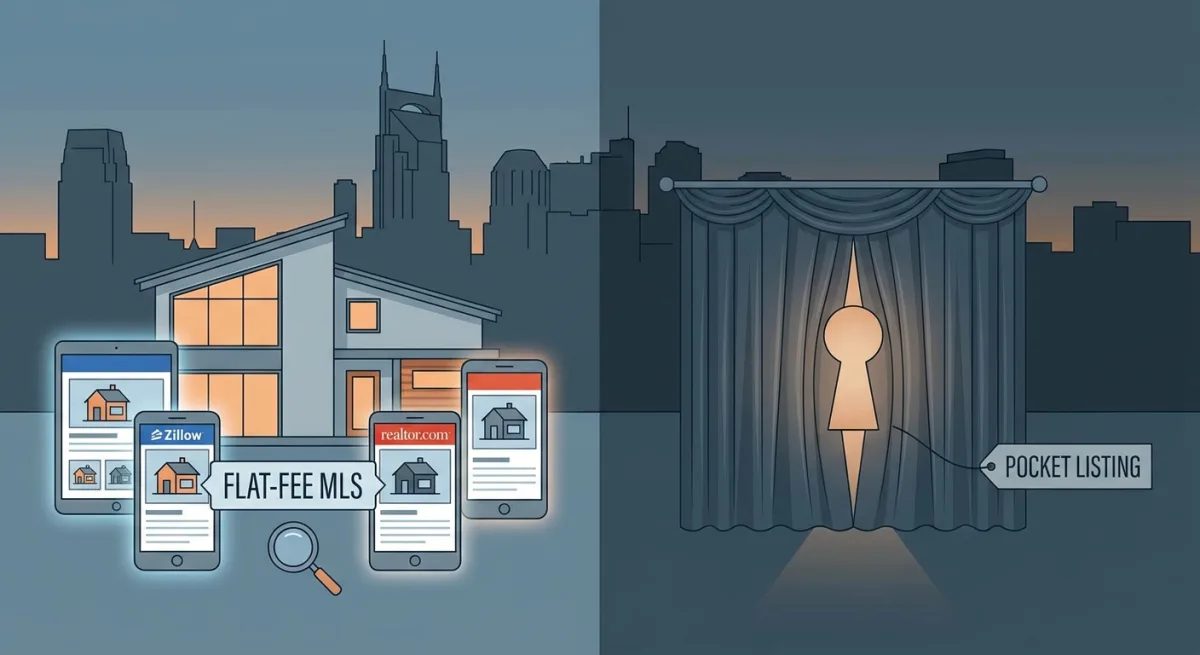
Short version: a flat fee MLS listing puts your Nashville home on Realtracs and every major portal for a one-time fee while you keep your equity. A pocket listing keeps it off the MLS entirely — quiet, private, and marketed only through one listing agent's network.
Pocket listings buy you privacy. Flat-fee MLS buys you a bidding-war audience. That audience matters: research from Bright MLS and Drexel University pegs the premium for MLS-exposed homes at roughly 17.5% compared to off-market sales.
I'm writing this from a TREC-licensed, Middle Tennessee principal-broker point of view — the rules below come straight from the Realtracs rulebook and NAR policy, not a national template. If you're weighing exposure against discretion in Davidson, Williamson, Rutherford, or Sumner County, this guide walks the exact mechanics most comparison posts skip.
What Is a Pocket Listing (and How Does Realtracs Define It)?
A pocket listing is a property that's for sale but deliberately kept out of the MLS. The listing agent markets it privately — to a personal buyer list, brokerage colleagues, or one qualified party — so it never hits Zillow, Realtor.com, or Redfin.
Under Realtracs Rule Section 2.32 (the Exempt Listing rule), a seller can direct their listing broker not to submit a listing to the MLS — but that instruction must be documented in writing. That's the "Seller's Instruction Not to Disseminate" form, a signed certification that the seller, not the agent, chose to keep the property off the MLS. Without it, you don't have a compliant off-market listing; you have a rule violation waiting to happen.
A true pocket listing means one agent, one network, and one shot at the price you want — with no competitive bidding to push it higher.
Rules current as of this writing; always verify the live Realtracs Rules & Regulations before relying on a specific section.
How a Flat-Fee MLS Listing Works on Realtracs
A flat-fee MLS listing flips the model. Instead of paying a listing agent a percentage-based commission, you pay a one-time fee to a TREC-licensed listing broker who enters your property into Realtracs on your behalf. You handle showings and negotiations; the broker handles compliant MLS entry.
That arrangement runs on a limited-service listing agreement, which Tennessee law and TREC rules expressly permit. The broker is still the listing broker of record on Realtracs — that's what makes your listing legitimate and syndicated.
Your listing gets the same treatment as any agent-listed property: same Realtracs entry, same IDX feed, same portals, same Days on Market (DOM) clock. The difference is where your money goes — into your pocket, not a percentage.
Flat-Fee MLS vs. Pocket Listing: Side-by-Side Comparison
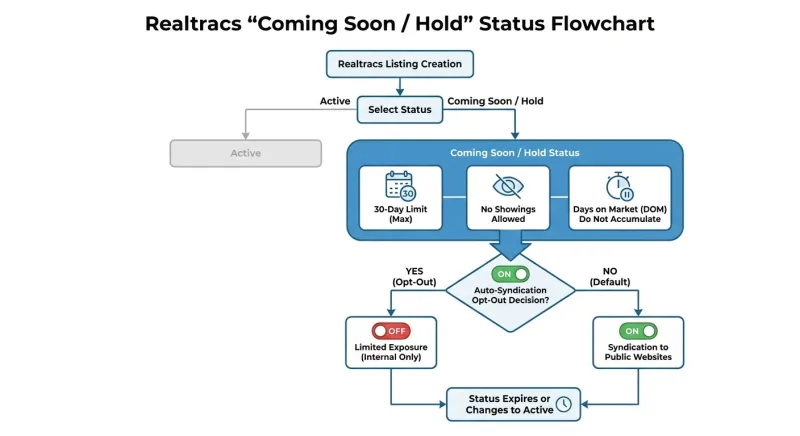
| Factor | Flat-Fee MLS on Realtracs | Pocket Listing (Off-Market) |
|---|---|---|
| Public exposure | Full Realtracs + IDX; all major portals | Near-zero; one agent's network only |
| Syndication reach | Zillow, Realtor.com, Redfin, Homes.com | None — no portal feed |
| Cost / commission | One-time flat fee; you set buyer-agent offer | Traditional listing-side commission typically still applies |
| Privacy | Public — anyone can see it | High — no public trace |
| DOM impact | DOM accrues once active | No DOM accrual while off-market |
| Clear Cooperation compliance | Fully compliant | Compliant only with signed non-dissemination form + no public marketing |
| Sale-price outcome | Competitive exposure supports market price | Research links off-market sales to a discount (~17.5% lower on average) |
| Best-fit seller | Equity-focused sellers who want max exposure at low cost | Sellers prioritizing privacy over price |
Almost every column where flat-fee wins traces back to one thing: exposure. And exposure is what turns a fair offer into competing offers.
Syndication Timelines: 12–24 Hours to Zillow vs. Zero Public Reach
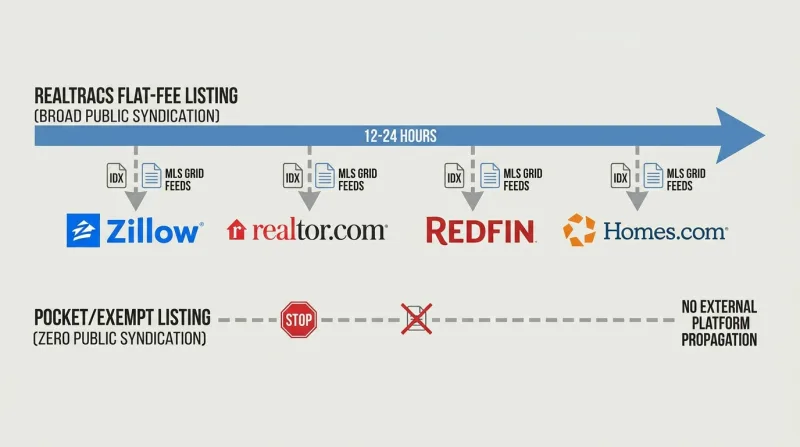
Once your flat-fee MLS listing goes active on Realtracs, it feeds an IDX data stream that pushes to portal partners through MLS Grid and syndication agreements. In practice, properties typically propagate to Zillow, Realtor.com, Redfin, and Homes.com within about 12 to 24 hours of activation — though portal refresh cycles vary and photos sometimes lag the initial data push.
A pocket listing has no timeline. There's nothing to syndicate. Zero reach isn't a bug in the off-market model — it's the entire point of it.
In Nashville specifically, that portal window matters more than in slower markets. Buyer agents and out-of-state relocators searching Davidson and Williamson inventory live on Zillow and Realtor.com. A listing that surfaces there overnight can generate showing requests before it's been active a full day. Off-market, those buyers never know your home exists.
Coming Soon / Hold Status: The 30-Day Middle Ground
Realtracs offers a Coming Soon / Hold status — a way to signal a listing exists before it's fully active, capped at a 30-day maximum before the listing must either go active or come down.
Here's what that status does and doesn't do:
- No showings. A property in Coming Soon status can't be shown yet.
- No DOM accrual. Your Days on Market clock doesn't start ticking.
- Auto-syndication opt-out. You control whether a Coming Soon listing syndicates to portals during that window.
Coming Soon with syndication on gives you public teaser exposure with zero DOM cost. Coming Soon with syndication off gives you an agent-only warm-up — closer to a pocket listing in privacy, but fully compliant and DOM-protected. That configuration is the closest legitimate approximation of a pocket listing's discretion, and almost no national aggregator explains it because it's Realtracs-specific plumbing.
The 30-day cap forces a decision date — exactly the kind of scarcity that drives buyer-agent urgency. A listing that's been "coming soon" for 90 days signals a problem. A hard 30-day runway signals a launch.
NAR's Clear Cooperation Policy: Why There's No Legal "Hybrid" Off-Market
NAR's Clear Cooperation Policy requires that once a listing broker publicly markets a property, the listing must be submitted to the MLS within one business day. "Publicly market" is broad — a yard sign, a public social post, a listing website, an open-house flyer to non-brokerage buyers. Any of it starts the clock.
You can't run a quiet public campaign — teasing the home on Instagram, gauging interest, collecting offers — and keep it off Realtracs. Even a Facebook Marketplace post is public marketing. If your broker doesn't enter the listing within one business day, that's a policy violation that can carry MLS fines against the listing broker.
Your real choices are cleaner than they first appear:
- Truly private — no public marketing, signed non-dissemination form, genuine pocket listing.
- Public and on the MLS — where flat-fee MLS gives you the exposure at the lowest cost.
There's no legal third door. The compliant middle path is Coming Soon status, which works on the MLS's terms.
Verify the current effective version at nar.realtor before relying on specific wording.
The Hidden Cost of Going Off-Market
Privacy isn't free — it just doesn't send you an invoice. The Bright MLS and Drexel University study found on-market listings fetched an average of 17.5% more than off-market properties. Treat this as a research finding, not a promise about your specific home — but the logic holds: fewer buyers means less competition, and less competition means softer prices.
Run the math on a Nashville sale. Even a mid-single-digit discount on a median-priced Davidson County home dwarfs what you'd save on commission by going quiet.
This is where flat-fee MLS does something a pocket listing structurally can't. It captures the cost savings sellers want from going private — a low, fixed fee instead of a percentage commission — while delivering the full-market exposure that protects your sale price.
How Days on Market Actually Accrues (and Where Sellers Lose Money)
The common assumption: keeping a home off-market protects it from a high DOM count. Half true. A pocket listing's private days don't reset your clock — they just delay visible marketing while the property may already be stale in the minds of the small buyer pool that saw it privately.
On Realtracs, DOM begins accruing when the listing goes Active. Coming Soon / Hold does not accrue DOM. Run a private listing for six weeks to a handful of buyers with no offers, then enter the MLS at Active with DOM at zero — clean on paper. But the most active buyer agents in Davidson and Williamson counties often already know the address. They saw it whispered. They know it didn't move. Your "fresh" listing isn't fresh to the exact people driving offers.
A Coming Soon listing inverts this: it builds anticipation inside the system every serious buyer agent watches, then converts pent-up demand into simultaneous showings the day it flips Active — DOM at zero, warm buyer pool instead of a burned one.
Reading the Realtracs Status Field Like a Broker
Incomplete. A listing entered but not finished. Realtracs gives a limited window — commonly cited as 48 hours — before the listing must be completed or flagged. It won't syndicate and won't generate showings, so it's no loophole for extended private marketing.
Coming Soon / Hold. A real pre-market status with a hard 30-day cap, no showings, no DOM accrual, and the syndication opt-out described above.
Active. Full syndication, showings open, DOM running.
Knowing which lever you're pulling changes the outcome — and the Coming-Soon-with-syndication-off configuration lets you approximate a pocket listing's privacy while staying compliant and DOM-protected.
Edge Cases Where a Pocket Listing Genuinely Wins
The privacy-critical sale. Public figures, high-profile Nashville addresses, divorce or estate situations where discretion outranks price. If a $30,000 privacy premium is worth more to you than the last dollar of equity, a genuine off-market sale can be rational.
The pre-negotiated buyer. You already have a serious, qualified buyer at a number you'll accept. There's no bidding war to capture because you're not seeking one. The Seller's Instruction Not to Disseminate form exists precisely for this.
The condition-sensitive property. A home mid-renovation or with issues you'd rather resolve before wide exposure. Coming Soon usually solves this better, but a short true off-market window can occasionally make sense.
The honest tradeoff on all three: weigh your privacy premium against that ~17.5% off-market discount. If the discount exceeds what privacy is worth to you, the math points back to maximum exposure.
The Equity-Retention Framework
Most guides treat this as a two-way choice: go public with a full-commission agent, or go private with a pocket listing. That framing is wrong for a seller who cares about net proceeds.
Every listing decision moves two dials — exposure and cost. A pocket listing dials both down (low cost, near-zero competition). A full-service MLS listing dials both up (maximum exposure, but 5–6% in commission). The interesting quadrant — high exposure, low cost — is where flat-fee MLS lives.
Think of your net proceeds as three levers:
Lever one — commission cost. A flat-fee listing swaps the traditional listing-side commission for a fixed fee. A private sale often quietly pays this back through a lower price.
Lever two — exposure-driven price. Full syndication puts your property in front of the entire active Middle Tennessee buyer pool within roughly 12–24 hours. Competitive bidding is the single largest price driver most sellers control. A pocket listing surrenders it by definition.
Lever three — DOM and timing. Coming Soon protects your DOM clock while pre-loading demand, so you launch to a warm market at zero days.
The flat-fee-plus-Coming-Soon configuration pulls all three in your favor at once: low fixed cost, maximum exposure, protected timing, full compliance. A pocket listing pulls lever one and drops the other two.
A quick self-test
- Is discretion worth more to you than top dollar? → Off-market may fit.
- Do you already have a buyer at your number? → Non-dissemination path.
- Do you want the highest defensible price while keeping commission savings? → Flat-fee MLS, launched from Coming Soon.
Frequently Asked Questions
Is a flat-fee MLS listing better than a pocket listing in Nashville?
For most Nashville sellers focused on price, yes — a flat-fee MLS listing on Realtracs syndicates to Zillow, Realtor.com, and Redfin within roughly 12–24 hours, driving competitive offers while you keep your equity. A pocket listing wins only when privacy or discretion outranks sale price.
What is Realtracs Rule Section 2.32?
Realtracs Rule Section 2.32 governs Exempt (office exclusive) listings, allowing a seller to keep a property off the MLS through a signed "Seller's Instruction Not to Disseminate" form. Confirm the exact rule number and form name against the current Realtracs Rules & Regulations before relying on it.
How long does a listing stay in "Coming Soon" status on Realtracs?
Coming Soon/Hold status is capped at up to 30 days, during which no showings occur and Days on Market don't accrue. Verify the current cap and auto-syndication opt-out settings with Realtracs, as these limits change.
Does the NAR Clear Cooperation Policy apply to Nashville sellers?
Yes. NAR's Clear Cooperation Policy requires a listing to be entered into the MLS within one business day of any public marketing. Confirm the current effective version at nar.realtor, as enforcement details have been revised over time.
How much less do off-market homes sell for?
Research has found sellers may net meaningfully less than comparable on-market homes — a discount reported in the 15–17% range in some studies. Treat it as a research finding, not a guarantee.
Can I use a flat-fee MLS service and still control my listing?
Yes. Under a TREC-licensed limited-service agreement, you get MLS entry and full portal syndication while handling showings and negotiations yourself — keeping commission savings without giving up exposure.
Conclusion
The choice comes down to what you're optimizing for. If privacy matters most, a pocket listing under Rule Section 2.32 gives you that discretion — with the honest tradeoff that off-market homes can sell for materially less, and that any public marketing forces MLS entry within one business day anyway.
If your goal is the strongest offer, a flat-fee MLS listing is the more direct path. It captures the cost savings sellers chase in a pocket listing while pushing your property to Zillow, Realtor.com, Redfin, and Homes.com through Realtracs and MLS Grid — usually inside a day.
Rank your priorities: privacy, speed, and net price. If net price sits at the top, a limited-service flat-fee listing on Realtracs almost always serves you best. If discretion truly outranks dollars, the exempt route exists — just go in knowing the discount. Confirm current rule numbers, forms, and windows directly with Realtracs before you sign anything.