

On August 17, 2024, the way Tennessee sellers pay a buyer's agent changed. Offers of compensation came out of the MLS, and buyers began signing written agreements with their agents before touring homes. For anyone selling on a flat fee listing, the NAR settlement turned buyer agent commission negotiation into something you now handle yourself, one offer at a time.
That freedom cuts both ways. Agree to too much and your savings shrink. Refuse every request and you may lose buyers who can't cover their own agent's fee.
This guide draws on NAR's practice-change FAQ, the Burnett v. NAR court record, lender guidelines from Fannie Mae, Freddie Mac, FHA, VA and USDA, and the published rules of Tennessee's MLSs. It's general information, not legal advice.
How Does Buyer Agent Commission Negotiation Work on a Tennessee Flat Fee Listing After the NAR Settlement?
Here's the short answer: Since August 17, 2024, Tennessee sellers can't advertise a buyer agent commission in the MLS, and buyers must sign a written agreement with their agent before touring. Any seller payment toward the buyer's agent is now negotiated off-MLS or written into the purchase contract as a concession. On a flat fee listing, the amount is your decision.
The money didn't disappear. It moved from a blanket MLS offer to a term you settle offer by offer.
That matters more on a flat fee listing. You've already skipped a traditional listing commission, so you have more room to decide whether to help with the buyer's side, how much, and in what form.
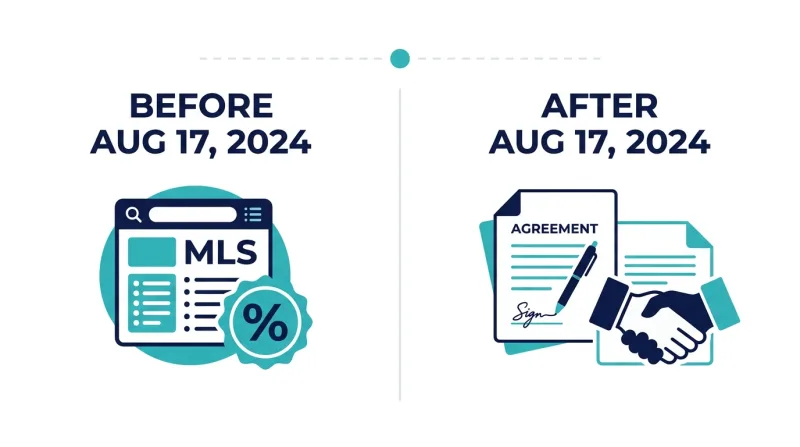
What Actually Changed: Pre- vs. Post-Settlement Rules
The shift began with Burnett v. NAR in the Western District of Missouri. On October 31, 2023, a jury returned a verdict of roughly $1.78 billion against NAR and several brokerages. NAR announced a nationwide settlement on March 15, 2024. The practice changes took effect on August 17, 2024, and the court granted final approval on November 26, 2024.
The settlement didn't make buyer agent compensation illegal. NAR's FAQ states that broker compensation remains fully negotiable and isn't set by law. What changed is where and how it gets offered.
| Item | Before Aug. 17, 2024 | After Aug. 17, 2024 |
|---|---|---|
| Offers of compensation in the MLS | Listing broker posted a buyer agent commission | Prohibited in NAR-affiliated MLSs |
| Written buyer agreement | Common, often signed late or not at all | Required before touring with an NAR member agent |
| Who sets the buyer agent's fee | Usually the listing side's MLS offer | Buyer and their agent, in writing |
| Fee format | Often unstated | Must be "objectively ascertainable" (flat dollars or a percentage) |
| Where seller help is negotiated | Mostly fixed before offers arrived | Off-MLS, in the purchase contract, or by direct seller-to-broker agreement |
| At closing | Paid from the listing commission split | Separate line on the settlement statement or Closing Disclosure |
One rule works in your favor. A buyer's agent can't receive more from any source, including you, than the amount stated in the buyer agreement. That figure becomes the ceiling on any request.
Can a Tennessee Seller Still Pay the Buyer's Agent?
Yes. Paying the buyer's agent is still legal and negotiable in Tennessee. You just can't post the offer in the MLS. You can still offer it off-MLS, agree to it as a concession in the purchase contract, or sign a direct agreement with the buyer's broker.
The MLS ban is narrower than many sellers assume. It covers offers of compensation in the listing itself. It doesn't stop you from telling a buyer's agent by phone, by email or in your own marketing that you're open to discussing their fee. Off-MLS negotiation is now the normal route, not a workaround.
Three separate rulebooks apply:
MLS rules. RealTracs covers Middle Tennessee, including Nashville and its surrounding counties. Memphis, Knoxville and Chattanooga each run their own MLS through local REALTOR® associations. The rule text differs between them, including whether remarks can say a seller "will consider concessions," and those rules have been revised more than once since 2024. Check the current version before you write your remarks.
Tennessee law. The Tennessee Real Estate Commission licenses brokers and enforces agency and disclosure rules under Tenn. Code Ann. Title 62, Chapter 13 and TREC Rules 1260-02. The requirement to sign a buyer agreement before touring comes from NAR settlement rules and MLS policy, alongside TREC's existing rules on written agency agreements.
Lender guidelines. These decide how a seller payment is treated in the buyer's loan, which can determine whether your concession helps the deal or sinks it.
The MLS is where you advertise the home, not the buyer agent's paycheck. You set the number.
Where the Negotiation Happens: Buyer Agreements and the Purchase Contract
Two documents are in play.
The buyer's representation agreement sets what their agent is owed. You aren't a party to it, and nothing in it obligates you. If the buyer agreed to 2.5%, that's their commitment, not yours.
The purchase contract is where any request for a seller contribution shows up. Most Tennessee residential offers use the Tennessee REALTORS® Purchase and Sale Agreement (RF401). A buyer who wants help with their agent's fee usually adds it in special stipulations or an addendum. That makes it a purchase contract concession, negotiable like price or closing date.
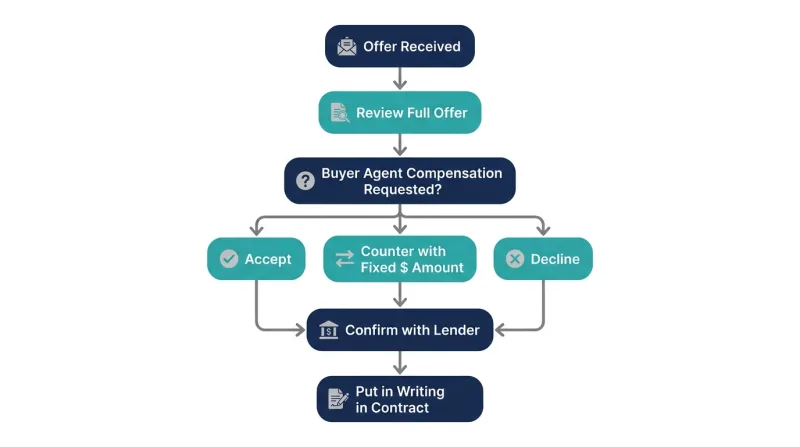
When a request arrives:
- Ask what the buyer agreement says. You never need to pay more than the buyer actually owes, and anything above that can't go to the agent anyway. The buyer doesn't have to show you the agreement. If they won't, write a dollar figure into your counter and let their agent confirm it fits.
- Check the buyer's cash position. Lenders generally won't let buyers finance their agent's fee into the loan, so any gap you leave comes out of the buyer's cash at closing. For a low-down-payment buyer, that gap can decide whether the deal closes.
- Counter in fixed dollars. A $9,000 commitment stays $9,000 whether an escalation clause pushes the price up or a repair credit pulls it down. If you accept a percentage, specify that it applies to the final contract price.
- Split the buckets. Write buyer broker compensation and closing-cost help as separate lines (more on why below).
- Make payment contingent on closing. The language should state that the amount is payable from your proceeds only on a closed, funded sale. A side letter promising a fee "for bringing a buyer" can create an obligation that doesn't depend on closing.
- Accept, counter or decline. Declining doesn't kill the offer. It goes back to the buyer, who decides whether to cover their own agent.
- Get it in writing. Verbal promises and side emails won't hold up when the closing statement is prepared.
Not legal advice. Confirm concession language with a Tennessee real estate attorney or your flat fee broker before you sign.
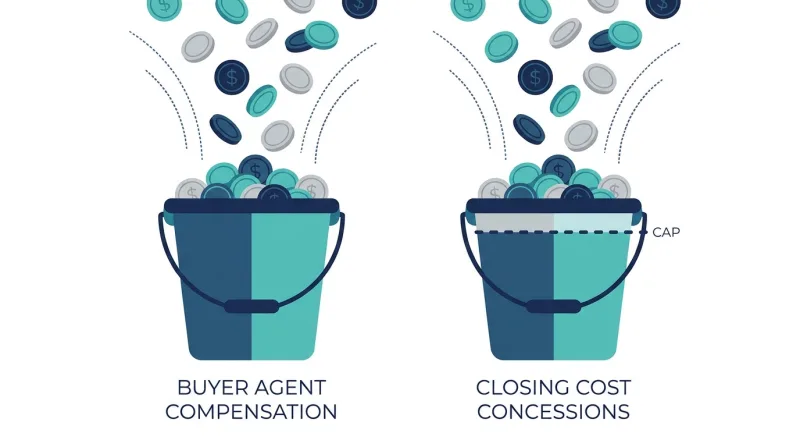
The Two-Bucket Rule: Compensation vs. Closing-Cost Help
This rule can decide whether a financed deal closes.
Here's the short answer: Lenders cap how much an "interested party," including the seller, can contribute to a buyer's costs. 2024 guidance from Fannie Mae, Freddie Mac and HUD/FHA indicates that seller-paid buyer broker commission generally does not count toward those caps when it's customary and reasonable locally. General closing-cost help still does.
If a contract lumps both into one line, such as "Seller to pay $15,000 toward buyer's costs," the lender may have to count the whole amount against the cap. On a low-down-payment loan, that can force a late renegotiation. Two separate lines, carried onto the Closing Disclosure, keep each bucket measurable.
| Loan type | Seller-contribution (IPC) limit | Seller-paid buyer broker commission counted? | Source |
|---|---|---|---|
| Conventional | 3% (LTV over 90%), 6% (75.01–90%), 9% (75% or less); 2% investment property | Generally no, if customary locally | Fannie Mae Selling Guide B3-4.1-02; Freddie Mac Guide, 2024 updates |
| FHA | 6% | Generally no, if customary in the area | HUD Handbook 4000.1; HUD 2024 guidance |
| VA | 4% in seller concessions; normal closing costs and points handled separately | VA Circular 26-24-14 (August 2024) began allowing veterans to pay their own buyer broker within limits; lender should confirm current policy | VA Lender's Handbook; VA Circular 26-24-14 |
| USDA | 6% | Lender to confirm current treatment | USDA HB-1-3555 |
Summarizes agency guidance as of July 2026. Not legal or lending advice.
Investor buyers deserve extra care. With a 2% cap on conventional investment loans, a mislabeled line can push a closing-cost credit over the limit.
Watch for price gross-ups, too. A buyer may offer $10,000 more if you pay $10,000 toward their agent. The lender lends against the lower of the contract price or the appraised value, so if the home appraises at the original price, the gross-up disappears. This works best when your comps already support the higher figure.
4 Post-Settlement Strategies for Flat Fee Sellers, Compared
A flat fee seller has already removed the listing-side commission. That leaves the buyer side as a discretionary budget. You're deciding how much of what you saved to spend, if anything, to win a specific buyer.
| Strategy | Buyer traffic | Net per closed sale | Leverage | Transaction risk | Best for |
|---|---|---|---|---|---|
| 1. Offer 0%, decline all requests | Lower | Higher, if price holds | Lower once offers arrive | Moderate | Hot micro-markets, cash-heavy buyer pools |
| 2. Signal openness off-MLS (your site, flyer, or remarks where your MLS allows) | Higher | Moderate | Moderate | Lower | Owners who want broad showings without precommitting |
| 3. Negotiate in each contract | Moderate to higher | Moderate to higher | Higher | Lower to moderate | Sellers comfortable countering, especially with multiple offers |
| 4. Direct seller-to-broker agreement | Moderate | Moderate | Moderate | Lower, if written clearly | Sellers who want fixed terms with a specific broker |
Ratings reflect how post-settlement rules and financing incentives typically interact, not proprietary statistics.
Strategy 1 looks best on a spreadsheet. The catch is who it filters out. First-time buyers and buyers using FHA, VA or other low-down-payment loans often can't pay their own agent out of pocket. If they make up much of your price band in Nashville, Murfreesboro or elsewhere, a firm 0% policy can mean fewer offers.
Strategies 2 and 3 pair well. You signal willingness, then set the number inside each contract. Before the first offer lands, decide the most you'd ever pay in dollars, while you're calm.
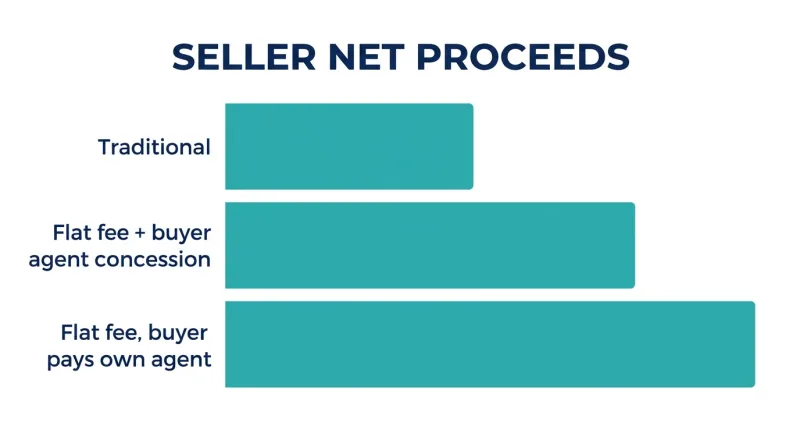
When offers ask for different things, compare net to seller: price minus seller-paid compensation, closing-cost concessions and repair credits. Then weigh financing, contingencies and timing separately. A $455,000 FHA offer asking 2.5% ($11,375) nets $443,625, which is less than a $445,000 offer where the buyer pays their own agent. Counter the first offer with a fixed $9,000, though, and it nets $446,000. (Illustrative figures.)
Net Proceeds Math: A $450,000 Tennessee Home Example
Assumptions: a $450,000 sale and a $500 flat listing fee used for illustration (check current ResultsMLS pricing). The traditional comparison assumes 3% + 3%, a common historical structure, not a market average. Title, attorney and closing fees are treated as equal and left out. Tennessee's transfer tax of $0.37 per $100 ($1,665 at this price, Tenn. Code Ann. § 67-4-409) is levied on the grantee and customarily paid by the buyer in Middle Tennessee. Local custom and contract terms vary, and it can be negotiated.
| Scenario | Commission math | Total | Proceeds before other costs |
|---|---|---|---|
| A. Traditional (assumed 3% + 3%) | $13,500 + $13,500 | $27,000 | $423,000 |
| B. Flat fee + 2.5% buyer agent concession | $500 + $11,250 | $11,750 | $438,250 |
| C. Flat fee + fixed $8,000 (≈1.78%) | $500 + $8,000 | $8,500 | $441,500 |
| D. Flat fee, buyer pays own agent | $500 + $0 | $500 | $449,500 |
Illustrative estimate only.
Even Scenario B keeps $15,250 more than A. The fixed-dollar counter in C adds another $3,250 at the same price.
Scenario D only wins if the price holds. Apply a simple break-even test: paying $8,000 beats paying nothing when it produces an offer at least $8,000 higher, or a financed offer that closes when the alternative is more waiting. The test tells you what each yes or no is worth.
Edge Cases Worth Knowing
Unrepresented buyers asking for "the savings." Some will argue the price should drop by the commission you aren't paying. On a flat fee listing, your price came from comps, not a commission budget. Treat it as an ordinary price negotiation, and expect to coordinate more during closing.
FHA appraisal risk. FHA appraisals carry property-condition requirements. A buyer asking for agent help may also have little cash to cover an appraisal gap, so factor that into how you weigh the offer.
Deals that fall apart. Seller-paid compensation written into the contract is normally payable from proceeds at closing. No closing usually means no obligation, provided the language says so.
Frequently Asked Questions
Is it illegal for a Tennessee seller to pay a buyer's agent after the NAR settlement?
No. Since August 17, 2024, NAR's practice changes bar offers of compensation in the MLS, but buyer broker compensation remains fully negotiable off-MLS or as a concession in the purchase contract.
Can I mention buyer agent compensation in my RealTracs flat fee listing?
Not as an offer of compensation, which RealTracs no longer permits in any MLS field. Check the current rule text before writing any remarks about concessions, because policies have changed since 2024.
Does paying the buyer's agent count against FHA or conventional seller concession limits?
Generally no, when the payment is customary locally, per 2024 guidance from Fannie Mae, Freddie Mac and HUD. General closing-cost help still falls under the 6% FHA cap and the 3%, 6% or 9% conventional caps. Confirm with the buyer's lender.
Do I have to pay the buyer's agent if their offer asks for it?
No. It's one negotiable term. You can accept it, counter with a fixed dollar amount or decline it.
Is flat fee MLS still worth it in Tennessee after the NAR settlement?
Usually. In the $450,000 example, a flat listing fee plus a 2.5% buyer agent concession totals $11,750, well below the $27,000 under an assumed 3% + 3% split.
What's the safest way to word a buyer agent concession?
State a fixed dollar amount, keep it on a separate line from closing-cost help, and make it payable only at a closed, funded sale. Have a Tennessee real estate attorney review the language.
The Bottom Line
The NAR settlement didn't remove buyer's agents from Tennessee sales. It moved compensation into each offer, where you can weigh it against price, financing and timing. Flat fee sellers start that negotiation with room to spare. MLS rules, lender guidance and Tennessee REALTORS® forms keep changing, so confirm current versions before relying on any figure here.
When you're ready, compare ResultsMLS flat fee MLS pricing for Tennessee, then read our guide on how to list on MLS without an agent. You set the number, not the MLS.