

Overprice a FSBO in Tennessee and it sits. Underprice it and you've handed a buyer the commission you were trying to save.
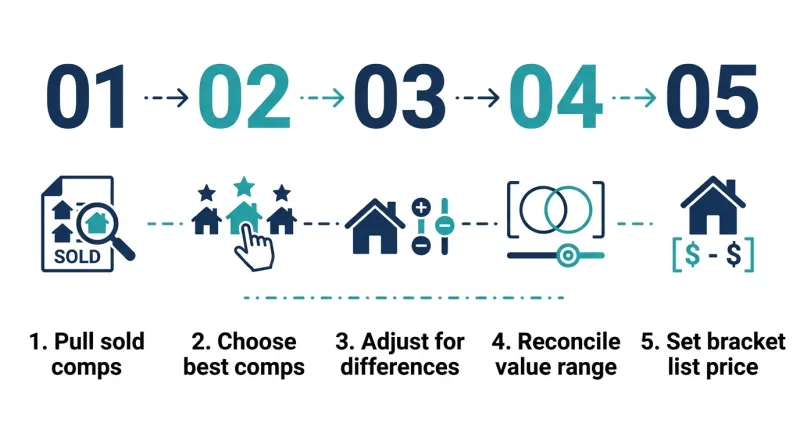
To price a FSBO home in Tennessee, start from recent sold comparables, not online estimates. Pull three to six nearby homes that sold in the last three to six months. Adjust each sale price for differences in size, baths, garage, basement and condition. Weight the closest match most heavily to get a value range. Then set a list price that lands inside a common buyer search bracket.
You don't need a license for this math. It's the comparable-sales approach appraisers use on the Uniform Residential Appraisal Report, scaled down to a laptop and a spreadsheet. Comps don't care what you paid.
Why Zillow and Redfin Estimates Aren't Enough
An automated valuation model (AVM) estimates value from public records, recent sales, tax data and listing details. It's fast, free and a reasonable first look at your Tennessee home value without a realtor.
It can't walk through your house, though. AVMs routinely miss:
- Condition and renovations, such as a new kitchen or a 25-year-old roof
- Finished basements and bonus rooms that never made it into county records
- Lot quirks like a creek, a steep grade or a yard backing onto a highway
- Mixed housing stock, such as a 1950s ranch next to a new tall-and-skinny, a common pattern in parts of Nashville
The portals publish their own error rates. At the time of writing, Zillow reports a nationwide median error of roughly 1.8% to 2.4% for active listings and about 7.2% to 7.5% for off-market homes. Redfin reports roughly 2% on-market and around 7% off-market.
Your home is off-market until you list it. On a $400,000 house, a 7% miss is $28,000 in either direction. Use the AVM as a starting range and let the comps set the price.
Step 1: Find Real Sold Prices in Tennessee Public Records
Where to look
- County Property Assessor sites show the parcel, square footage, year built and usually the last sale price and date. The big offices are Davidson (Nashville), Williamson (Franklin, Brentwood), Rutherford (Murfreesboro), Knox (Knoxville), Shelby (Memphis) and Hamilton (Chattanooga). The Tennessee Comptroller's statewide real estate assessment search covers most other counties.
- County Register of Deeds indexes hold the recorded deed itself. Some counties have free online indexes. Others charge a fee, and the courthouse terminal still works.
The deed-stamp back-out
Tennessee deeds generally carry an oath of consideration stating the value of the transfer. Every recorded transfer also pays a realty transfer tax of $0.37 per $100 of consideration under T.C.A. § 67-4-409(a). So you can check the price two ways.
Sale price ≈ transfer tax paid ÷ 0.0037 Hypothetical: $1,110 ÷ 0.0037 ≈ $300,000
If the oath of consideration on that deed also says $300,000, the sources agree and you have a usable comp. Rounding can shift the result by a few hundred dollars.
Not every recorded deed is a market sale. Discard or flag these:
| Red flag on the deed | Why it distorts your comp |
|---|---|
| Consideration of $10, $1 or "love and affection" | Gift or family transfer |
| Quitclaim deed | Often a title cleanup, divorce or estate transfer |
| Foreclosure, trustee's or substitute trustee's deed | Distressed sale, priced for speed |
| Several parcels on one deed | Price covers more than one property |
| Transfer to or from a relocation company | Can be a paper step inside a corporate move |
| Land-only deed on new construction | The house may have been built under a separate contract |
Watch out: Don't confuse the deed with the deed of trust. A mortgage recorded the same day is taxed at $0.115 per $100 of debt above $2,000 under § 67-4-409(b). Back that tax out and you get the loan amount, not the price. The Assessor's "appraised value" is a tax figure too, sometimes from a reappraisal several years old. Use the sale price and the deed instead.
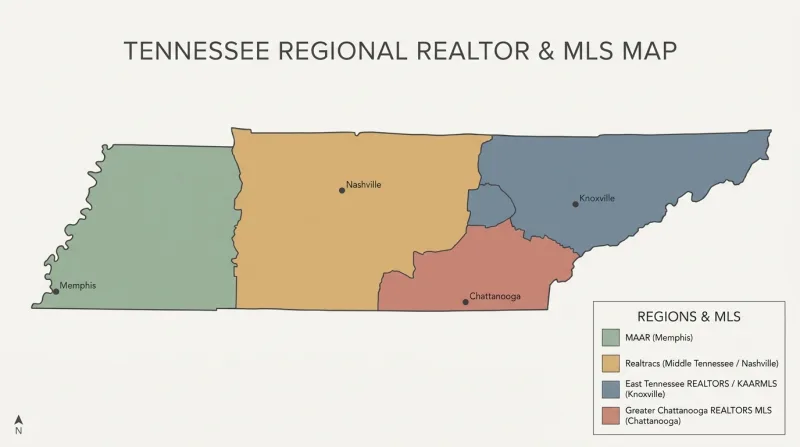
Tennessee isn't one MLS
Buyers' agents in Knoxville aren't pulling Nashville data, and your comps shouldn't cross that line either.
| Region | Primary MLS | Pricing implication |
|---|---|---|
| Middle Tennessee (Nashville, Franklin, Brentwood, Murfreesboro, Mount Juliet, Hendersonville, Clarksville) | Realtracs | Williamson comps rarely transfer to Rutherford. Match county and school zone first. |
| East Tennessee (Knoxville) | East Tennessee REALTORS MLS, formerly KAARMLS | Its own market and pace. Pull comps from inside it. |
| Southeast Tennessee (Chattanooga) | Greater Chattanooga REALTORS MLS | Coverage may cross the state line. Stay on the Tennessee side unless you're pricing a border property. |
| West Tennessee (Memphis) | Memphis Area Association of REALTORS (MAAR) MLS | Price levels can shift sharply within blocks. Match by subdivision, not radius alone. |
Northeast Tennessee and other areas have their own regional systems. Coverage boundaries shift, so treat this table as a starting map.
Can a FSBO seller see Realtracs sold comps? No. MLS back-end data is generally limited to participants and subscribers, so your sold-price research runs through public records.
The access issue cuts the other way too. Buyers' agents search the MLS first, and a home that isn't in it misses that search. Once your price is set, the next lever is exposure. A ResultsMLS flat-fee listing puts your home in Realtracs or your regional MLS and syndicates it to the major portals, so buyers' agents in Nashville, Franklin, Murfreesboro, Knoxville, Chattanooga, Memphis and beyond actually see it.
Step 2: Choose the Right Comps
Close is not the same as comparable. A house two streets over can be a worse comp than one a mile away in your subdivision with your floor plan.
These are appraisers' rules of thumb, not lender requirements, but they make a solid filter:
- Location: Start in your subdivision or school zone, then go out about 0.5 to 1 mile in suburbs.
- Recency: Use the last 3 to 6 months. Rural West and East Tennessee counties may need 12 months and a wider radius.
- Size: Keep living area (GLA) within about 15% to 20% of yours.
- Age and style: Match a 2005 two-story to other 2000s two-stories, not a 1970s split-level.
- County lines: A Williamson sale says little about a Rutherford house ten minutes away.
Use sold prices, not list prices. Active listings still matter, since they're your competition, and expireds show which prices buyers rejected. Note the median days on market for your sold comps.
Watch out for builder incentives. In fast-growing parts of Rutherford and Wilson County, builders often offer rate buydowns or paid closing costs. A spec home that "sold for $425,000" with a $15,000 credit really competed at about $410,000. The concession may show on the closing disclosure or in MLS remarks. Without MLS access, ask the builder's sales office what's running now.
Step 3: Adjust Your Comps
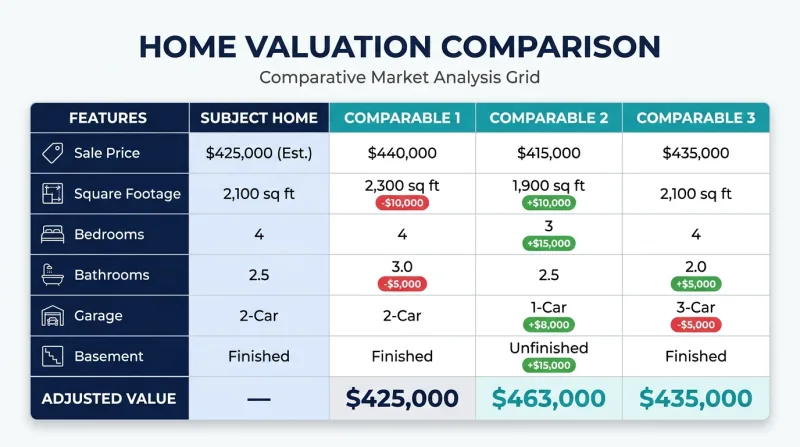
No comp matches your home exactly, so you adjust each comp's sale price to estimate what it would have sold for if it were your house.
The rule: If the comp is better than your home, subtract. If it's worse, add. You're adjusting the comp, not your home, and that trips up nearly everyone the first time.
Time first, then the house
A comp that closed five months ago sold into a different market. Appraisers typically apply a market-conditions adjustment before anything physical.
Hypothetical: a comp sold for $380,000, and median sold price per square foot in that ZIP rose 2% since then, per monthly Greater Nashville REALTORS or Tennessee REALTORS reports. $380,000 × 1.02 = $387,600. Run your other adjustments on that number. In a flat or falling stretch, the time adjustment can be zero or negative.
Illustrative adjustment ranges
These are examples, not Tennessee standards. Values vary by price tier and neighborhood.
| Feature | Illustrative adjustment | Notes |
|---|---|---|
| Living area (GLA) | $60–$120 per sq ft of difference | Usually below the comp's average $/sq ft, since land and kitchens don't scale with size |
| Full bath | $8,000–$15,000 | Less in lower price tiers |
| Half bath | $4,000–$8,000 | |
| Garage bay | $5,000–$12,000 | Higher where most homes have garages |
| Finished basement | Often 40%–60% of the above-grade $/sq ft | Ceiling height, egress and finish matter |
| Pool | $0–$15,000 | Some buyers see a cost, not a feature |
| Condition | $5,000–$25,000+ | Dated vs. updated kitchen, roof and HVAC age |
Professionals get local figures from paired sales, meaning two near-identical sales that differ in one feature. If two same-plan houses in one subdivision sold a month apart, $8,000 apart, and the only real difference is a third garage bay, that's your local garage number.
Stress-test each comp
Calculate two percentages for every comp:
- Net adjustment % = sum of adjustments with signs ÷ sale price
- Gross adjustment % = sum of adjustments ignoring signs ÷ sale price
Big pluses and minuses can cancel out on paper. A comp with +$12,000 GLA, −$10,000 garage and +$6,000 kitchen nets only 2.1% on $380,000, but its gross is 7.4%. Long-standing appraiser rules of thumb flag a comp past about 15% net or 25% gross. Those aren't hard lender limits anymore, but the logic holds: a comp needing that much correction is a different house. If two of your three break those lines, widen the search.
Worked Example: A Hypothetical Murfreesboro CMA
These numbers are made up to show the math. Assume a flat market, so no time adjustment.
Subject: 1,850 sq ft, 3 bed, 2 full baths, built 2005, 2-car garage, average updated condition. GLA is adjusted at an illustrative $100 per sq ft.
| Comp A | Comp B | Comp C | |
|---|---|---|---|
| Location / sold | Same subdivision, 2 months ago | 1 mile, 4 months ago | 0.7 miles, 5 months ago |
| Sale price | $389,000 | $412,000 | $372,000 |
| Sq ft | 1,800 (+$5,000) | 2,000 (−$15,000) | 1,850 ($0) |
| Baths | 2 ($0) | 2.5 (−$6,000) | 2 ($0) |
| Garage | 2-car ($0) | 2-car ($0) | 1-car (+$8,000) |
| Condition | Similar ($0) | Similar ($0) | Dated kitchen (+$12,000) |
| Adjusted price | $394,000 | $391,000 | $392,000 |
| Gross adjustment | 1.3% | 5.1% | 5.4% |
Don't average equally. Comp A is the closest, most recent and least adjusted, so it gets half the weight:
($394,000 × 50%) + ($391,000 × 25%) + ($392,000 × 25%) = $392,750
That gives a range of $391,000 to $394,000 and a reconciled value of about $393,000. Adjusted prices within $3,000 of each other is a good sign. If they spread $30,000 apart, revisit the comps before trusting any number.
Edge Cases That Break the Grid
Acreage. Land doesn't add value in a straight line. The first acre or so carries most of the site value because it holds the well or septic, the driveway and the yard. Extra acres usually add less each, so a 6-acre Maury County homesite isn't worth six times a 1-acre lot. Also confirm with the assessor whether the land is in Tennessee's Greenbelt program. If the buyer's use removes it, rollback taxes can come due, generally covering three years of savings for agricultural and forest land and five for open space. Who pays is negotiable, and buyers know it.
Condos and HOAs. Match within the same complex when you can. Monthly dues work like extra mortgage payments in a buyer's budget, so a $150-per-month difference can cut purchasing power by roughly $20,000 to $30,000, depending on rates. Check HUD's FHA-approved condo list too. If your complex isn't on it, FHA buyers can't finance the unit.
Flood zones. Look up your parcel and each comp on FEMA's Flood Map Service Center. A federally backed mortgage in a Special Flood Hazard Area requires flood insurance, and that premium shrinks what a buyer can afford. Comparing an X-zone comp to an AE-zone subject without adjusting is a common miss along the Cumberland, Harpeth and Stones rivers.
When comps are this thin, or the home is one of a kind, a pre-listing appraisal earns its fee. Expect several hundred dollars, get quotes, and check the license with the Tennessee Real Estate Appraiser Commission.
Setting the List Price
The list price is a marketing decision; the value is a math problem. You've solved the math.
Bracket pricing
Buyers filter portal searches by round numbers. List at $405,000 and you vanish from every "under $400K" search. At $399,900 you show up there and still catch buyers searching from $375,000 up. For the hypothetical $393,000 value, $394,900 to $399,900 keeps the home inside that bracket.
Read the pace
Divide active listings by average monthly sales to get months of inventory. By a widely used convention attributed to NAR, about 6 months signals balance. Lower favors sellers, and higher favors buyers. Check the latest Greater Nashville REALTORS or Tennessee REALTORS report for your area before you commit.
Don't "test high"
Every price cut shows up in listing history, and buyers' agents read a string of reductions as an invitation to negotiate harder. Set a review rule before you list. If showings are thin after 14 to 21 days, adjust once and decisively.
The appraisal ceiling
Your real ceiling usually isn't what a buyer will offer. It's what an appraiser will support. Most buyers finance, and the appraisal contingency in the Tennessee REALTORS Purchase and Sale Agreement (RF401) gives them options when the appraisal comes in low. Read the current form or have a Tennessee real estate attorney review it. Generally you renegotiate, the buyer covers the gap in cash, or the buyer walks.
Covering the gap is harder than sellers assume, because lenders size the loan on the lower of price or appraised value. FHA allows a maximum 96.5% LTV for most buyers under HUD Handbook 4000.1. VA allows up to 100% with full entitlement, and conventional limits vary per the Fannie Mae Eligibility Matrix. Say you contract at $420,000 with an FHA buyer and it appraises at $400,000. That buyer now needs $20,000 in cash on top of the down payment, and many chose FHA because cash is tight.
So run the test. Would your best two adjusted comps support this number to a stranger with a clipboard? If your answer starts with "but my kitchen is nicer," you're over the ceiling.
Reading the market's response
| What you're seeing | Likely cause | Lever to pull |
|---|---|---|
| Few saves, few showing requests | Above the bracket buyers search | Drop into the next bracket |
| Steady showings, no offers | Condition doesn't match the price in person | Compare feedback to your condition adjustments |
| Offers well under list | Buyers are reading comps you skipped | Recheck your highest-weighted comp |
| Multiple offers in week one | At or below market | Hold firm on terms and consider an offer deadline |
A price cut won't fix a condition problem. Move one lever at a time so you know what worked.
Credits, Commissions and Your Real Net
A credit isn't a price cut
| Hypothetical structure | Contract price | Seller credit | Seller's gross | Appraisal must support |
|---|---|---|---|---|
| Price with credit | $400,000 | $8,000 | $392,000 | $400,000 |
| Straight price cut | $392,000 | $0 | $392,000 | $392,000 |
Your gross is the same either way. The credit helps a cash-tight buyer, but the appraisal has to reach the higher price. If your DIY range tops out at $395,000, the credit version is the one that risks a gap. Lenders also cap seller contributions. Conventional limits generally run 3% to 9% depending on down payment and occupancy, and FHA caps them at 6%. Check the buyer's loan type before you agree.
Don't discount by the commission you're saving
Knocking the saved commission off your price hands that money to the buyer, often before anyone asked. It doesn't change what a lender will finance or an appraiser will support. Price at market. The commission you're not paying is already your margin.
Keep two numbers separate:
- Market price, from your adjusted comps. List here.
- Walk-away net, your negotiating floor:
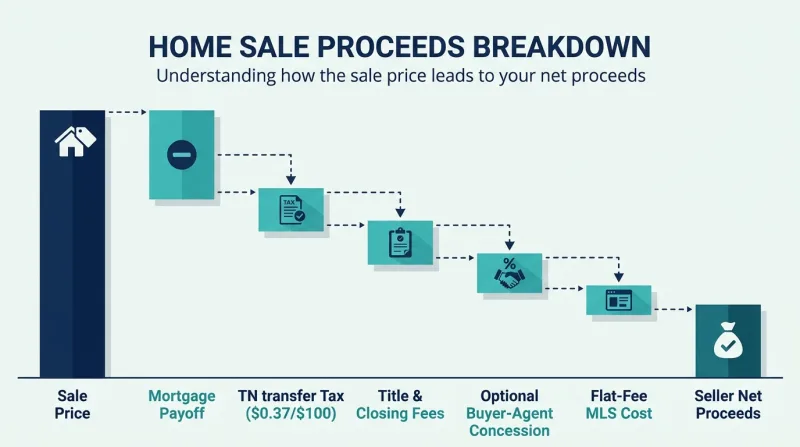
Walk-away net = sale price − mortgage payoff − transfer tax (if allocated to you) − title/closing fees − any negotiated buyer-broker concession − flat-fee MLS cost
Under the NAR settlement practice changes effective August 17, 2024, offers of buyer-broker compensation no longer appear on the MLS, and buyers working with an agent must sign a written agreement. Some buyers will ask you to cover part of their agent's fee and some won't. Treat that as a line in your net, not a discount baked into your list price.
| Hypothetical $400,000 sale | Traditional listing | Flat-fee MLS listing |
|---|---|---|
| Sale price | $400,000 | $400,000 |
| Listing-side + buyer-side commission | Negotiable; historically around 5%–6% total | No listing-side commission |
| Buyer-broker concession | Included above | $0 to whatever you agree to |
| Flat-fee MLS cost | Not applicable | Per the provider's pricing |
| Transfer tax at $0.37/$100 (per contract) | $1,480 | $1,480 |
These figures are illustrative, and your title company and contract set the real ones. Price at market, control the concessions, and the difference stays with you.
Frequently Asked Questions
How do I calculate my home's value for a FSBO sale in Tennessee?
Pull 3 to 6 recent sold comps, adjust each for size, baths, garage, lot and condition, and reconcile them into a range. Give the most weight to the comp that needed the fewest adjustments.
How do I find what a house actually sold for in Tennessee public records?
Check the County Property Assessor portal, then confirm the price on the recorded deed through the Register of Deeds. If only the transfer tax shows, divide it by 0.0037. For example, $1,110 ÷ 0.0037 ≈ $300,000.
Can a FSBO seller access Realtracs sold comps?
No. Realtracs back-end data is limited to MLS participants and subscribers, so FSBO sellers use county records. A flat-fee MLS listing still puts your home in front of buyers' agents searching Realtracs.
Are Zillow estimates accurate in Nashville?
They're usually close for on-market homes and much less reliable off-market, where national median error runs around 7%. They often miss condition, renovations and finished basements, so use them as a starting range only.
How much does a pre-listing appraisal cost in Tennessee?
Often several hundred dollars, and more for acreage or unusual properties. Get quotes from two or three licensed appraisers and confirm each license with the Tennessee Real Estate Appraiser Commission.
What happens if my home appraises below the asking price in Tennessee?
Under the RF401 appraisal contingency, a low appraisal usually leads to renegotiating, the buyer covering the gap in cash, or the buyer terminating. Your signed contract controls the exact terms.
Your Next Step
Fill in the grid with three to six deed-verified sales. Take the weighted middle of your adjusted range and set it at the edge of a search bracket. Then sanity-check it against what's active right now and against what an appraiser would sign. If your number holds up, the remaining job is exposure. A flat-fee MLS listing on Realtracs or your regional MLS gets a well-priced home in front of the buyers' agents who'll bring the offer.
Keep the commission, not the guesswork.