

Meta description: Got a Tennessee RF141 with a commission demand? You're not a party to it. Here's what to say, the net-proceeds math, and lender limits for FSBO & flat-fee sellers.
By [Author Name] · Sources checked [date] · General information, not legal advice
A buyer's RF141 is a contract between the buyer and their broker. As the seller, you decide whether to offer any compensation.
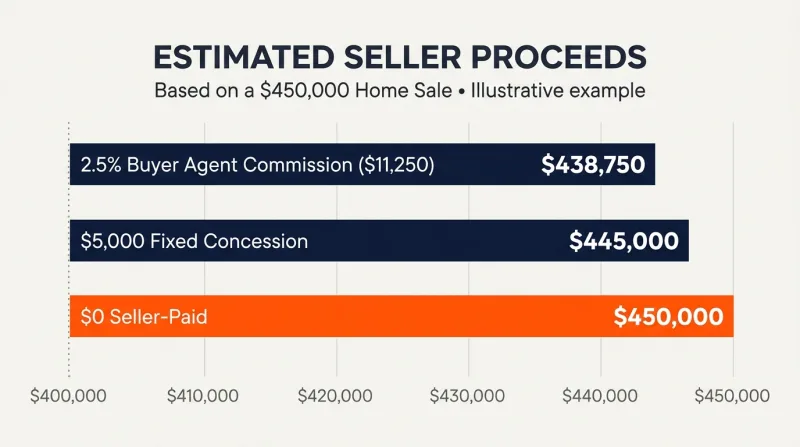
An offer just landed on your flat-fee listing. Attached is a Tennessee Form RF141 with a 2.5% line the buyer's agent wants you to pay, which comes to $11,250 on a $450,000 sale.
Short answer: you don't have to sign or pay it. The RF141 buyer representation agreement is an employment contract between the buyer and their broker. You're not a party to it. Any compensation you offer is your choice, negotiated in the purchase contract.
The legal idea is contract privity: only the people who sign a contract are bound by it. The buyer and their broker signed the RF141. You didn't.
That doesn't mean you should ignore the request. Below you'll find what the form says, why it's showing up now, three reply scripts, and the net-proceeds math for every option.
Disclaimer: This is general information, not legal advice. For your specific contract, talk to a Tennessee real estate attorney or your closing attorney.
What Is Tennessee Form RF141?
RF141 is a standard form in the Tennessee REALTORS member forms library, titled Exclusive Buyer Representation Agreement – Designated Agency. A buyer signs it to hire a brokerage. Three parts matter to you.
The parties. Only the buyer and the buyer's brokerage sign. There's no seller signature line.
Designated agency. The managing broker assigns a specific licensee to the buyer, and that agent owes duties to the buyer, not to you. Tennessee's agency framework sits in T.C.A. Title 62, Chapter 13, with related TREC Rules Chapter 1260-02.
Compensation and shortfall. The form states what the buyer's broker expects to earn. Typically, the broker tries to collect from the seller's side first, and the buyer owes any balance. The commission line is what the agent hopes to be paid, not a figure you owe.
| Form | General purpose | Who signs | Binds the seller? |
|---|---|---|---|
| RF141 | Exclusive buyer representation, designated agency | Buyer + buyer's brokerage | No |
| RF161 | Non-exclusive buyer representation | Buyer + buyer's brokerage | No |
| RF302 | Confirmation of Agency Status | Buyer, seller, and licensees | Only acknowledges that statutory disclosure was provided |
Form numbers and titles change. Check the current Tennessee REALTORS library.
Why Are Buyer's Agents Suddenly Showing Sellers an RF141?
Blame the commission lawsuits. In Burnett v. NAR, a Missouri jury returned a verdict against NAR and several brokerages on October 31, 2023, while a related case, Moehrl v. NAR, was pending in Illinois. NAR announced a settlement on March 15, 2024, and its practice changes took effect August 17, 2024. Per NAR's settlement FAQ, two changes matter here:
- MLS participants working with buyers need a written buyer agreement before touring a home.
- Offers of compensation to buyer's brokers can no longer be published on the MLS.
These rules bind NAR members and MLS participants, not automatically every licensee in the state.
Before 2024, your listing broadcast a commission split through the MLS and agents rarely raised it. That channel closed. Now many agents attach the RF141 to an offer, or mention it with a showing request, to signal what they'd like covered. This is how they open the conversation, and it's a request, not a requirement.
Showing Request or Written Offer: Which Stage Are You In?
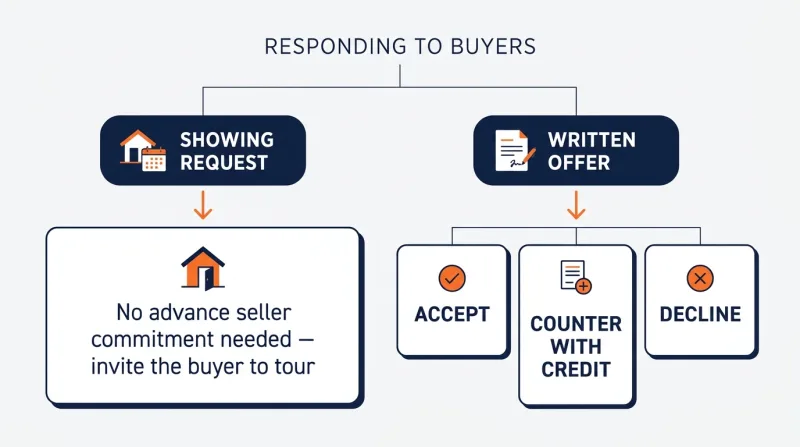
Before a showing, an RF141 just tells you the buyer has signed with an agent. Inside a written offer, compensation becomes one more term you can accept, counter or decline, like price or closing date.
Mixing up the two is how sellers get pushed into early commitments. At the showing stage there's no price and no terms, so you can't judge what a concession would cost.
| Stage | What the agent asks | What you do | Form |
|---|---|---|---|
| Showing request | "Will the seller pay my 2.5%?" or "Please acknowledge our RF141" | Confirm the showing. Say compensation can go in a written offer. Sign nothing. | None from you |
| Written offer | Seller-paid compensation in the offer or attached | Weigh it like any term: accept, counter, or decline | RF401 Purchase and Sale Agreement or addendum; counter on RF651 or current equivalent |
| After acceptance | A separate side agreement | Decline. Keep every term in the executed contract. | Contract amendment only |
Two stages, two different decisions. Most of the pressure happens at the showing stage, where you owe no answer on compensation.
What if an agent won't show without a commitment?
It happens. But a buyer's agent works for the buyer, and steering a client away from a suitable home to protect a fee may conflict with duties to their client under T.C.A. §62-13-404.
That doesn't make it illegal, and you shouldn't say it is. Reply calmly by email so you have a dated record: the home is available, the buyer is welcome, and any request can go in a written offer. If conduct still seems improper, you can contact the Tennessee Real Estate Commission. Usually it never gets that far.
What Should You Say? Three Scripts
Copy, adjust the numbers, send.
At the showing stage:
"Thanks for reaching out. The home is available Saturday at 2:00 and we're glad to have your buyer tour it. If your client would like the seller to contribute toward your fee, please include that in a written offer and we'll review it with the other terms."
Countering with a credit:
"Thanks for the offer. We're countering at $450,000 with a $4,000 seller credit toward the buyer's closing costs, to be applied as their lender allows. We're not agreeing to a percentage-based commission."
A polite decline:
"We appreciate the offer. We aren't offering buyer-broker compensation on this sale, but we're open to discussing price. Feel free to send a revised offer."
Put it in the offer, not in a side deal.
What Does Each Option Cost You?
Here's the reframe most guides miss. Because of the shortfall clause, the buyer's agent gets paid either way. The only question is who pays and how it shows up. "$440,000 plus seller pays 2.5%" is really one number: a lower net price split across two lines. The request is a pricing decision.
| Option | What you say | Cost on a $450K sale | Risk | Best when |
|---|---|---|---|---|
| Decline outright | "No seller-paid compensation. Send your best price." | $0 | A cash-short buyer may walk or lower the price | Multiple offers, or under 7 days on market |
| Flat-dollar credit | "$3,000 toward the buyer's closing costs." | $3,000 | Counts toward the buyer's lender cap | One strong offer from a buyer who needs a little help |
| Partial % (1%) | "We'll contribute 1% to the buyer's broker." | $4,500 | Agent may push for more | 21+ days on market, little activity |
| Full requested % (2.5%) | "We'll cover the 2.5%." | $11,250 | Biggest hit to your net | 45+ days, or best available offer after a price cut |
| Price reduction instead | "Revised price $440,000, no compensation." | $10,000 | Lowers the recorded sale price | Appraisal is a concern |
A dollar credit gives you a fixed, known cost. A percentage grows with the price. Before you go live, write down your floor (the lowest net you'll accept) and which row you'll move to under which conditions. Then a deadline can't make the decision for you.
Sometimes paying part of the fee is the smart move. A modest credit can turn a stretched buyer's offer into a closing.
How Does the Money Move at Closing?
Who pays the buyer's agent changes the buyer's cash to close and the appraisal risk, even when your net comes out the same.
Seller-paid compensation appears as a seller debit on the closing statement, paid by your closing attorney or title company from your proceeds. Any shortfall under the RF141 is a buyer debit, usually paid in cash unless the lender allows it through permitted concessions. That's why agents ask you first. Their client may not have the extra cash.
| Structure | Where it appears | Who's exposed | Hidden effect |
|---|---|---|---|
| You pay the fee directly | Seller debit | You | A selling expense that generally reduces your amount realized for tax purposes (IRS Pub. 523) |
| You give a seller credit; the buyer pays their agent | Seller credit → buyer | Buyer, via lender caps | Counts toward interested party contribution limits |
| Buyer "grosses up" the price to cover the fee | Higher contract price | You, at appraisal | Must appraise; transfer tax is figured on the higher price ($0.37/$100, T.C.A. §67-4-409) |
Watch the gross-up. Say a buyer offers $461,250 on your $450,000 house and asks you to pay 2.5%, or $11,531. Your net looks close to $450K, but the deal now depends on an appraiser agreeing the house is worth $461,250.
Credits carry their own appraisal wrinkle. Under Fannie Mae Selling Guide B4-1.3-09, appraisers adjust comps for concessions, so a $455,000 sale with an $8,000 credit may read closer to $447,000. If your comps don't support a higher number, a capped credit is usually safer than a grossed-up price.
How Do You Compare Two Offers With Different Commission Requests?
Run the net number on each, then rank by risk:
Net to seller = contract price − seller-paid buyer-agent compensation − seller credits − other seller-paid items
Say you've got an RF141 on a flat fee MLS Nashville listing at $450,000, posted on Realtracs, and two offers come in:
| Offer A | Offer B | |
|---|---|---|
| Price | $455,000 | $446,000 |
| Commission request | 2.5% paid by seller ($11,375) | None |
| Seller credit | $0 | $3,000 toward closing costs |
| Net before standard costs | $443,625 | $443,000 |
| Financing | Conventional, 5% down | Conventional, 20% down |
| Appraisal exposure | Higher (above list) | Lower (below list) |
Hypothetical. Excludes payoff, title fees, prorations, and transfer tax.
Offer A wins by $625 on paper. Offer B has a bigger down payment and a price your comps already support, so many sellers would reasonably take it. After net, rank by financing strength, appraisal margin, contingencies, then closing-date fit.
What Edge Cases Should Flat-Fee Sellers Watch For?
The agent wants you to sign a compensation agreement before the showing. That's a different document, such as Tennessee REALTORS Form RF702 or an unrepresented-seller compensation agreement, and you would be a party to it. Check the expiration, whether the fee survives if the buyer returns months later, and whether it's owed at contract or only at a funded closing. When in doubt, decline and point to the offer stage.
The buyer comes back without their agent. This raises procuring cause. If you signed nothing with that agent, any fee claim generally stays between the buyer and their broker. Ask in writing, "Are you currently under a buyer representation agreement?" and make sure the RF401 agency section states the answer accurately.
Tour-only agreements. Some agents use single-property or single-day agreements, often with a low fee or none. You can ask what the client agreed to. The agent doesn't have to share it, but the answer hints at whether a shortfall commitment exists.
The agent is the buyer. Licensees buying for themselves must disclose their license status in writing (T.C.A. §62-13-403). A request to pay "their commission" is just a price reduction. Treat it as one.
Cash buyers. No lender means no contribution caps and usually no appraisal issue, so the choice comes down to net and transfer tax.
"Offer contingent on seller paying buyer's agent." It reads like an ultimatum, but it's a contract term you can counter on RF651, for example by swapping the percentage for a fixed credit.
Frequently Asked Questions
Do I have to sign or pay under a buyer's agent's RF141 in Tennessee?
No. Form RF141 is an agreement between the buyer and their broker, so you aren't a party to it and it creates no payment obligation for you. Seller-paid compensation exists only if you agree to it in writing, usually in the purchase and sale agreement (Tennessee REALTORS RF401 or current equivalent).
Can a buyer's agent refuse to show my flat-fee listing if I won't commit to paying them?
They can ask, but you don't have to commit before a showing. Under T.C.A. §62-13-404, an agent owes duties to their buyer, so passing over a suitable home because of a fee may conflict with those duties. TREC accepts complaints if conduct seems improper.
Should I sign anything before I receive an offer?
Generally, no. A showing request needs only your showing instructions. Compensation terms belong in a written offer or a counteroffer on Tennessee REALTORS Form RF651 or its current equivalent, ideally reviewed by your closing attorney.
Can a seller concession cover the buyer's agent fee instead of a commission?
Often, yes, but the buyer's loan sets the limit. Conventional caps run from 3% to 9% depending on loan-to-value under Fannie Mae Selling Guide B3-4.1-02, FHA allows 6% under HUD Handbook 4000.1, and VA limits concessions to 4% under M26-7. Confirm with the buyer's lender before agreeing to a number.
Does RF141 apply if I'm selling FSBO with no MLS listing?
The same rule holds: RF141 binds only the buyer and their broker, whether your home is on Realtracs or has only a yard sign. Off-MLS, the real difference is exposure, since fewer agent-represented buyers will find you. That's why many owners pair FSBO with a flat fee MLS listing.
If I decline to pay, who covers the buyer's agent?
Under the typical buyer-agreement structure, the buyer owes their broker whatever the seller doesn't pay, per the terms of their RF141. That's why many buyers respond by adjusting their offer price or asking for a closing-cost credit instead.
This is general information, not legal advice. For your specific transaction, talk to a Tennessee real estate attorney or your closing attorney.
What to Do in the Next 24 Hours
- Identify the stage. A showing request needs showing instructions. A written offer is where compensation gets negotiated.
- Pick your option and run the net number. Use the decision table, and check the buyer's loan type against lender limits before promising any credit.
- Send a script and get it in writing. Every term goes in the purchase and sale agreement or a counteroffer, never a text thread.
Form numbers, lender caps and MLS rules change, so confirm current versions with Tennessee REALTORS, the buyer's lender and your closing attorney before you sign. If you'd rather settle your compensation stance before the first agent calls, a flat fee MLS listing with ResultsMLS puts you on Realtracs and keeps those decisions with you.