

Here's the short answer: you can sell FSBO in Nashville without closing compliance fees if your flat fee listing agreement doesn't authorize one and your settlement statement doesn't add it. Tennessee law doesn't require the fee. It's a charge some limited-service brokerages choose to collect.
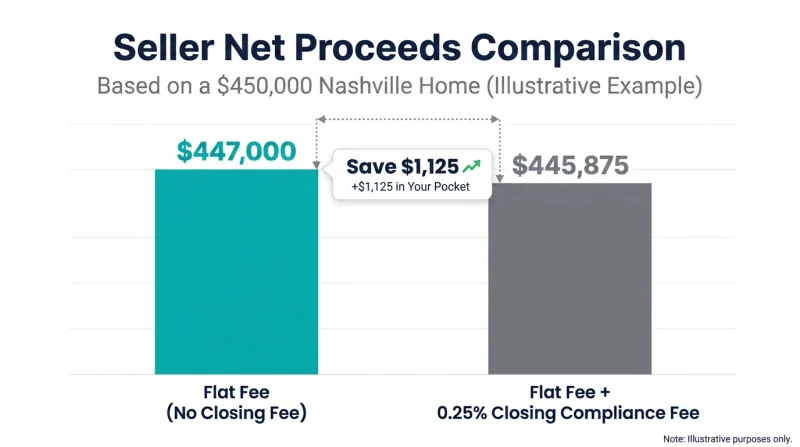
Many Tennessee flat fee MLS plans advertise a low upfront price, then take a "compliance," "broker review" or "transaction coordinator" charge at closing. At 0.25% of a $450,000 sale, that's $1,125 out of your net proceeds.
The fee is easy to spot once you know where to look. It lives in two documents: the listing agreement you sign before your home goes live on Realtracs, and the settlement statement the title company prepares before funding. This guide covers both, plus seven steps to list and close without paying one.
What Is a Closing Compliance Fee in Tennessee Real Estate?
A closing compliance fee is a charge the listing brokerage collects through the title company at closing, usually as a flat amount or a percentage of the sale price. For a For Sale By Owner (FSBO) seller on a limited-service listing, it works as a second, later price for the same MLS listing.
It goes by several names. In a flat fee listing agreement, look for:
- Broker review fee
- Transaction coordinator or closing coordination fee
- File management fee
- Regulatory or document archive fee
- "Success fee" or "fee due upon closing"
They all work the same way. The contract lists it, the closing agent deducts it, and you see it on your final statement.
Brokerages usually justify it with supervision costs. The Tennessee Real Estate Commission (TREC) requires a principal broker to supervise licensees and keep transaction records . That's a real duty. But TREC's rules don't set a closing fee or say how a broker must pay for that supervision . Some brokers build it into the upfront price. Others bill you at closing.
Sellers often ask whether Realtracs, the Middle Tennessee MLS, is behind these charges. It isn't. Realtracs is a subscription service paid by member brokers, so any closing fee is set by the listing brokerage.
Where Hidden Closing Fees Hide
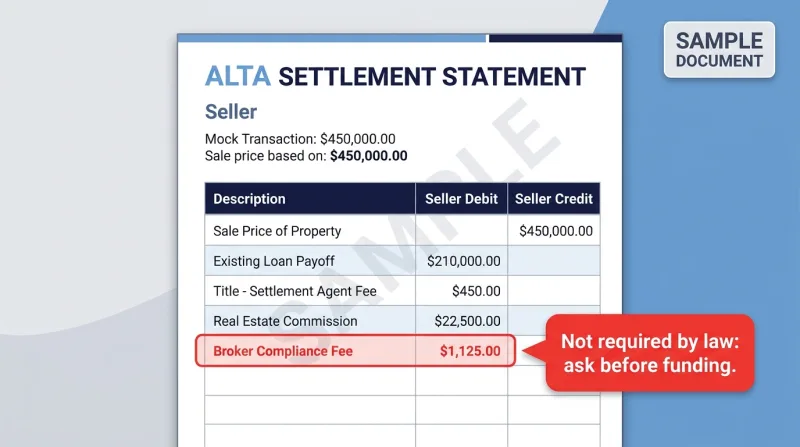
The listing agreement creates the fee. The settlement statement collects it. Read both and you'll catch a compliance fee before it costs you anything.
The listing agreement and addendum
Most flat fee MLS companies pair a main listing agreement with a limited-service addendum. Back-end charges usually sit in the addendum, below the advertised package price.
Read the fine print for:
- A second fee line below the upfront price, written as a percentage or "per transaction."
- Payment-timing phrases like "due at closing," "collected through settlement" or "payable from seller's proceeds." Those mean the money comes from your equity, not your card.
- Authorization language telling the title company to pay the broker directly. That clause is how the fee reaches your statement.
- Tier differences. Cheaper tiers sometimes add a closing percentage that pricier tiers drop.
A common scenario: the seller sees "$399 to list" on the website and signs. Two pages later, the addendum adds 0.25% at closing. Both terms are enforceable.
Watch for contingent clauses too. They only trigger under certain conditions, which is why skimmers miss them:
- Procuring-buyer switch. If the brokerage or one of its agents brings the buyer, the fee becomes a percentage. At 1% on $450,000, that's $4,500.
- Unrepresented-buyer facilitation. If a buyer shows up without an agent, some brokers step in and bill for it. You should decide whether you want that help.
- Protection (tail) periods. TREC rules require a definite expiration date on listing agreements , but a tail clause can make a fee owed on a sale after expiration. Ask for the shortest tail, limited to buyers the broker registered with you in writing.
- Mid-listing upgrades. Add-ons like offer review or contract-to-close help are often "collected at settlement." Get them priced as a fixed dollar amount that replaces any percentage language.
- Withdrawal penalties and renewal charges. A plan that charges again at 90 or 180 days isn't flat if your home sits through a slow winter.
The settlement statement
In most Middle Tennessee sales, a title company or real estate attorney runs the closing, often using the ALTA Settlement Statement format. In a financed sale, the buyer's lender also issues a federal Closing Disclosure, and you may receive a seller's version .
Your seller debit column lists every charge taken from your proceeds. Typical lines:
- Payoffs. Your mortgage and any liens, matching your lender's payoff letter.
- Commissions and broker charges. Listing broker pay, any buyer-agent compensation you agreed to, and any compliance or review fee. Check "miscellaneous" and "other" lines, too.
- Title and settlement charges. Settlement fees, the owner's title policy if you agreed to pay it, wire fees and document prep.
- Taxes and prorations. Your share of property taxes and any transfer tax your contract assigns to you.
Here's how a back-end fee actually lands there. After you go under contract, the brokerage sends the closing agent a written disbursement instruction, often called a commission demand. The closing agent is a neutral escrow party. It follows paperwork and doesn't judge whether a fee is fair.
Your signature on the final statement authorizes the payout.
That's the leverage point most sellers miss. Before you sign, a disputed line is a conversation. After funding, it's a demand letter or a lawsuit.
The Flat-Fee Test and the Break-Even Math
A listing fee is only flat if it stays the same no matter what you sell for, whether you sell at all, and how long the listing runs. If any of those moves the number, part of your price is waiting at closing.
Percentage fees are the biggest offender. Entering a $300,000 house into the MLS takes the same work as a $900,000 house, yet a percentage charges the second seller three times as much. Outcome-based plans have a fair argument (you pay more only when you have proceeds), but the fee comes from your equity and peaks when your home sells best.
What you actually pay is: upfront fee + (closing percentage × sale price).
Take two illustrative plans:
- Plan A: $99 upfront plus 0.25% at closing
- Plan B: $499 upfront, nothing at closing
Plan A saves $400 at signing. That savings disappears at a $160,000 sale price, and the gap grows from there.
| Sale price | Plan A total ($99 + 0.25%) | Plan B total ($499 flat) | Extra cost of Plan A |
|---|---|---|---|
| $300,000 | $849 | $499 | $350 |
| $450,000 | $1,224 | $499 | $725 |
| $700,000 | $1,849 | $499 | $1,350 |
| $1,000,000 | $2,599 | $499 | $2,100 |
Illustrative plans only. They do not reflect any specific company's pricing.
Nashville-area medians have run well above $160,000 for years , so most sellers in Davidson, Williamson and Rutherford counties land on the expensive side.
For scale, Tennessee's realty transfer tax under T.C.A. § 67-4-409 is $0.37 per $100, or $1,665 on a $450,000 sale . A 0.25% compliance fee on that home is about two-thirds of the state tax. And unlike the tax, you can usually avoid it.
So here's a point that cuts against how most people shop. A higher upfront price can be the more honest one. The broker quoting the full cost on day one has shown you the whole bill.
How to Sell FSBO in Nashville Without Closing Compliance Fees: 7 Steps
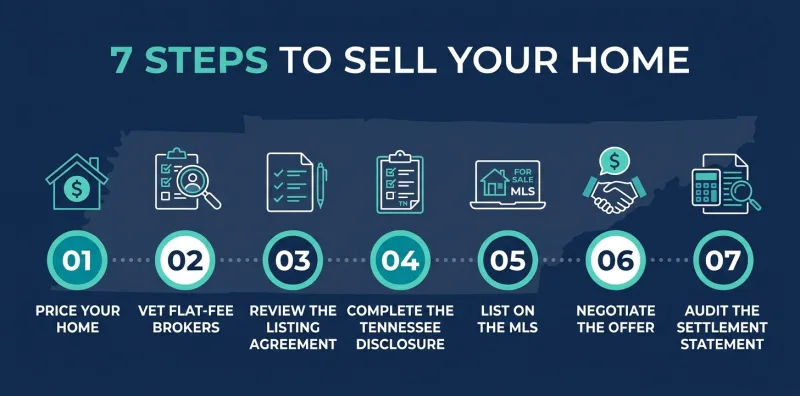
The work comes down to two things: choose a broker whose contract has no back-end charge, then confirm your settlement statement matches that contract before funding.
1. Price the home with real comparable sales
Use sales from the last three to six months of similar size, age and condition in your area. An East Nashville bungalow priced against Brentwood sales won't give you a useful number. County assessor sites and public listing portals cover Davidson, Williamson, Rutherford and Sumner counties.
2. Vet brokers and get "no closing fee" in writing
Ask each broker for the full agreement and addendum before you pay. Then ask: "Will any amount, under any name, be collected from my proceeds at closing?" Get the answer by email and make sure it matches the contract. Confirm the broker's active license through TREC's public lookup.
We'll send ResultsMLS's agreement on request so you can read every term before you list.
3. Strike back-end clauses before you sign
If a broker you like has a closing fee in the addendum, ask them to remove it in writing. Some will. If they won't, you now know the real cost of that listing.
This is where your leverage lives. At signing, you can walk away for free. At closing, your buyer has a rate lock, your move may depend on the funds, and the fee is backed by a contract you signed months earlier.
4. Complete the Tennessee property disclosure
Tennessee's Residential Property Disclosure Act, T.C.A. § 66-5-201 et seq., requires most residential sellers to give buyers a disclosure statement or, where allowed, a disclaimer . Most sellers use the Tennessee REALTORS® Residential Property Condition Disclosure form, RF201 . Homes built before 1978 also need the federal lead-based paint disclosure .
Answer every question honestly before you accept an offer. Some sales are exempt, so check with a Tennessee real estate attorney if yours isn't clear-cut.
5. Go live on Realtracs and handle showings
Your broker enters the listing into Realtracs, and from there it typically syndicates to Zillow, Realtor.com and other portals . Check photos, room sizes, school zones and contact details before it goes public.
Honestly, this is where FSBO takes time. You schedule showings, answer buyer agents and follow up on feedback. Plenty of sellers manage it fine, but expect it to eat some evenings.
6. Negotiate offers and keep buyer-agent compensation separate
Since August 17, 2024, NAR rules have barred offers of buyer-broker compensation on the MLS . Buyers working with an agent must sign a written agreement with that agent before touring .
Buyer agents may still ask you to cover part of their fee. That's allowed and negotiable. If you agree, put it in the purchase contract or a separate written agreement. And ask the closing agent to show each payee on its own line, so a buyer-side amount can't hide a listing-side override.
Compare offers by net: price minus concessions, contributions and repair credits. If there are multiple owners, an estate or a divorce, give every titleholder the fee schedule early, since each signature binds the sale.
7. Audit the draft settlement statement before funding
Ask the title company or closing attorney for the draft seller statement and the brokerage's disbursement instruction a few days before closing. Send them your full listing agreement as soon as you're under contract, too. Then match every broker line in the seller debit column to a clause you signed.
If a charge doesn't trace back, email the closing agent and the broker together. Quote the clause, or point out that none exists, and ask for the line to be removed. Once the wire goes out, getting money back is much harder.
Ask This Before You Sign: Red-Flag Checklist
One question does most of the work: "If my home sells for $450,000, what's the total dollar amount I'll pay your brokerage, from listing to closing?" A true flat fee gets a one-sentence answer. "It depends" is a red flag.
Then confirm each of these reads "$0" or a fixed dollar figure:
- Any balance deferred to closing
- Price changes, photo swaps or extensions
- Withdrawal or cancellation
- A buyer brought by the brokerage
- An unrepresented buyer
- Compliance, review or file fees at settlement
- Sales during the tail period
Worst-case total = upfront fee + add-ons you'll likely need + the largest contingent fee that could realistically trigger. Compare brokers on that number, not the headline price.
Frequently Asked Questions
Are closing compliance fees required by Tennessee law?
No. TREC rules require brokers to supervise transactions and keep records, but they don't require a separate fee at closing . Any compliance fee is a charge the brokerage chooses to set, which means you can avoid it by choosing a broker whose agreement doesn't include one.
Does Realtracs charge FSBO sellers a fee at closing?
Realtracs is a subscription service paid by member brokers, so any fee at closing is set by the listing brokerage, not the MLS . If a closing charge is labeled as an "MLS fee," ask the broker to show you where your listing agreement authorizes it.
How much is the transfer tax on a $450,000 Nashville home?
Under T.C.A. § 67-4-409, the realty transfer tax is $0.37 per $100 of value, or $1,665 on a $450,000 sale . In Middle Tennessee the buyer customarily pays it, but your purchase contract controls who actually covers it.
Can I remove a compliance fee after signing the listing agreement?
Start by asking the broker for a written waiver. If a charge appears that your agreement doesn't authorize, raise it with the title company or closing attorney before funding. If the clause is in your signed contract, a Tennessee real estate attorney can tell you how strong your position is.
Do I have to offer buyer-agent compensation on the MLS in Tennessee?
No. Since NAR's practice changes took effect on August 17, 2024, compensation offers can't be made on the MLS . Any payment to a buyer's agent is optional and negotiable, and it belongs in the purchase contract or a separate written agreement.
Is flat fee MLS worth it in Nashville compared with selling purely FSBO?
For many sellers, yes. A fixed upfront fee buys Realtracs exposure and syndication to the major home-search sites a yard sign can't reach. It's only a good deal without a back-end fee, though. A 0.25% closing charge adds $1,125 to the cost of selling a $450,000 home .
The Bottom Line
Some costs belong on your statement: payoffs, prorated property taxes, recording charges and the owner's title policy if you agreed to it. A fee you never agreed to doesn't.
Get the no-closing-fee promise in writing, strike back-end clauses before you sign, and audit the draft statement before funding. Flat means flat, and the figure you expect at the closing table should be the figure you get. If you want to compare, we'll show you exactly what's included and what you'll pay, upfront.
This guide is general information, not legal advice. For questions about a specific clause, talk to a Tennessee real estate attorney.