
Why One Tennessee MLS Listing Isn't Enough
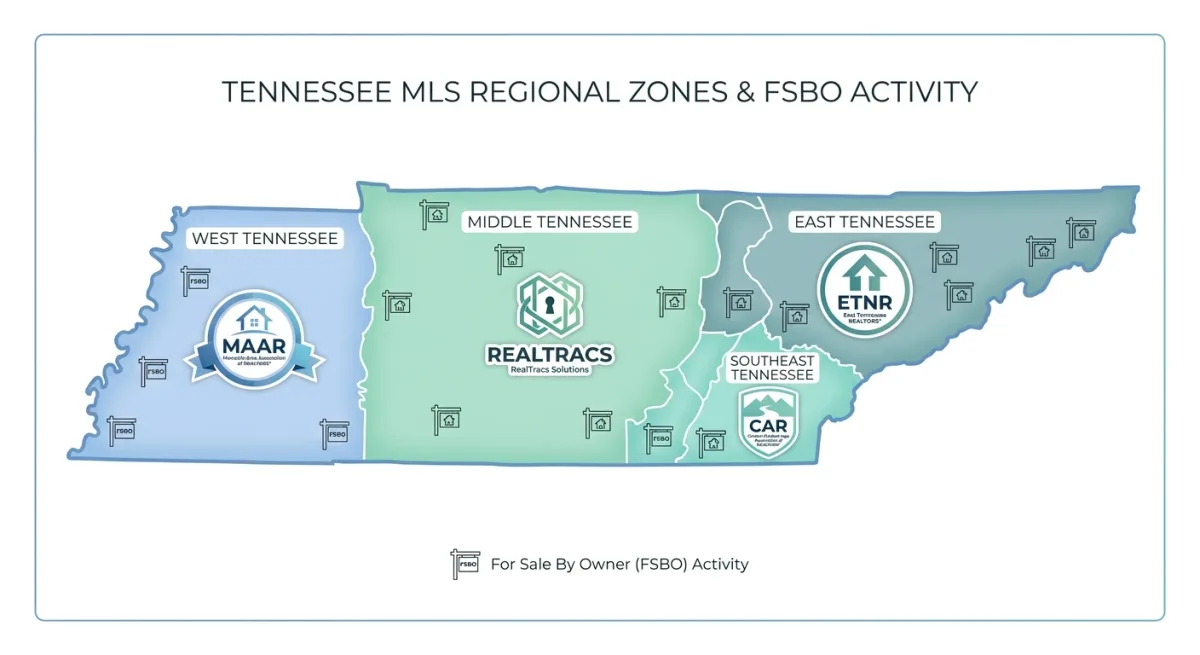
If you're planning Tennessee MLS syndication across RealTracs, MAAR, ETNR, and CAR as an FSBO seller, here's the fact every national flat-fee site gets wrong: Tennessee has no single statewide MLS. It runs on four separate regional networks. List in the wrong one, and local agents in the county where your buyer actually lives may never see your home.
Sellers pay an $89 sticker fee to a national provider, assume they're "on the MLS," and never realize their Nashville listing didn't reach the database Memphis or Knoxville agents search every morning. That's not a fluke — it's how Tennessee's fragmented system works.
Short version: you can get full statewide exposure without paying a full 6% commission — but only if you match your county to the correct regional MLS first.
This guide gives you the whole map: a plain-English breakdown of all four networks, a county-by-county coverage table (updated for 2026), the real difference between portal syndication and agent-to-agent visibility, and what the NAR settlement actually changed about buyer-agent commission.
Tennessee's Four Regional MLS Networks Explained
Tennessee's REALTOR® associations formed regionally, each building its own MLS. No statewide consolidation ever happened. Agents in one MLS generally can't see listings entered only in another.
RealTracs — Middle Tennessee
RealTracs is the largest MLS in the state, covering the Nashville metro and most of Middle Tennessee — Davidson County (Nashville), Williamson (Franklin, Brentwood), Rutherford (Murfreesboro), and Montgomery (Clarksville), plus dozens of surrounding counties. As of 2026, RealTracs has been expanding through partner-board arrangements into parts of East and Southeast Tennessee — but confirm your specific county directly before assuming coverage.
MAAR — Greater Memphis / West Tennessee
The Memphis Area Association of REALTORS® (MAAR) runs the MLS for Shelby County (Memphis) and surrounding West Tennessee counties. A RealTracs listing won't reach agents in Memphis, Germantown, Collierville, or Bartlett.
ETNR — Knoxville / East Tennessee
East Tennessee REALTORS® (ETNR) covers Knox County (Knoxville) and much of East Tennessee. This region has gone by several names over the years (KAAR, TVRMLS), which trips up sellers reading old guides. For a Knoxville-area home, you need a broker with ETNR access.
CAR / GCAR — Greater Chattanooga / Southeast Tennessee
Greater Chattanooga REALTORS® (GCAR) runs the MLS for Hamilton County (Chattanooga) and Southeast Tennessee. You'll still see "CAR" in older directories. This is also where RealTracs' 2026 expansion gets murky — verify by county.
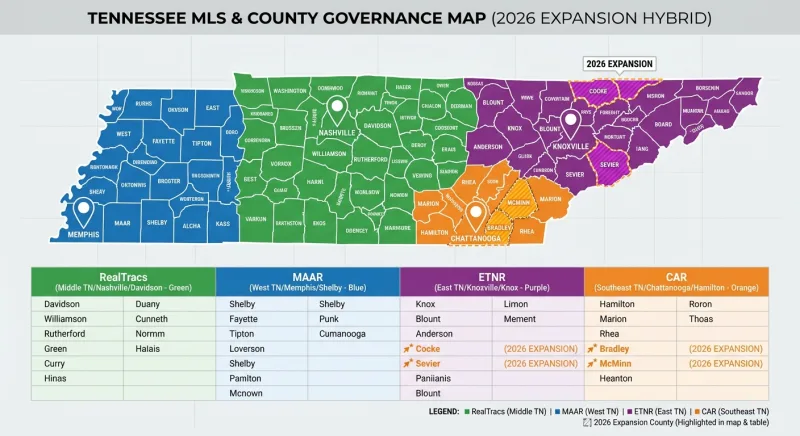
County-by-County MLS Coverage Map (2026)
| Metro / Area | Key Counties | Governing MLS |
|---|---|---|
| Nashville, Franklin, Brentwood, Murfreesboro, Clarksville | Davidson, Williamson, Rutherford, Montgomery | RealTracs |
| Memphis, Germantown, Collierville | Shelby, and West TN counties | MAAR |
| Knoxville, Maryville | Knox, Blount, and East TN counties | ETNR |
| Chattanooga | Hamilton, and Southeast TN counties | GCAR / CAR |
| Border & rural counties (Bradley, Sevier, McMinn, Cocke) | — | May fall under RealTracs partner-board expansion (2026) — verify directly |
County MLS boundaries shift as boards form partnerships — confirm your county's current governing MLS with the association directly before you list.
Portal Reach vs. Agent Reach: The Difference That Costs Sellers
National providers blur this distinction, and it quietly costs sellers real money.
Portal reach is what shows up on Zillow, Realtor.com, Redfin, and Homes.com. Any MLS entry feeds consumer portals through IDX and MLS Grid syndication. Because portals aggregate from every MLS, a single regional entry already blankets them nationally. One RealTracs listing shows on Zillow to a buyer anywhere.
Agent reach is different — whether a buyer's agent searching for inventory inside their professional MLS database can pull up your listing. That access comes only from being entered in the correct regional MLS for your county. It is not aggregated. It's region-locked.
You can be all over Zillow and still be invisible to the local agents who actually bring buyers. A national service might enter your Memphis home in RealTracs and push it to Zillow — the portal traffic looks fine, but MAAR agents can't see you.
One MLS entry can cover Zillow statewide. It cannot cover agents statewide. Those are two different problems, and Tennessee's fragmentation makes the second one the one that matters.
Portal reach gets you looky-loos. Agent reach gets you the qualified buyer represented by someone who never opens Zillow to source a home. National platforms optimize for portal reach because it's cheap and automatic — agent reach is the region-specific part they cut corners on.
How to Syndicate Your FSBO Listing Without Full Commission
You list in the one (occasionally two) MLS that governs your county, then syndicate wide from there.
Step 1 — Identify your county's governing MLS. Use the coverage table. Davidson → RealTracs. Shelby → MAAR. Knox → ETNR. Hamilton → GCAR. If you're on a metro border, call the associations directly. Don't guess.
Step 2 — Choose a flat-fee broker with the right membership. Only a licensed broker who's a member of that specific MLS can enter your listing. Flat-fee companies charge an upfront fee — typically $99–$499 — instead of a percentage. The critical question: "Are you a member of the MLS that covers my county?" A RealTracs-member broker can't put you in MAAR.
Step 3 — Prepare your listing data. Gather accurate square footage, bed/bath count, lot size, high-resolution photos, description, and list price before you sign. Clean data cuts the back-and-forth that delays going live.
Step 4 — Enter the listing in the correct database(s). If you sit on a border and want visibility in two regions, confirm your broker can enter both — and get the price in writing.
Step 5 — Confirm portal syndication. Once you're in the MLS, the IDX/MLS Grid feed pushes your listing to Zillow, Realtor.com, and others — usually within 24–72 hours. Verify it appears. If it doesn't show within a few days, ask your broker whether syndication is enabled.
The Metro-Border Trap: When One MLS Isn't Enough
This is where sellers on a county line quietly leave money on the table. Tennessee's regional MLS boundaries don't respect commuting patterns. Buyers do.
A property near the East/Southeast seam, or an East Tennessee home filed under the wrong board — buyers touring it are driven by agents from two different systems. List in one, and half your ready-buyer pool never sees you in their working database.
Three factors justify a second regional entry:
- Metro-border counties where buyer agents routinely work across the line.
- Relocation buyers whose agent is MLS-affiliated in a different region than the property.
- Property types (large land, luxury) that draw region-hopping specialist agents.
A second MLS entry buys you almost nothing on the portals — they already show your home. It buys you agent access in a second region. For a house dead-center in Davidson County, that's wasted money. Near a seam, it can be the difference between two buyer pools and one — sometimes a $200 second entry protecting a $380,000 sale.
Rule of thumb: Nashville, Memphis, Knoxville, and Chattanooga proper are single-region listings. Everything on a metro fringe deserves a two-minute check before you assume one MLS covers it.
Buyer-Agent Commission After the NAR Settlement
Under the NAR settlement, practice changes that took effect in August 2024 and remain in force in 2026 mean offers of buyer-agent compensation can no longer be published on the MLS. Sellers used to advertise a co-op commission (often 2.5%–3%) in the listing. That's gone.
Removing the number from the MLS field did not remove the negotiation. Buyer agents still get paid — they surface their fee through buyer-broker agreements and bring the ask directly, or write it into the offer as a seller concession. A seller who assumes "no MLS commission field means I owe nothing" is misreading the change.
Three levers you now control:
- Whether to offer anything at all. You can list with zero buyer-agent compensation. Cash buyers will love it; agented buyers may structure the fee into their offer as a concession line.
- How you signal willingness. You can't post a number in the MLS field, but you can respond to individual agent inquiries and accept offers that include a concession.
- What you disclose and when. Concessions appear on the closing statement and can affect the buyer's loan and appraisal treatment — get the mechanics right with your title company before agreeing to a figure.
General information, not legal advice — confirm current requirements with a licensed Tennessee broker or real estate attorney before you list.
Data Ownership and Status Accuracy
There's a mechanism operating underneath your listing that outlasts the sale: who controls your listing data. Regional MLSs govern how data is licensed, retained, and redistributed through participant agreements being updated around 2026.
- Cancellation and withdrawal. When you delist, does the data drop from portals promptly, or persist in cached feeds? Regional MLS rules govern this, not the portal.
- Photo and copy licensing. Your photos may be licensed to the MLS for redistribution. If you paid a photographer, understand what rights you granted.
- Status accuracy. A dual-region listing must be updated to "pending" or "sold" in both databases. A stale "active" status in region #2 after you've gone under contract in region #1 generates junk showing requests and, in some boards, compliance flags.
Ask your broker who's responsible for status updates in each MLS. If it's you, calendar it. If it's them, get the turnaround time in writing.
Frequently Overlooked Failure Points
Membership lapses mid-listing. A broker whose board membership lapses can have your listing auto-removed from that database — silently. For multi-region entries, confirm active membership in every board involved, not just at signup.
The county-line property. A parcel straddling two counties in different regions is a genuine edge case. The governing MLS typically follows the tax parcel's primary county. Verify before assuming.
Assuming 2026 expansion counties are locked. Regional footprints shift as boards partner and merge. Confirm your county's current governing MLS directly for your specific address — this is the single most common way a national comparison page gets Tennessee wrong.
What National Flat-Fee Sites Get Wrong About Tennessee
When you list on a national platform and check the "Tennessee" box, their software drops your home into whatever single MLS they have a broker relationship with, then tells you you're "on the Tennessee MLS." There is no Tennessee MLS. There are four.
A listing entered into RealTracs is invisible to a buyer's agent working out of Memphis, because that agent logs into MAAR — a completely separate database. Sellers ask us constantly: "I listed with a national company — why isn't my Chattanooga house showing up for agents down here?" The platform put them in the wrong regional database.
Competitors can't easily fix their pages because the truth breaks their funnel. Admitting portal reach ≠ agent reach undercuts the "you're on the MLS!" pitch. Admitting the metro-border trap means telling customers to pay for two listings — their checkout isn't built for that. And maintaining an accurate county map against four regional primary sources is a burden a fifty-state aggregator won't carry for one state.
Frequently Asked Questions
Does Tennessee have one statewide MLS?
No. Tennessee runs on four regional MLS networks — RealTracs (Middle TN), MAAR (West TN/Memphis), East Tennessee REALTORS® (East TN/Knoxville), and Greater Chattanooga REALTORS® (Southeast TN) — with no single statewide database.
Can I list on RealTracs without a real estate agent?
Not directly — RealTracs only grants access to member brokers. An FSBO seller lists through a limited-service flat-fee broker who holds RealTracs membership and enters the property. You keep control of the sale; the broker handles MLS entry.
How much does it cost to syndicate a Tennessee FSBO listing?
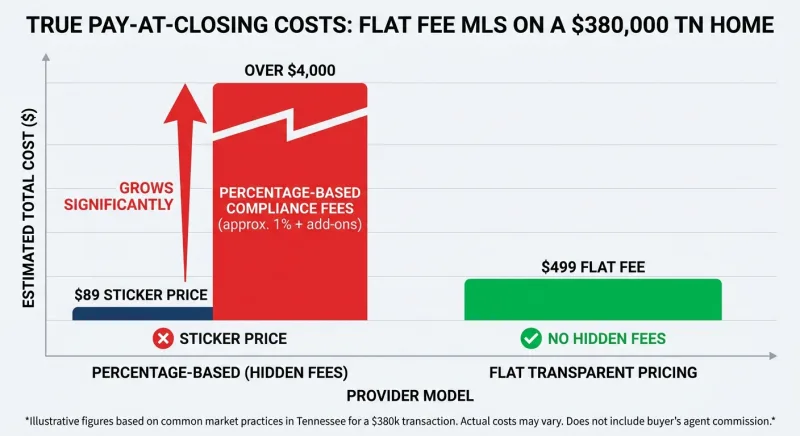
Typical upfront flat fees run roughly $99–$499 per MLS region. Watch for backend closing fees some providers charge — often $495–$995 or 0.25%–1.25% of the sale price — which can add thousands at closing.
Do I have to offer a buyer-agent commission on the MLS in 2026?
No. Since the NAR settlement practice changes took effect in August 2024, offers of buyer-agent compensation can no longer be posted on the MLS and must be negotiated off-MLS. Confirm with a licensed TN broker or attorney — this is general information, not legal advice.
Which MLS covers Nashville, Memphis, Knoxville, and Chattanooga?
Nashville (Davidson County) → RealTracs. Memphis (Shelby County) → MAAR. Knoxville (Knox County) → East Tennessee REALTORS®. Chattanooga (Hamilton County) → Greater Chattanooga REALTORS®.
Does one regional MLS listing show up statewide for agents?
No. A RealTracs listing gives agent-to-agent visibility only within RealTracs' coverage area. Agents in Memphis or Knoxville won't see it unless you also enter the correct regional database for that market.
Your Next Step
Tennessee is four regional MLS systems, not one — and that single fact changes how you sell FSBO without paying full commission. Work it in order: find your county, match it to the governing MLS, then pick a limited-service broker who actually holds membership in that region. If your property sits on a metro border, you may need coverage in two networks.
Two things protect your wallet: read the closing paperwork before you sign, because an $89 sticker price means nothing if a $995 backend fee is waiting at settlement — and remember buyer-agent compensation is now a private, off-MLS negotiation. Confirm the current rules with a licensed Tennessee broker or attorney before you commit.
Get the region right, read the fine print, and full statewide exposure without full commission becomes a checklist you can finish this week.