
How to Write a Legally Compliant FSBO Counter-Offer in Tennessee Without Realtor Form RF651
You got an offer on your house. You want to counter. Then you found out you can't legally use the realtor's RF651 form. Here's what you can do instead.
Writing a FSBO counter offer in Tennessee without RF651 isn't a workaround or a gray area — it's just following what Tennessee law actually requires. The law doesn't require any specific association form.
Short answer: Tennessee's Statute of Frauds (T.C.A. § 29-2-101) requires a signed writing to make a real estate agreement enforceable — not Tennessee REALTORS® form RF651, and not any branded template. A clear written counter-offer with the right terms and both signatures is what makes the deal binding. You can write your own, use a title company's paperwork, or have a Tennessee real estate attorney review a template.
One thing up front: this is an educational guide, not legal advice. We sell flat-fee MLS listings — we're not attorneys. Before you sign anything binding, run it past a licensed Tennessee real estate attorney.
Is RF651 Legally Required to Counter an Offer in Tennessee?
No. RF651 is a convenience form, not a legal requirement.
It's the Counter Offer form published by Tennessee REALTORS® for its members — a standardized template that licensed agents fill in to save time. It is not written into Tennessee statute. What Tennessee actually requires comes from the Statute of Frauds: under T.C.A. § 29-2-101, a contract for the sale of real estate must be in writing and signed by the party to be bound. The form is just one way people satisfy it.
There's no mandated form. There's a mandated format: a signed writing that states the deal clearly enough to enforce. You don't need access to a members-only form.
Why FSBO Sellers Can't Legally Use Tennessee REALTORS® Forms
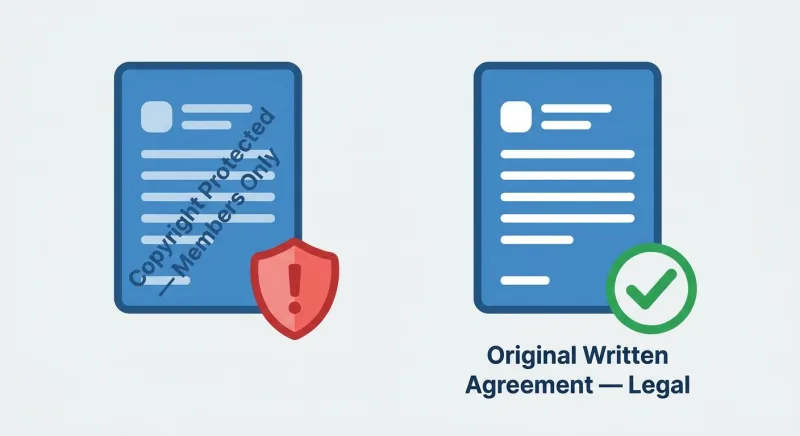
RF651 and the rest of the Tennessee REALTORS® form library are copyrighted and licensed for use by association members only. Under federal law, the copyright owner holds the exclusive rights to reproduce and distribute the work (17 U.S.C. § 106). Reproducing a member-restricted form as an unrepresented, non-member seller can constitute infringement.
That warning extends to the PDF "form filler" sites you'll find in search results. Several host blank, fillable copies of RF651 and similar forms. Many are outdated; some are unauthorized reproductions. Skip them entirely. A counter-offer you draft yourself — or one prepared through the buyer's agent, a title company, or an attorney — sidesteps the copyright issue and still satisfies Tennessee law.
What Makes a Counter-Offer Legally Binding in Tennessee
A binding counter-offer must satisfy the writing requirement and be definite enough to enforce. The Statute of Frauds supplies the first; basic contract law supplies the second — the document has to state essential terms clearly enough that a court could tell what the parties agreed to.
One doctrine changes the stakes: a counter-offer legally rejects the original offer and creates a new one in its place (Restatement (Second) of Contracts § 39). Once you counter, the buyer's first offer is dead.
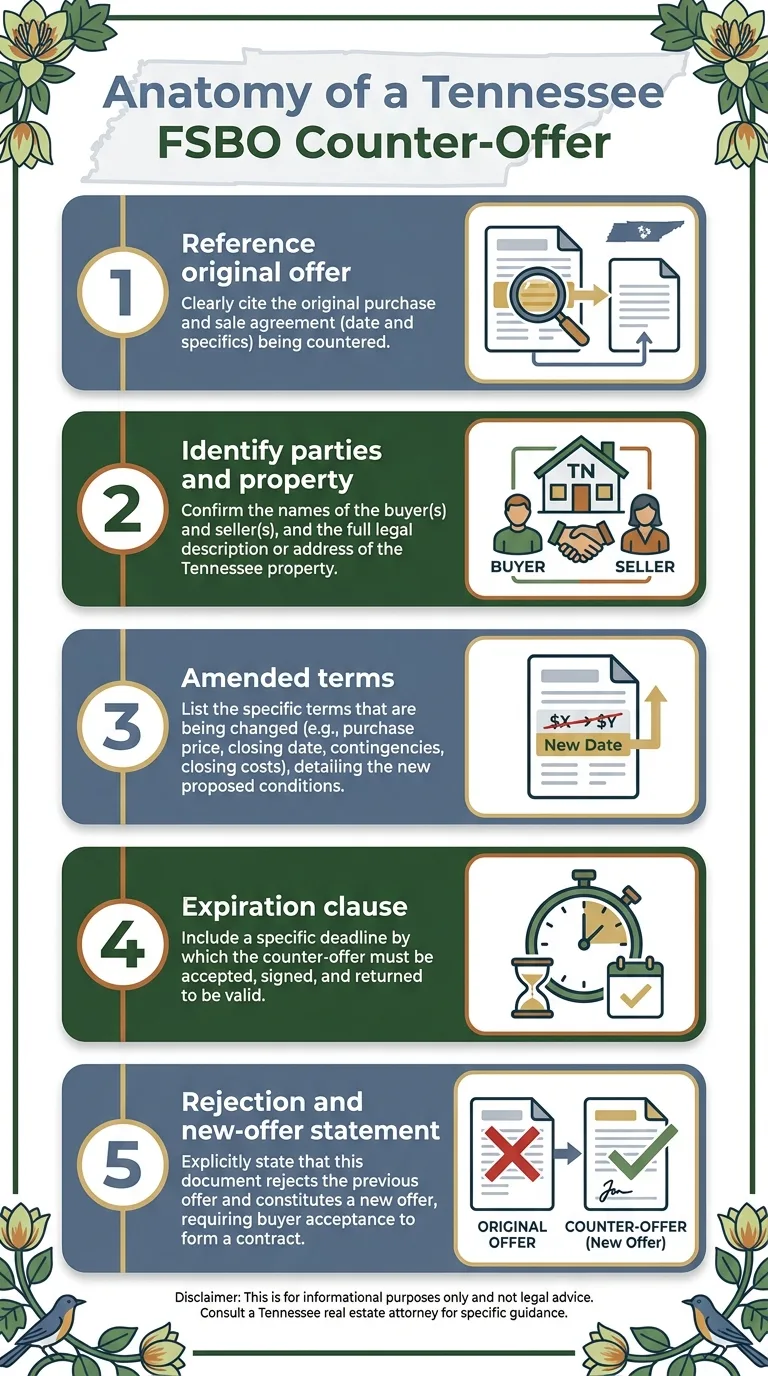
Build the document from its legal elements:
- A signed writing — the Statute of Frauds foundation.
- A reference to the original offer — so the counter attaches to a known deal.
- Identified parties and property — seller(s), buyer(s), address (with legal reference if the offer used one).
- Amended terms stated with definiteness — price, concessions, contingencies, closing date.
- An expiration clause — a counter that never dies keeps you exposed.
- A rejection-plus-new-offer statement — the doctrine above, made explicit.
- Signature and date blocks for both sides.
Miss the signature and you may have nothing enforceable. Leave the terms vague and you may have a dispute.
How to Draft a Compliant FSBO Counter-Offer (Step-by-Step)
1. Reference the original offer. One sentence: "This is a counter-offer to the offer dated [date] for the property at [address]."
2. Identify the parties and property. Name the seller(s) and buyer(s) in full and describe the property clearly.
3. State the amended terms, numbered.
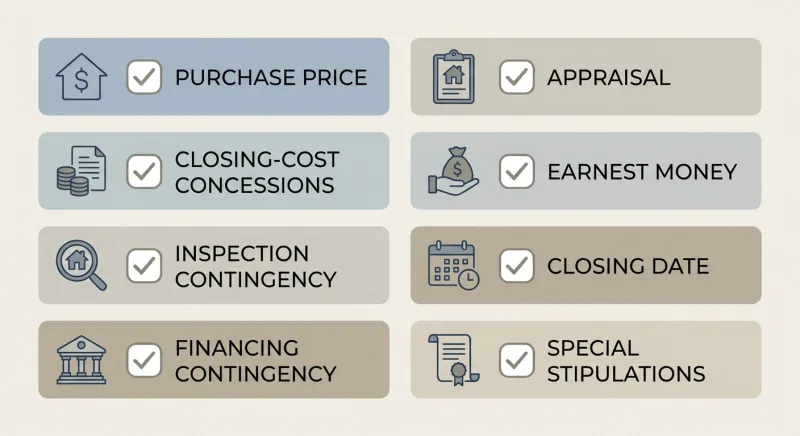
- Purchase price: $______
- Seller-paid closing-cost concessions: $______ or none
- Closing date: ______
- Contingencies you're keeping, changing, or removing (inspection, financing, appraisal)
- Earnest/trust money amount and holder
- Any special stipulations
Then add: "All other terms of the original offer remain unchanged." Use numbers — "Seller credit not to exceed $6,000 toward buyer's closing costs" is enforceable; "Seller will help with costs" is a lawsuit waiting to happen.
4. Add an expiration clause. A workable window is 24–72 hours. Include date, clock time, and time zone — Tennessee spans Central and Eastern: "This counter-offer expires at 5:00 PM Central Time on [date]."
5. Include the rejection + new-offer statement, then signatures. Add a line making the doctrine explicit, then a signature and date block for each party. No signatures, no binding deal.
Before it becomes binding, have a Tennessee real estate attorney review terms touching earnest/trust money, contingencies, and escrow. A few hundred dollars of review can save you a failed closing.
Two Traps That Break FSBO Counters
The mirror-image trap. Acceptance must match your counter exactly. The moment the buyer changes one word, they've countered you back — and your version is dead. Date and time-stamp every round.
The dead-offer problem. Once you counter, you cannot accept the original offer. Legally, that offer no longer exists — you rejected it. Don't counter a good offer over trivia.
Common Terms to Negotiate in a Tennessee Counter-Offer
- Purchase price — the obvious one, rarely the only one worth moving.
- Closing-cost concessions — how much, if anything, you'll credit the buyer.
- Contingencies — inspection, financing, and appraisal contingencies shape your risk.
- Earnest/trust money — the amount and who holds it.
- Closing date — align with your move-out and the buyer's financing timeline.
- Special stipulations — repairs, included fixtures, occupancy, home warranty.
Tennessee closings are typically handled by title companies or closing attorneys, not by the seller drafting the final binding paperwork. Once you've agreed on terms, a professional closing agent carries the transaction across the line.
Edge Cases Worth Knowing
Multiple offers, multiple counters. If two buyers accept simultaneous counters, you may have created two binding contracts on one house. Add a "subject to prior sale" clause to each counter, or use a structure where your signature is the final binding act. This is a genuine call-the-attorney moment.
Trust money and who holds it. Your counter should name who holds earnest money and when it becomes non-refundable — not just the amount. Never take earnest money directly into your own hands as an unrepresented seller.
The buyer is represented, you aren't. The buyer's agent often prepares the paperwork — using a form their brokerage is licensed to use. That's legitimate, but that agent works for the buyer. Never sign the same day you first see new language on a material term, and run any addendum touching contingencies, financing, or trust money past your own attorney first.
As-is sales. Countering an inspection contingency ("sold as-is") does not erase your Tennessee residential property disclosure obligations. As-is limits repair liability; it doesn't license non-disclosure of known material defects.
The Draft-vs-Decide Split
Separate the transaction into two jobs:
- Drafting — reducing terms to enforceable written language. It's mechanical.
- Deciding — choosing what to accept, counter, or walk from. It's strategic.
| Draft-vs-decide setup | Who drafts | UPL / copyright risk | Best for |
|---|---|---|---|
| Attorney drafts | TN real estate attorney | Lowest | Complex terms, multiple offers, trust-money disputes |
| Buyer's agent drafts, you review | Buyer's agent | Low (they're licensed) | Simple counters, represented buyer |
| Title/closing company forms | Closing company | Low | Standard single-round counters |
| You draft, attorney reviews | You | Low, if truly original | Cost-conscious sellers with straightforward terms |
| You copy RF651 / scraper PDF | You (copying) | High — copyright | Nobody. Avoid. |
The winning move for most FSBO sellers with a clean deal: write your own original counter, then pay a Tennessee real estate attorney a flat fee to review it before you sign.
Comparing the Four Compliant Paths, Honestly
| Compliant path | Typical cost | How binding | Watch-out |
|---|---|---|---|
| Hire a TN real estate attorney to draft | Higher hourly/flat fee | Strongest — drafted to your interests | Overkill for a simple price counter |
| Title / closing-company forms | Often low or bundled with closing | Standard, transaction-tested | Not tailored to unusual terms |
| State-neutral template + attorney review | Low-to-moderate + review fee | Strong if reviewed | A template alone, unreviewed, can be too generic for TN |
| Buyer's agent prepares it | Free to you | Binding, but drafted for the buyer | It protects their client — read hard |
If your counter is simple — moving the price, adjusting concessions, setting an expiration — a state-neutral template plus a short attorney review is usually plenty. If there's real money in escrow, unusual contingencies, or stipulations you don't fully understand, pay the attorney.
Where Flat-Fee MLS Fits (and Where It Doesn't)
We sell flat fee MLS in Tennessee listings — we're not attorneys, and none of this is legal advice. A counter-offer only matters if you have offers to counter. When you list for sale by owner in Tennessee through a flat-fee service, your property syndicates to Zillow, Realtor.com, and buyer-agent search feeds — which means the represented buyers whose agents can prepare paperwork actually find your home. We handle the listing across Nashville, Franklin, Memphis, Knoxville, and every other TN market. You handle the decisions. When it's time to draft binding language, bring in an attorney or lean on the buyer's agent.
Frequently Asked Questions
Can a FSBO seller use RF651 in Tennessee?
No. RF651 is copyrighted content licensed to Tennessee REALTORS® members, so an unrepresented for-sale-by-owner seller has no authorized right to use it. Tennessee law requires a signed writing to counter an offer — not that specific form.
Is it illegal to copy a realtor's counter-offer form in Tennessee?
Reproducing Tennessee REALTORS® forms like RF651 without authorization can constitute copyright infringement under federal law (17 U.S.C. § 106), because the association holds exclusive rights to copy and distribute its copyrighted forms. Downloading a blank RF651 from a PDF-scraper site does not make that use legal.
What counter-offer form can a FSBO seller use in Tennessee?
You don't need a branded form. A written counter-offer that references the original offer, names the parties and property, states your amended terms, sets an expiration, and is signed satisfies Tennessee's Statute of Frauds (T.C.A. § 29-2-101). A title/closing company or your attorney can also supply a compliant form.
Do you need a lawyer to counter an offer in Tennessee?
You are not legally required to hire an attorney, but a licensed Tennessee real estate attorney should review any language involving earnest/trust money, contingencies, or special stipulations. For a few hundred dollars, that review protects a five- or six-figure sale.
Does a counter-offer cancel the original offer?
Yes. Under long-settled contract doctrine (Restatement (Second) of Contracts § 39), a counter-offer both rejects the original offer and creates a new offer. The buyer can accept, reject, or counter back — the first offer is off the table.
The Bottom Line
You never needed RF651 to counter an offer in Tennessee. What the law cares about is a signed writing with definite terms. Draft your counter as an original written document: reference the original agreement, name the parties and property, spell out your amended terms with real numbers, add an expiration with a date and time, and sign it. Then have a licensed Tennessee real estate attorney review anything touching trust money, contingencies, or special stipulations before you sign.
Stay off the PDF-scraper sites hosting blank RF651 copies — they can't shield you from the copyright problem.
We sell flat-fee MLS listings — we're not attorneys, and this isn't legal advice. What we can do is get your Tennessee home in front of buyers so real offers show up, giving you something worth countering.
Educational content only, not legal advice. Consult a licensed Tennessee real estate attorney about your specific counter-offer.