
Here's what actually changed. The NAR settlement didn't ban commissions, and it didn't kill for-sale-by-owner. It moved buyer-agent compensation off the MLS and put it back where it always belonged — on the negotiating table. For Tennessee sellers going the FSBO route, that's not a threat. It's an opening.
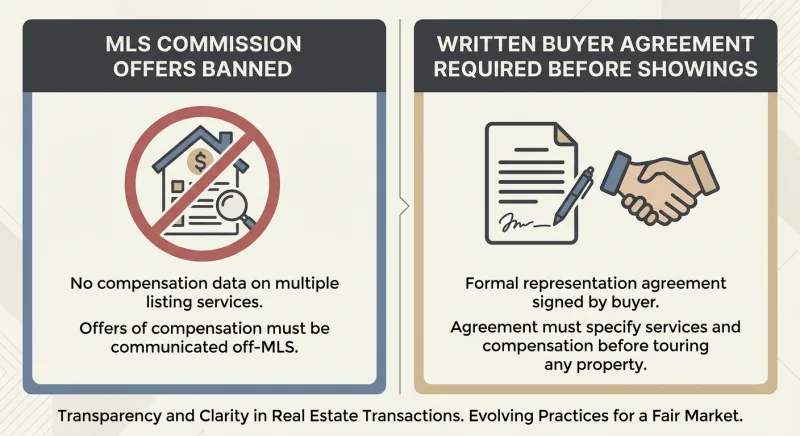
Under the National Association of REALTORS® settlement, effective August 17, 2024, offers of buyer-agent compensation can no longer be published in the MLS, and buyers must sign a written representation agreement before touring homes. Two rule changes. That's the whole shift.
Most of what you'll read online spins this as "FSBO is riskier now." It's coming from people who sell full-service representation. This guide takes the opposite view, backed with actual Tennessee REALTORS® forms and regional MLS mechanics. By the end you'll know exactly how to list on RealTracs, MAAR, or NETAR at a flat fee and negotiate buyer compensation on your own terms.
Quick note: This is general information, not legal advice. Before you sign anything, run it past a licensed Tennessee real estate attorney or your title/closing company.
What the NAR Settlement Actually Changed (Plain-English Breakdown)
The National Association of REALTORS® agreed to a settlement — roughly $418 million — resolving antitrust claims over how buyer-agent commissions were advertised. Effective August 17, 2024, two practice changes took effect nationwide, flowing through Tennessee REALTORS® and the state's regional MLSs: RealTracs in Middle Tennessee, MAAR in West Tennessee, and NETAR/East Tennessee REALTORS® in the east.
Here's what changed:
- No compensation offers in the MLS. Sellers and listing brokers can no longer publish an offer of buyer-agent compensation inside the MLS. The old "co-op commission" field is gone.
- Written buyer agreements required. A buyer's agent must have a signed, written buyer representation agreement in place before touring a home — including yours.
Notice what's not on the list: nothing says you can't offer a buyer's agent compensation. Nothing sets an amount. Nothing forbids seller concessions.
For years, the MLS field made a 2.5%–3% buyer-agent offer look standard, almost mandatory. Removing that field didn't remove your ability to pay. It removed the default. Instead of advertising a number to every agent through the MLS, compensation now gets negotiated deal by deal, in writing, outside the MLS — simpler to control than it sounds, because you were never bound by the old default anyway.
How the NAR Settlement Impacts FSBO Sellers in Tennessee
Does the NAR settlement hurt Tennessee FSBO sellers? No. It removes a hidden default that pressured sellers into a set buyer-agent commission and hands that decision back to you.
The scare story: "Now that agents need signed buyer agreements, they'll steer clients away from FSBO homes because they're not sure they'll get paid." It falls apart when you look at how a buyer's agent actually gets paid in 2026. That signed buyer agreement states what the buyer owes their own agent. If a buyer has agreed to pay their agent 2.5%, that agent gets 2.5% whether they show your FSBO home or a full-service listing down the street. The agent's income hinges on the deal closing, not your MLS field.
What buyers and their agents care about: is compensation covered, and by whom? You answer that in your listing and in the offer negotiation. If you signal — clearly, off the MLS — that you'll consider a reasonable concession, agents have every reason to bring their clients through.
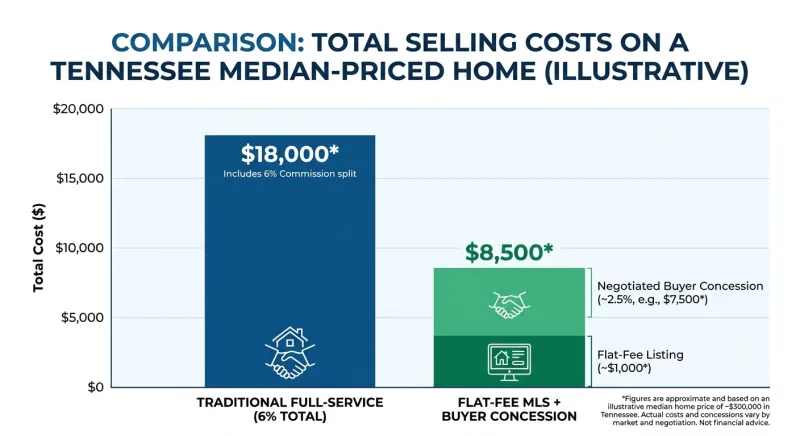
Because you're listing at a flat fee instead of paying a traditional listing-side commission (historically 2.5%–3%), you've already saved before the first showing. That savings gives you room to offer a buyer-side concession and still net more than a full-commission sale. The settlement didn't shrink your options. It widened them.

The 2026 FSBO Strategy: Flat-Fee MLS + Off-MLS Negotiation
The winning move in 2026 is a two-part play: get maximum exposure through a flat-fee MLS listing, then handle buyer-agent compensation privately, off the MLS, on your terms.
You still want to be on the MLS. RealTracs, MAAR, and NETAR are where serious buyers and their agents look first. A flat-fee listing puts your home on the same MLS as every agent-listed property — then syndicates to Zillow, Realtor.com, and the rest — for a one-time fee instead of a percentage.
The four-step play:
- List flat-fee on your regional MLS so your home reaches every buyer's agent in the market.
- Decide your compensation posture before offers arrive — willing to consider a concession, expecting the buyer to cover it, or open to either. Know your number.
- Field compensation requests off the MLS, in writing, using the correct Tennessee REALTORS® forms so nothing lives in the MLS record.
- Negotiate each offer on total net, treating any buyer-agent concession as one term alongside price, closing date, and repairs.
Buyer-agent compensation is no longer a line item you set-and-forget in the MLS. It's a negotiable term inside each specific offer — like a price reduction or a closing-cost credit. You react to what's in front of you, deal by deal. That's exactly why the settlement strengthens the flat-fee FSBO case: you skip the listing-side commission, keep full control of the buyer-side number, and only pay a concession when it wins you a better overall deal.
The Tennessee Forms You'll Actually Use (RF161, RF702, RF620, RF401)
Again — not legal advice. Form versions and required paragraphs change. Confirm the current version of each form and have a Tennessee real estate attorney or your closing agent review your specific contract before signing.
Four forms matter most for a post-settlement FSBO deal:
| Form | Name (verify current title) | What it does in your deal |
|---|---|---|
| RF161 | Agreement to Show Property | A single-showing agreement letting a buyer's agent show your home and setting compensation for that showing/buyer — without you signing a full listing agreement. |
| RF702 | Compensation Agreement | The dedicated form for agreeing on buyer-agent compensation outside the MLS. Your primary tool for putting an off-MLS number in writing. |
| RF620 | Compensation Addendum / Amendment | Attaches to or amends the purchase agreement to document a buyer-agent concession as part of the accepted offer. |
| RF401 | Purchase and Sale Agreement (FinCEN-updated) | The core contract. Updated effective March 31, 2026, to include fields for potential FinCEN reporting requirements. |
RF161 vs. RF702. RF161 is narrow; RF702 is the compensation instrument. When a buyer's agent calls to show your home, RF161 can cover that one visit without committing you further. If an offer materializes, RF702 formalizes the actual compensation you and the buyer's side agree to.
RF620 lives inside the offer. Once you're negotiating an accepted contract, a buyer-agent concession gets papered as an addendum tied to the RF401 so the closing agent knows exactly what to disburse.
Watch the Paragraph 17 exclusion. Tennessee's Purchase and Sale Agreement includes an "Exhibits and Addenda" paragraph — commonly Paragraph 17 — governing which attached documents become part of the contract. If a compensation addendum isn't properly referenced there, it may not bind. Confirm the current paragraph number and reference your addenda correctly.
Why the FinCEN update matters. Although a federal court vacated the FinCEN residential real estate reporting rule shortly after its March 1, 2026 effective date, the RF401 revision was still issued in case the ruling is appealed or modified. It won't affect most financed sales. But if your buyer is an LLC or paying cash, the reporting obligation flows through your title company — and using the current-version RF401 keeps you compliant.
Why "Steering" Legally Backfires on the Buyer's Agent
The fear competitors sell: a buyer's agent sees no commission in the MLS and quietly routes their client elsewhere. It happens. But the settlement changed who carries the risk.
A buyer's agent must now have a signed written buyer agreement before touring. That agreement states what the buyer owes their agent — so the agent's fee is the buyer's contractual obligation, not a mystery pool funded by the seller. If an agent steers a client away from a well-priced FSBO purely because the seller didn't pre-load a commission, they're steering their own paying client away from a house that fits, while that client owes the agent's fee either way. That's a fiduciary problem, and a smart buyer notices fast.
Compensation is discoverable, just not published. What's banned is the published offer inside MLS listing fields. Nothing bans a buyer's agent from asking, and nothing bans you from answering. Most Tennessee brokerages route these questions through the showing request or a direct broker-to-seller message. The information still flows — on request, one deal at a time, on your terms.
When to Pre-Signal Compensation, and When to Stay Silent
Slow market or thin buyer-agent interest. Pre-signal. Note (through whatever off-MLS channel your flat-fee brokerage allows) that compensation is negotiable and you'll consider a reasonable concession. You're removing friction because you can't afford lost showings.
Hot market, strong showing volume. Stay silent and let the offer speak. When demand outpaces supply, a buyer's agent who wants the deal will structure their fee into the buyer's offer as a seller concession. You concede nothing preemptively and often pay less.
Cash or unrepresented buyer. No buyer's agent, no concession.
In one line: pre-signal when demand is scarce, stay silent when demand is thick, pay nothing when there's no agent to pay.
Concession Structuring: Net Proceeds vs. Sticker Price
The appraisal ceiling problem. When a buyer asks you to raise the price by 2.5% and hand it back as a concession — "grossing up" — you've created appraisal risk. On a home near the current Tennessee median of roughly $365,000, a $10,000–$12,000 gross-up can push the deal past what comparable sales support, blowing it up or forcing renegotiation. Better: negotiate the concession as a credit against the existing agreed price, documented on RF702 or through RF620 rather than inflating the sale price.
Loan-program concession caps. Seller-paid buyer-agent compensation can interact with the buyer's financing. Conventional, FHA, and VA loans each cap total seller-paid concessions, and lender treatment of buyer-broker fees is still settling out across programs. Loop in the buyer's lender and your closing attorney or title company before signing.
| Structure | How it's documented | Appraisal risk | Effect on your net |
|---|---|---|---|
| Gross-up (raise price, credit back) | Amendment to sale price | High — must still appraise | Neutral if it appraises, negative if it doesn't |
| Direct credit at closing | RF702 / RF620 concession terms | Low | Clean, predictable |
| Buyer pays own agent | Buyer agreement only; nothing from you | None | Best net for seller |
| Flat-dollar concession (capped) | RF702 fixed amount | Low | Predictable, easy to counter |
A flat-dollar concession beats a percentage almost every time — it doesn't scale with your sale price and it's easy to counter ("I'll credit $6,000, not 3%").
Edge Case: The Facilitator Question in Tennessee
Tennessee's agency framework recognizes distinct relationships — a licensee acting as an agent versus operating as a facilitator (transaction broker). As a FSBO seller you're unrepresented by design. But when a buyer's agent shows your property, they may use Form RF161 to establish terms of that showing, including how compensation gets handled if their buyer purchases. Read that document. An RF161 handed to you is often the cleanest early signal of what they expect on fee — and your first chance to counter before an offer is drafted.
One trap: don't let a buyer's agent's paperwork accidentally position you into a representation relationship you didn't intend. You're the principal — unrepresented, negotiating at arm's length.
The FinCEN Layer Most FSBO Sellers Miss
A meaningful slice of FSBO buyers are cash and LLC/trust buyers — exactly the transactions FinCEN's rule targets. Although the residential reporting rule was vacated in March 2026, the RF401 was updated effective March 31, 2026 to accommodate reporting guidelines for certain non-financed transfers to legal entities and trusts.
Practical takeaways:
- Confirm you're using the current RF401 version dated for 2026, not an older downloaded copy.
- Ask your title company up front whether your specific buyer triggers FinCEN reporting.
- Don't structure a "convenience" entity sale without understanding the paperwork it creates.
Building Your Counter-Offer Sequence
When a buyer's agent submits an offer with a 3% buyer-broker concession, don't just accept or reject the number. Run a sequence.
Separate the fee from the price. Evaluate the net you'd receive after the concession. Compare it to what an unrepresented or lower-concession offer would leave you.
Counter the structure, not just the amount. Convert a percentage to a flat dollar. Convert a gross-up to a direct credit. You're often better on both risk and net without moving the headline number much.
Anchor to the buyer's own agreement. The buyer already signed a representation agreement setting their agent's fee. If that agreement says 2.5% and the offer asks you for 3%, that half-point gap is a legitimate counter point.
Offering 0% is usually a mistake unless you're in a genuine seller's market with cash buyers stacked up. Buyer-agent commissions have historically averaged 2%–3%, and many Tennessee buyers continue to request seller-paid concessions in that band. A well-structured flat-dollar counter inside that range keeps your listing competitive without overpaying.
Reframe Your List Price as a Two-Lever System
Stop thinking of one number. Think of two levers you control independently:
- Your net floor — the smallest amount you'll walk away with.
- Your concession allowance — a pre-decided amount you'll contribute toward a buyer's agent fee if an offer needs it to close.
When a concession request lands, you already know your allowance. An offer asking for 2.5% but strong on price and terms can be a yes. An offer at your ceiling and asking for a full concession can be a counter. You're playing your own numbers instead of reacting to theirs — the middle path between offering 0% out of the gate (thins your buyer pool) and pre-loading a blank check in the MLS.
The Old System Was a Bundled Price
Historically, a 5%–6% total commission was quoted as a single rate, then split between listing and buyer's brokerages. You paid the buyer's agent even though they worked against your interest at the negotiating table. Nobody questioned it because the MLS pre-loaded it.
| Pre-settlement (before Aug 2024) | Post-settlement (2026) | |
|---|---|---|
| Where buyer-agent pay is set | Published in the MLS, per listing | Negotiated off-MLS, per deal |
| Who decides the amount | Effectively the listing side, by convention | You, the seller |
| When buyer's agent pay is locked | Before any offer came in | Whenever you agree to it |
| Buyer's obligation | Vague — "seller pays" | Buyer signs a written agreement first |
| Your leverage | Near zero | High — you can say yes, no, or counter |
When an agent brings a buyer to your flat-fee listing, one of two doors opens. Door 1: the buyer pays their own agent — the concession request never lands on you. Door 2: the agent or buyer asks you to cover some or all of that fee as a concession. Both are fine. The mistake is assuming Door 2 is automatic and mandatory. It isn't.
Frequently Asked Questions
Did the NAR settlement ban buyer-agent commissions in Tennessee?
No. The settlement banned publishing offers of buyer-agent compensation in the MLS — not the commissions themselves. In Tennessee, you can still offer and negotiate buyer-broker compensation directly, just off the MLS instead of inside it.
Do I have to pay a buyer's agent as a Tennessee FSBO seller in 2026?
No, it's your call. No rule requires you to cover the buyer's agent. But since buyers must sign a written agreement before touring, they frequently request a seller-paid concession to help cover their agent's fee — often in the 2%–3% range in Tennessee transactions. You can agree, counter, or decline.
What Tennessee form do I use to negotiate buyer-agent compensation off the MLS?
Tennessee REALTORS® provides Form RF702 (Compensation Agreement) for setting buyer-agent compensation outside the MLS, and Form RF620 (Compensation Amendment) to adjust it. Confirm current versions with your title company or a licensed TN real estate attorney before signing.
Will buyer's agents avoid my listing because I'm FSBO?
Rarely, if you signal you'll consider a concession. Buyer agents follow buyers, and buyers want your house — most cooperating agents will bring their client and simply ask how compensation works. Listing on RealTracs, MAAR, or NETAR keeps you visible to those agents.
Is a flat-fee MLS listing still worth it after the NAR settlement?
Yes — arguably more than before. You get onto your regional MLS to attract agent-represented buyers, skip the listing-side commission, and keep full control over any buyer-agent concession you negotiate off the MLS.
Conclusion
Commissions moved off the MLS, so as a Tennessee FSBO seller you now hold the pen. List on your regional MLS — RealTracs in Middle Tennessee, MAAR in the West, NETAR in the East — through a flat-fee service. When a buyer's agent asks about compensation, treat it as one line item you control: agree, counter, or decline using RF702 to set terms, RF620 to amend, and the active 2026 RF401 for the sale itself. Offering a reasonable concession in the typical 2%–3% band usually keeps showings flowing without giving away your net.
One honest caution: form versions and dates change, so confirm current documents and your specific obligations with a licensed Tennessee real estate attorney or your closing title company before signing anything.
The commission was never a rule — it just used to feel like one. In 2026, you get to decide what it's worth.