

If you're trying to sell a house in Tennessee without it showing up on Zillow, the RealTracs exempt listing form is probably the document you've heard about but can't get a straight answer on. Its official name is the Sellers Instruction Not to Disseminate Property Information Through RealTracs. In plain terms: it's the form a member brokerage files to keep your listing off public MLS syndication while still logging it inside the RealTracs system.
Most articles on this fail you. The top results are agent-facing backend walkthroughs — short, technical, written for licensees. Nobody explains it from the seller's side. So this page does.
We run the flat-fee MLS side of Tennessee real estate, which means we walk sellers through the opposite of an exempt listing every day. That gives us a reason to be straight with you: an exempt listing limits your exposure and your buyer competition. For most true sellers, that's a bad trade. But for a few — privacy-focused owners in Brentwood or Franklin, quiet price-testers, discreet luxury sales — it's the right move.
RealTracs Exempt Listing Form: A Quick Definition
The RealTracs exempt listing form is the document a Tennessee seller signs to keep a property off the public MLS while it's actively for sale through a member brokerage. It tells RealTracs — the primary MLS across Middle and East Tennessee — not to push your listing out to Zillow, Realtor.com, Homes.com, or the public search.
The listing still exists inside the system. It just doesn't get syndicated.
This is what agents call an "office exclusive" or "pocket listing." You'll also hear RealTracs Exclusive and Company Exclusive — all the same core idea: a listing marketed inside the brokerage rather than broadcast to the market.
One thing up front. A seller doesn't file this form directly. It's broker-administered — a RealTracs member brokerage signs you and files it on the backend. Confirm current policy with your listing brokerage, since MLS rules get updated.
What Is an Exempt (Office Exclusive) Listing?
An exempt listing is a property under a signed listing agreement that the seller has instructed to stay out of public MLS syndication. RealTracs lets the brokerage load the listing but hold it in a state where it never reaches consumer-facing feeds. No public Days on Market. No Zillow price history. No inbound calls from buyers browsing online.
Where sellers trip up is assuming "exempt" means "secret from everyone." It doesn't. Other agents inside the brokerage can know about it, and the listing agreement — usually an Exclusive Right to Sell or Exclusive Agency — is still a binding contract with a real commission structure. You've hired a broker. You've just told them to keep it off the open market.
The catch is exposure. An exempt listing trades market visibility for privacy. Fewer eyes means fewer competing offers, which in most markets means a softer final price. That tradeoff is baked into the form.
The Mechanism: Why "Incomplete" Status Keeps You Off Zillow
The form doesn't hide your listing — the status code does.
Every RealTracs record carries a status. "Active" pushes the listing out through the syndication pipeline — Zillow, Realtor.com, Homes.com, every consumer portal. An exempt listing never reaches Active. It sits in Incomplete status, meaning the record exists in the database for compliance purposes but never triggers the outbound feed.
The signed Sellers Instruction Not to Disseminate is your documented consent. The Incomplete status is the technical switch that enforces it. One without the other creates a gap.
The "half-exempt" mistake
The most common failure is a broker who sets the status to Coming Soon or Hold thinking that keeps the property private. It doesn't. Coming Soon is still a published status — it starts your Days on Market (DOM) clock and counts as MLS entry. Hold plans to come back. Exempt plans to stay dark. They are not interchangeable, and confusing them is how sellers accidentally start a DOM count they were trying to avoid.
The Rules: Section 2.32 and Two Clocks You Have to Watch
The exempt path isn't a loophole. It's a documented procedure with a hard deadline — and two separate clocks that measure different things.
Clock one — the RealTracs 48-hour upload window. Under RealTracs Rule Section 2.32, a listing kept out of the MLS requires a signed seller authorization on file, uploaded to the listing's Documents or Media section within 48 hours of the listing agreement's effective date. Miss it, and the listing is out of compliance regardless of intent.
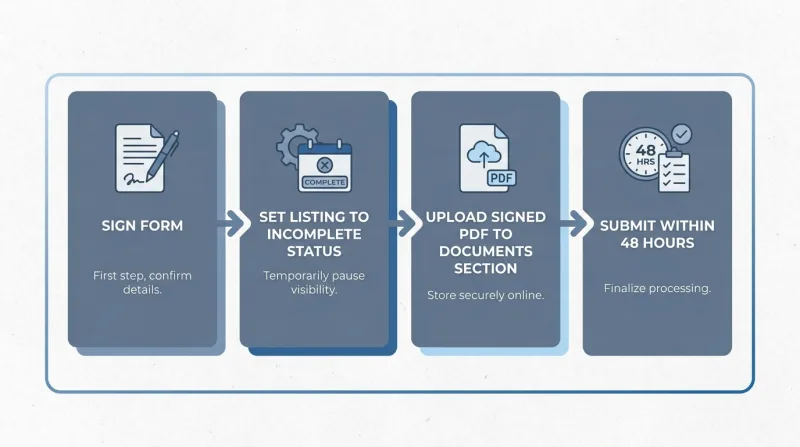
The general sequence a brokerage follows:
- The seller signs the listing agreement and the exempt form.
- The brokerage sets the listing to Incomplete (unpublished) status so it never syndicates.
- The signed form gets uploaded to the Documents or Media section inside RealTracs.
- All of it happens within 48 hours of the effective date.
Clock two — NAR's Clear Cooperation Policy (CCP). The moment a listing is publicly marketed, the broker has one business day to submit it to the MLS as an active listing available to all cooperating members. NAR authors this policy. RealTracs enforces it.
Here's where they collide. The 48-hour clock governs your paperwork. The one-business-day clock governs your marketing behavior. You can be perfectly compliant on the first and blow the second with a single Instagram post.
What counts as public marketing — and what doesn't
NAR's definition is broader than most sellers assume. A yard sign visible from the street, a public social media post, a listing on a public website, an email blast to a consumer list — any of those can start the one-business-day clock.
What generally doesn't trigger it: one-to-one communication and marketing kept strictly inside the listing brokerage. That's the entire logic of an office exclusive — the property can be shopped to that brokerage's own buyers without tripping CCP.
Exempt means quiet, and quiet means genuinely quiet. Break the 48-hour rule and you have a documentation problem. Break CCP and your broker faces the penalty — and the off-MLS strategy collapses into a mandatory Active listing anyway.
Confirm the current section number, form title, and exact hour count with your brokerage before relying on any of it.
Exempt Listing vs. the Comp-Only Form: Don't Confuse Them
There are two RealTracs forms that both sound like "keep it off the MLS," and mixing them up causes real problems.
The exempt form — the Sellers Instruction Not to Disseminate — is for a listing that's active but private. It sits in Incomplete status, it's genuinely for sale, and it's under a current listing agreement.
The Non-MLS Form records a sale that already happened — often an FSBO or off-market deal — into RealTracs For Comp Purposes Only, so it lands in comparable-sales data appraisers and agents rely on. That listing goes in as Closed status, because the sale is done.
- Exempt (Incomplete): active, private, still selling.
- Comp-only (Closed): already sold, entered only as a data point.
Where sellers trip up is searching "mls exempt form fsbo tn" when they actually want the comp-only path — or vice versa. If you sold your house yourself and just want the sale recorded for future comps, that's the Non-MLS comp-only form, not the exempt instruction.
Edge Cases the Boutique Blogs Never Mention
Dual agency inside an office exclusive
An office exclusive concentrates the buyer pool inside one brokerage. When the listing brokerage also produces the buyer, you're in a dual-agency situation, handled in Tennessee under TREC's designated agency framework. For a genuine privacy seller in Brentwood or Leiper's Fork, that concentration is acceptable — they've traded reach for discretion knowingly. For a seller who actually wants top dollar, it quietly caps competition. Fewer buyers means less bidding pressure, and the one broker holding both sides has an obvious interest in closing internally. The incentives just don't point toward your highest sale price.
The DOM advantage of price-testing
Because an exempt listing sits in Incomplete and never publishes, it accrues zero DOM. Flip it to Active later, and the DOM clock starts fresh. You can spend three quiet weeks off-market and still hit the portals with a clean "0 days on market." A Coming Soon or Hold entry doesn't give you that — those already started counting. So exempt isn't only for privacy diehards. It's the only RealTracs state that lets you test the water without aging your listing before it ever goes live.
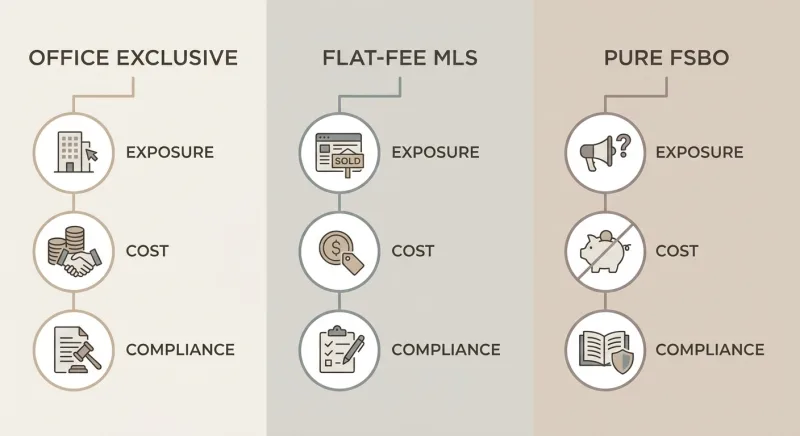
Exempt vs. Flat-Fee MLS vs. Pure FSBO: Compared
| Factor | Office Exclusive (Exempt) | Flat-Fee MLS | Pure FSBO |
|---|---|---|---|
| On RealTracs public MLS? | No — Incomplete status | Yes — full active listing | No |
| Syndicates to Zillow, Realtor.com, Homes.com? | No | Yes | No |
| Buyer-agent exposure | One brokerage's agents only | Every RealTracs member across Middle TN | None automatic |
| DOM accrues? | No while unpublished | Yes | N/A |
| CCP compliance risk | High if marketed publicly | None — already on MLS | N/A |
| Who files it | Member brokerage | Brokerage inputs your listing | You, everywhere, yourself |
| Typical cost | Full listing agreement + commission | Flat fee | Little to nothing |
| Best for | Genuine privacy, pre-market testing | Selling for real at low cost | Sellers with a buyer lined up |
Read the "buyer-agent exposure" row twice. That's where the money is. An office exclusive shows your home to one brokerage's agents. A RealTracs flat-fee listing shows it to every member agent working buyers across Nashville, Franklin, Brentwood, and Murfreesboro. One's a keyhole. The other's a front door.
Should a Tennessee FSBO or Flat-Fee Seller Go Exempt?
Run your situation through three questions, in order.
1. Is your primary goal privacy, or price? If the honest answer is price, off-MLS works against you by design. If it's genuine privacy — a public figure, an estate sale, a home you don't want photographed while you still live there — exempt earns its place.
2. Do you already have a buyer, or are you searching for one? If you have a buyer lined up — a neighbor, a relative, an off-market investor — an office exclusive is a clean, compliant way to paper that deal without touching syndication. If you're searching, you're choosing a smaller pond on purpose, and you should be able to say why.
3. Is exempt a strategy, or a stall? Price-testing for a defined window before launch is a strategy. "I'll list it quietly and see what happens" for months is a stall — and it usually ends with a stale internal listing and money left on the table.
Can an FSBO seller use an office exclusive in TN? Not directly. The exempt form is broker-administered — a member brokerage files it under a listing agreement, not you at your kitchen table. A true FSBO seeking maximum privacy and independence can't have both through the exempt path. You pick one.
For most people who tell us they want to sell, exempt is the wrong tool. It feels sophisticated. It quietly costs you buyers.
Frequently Asked Questions
What is the RealTracs exempt listing form called? Its official title is the Sellers Instruction Not to Disseminate Property Information Through RealTracs. Signing it tells RealTracs to keep your listing off public MLS syndication — Zillow, Realtor.com, Homes.com — while the property is still for sale through a member brokerage. Confirm the current form title with your brokerage.
How long does a broker have to file the exempt form? Under RealTracs Rule Section 2.32, the signed exemption must be uploaded to the listing's Documents section within 48 hours of the listing agreement's effective date. The listing is held in Incomplete status so it never syndicates. Miss the window and the listing shouldn't remain exempt.
Does an exempt listing avoid the Clear Cooperation Policy? Only until you publicly market it. Per NAR's Clear Cooperation Policy, once a listing is publicly marketed the broker has one business day to submit it to the MLS as an active listing. NAR authors this policy; RealTracs enforces it. A sign, a public post — either ends the exemption.
Can a Tennessee FSBO seller use an office exclusive? Not directly. The exempt form is broker-administered, so a pure FSBO with no brokerage relationship can't submit one. If you want to be on RealTracs at all, flat-fee MLS is the practical path.
Is an exempt listing the same as the comp-only form? No. An exempt listing is active but private (Incomplete status). The Non-MLS "For Comp Purposes Only" form records a deal that already sold (Closed status) so appraisers have the comp data. Different forms, opposite timing.
Bottom Line
The RealTracs exempt listing form — the Sellers Instruction Not to Disseminate — is a legitimate, broker-filed tool for keeping a Tennessee property off the public MLS. The mechanics are tight: signed and uploaded within 48 hours under Section 2.32, held in Incomplete status, and the moment marketing goes public, NAR's Clear Cooperation Policy gives you one business day to list it.
Going exempt means fewer eyes, less competition, and usually a softer price. That fits a narrow group — a Brentwood or Franklin owner protecting privacy, a seller price-testing before launch — and almost nobody else.
Decide whether your real goal is privacy or a sale. If it's privacy, ask your brokerage to confirm current RealTracs policy and file the form correctly, because the timing is where it bites. If it's a sale, flat-fee MLS puts you on RealTracs and out to Zillow, Realtor.com, and Homes.com for a flat cost, with full exposure and DOM working normally.
Rules change, so verify Section 2.32 and the CCP language with your brokerage before you sign anything. This is documented procedure, not legal advice. Quiet has its place. Just don't confuse it with sold.