
Tennessee Form RF201 Exemptions: When FSBO Sellers Can Legally Skip the Disclosure
Here's the short version. If your Tennessee sale qualifies for an exemption under Tenn. Code Ann. § 66-5-209, you don't fill out Form RF201 at all. You file Form RF203, the Property Condition Exemption Notification, instead. Same paperwork trigger — different form. That one distinction trips up more for-sale-by-owner sellers than any other part of the Tennessee Residential Property Disclosure Act.
The exemption isn't a blank space where the disclosure used to be. It's a document that tells the buyer why the standard disclosure doesn't apply.
A common mix-up: FSBO sellers assume "no agent means no disclosure." Not true. The Tennessee Residential Property Disclosure Act (Tenn. Code Ann. § 66-5-201 et seq.) applies to owners, not agents. Selling your own home doesn't exempt you. Your transaction type might.
We work with FSBO sellers every day on the documentation side of getting a home onto the Tennessee MLS, so we've watched this confusion play out repeatedly. This guide maps every statutory exemption to its subsection, walks the exact steps to claim one, flags the three-year landlord trap, and covers the crucial limit almost nobody mentions: exempt doesn't mean immune.
This is general information, not legal advice. We help sellers list on the Tennessee MLS — we're not attorneys. For a specific transfer, confirm your exemption with a Tennessee real estate lawyer.
What Form RF201 Actually Is
Form RF201 is the Residential Property Condition Disclosure published by Tennessee REALTORS®. It's the standard statement most sellers complete to tell buyers what they know about the home — the roof, the plumbing, past water intrusion, known material defects, that kind of thing.
The law behind it is Tenn. Code Ann. § 66-5-202. A key limit: you're disclosing what you have actual knowledge of. Under § 66-5-203, you have no duty to go hunting for hidden problems. The RF201 asks what you know, not what a home inspector might find.
Why do some sellers skip it entirely? Because the statute recognizes that certain transfers don't fit the ordinary owner-buyer situation. A sheriff selling a foreclosed home has no lived-in knowledge of its condition. An executor settling an estate never occupied the property. For those sellers, the legislature carved out exemptions — and gave them the RF203 as a substitute.
The RF201 is the default. The exemption is the exception.
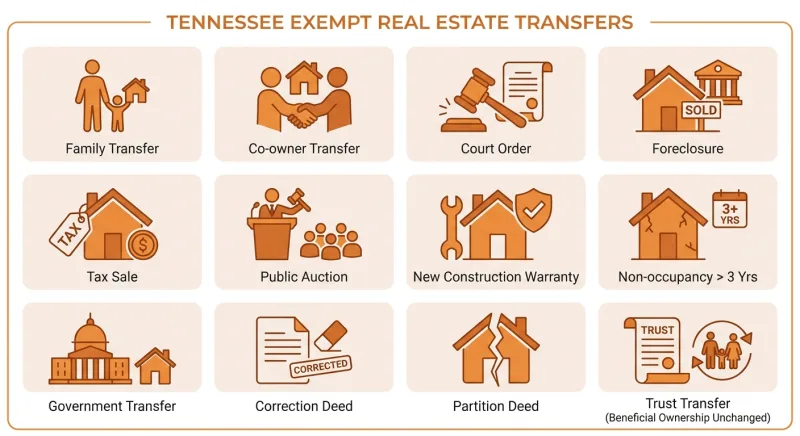
All Statutory RF201 Exemptions Under Tenn. Code Ann. § 66-5-209
Section 66-5-209 lists the transfers the disclosure requirement does not apply to. If your sale fits one of these categories, you file the exemption notification instead of the full disclosure. Read your row carefully — a near-match isn't a match.
| Exempt transfer | Plain-English scenario | Statutory pinpoint |
|---|---|---|
| Court-ordered transfer | Sale directed by a court (probate, divorce, partition) | § 66-5-209(1) |
| Transfer by mortgagee / foreclosure | Bank or lender selling after foreclosure or deed in lieu | § 66-5-209(2) |
| Transfer by fiduciary in estate administration | Executor, administrator, trustee, guardian, conservator | § 66-5-209(3) |
| Transfer between co-owners | Sale from one co-owner to another | § 66-5-209(4) |
| Transfer within family (lineal consanguinity) | Parent to child, grandparent to grandchild, etc. | § 66-5-209(5) |
| Transfer between spouses | Divorce, decree, or support settlement | § 66-5-209(6) |
| Transfer to/from government entity | Sale involving a public body | § 66-5-209(7) |
| New construction with written warranty | First sale of a dwelling never occupied, with builder's written warranty | § 66-5-209(8) |
| Transfer by tax sale | Sale for delinquent taxes | § 66-5-209(9) |
| Transfer by public auction | Sale at public auction | § 66-5-209(10) |
| Owner who never occupied within 3 years | Landlord/investor who didn't live there in the 3 years prior | § 66-5-209(11) |
Two of these deserve a closer look: the three-year landlord rule and the reality that being exempt from the form doesn't erase what you know.
How to Claim an Exemption: Filing Form RF203
You've confirmed your transfer fits a § 66-5-209 category. Now you claim it — in writing, delivered to the buyer before the deal is locked in.
- Identify your exemption. Match your transfer to a specific subsection and write it down.
- Complete Form RF203, the Property Condition Exemption Notification from Tennessee REALTORS®. This tells the buyer the disclosure requirement doesn't apply and why.
- Deliver it before the buyer's offer is accepted. Under Tenn. Code Ann. § 66-5-204, disclosure documents must reach the buyer before you accept a written offer. The exemption notification follows the same timing.
- Keep a signed copy with your transaction file.
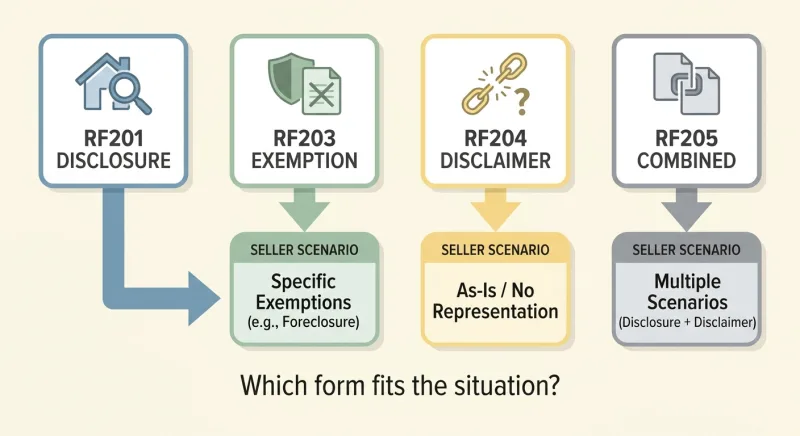
Sellers confuse the related forms constantly, so here's the map:
| Form | Real name | Who uses it |
|---|---|---|
| RF201 | Residential Property Condition Disclosure | The default. Non-exempt sellers disclosing known condition. |
| RF202 | Update / Amendment | A seller who gains new knowledge and must amend. |
| RF203 | Property Condition Exemption Notification | Sellers claiming a statutory exemption under § 66-5-209. |
| RF204 | Disclaimer | An "as-is" transfer where the buyer waives the disclosure by agreement. |
| RF205 | Combined form | Situations where disclosure and exemption/disclaimer language travel together. |
Form functions per the current Tennessee REALTORS® library; confirm exact titles and numbers against the latest version, since numbering gets revised.
One important point: an exemption and a disclaimer are not the same thing. An exemption (RF203) is a status the statute grants you — you qualify because of who you are or how the property transfers. A disclaimer (RF204) is something you negotiate — the buyer agrees to take the property without a condition disclosure. A seller who thinks "as-is means I'm exempt" has confused a legal status with a contract term.
The Three-Year Landlord Trap
This one catches investors off guard.
Under § 66-5-209(11), an owner who has not occupied the property within the three years before the transfer is exempt from the standard disclosure. Bought a rental, leased it out for years, never lived there yourself? You may qualify to file the RF203.
Here's the catch. The clock is about your occupancy — a hard line. If you lived in the home at any point inside that window (house-hacked it, stayed there during a vacancy, moved in while renovating between tenants) the exemption evaporates, and you're back to the standard RF201.
And "actual knowledge" doesn't disappear just because you moved out. A landlord who knows the basement floods every spring still holds that knowledge whether or not they qualify to skip the form. Count the three years carefully, and don't treat the exemption as a license to hide a known defect.
"Exempt" Does Not Mean "Immune"
Qualifying for a § 66-5-209 exemption removes your duty to complete the statutory disclosure form. It does not remove your exposure to common-law fraudulent concealment. You can be perfectly, legally exempt from RF201 and still lose in court if you actively hid a known material defect. Statutory remedies, including buyer rescission, live in Tenn. Code Ann. § 66-5-210.
Think of it as two separate machines. One is the statutory disclosure engine (RF201, RF202, RF203). The other runs on common law: fraud and concealment. Claiming an exemption switches off the first. The second keeps running no matter what form you file.
The distinction in practice:
- Not knowing a defect — you're generally protected.
- Knowing and concealing it — you're exposed, form or no form.
A foreclosing bank filing an RF203 genuinely may not know the home's history — that's the point of the exemption. But a landlord who knows about a chronic roof leak, and papers over it with an exemption notice, can face rescission or a damages claim. Exemption is a paperwork carve-out, not a liability shield.
The Executor Edge Case
Consider a probate sale. A fiduciary transferring under court authority typically qualifies under § 66-5-209 — the reasoning being that the executor never lived in the home and has no personal knowledge of its condition. Usually right. Not always.
If the executor is the deceased's adult child who grew up in the house and knew the basement floods every spring, the exemption on the form does not shield the concealment. Actual knowledge is personal, not positional. A fiduciary title doesn't erase what the human being behind it knows.
The Federal Lead-Paint Rule Doesn't Care About Your State Exemption
Every RF201 exemption under Tennessee law is a Tennessee exemption. It has zero effect on federal disclosure requirements. The big one: lead-based paint.
If your home was built before 1978, federal law — 42 U.S.C. § 4852d, implemented through 24 CFR Part 35 and 40 CFR Part 745 — requires you to disclose known lead-based paint hazards, provide the EPA "Protect Your Family From Lead in Your Home" pamphlet, and give buyers a 10-day inspection window. This applies even if you're exempt from the RF201.
A seller who inherits a 1955 Nashville bungalow, correctly files RF203, and skips the lead-paint disclosure too, assuming "exempt is exempt," has violated federal law while complying perfectly with state law.
The sequence for a pre-1978 exempt sale:
- Confirm your Tennessee exemption ground and file RF203.
- Separately complete the federal lead-based paint disclosure (Tennessee REALTORS® provides a form — it is not RF201).
- Deliver the EPA pamphlet.
- Offer the buyer the federally required inspection window.
Two systems. Two sets of paperwork. One transaction.
Disclosures Are Living Documents
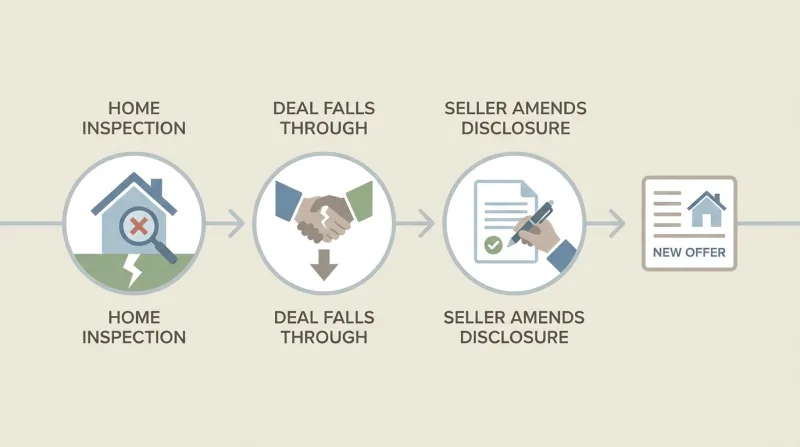
Most sellers treat the disclosure as a one-and-done form signed at listing. Under Tenn. Code Ann. § 66-5-205, it works more like a living document tied to your actual knowledge. When your knowledge changes, your obligation changes with it.
Real scenario: you list, complete the RF201, go under contract, and the buyer's inspection reveals a foundation crack you didn't know about. The deal falls through. You now know about the crack. Before the next offer, you amend your disclosure using Form RF202. Skip that step and you've moved from "didn't know" to "knew and stayed quiet."
What about an exempt seller who filed RF203? Technically there's no RF201 to amend and no statutory RF202 obligation. But the moment an inspection hands you actual knowledge of a serious latent defect, your risk profile changes even if your form status doesn't. The practical move: voluntarily disclose in writing what the inspection revealed before signing with the next buyer. It converts lawsuit exposure into a documented, defensible position.
The "Disclose Anyway" Decision
Being legally exempt and choosing to disclose aren't mutually exclusive. For many FSBO sellers, voluntary disclosure is the smarter play even when RF203 is available:
Do you have actual knowledge of any material or latent defect?
- No, genuinely none (you inherited a property you never occupied) → File RF203. A voluntary RF201 you can't complete honestly helps no one.
- Yes, minor and visible → Exemption is low-risk; RF203 is fine.
- Yes, material or latent → Consider disclosing voluntarily even though you're exempt.
Why disclose when the law lets you skip it? Because disclosure is the single strongest defense against a later concealment claim. A buyer who received written notice of the foundation crack cannot credibly argue you hid it.
These terms get used interchangeably, and they shouldn't. A material defect is any condition that would affect a reasonable buyer's decision or the property's value. A latent defect is the dangerous subset: material and hidden, not discoverable by ordinary inspection — intermittent basement seepage, a patched-over sinkhole, wiring behind a finished wall. Latent defects are where exempt sellers get sued.
Exempt Transfer vs. Still Required: A Reality Check
| Scenario | RF201/RF203 status | Concealment risk | Federal lead-paint (pre-1978) |
|---|---|---|---|
| Standard owner-occupied FSBO sale | RF201 required | — | Required |
| Inherited home, never occupied, no known defects | Exempt — file RF203 | Low | Required |
| Family transfer (parent → child) | Exempt — file RF203 | Low–moderate (depends on knowledge) | Required |
| Foreclosure / lender REO sale | Exempt — file RF203 | Low | Required |
| Court-ordered / probate sale | Exempt — file RF203 | Varies by executor's knowledge | Required |
| Landlord who occupied within past 3 years | NOT exempt — RF201 required | High if defects concealed | Required |
| New construction, written warranty, never occupied | Exempt — file RF203 | Low | N/A (post-1978) |
| Owner-occupied, sold "as-is" by agreement | RF201 still applies | — | Required |
| Exempt seller who knows of a latent defect | Exempt on form — RF203 valid | High — disclose anyway | Required |
Read the pattern: the form-status column and the risk column are not the same column. Exemption lives on the left. Liability lives in the middle. Federal duty sits on the right, indifferent to both.
Where This Leaves You
None of this is meant to talk you out of an exemption you legitimately have. Plenty of Tennessee FSBO transfers — family, estate, court-ordered, foreclosure, qualifying non-occupancy — are cleanly exempt, and RF203 is the right, simple move.
The point is precision. File the correct form. Honor the duties that survive the exemption. Amend when your knowledge changes.
Once your disclosures are handled correctly, the next step is getting the property in front of buyers. You can list FSBO on the Tennessee MLS for a flat fee and stay in control of your sale. Get the paperwork right first. The listing part is the easy half.
Frequently Asked Questions
Do exempt FSBO sellers fill out Form RF201 in Tennessee?
No. Exempt Tennessee sellers file Form RF203, the Property Condition Exemption Notification, to document that the transfer falls under one of the exemptions in Tenn. Code Ann. § 66-5-209.
When is a property condition disclosure not required in Tennessee?
When your sale matches a statutory exemption in § 66-5-209 — transfers between close family members, court-ordered sales, foreclosures, tax sales, transfers by a co-owner, public auctions, and first sales of new construction under written warranty, among others. In those cases you provide Form RF203 instead of the standard disclosure.
Does being exempt from the RF201 protect me from a lawsuit?
No. "Exempt" is not "immune." Even with a valid exemption, a seller who actively conceals a known material defect can face fraudulent-concealment liability and buyer rescission under Tennessee common law and § 66-5-210.
Am I still required to disclose lead-based paint if my sale is exempt?
Yes. The lead-based paint disclosure is a separate federal requirement under 42 U.S.C. § 4852d. It applies to most homes built before 1978 regardless of your state-law exemption, so an RF203 does not cancel it.
Can a landlord who hasn't lived in the property skip the disclosure?
Sometimes. Section 66-5-209 exempts a seller who has not occupied the property within three years before the sale. But the timing threshold is exact — an owner who occupied it too recently does not qualify.
Can I change my disclosure after a buyer's inspection finds a problem?
Yes. Under § 66-5-205, the disclosure is treated as a living document. If you gain actual knowledge of a new defect before closing, you amend it using Form RF202 rather than staying silent.
This is general information for Tennessee FSBO sellers, not legal advice. Form numbers and statutory subsections are periodically revised — confirm the current Tennessee REALTORS® form library and the current text of Tenn. Code Ann. § 66-5-201 et seq. before relying on any specific exemption. When your situation is close to the line, a Tennessee real estate attorney is worth the hour.