
Tennessee Form RF201 Instructions: A Field-by-Field FSBO Guide to the Residential Property Disclosure
Selling your house yourself in Tennessee means you're the one filling out the disclosure form. No agent hands it to you pre-explained. That's Form RF201 — the Tennessee Residential Property Condition Disclosure — and getting it wrong is one of the few paperwork mistakes that can follow you after closing.
This guide walks the form top to bottom, field by field. We'll cover whether you're required to use it, how to get a legal copy, and how to answer the parts sellers trip on most. Everything is anchored to Tennessee statute.
Short version: you disclose what you know, in good faith, before you accept an offer.
Is Form RF201 Required for a FSBO Sale in Tennessee?
Yes. If you're selling residential property of one to four dwelling units in Tennessee, you must give the buyer a written property condition disclosure — whether or not you use an agent (T.C.A. § 66-5-201). For sale by owner doesn't exempt you. The law targets the transaction, not the presence of a licensee.
The requirement lives in Tennessee's Residential Property Disclosure Act (T.C.A. §§ 66-5-201 through 66-5-213). Form RF201, published by Tennessee REALTORS®, is the standard document most sellers use. But the obligation comes from statute, not from the form.
A short list of sales is exempt (T.C.A. § 66-5-209): transfers by court order, foreclosure sales, transfers between co-owners, and certain transfers to a spouse or direct relative. Most ordinary FSBO home sales are not exempt. If you're unsure whether your transfer qualifies, that's a genuine attorney question.
How to Get a Legal, Up-to-Date RF201
The RF201 form is copyrighted by Tennessee REALTORS®. You can't grab a random PDF off the internet and trust it's current. Three legitimate paths exist.
1. The statutory-format disclosure (free, fully legal). Tennessee law spells out the required disclosure content (T.C.A. § 66-5-210). You're entitled to make your disclosure in that statutory format rather than on the association's branded PDF. Almost nobody tells FSBO sellers this, and it's the cleanest free route.
2. A flat-fee MLS listing packet. When you list flat-fee to get on the MLS, compliant disclosure paperwork typically comes bundled — legitimately licensed, current version, ready to complete. For most FSBO sellers this is the least-friction way to get both a legal form and MLS exposure without hiring a full-service agent.
3. A Tennessee real estate attorney. Worth it when your property has complications — easements, prior structural repairs, or an estate or divorce transfer.
The most common mistake: sellers download an outdated or out-of-state form and assume it's fine. Form revisions happen. Use a current source.
Before You Fill Anything Out: Documents, Timing, and Good Faith
The disclosure is a good faith statement of the property's condition based on your actual knowledge (T.C.A. § 66-5-202(a)). You're reporting what you know — not guaranteeing the house is perfect.
Gather these before you start:
- Past home inspection reports
- Repair invoices — roof, HVAC, foundation, plumbing, electrical
- Permits, especially for a subsurface sewage disposal (septic) system
- Warranty documents for systems and appliances
Timing is non-negotiable. RF201 must be delivered to the buyer before you accept their offer — not at closing (T.C.A. § 66-5-203). If a signed disclosure shows up after the purchase agreement is executed, the buyer may have rescission rights. Deliver it up front, get it acknowledged, keep the signed copy.
Step 1: The Header and General Property Information
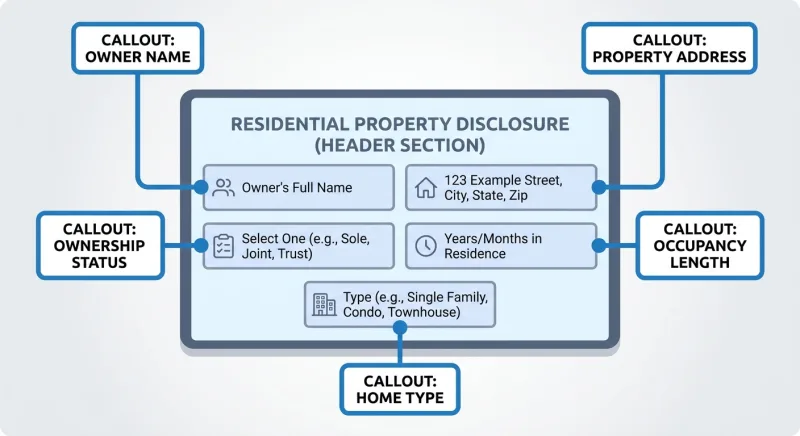
- Property address — full legal street address
- Seller name(s) — every person on title, matched to the deed exactly
- Date — the date you're actually completing the disclosure
If the house is owned by an estate or a seller who never occupied it, the statute accounts for limited knowledge — but you can't check boxes about systems you've never used and pretend certainty.
Section A: Appliances, Systems, and Services
Section A covers working components — appliances, heating, cooling, plumbing, electrical, water source, and sewer type. For each line you indicate whether the item is present and whether you're aware of a material defect — a problem a reasonable buyer would consider important to value or safety.
A furnace that cycles off unexpectedly, an electrical panel a prior inspector flagged, a water heater that leaks — those are the high-liability lines. Disclose them. If you've had a system repaired, note it. Concealing a known defect is exactly what the statute is built to prevent.
Section B: Structural Conditions and Known Defects
Section B covers foundation, roof, basement or crawl space, walls, ceilings, floors, windows, doors, and prior damage from water, fire, or wind. Slow down here — structure, water, and moisture drive most post-sale disputes.
Water is the one sellers most want to soft-pedal, and the one you most need to be straight about. If your basement has ever taken on water, disclose it — even if you fixed it. A prior repair doesn't erase your knowledge.
Tennessee specifically flags foundations that have been moved or repaired, sinkhole activity, and percolation test results (T.C.A. § 66-5-212). If any of that applies, it belongs on the form. Latent defects — hidden problems a buyer's walkthrough wouldn't catch — are exactly what disclosure exists to surface.
Section C: Environmental, HOA/PUD, and Site Conditions
Section C covers environmental hazards (asbestos, mold, radon, contaminated soil), subsurface sewage disposal, HOA/PUD membership and dues, boundary and easement issues, and flooding or drainage problems.
The septic marketing overlay
If your property runs on a septic system, two statutes stack. RF201 asks about the sewage disposal method. Separately, the Tennessee Consumer Protection Act limits how you market bedroom count relative to septic capacity (T.C.A. § 47-18-104(b)) — you can't advertise a four-bedroom house when the subsurface sewage disposal permit only supports three. Get the permit and read the number off it. If your disclosure, listing, and permit don't align, do a TDEC permit check before you go live.
Impact fees and adequate-facilities taxes
The statute contemplates disclosure of known impact fee or adequate-facilities tax obligations that run with the land (T.C.A. § 66-5-211). In fast-growing counties around Nashville, Franklin, and Murfreesboro, these can be significant. Surface them here rather than let the buyer find out after closing.
Note that lead-based paint is a separate federal disclosure for homes built before 1978 (42 U.S.C. § 4852d). RF201 is not a substitute — you provide both.
The Actual-Knowledge Standard: What You're Really Certifying
Every checkbox points back to one legal test: your actual knowledge at the time you sign (T.C.A. § 66-5-202). Tennessee runs a modified caveat emptor system. You owe the buyer honest answers about conditions you actually know about. You do not owe them the results of an inspection you never ordered, and you're not on the hook for defects hiding behind a wall you've never opened.
There's no duty to investigate before filling out RF201. If you genuinely don't know whether the 1962 supply lines are galvanized or copper, "Unknown" is the correct, defensible answer.
The liability is almost entirely about concealment and misrepresentation. You get sued when you knew a thing and checked "No," or when you actively hid it.
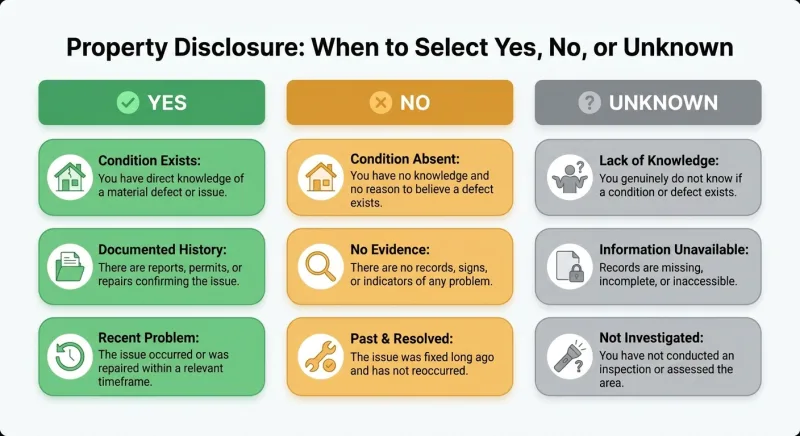
Yes vs. No vs. Unknown
| Your answer | Choose it when | Liability level |
|---|---|---|
| Yes (defect exists) | You know a problem exists or existed | Fully protects you — disclosing is never the risk |
| No (no defect) | You know the item is fine | Only safe if it's genuinely true to your knowledge |
| Unknown | You honestly have no knowledge either way | Protected safe harbor when genuine |
"Unknown" only protects you when it's true. Checking Unknown on the basement water question after you've personally mopped it out twice is concealment. Never check No to make the house look better — a false "No" on a known defect is the single most dangerous thing you can do on this form.
Latent vs. patent defects
A patent defect is visible on a normal walkthrough: the cracked driveway, the stained ceiling tile. Caveat emptor largely covers these.
A latent defect is what hurts you if you stay quiet — hidden, material, and known to you. The crawlspace leak you manage with a sump pump. The foundation crack you had epoxied and re-covered. Ask yourself: is this something the buyer couldn't reasonably see, that I already know about? If yes, disclose it and add a written comment.
Timing, Signatures, and Amendments
Every seller on title signs and dates the disclosure. The buyer acknowledges receipt — keep the signed copy as proof of timely delivery.
Delivery timing: before the buyer accepts, before the purchase agreement is signed (T.C.A. § 66-5-203). On a FSBO deal where you're juggling showings and offers yourself, the mistake we see most often is a signed contract exchanged before the disclosure was actually in the buyer's hands.
Disclosure first, offer second. Build it into your listing so RF201 goes out with the property packet from day one.
Amending after new knowledge. If something changes before closing — a storm cracks the foundation, the HVAC dies during inspection — you have a duty to update the buyer. Issue a written amendment, date it, deliver it, and keep the delivery proof.
Why "As-Is" Doesn't Do What Most Sellers Think
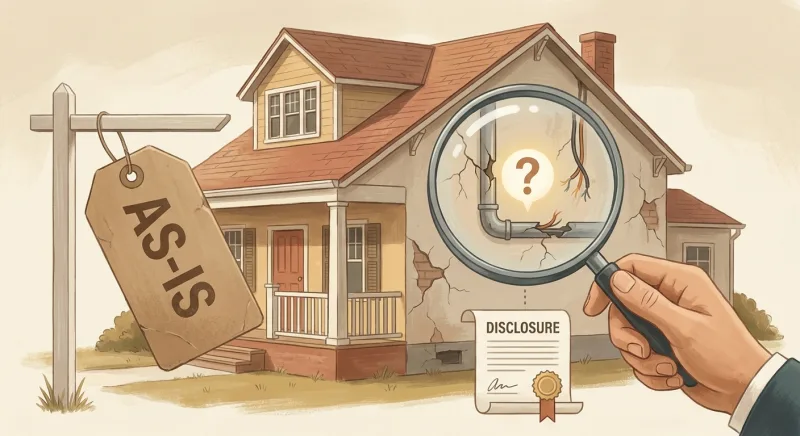
Selling "as-is" does not delete your duty to complete RF201. It means you won't pay to fix things — it says nothing about your obligation to disclose what you know.
Your disclosure duty survives an as-is sale unless the buyer signs a written waiver — Form RF204 — accepting the property with no disclosure statement (T.C.A. § 66-5-202(b)). No signed waiver, no waived disclosure.
| What you're doing | Which lever | Governing statute |
|---|---|---|
| "I won't fix anything" | As-is sale clause | Contract term, not a disclosure waiver |
| "Buyer accepts with no disclosure" | RF204 waiver, signed by buyer | § 66-5-202(b) |
| "Here's everything I know" | RF201 disclosure statement | § 66-5-201 |
Most buyers won't sign a waiver — it signals you're hiding something. Completing an honest RF201 is usually the stronger FSBO position: it builds trust and shrinks post-closing liability simultaneously.
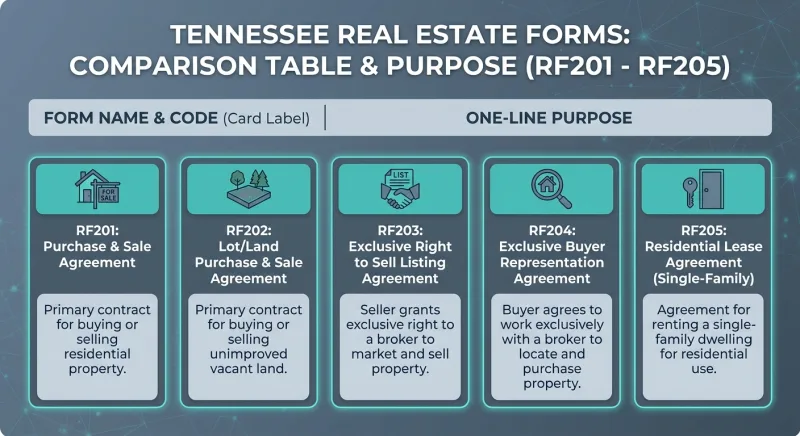
The RF-Series Ecosystem: RF201 Is One of Five
| Form | What it's for | When a FSBO seller reaches for it |
|---|---|---|
| RF201 | Residential Property Condition Disclosure | Default for nearly every FSBO sale of 1–4 units (§ 66-5-201) |
| RF202 | Disclaimer of property condition | Statutorily exempt transfers — estate, foreclosure, certain new-construction first sales (§ 66-5-209) |
| RF203 | Amended disclosure | When something you disclosed changes before closing |
| RF204 | Waiver of property condition disclosure | Buyer voluntarily signs away disclosure (§ 66-5-202(b)) — rare |
| RF205 | Owner's disclosure of no representation | Alongside disclaimer situations |
Section numbers reflect current Title 66, Chapter 5, Part 2. Verify against the official Tennessee Code.
Ninety-plus percent of standard FSBO sellers use RF201 only. But if you're an executor selling an estate property, forcing yourself through a full RF201 you can't honestly complete may be the wrong move — get an attorney's read.
When to Stop and Call a Tennessee Attorney
Get counsel before you sign if: there's a disputed or unrecorded easement; a defect is arguably material but you can't characterize it; the sale is an estate, trust, or foreclosure transfer (§ 66-5-209 gets technical); a prior buyer backed out over a condition issue; or you're weighing an RF204 waiver. A brief attorney consultation prevents a five-figure rescission claim.
Frequently Asked Questions
Is Form RF201 required if I sell my house myself in Tennessee?
Yes. Tennessee's disclosure law applies to sellers of one to four residential units regardless of whether an agent is involved (T.C.A. § 66-5-201). RF201 is the standard form that satisfies this duty, though the statutory format under § 66-5-210 is also legal.
Can I legally check the "Unknown" box on RF201?
Yes, if you genuinely have no actual knowledge of the item's condition. Tennessee's standard is based on what the seller actually knows, not on an inspection you never did (T.C.A. § 66-5-202). Never use "Unknown" to hide something you're aware of.
Does selling "as-is" waive the RF201 disclosure requirement?
No. Selling as-is limits repair obligations but does not eliminate your duty to disclose known defects unless the buyer signs a valid written waiver, Form RF204 (T.C.A. § 66-5-202(b)).
When must I give the buyer the RF201 disclosure?
Before the buyer's offer is accepted, not at closing (T.C.A. § 66-5-203). Delivering it after a contract is signed exposes you to a possible rescission right.
Where can I get a legal, up-to-date RF201 PDF?
The form is copyrighted by Tennessee REALTORS®. Obtain it through a flat-fee MLS listing packet, a Tennessee real estate attorney, or a broker. Alternatively, use the free statutory-format disclosure permitted under T.C.A. § 66-5-210.
What happens if I forget to disclose a known defect?
Failing to disclose a material defect you actually knew about can expose you to buyer claims for damages or rescission (T.C.A. § 66-5-208). Honest, good-faith completion is your best protection.
Conclusion
RF201 is the document standing between you and a post-closing dispute, and the law gives you a clear standard: disclose what you actually know, in good faith, before the buyer's offer is accepted (T.C.A. §§ 66-5-201, 66-5-202, 66-5-203).
Walk the form in order — Section A appliances and systems, Section B structural items, Section C environmental and site conditions. When something's genuinely outside your knowledge, "Unknown" is legitimate. When you know about a leak, a prior foundation repair, or a septic quirk, write it down. Sign, date, deliver on time, keep a copy.
If your situation involves disputed easements, an estate or foreclosure sale, or a defect you're unsure how to characterize, spend an hour with a Tennessee real estate attorney first. One document, done honestly, keeps you in control of your own sale.
This article is educational and not legal advice. Tennessee statutes and Tennessee REALTORS® forms are amended periodically; confirm current section numbers and form versions against the official Tennessee Code and Tennessee REALTORS® form catalog. For disputed defects, easements, or estate and foreclosure sales, consult a licensed Tennessee real estate attorney.
Sources
- Tennessee Code Annotated, Title 66, Chapter 5, Part 2 — Residential Property Disclosures (§§ 66-5-201 through 66-5-213)
- T.C.A. § 66-5-202 — Disclosure statement; actual knowledge; as-is waiver at subsection (b)
- T.C.A. § 66-5-203 — Timing and delivery before acceptance
- T.C.A. § 66-5-208 — Remedies for failure to disclose
- T.C.A. § 66-5-209 — Exemptions
- T.C.A. § 66-5-210 — Statutory disclosure format
- T.C.A. § 66-5-211 — Impact fees / adequate-facilities taxes disclosure
- T.C.A. § 66-5-212 — Sinkhole, foundation, percolation conditions
- T.C.A. § 47-18-104(b) — Consumer protection: bedroom/septic capacity marketing
- 42 U.S.C. § 4852d and EPA/HUD lead-based paint disclosure rule (24 CFR 35 / 40 CFR 745)
- Tennessee REALTORS® — form catalog and copyright (RF201–RF205)