
TN FSBO & Buyer-Agent Commission After the NAR Settlement: The 50-Word Answer
In Tennessee, FSBO sellers no longer owe a buyer's agent any set commission. Under the NAR settlement effective August 17, 2024, offers of buyer-agent compensation can't appear in MLS fields. You choose what to offer (0%, 1.5%, 2.5%, or a flat dollar amount), negotiated deal by deal.
That's the short version. The longer version is where the money is.
Most stale guides still say you "have to" offer 3% to the buyer's agent. That rule is gone. The number you offer is a choice, not a default. This tennessee fsbo buyer agent commission playbook walks you through how to set that number, which TN forms control it, and how to keep it from eating into your closing-cost concessions.
What Changed: Post-NAR Settlement Commission Rules in TN (2026 Baseline)
Three things shifted on August 17, 2024, and they still define the 2026 baseline:
- No commission offers in the MLS. You cannot list a buyer-agent fee in any RealTracs, MAAR, or NETAR compensation field. Compensation now lives outside the MLS entirely.
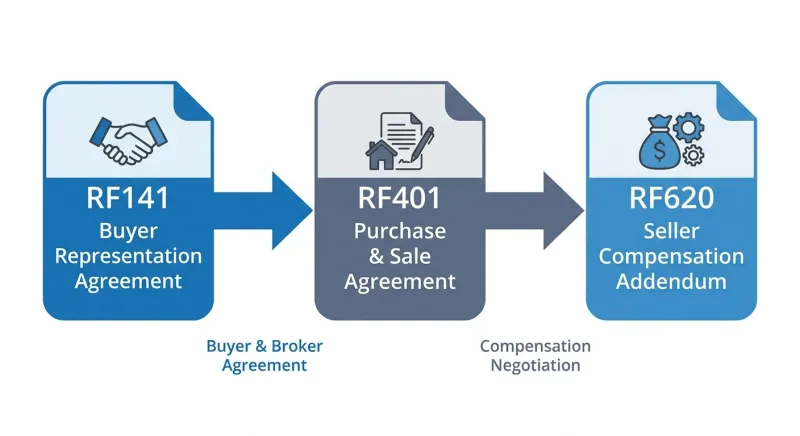
- Buyers must sign a written agreement before touring. Any agent working with a buyer needs a signed buyer-broker agreement before showing a home. In Tennessee, that's usually Form RF141. It moves the fee conversation into writing, upfront, where you can see it.
- Buyer-agent pay is now openly negotiable. The fee is set between the buyer and their own agent first. Whether you contribute is a separate, voluntary decision.
None of this changed Tennessee law on who can sell a home. FSBO is legal here, same as always. What changed is the leverage. The "you must offer 3%" assumption lost its structural support the moment it left the MLS.
Think of it as shown vs. sold. A buyer-agent commission buys showings and sometimes a faster offer. It does not buy you a legal closing. Conflating those two is what costs FSBO sellers thousands.
The TN Forms That Control the Negotiation: RF141, RF401 & RF620
Verbal promises don't close houses in Tennessee. Forms do.
| Form | Name | Who it binds | Role in your negotiation |
|---|---|---|---|
| RF141 | Exclusive Buyer Representation Agreement | Buyer ↔ buyer's agent | Sets what the buyer's side expects to be paid. This is the demand you're countering, not an obligation you signed. |
| RF401 | Purchase & Sale Agreement | Buyer ↔ seller | The main contract. Price, closing-cost credits, and terms land here. |
| RF620 | Seller Compensation Addendum | Seller ↔ cooperating broker | Where the actual cooperating-broker figure gets set, in writing, if you choose to offer one. |
A buyer signs RF141 with their agent. That agreement often says the buyer owes, say, 2.5%, and that the agent will try to collect it from the seller first. That's the source of the "the seller pays my commission" pressure you'll feel.
The offer arrives on RF401. Inside it, you'll see a request: either a closing-cost credit, or a request that you sign RF620 to pay the buyer's broker directly.
RF141 does not bind you. It's an agreement between the buyer and their agent. The only document that obligates you to pay a buyer's broker is one you sign yourself, usually RF620.
Watch for the shortfall clause (commonly Paragraph E in buyer-broker paperwork). It says: if the seller doesn't cover the full fee the buyer agreed to, the buyer makes up the difference. That clause is your friend. It means an offer of less than the buyer's agreed rate doesn't kill the deal—it just shifts who covers the gap.
Why this changes your counter
Say you're listing a $435,000 home in Spring Hill and the buyer's RF141 says 3%. You don't negotiate against 3%. You negotiate against your number—say 2%—and let the shortfall clause do the rest. The buyer either absorbs the 1%, asks their agent to reduce, or walks. None of those outcomes require you to cave.
Confirm the live form language before you sign anything; Tennessee REALTORS® revises these forms, and paragraph lettering can shift between versions.
The Double-Bucket Rule: Why Paying a Buyer's Agent Won't Blow Your Concession Cap
The fear: "If I pay the buyer's agent, won't that use up the closing-cost credit my buyer needs to qualify?"
Under current underwriting guidance: no. They sit in two separate buckets.
Bucket one is interested-party contributions (IPC), also called seller concessions: credits toward the buyer's closing costs, prepaids, and rate buydowns. On most conventional loans, Fannie Mae's Selling Guide sets IPC limits that scale with down payment (commonly 3%–9%). FHA caps seller concessions at 6%. VA allows up to 4% in seller concessions on top of normal closing costs.
Bucket two is seller-paid buyer-broker compensation. Per Fannie Mae's Selling Guide, seller-paid buyer-agent compensation is treated separately from interested-party contributions and generally does not count against the IPC cap. Freddie Mac, FHA (Handbook 4000.1), and the VA Lenders Handbook have each issued aligned guidance treating reasonable, customary buyer-agent fees as outside the concession cap.
What that means: offering 2% to a buyer's agent on RF620 does not shrink the closing-cost credit you can give under RF401. Two buckets, two separate limits. On a financed deal, that flexibility can be the difference between an accepted offer and a dead one.
One hard caveat: underwriting guidance can shift, and lenders interpret it differently. Confirm the treatment with the buyer's lender and underwriter in writing before you sign RF620. If a loan officer says the fee counts against the IPC cap, ask them to cite their investor overlay—many overlays run stricter than agency baseline.
The Decision Matrix: 0% vs 1.5% vs 2.5% on a $435,000 TN Home
Vague ranges don't help you at the closing table. Dollars do.
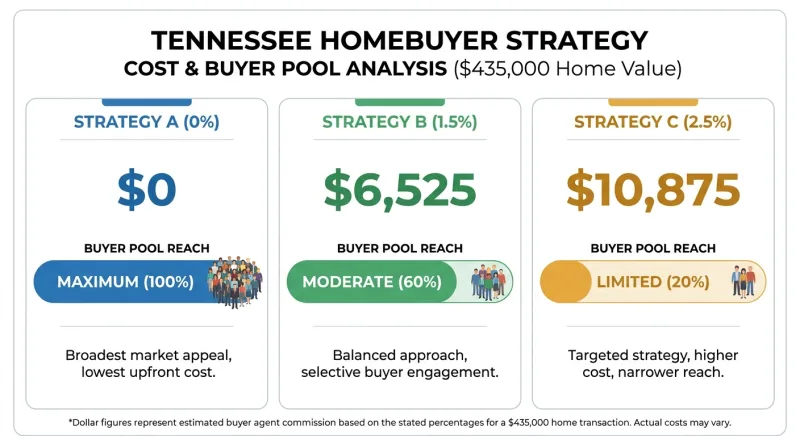
| Strategy | What you offer | Cost on $435K | Your net vs. 2.5% | Buyer pool / showing effect |
|---|---|---|---|---|
| A — Zero | 0% | $0 | +$10,875 | Smallest agent-driven pool. Best in hot submarkets, cash/unrepresented buyers, or when priced sharp. |
| B — Split the difference | 1.5% | ~$6,525 | +$4,350 | Solid middle. Signals cooperation without matching old defaults. Keeps most agents willing to show. |
| C — Match the old norm | 2.5% | ~$10,875 | baseline | Widest pool. Removes the fee as any objection. Highest cost, lowest net. |
The spread between offering nothing and matching the old norm is about $10,875 on this home. Strategy B is where many smart FSBO sellers land. You offer 1.5%, the buyer's RF141 says 2.5%, and the shortfall clause quietly covers the 1% gap on the buyer's side. You keep roughly $4,350 while most buyer agents still bring their clients through.
The honest tension: $0 can reduce showings in some areas. In a slower Clarksville or rural submarket where most buyers come with agents, zero may stretch your days on market. In a tight Nashville or Franklin price band with hungry buyers, zero may cost you nothing.
Start at Strategy A or B, test showing response for two weeks, and raise only if the market tells you to. You can always offer more; you can't claw back a promise. And note: 2.5% on an $850K Brentwood listing is over $21,000—run your own net sheet before committing.
Edge Cases the National Guides Skip
The unrepresented buyer. No buyer agent means no buyer-agent commission. Offer nothing on the buy side and redirect part of the savings into a closing-cost credit the buyer actually feels. A $6,000 credit often closes faster than a 2.5% cooperating fee and keeps the whole amount inside your net-proceeds math.
The dual-licensed buyer buying for themselves. Treat any commission request as a price reduction. Put it in the RF401 as a price adjustment, not an RF620 compensation figure, so your net sheet and the appraisal read cleanly.
The relocation or corporate buyer. Relo buyers often arrive with a referral-fee obligation baked into their representation. That fee doesn't come out of your pocket unless you agree to it in writing. Don't let a relo coordinator frame their internal referral cut as your cost.
The VA buyer and the buyer-broker fee. Under current VA guidance, a VA buyer may pay buyer-broker charges in certain conditions—but confirm with the buyer's lender before you build your counter around it. This rule changes.
Copy-Paste Negotiation Scripts: Countering an RF141 Commission Demand
Acknowledge, don't concede.
"Thanks for the offer. I'm handling buyer-agent compensation through a Seller Compensation Addendum (RF620) rather than any blanket percentage. I'm prepared to offer [1.5%] to your client's agent, documented at closing."
The zero-commission counter.
"At this price, I'm not offering buyer-side compensation. Your client is welcome to roll your agreed fee into their offer, and we can discuss a closing-cost credit within their loan's concession limits."
The shortfall redirect.
"I understand your agreement with your buyer is for 3%. The difference between that and my offer is between you and your client under your representation agreement. My offer on RF620 stands at [1.5%]."
Never attack the agent—point to the paper they signed with their buyer. Keep every counter in writing; verbal commission promises create disputes and potential liability.
A Decision Framework for Setting Your Number
Stop asking "what's normal." Ask "what does my listing need to sell at my target net?" Three inputs drive the answer:
Days-on-market pressure. A move-in-ready home in a hot Williamson County pocket can sell on a $0 or 1% buyer-side offer. A dated home in a slower submarket may need 2.5% to buy agent attention.
Buyer-pool composition. Entry-price homes draw more financed, agent-represented buyers. Higher-price and cash-heavy segments carry more unrepresented buyers, which means a lower offer costs fewer showings.
Your net-proceeds floor. Work backward from the number you must clear, not forward from a percentage.
Then: set your minimum acceptable net → start your buyer-side offer at the floor your submarket tolerates (often 0–1.5%) → hold the difference between your floor and 2.5% as a reserve you concede selectively, buyer by buyer, through RF620 rather than broadcasting it up front → favor concessions buyers can feel (rate buydowns, closing-cost credits), which often move offers more per dollar than flat commission.
The seller who publishes 2.5% to everyone has spent the lever before the negotiation starts. The seller who holds a reserve negotiates from strength on every offer.
City-by-City: Buyer-Agent Commission Norms Across TN MLSs
| Region / cities | MLS | What buyers' agents typically expect in 2026 |
|---|---|---|
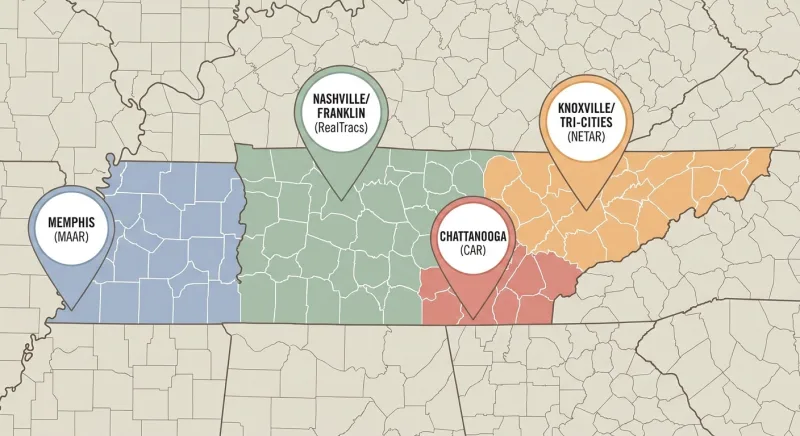
| Nashville, Franklin, Brentwood, Murfreesboro, Clarksville | RealTracs | Higher-price Middle TN often still sees 2–2.5% expected; sharp-priced Nashville listings move at less. |
| Memphis & West TN | MAAR | More price-sensitive; 1.5–2.5% common, with room to go lower in strong-demand pockets. |
| Knoxville & Tri-Cities | NETAR | Agent-represented buyers dominate; competitive pricing matters more here than in Nashville. |
| Chattanooga & Southeast TN | CAR / Greater Chattanooga MLS | Mid-range expectations; test low first, adjust to showing response. |
Franklin and Brentwood sit above the statewide median, so a 1.5% offer is still real money and often enough. Memphis and Clarksville run below median—the percentage norm may hold but the dollar cost is smaller, giving you room to be generous without denting net proceeds.
Your house needs to be on RealTracs, MAAR, or NETAR for agents to find it. A flat-fee MLS listing puts you there. Once you're visible, the commission you offer is a dial you control—region by region, deal by deal.
Where Flat-Fee Listing Fits the Play
A full-service listing agreement hands the compensation conversation to someone whose own commission is tangled in the buy-side number. A flat-fee MLS listing ($99–$399) gives you full RealTracs, MAAR, or NETAR exposure while you keep 100% of the buy-side decision: the reserve, the RF620 figure, the concession-versus-commission trade—all of it. You get MLS reach that drives showings, and you keep every lever on the side of the table where real money is decided.
Frequently Asked Questions
Do Tennessee FSBO sellers have to pay the buyer's agent commission in 2026?
No. Under the NAR settlement that took effect August 17, 2024, seller-paid buyer-agent compensation is a voluntary choice, not a requirement. You can offer 0%, a flat dollar amount, or a percentage. The buyer can also pay their own agent directly.
Where does buyer-agent compensation get documented if it can't appear in the MLS?
In Tennessee, the figure gets negotiated into the contract, typically through Tennessee REALTORS® Form RF620 (Seller Compensation Addendum) attached to the RF401 Purchase and Sale Agreement, so the amount is set deal by deal.
Does paying a buyer's agent count against my buyer's seller-concession cap?
Generally no, under current underwriting guidance. Per Fannie Mae's Selling Guide, seller-paid buyer-broker compensation is treated separately from interested-party contributions and usually doesn't eat the 3%–6% IPC limit. Confirm with your buyer's lender, as this guidance can change.
Will offering 0% to buyer agents stop people from seeing my home?
Not from the MLS. Your listing still appears on RealTracs, MAAR, or NETAR regardless. The honest tradeoff: in some TN markets, a $0 offer can thin agent-shown traffic, so many sellers offer 1.5%–2.5% to keep showings steady.
How much does it cost to list on the MLS as a Tennessee FSBO?
Flat-fee MLS listing in Tennessee typically runs $99–$399 depending on the package. You pay once for full MLS exposure and keep 100% control over what, if anything, you offer a buyer's agent.
Conclusion
The number you offer a buyer's agent is now a choice, not a default. That shift hands Tennessee FSBO sellers a lever they never fully controlled. Use it deliberately.
Start with the math, not the myth. Run your own net sheet against the figure a buyer's agent requests, then put your decision in writing where it actually binds: the RF620 addendum attached to the RF401, not a handshake and not an MLS field that no longer exists.
Two guardrails: confirm the concession buckets with your buyer's lender before signing, and verify current TN REALTORS® form numbers at signing since forms get revised.
Full MLS exposure doesn't require surrendering the commission conversation. A flat-fee listing puts your home in front of every RealTracs, MAAR, or NETAR agent while you keep the buy-side decision in your hands. Price it right, document the terms cleanly, and treat buyer-agent pay as a marketing budget you manage—not a tax you owe.