

Using Seller Concessions to Cover Buyer Agent Fees in 2026 (Tennessee Playbook)

Using seller concessions to cover buyer agent commission in Tennessee is one of the most common questions we hear from FSBO and flat-fee sellers — and the answer changed when NAR settlement rules took effect on August 17, 2024. Buyer-broker compensation no longer lives in an MLS field. It lives in your contract, drafted alongside the Tennessee REALTORS® Purchase and Sale Agreement (Form RF401) and, where compensation is involved, a compensation addendum.
Short version: yes, a Tennessee seller can agree to cover the buyer's agent fee. But how you do it decides whether it counts against your buyer's loan limits, whether it survives underwriting, and how much lands in your pocket at closing.
Below: the "double bucket" rule, exact contract mechanics, worked dollar-math on a $450,000 Nashville home, and a compliant way to advertise your offer without a full listing commission.
Can a Seller Cover the Buyer's Agent Commission in Tennessee?
Yes. The NAR settlement removed compensation offers from RealTracs and other Tennessee MLS fields, but it never barred sellers from agreeing to pay buy-side fees. What changed is where the deal gets documented — from a public MLS field to a private contract line. TREC still governs how transaction funds are held and disbursed through a neutral escrow custodian.
The real question isn't "can you?" It's "how do you structure it so it survives underwriting and closes clean?" You can do this while selling FSBO or on a flat-fee MLS listing — keeping listing-side savings while controlling buy-side spend.
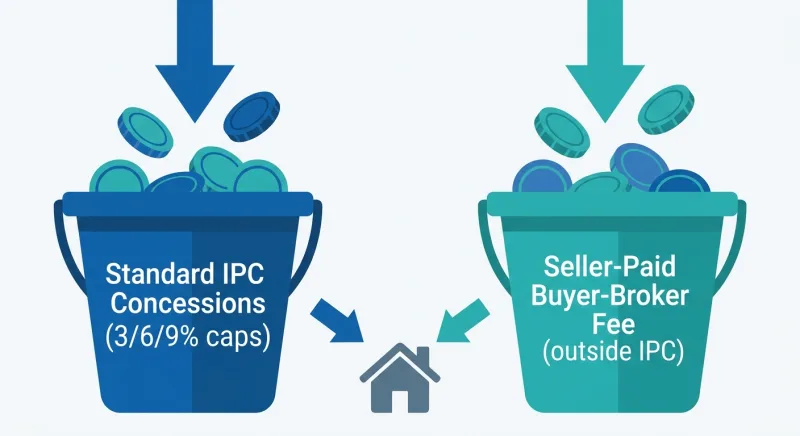
The Double Bucket Rule: Do Buyer-Agent Concessions Count Against Loan Limits?
Not all seller-side money lives in the same accounting bucket. Miss that, and you can accidentally cap a buyer out of financing they otherwise qualify for.
Bucket one — Standard Interested Party Contributions (IPCs). Closing costs, prepaids, discount points, escrows. Capped by loan type per the Fannie Mae Selling Guide (B3-4.1-02) and Freddie Mac Seller/Servicer Guide: conventional IPC limits run 3% / 6% / 9% of value depending on occupancy and LTV. FHA caps seller contributions at 6% under HUD Handbook 4000.1. VA limits certain seller concessions to roughly 4% under VA Lenders Handbook 26-7.
Bucket two — Seller-paid buyer-broker compensation. Fannie Mae, Freddie Mac, FHA, and VA issued guidance stating that seller payments toward buyer-agent compensation generally do not count against IPC concession caps — they're treated as a separate item.
| Bucket 1: Standard IPC Concessions | Bucket 2: Seller-Paid Buyer-Broker Fee | |
|---|---|---|
| What it covers | Closing costs, prepaids, points, escrow | Buyer's agent compensation |
| Counts toward IPC cap? | Yes | Generally no (as of 2026) |
| Where it's drafted | Purchase agreement concession line | Compensation addendum / Special Stipulations |
| Typical caps | Conventional 3/6/9% by LTV; FHA 6%; VA ~4% on certain items | Excluded from those caps per GSE guidance |
| Post-settlement change | Unchanged | Can no longer be advertised in MLS compensation fields |
What this means: a buyer who's already maxed their 6% closing-cost allowance can still have the seller cover a 2.5% buyer-agent fee on top — because that fee sits in bucket two. Treat both asks as one bucket and you'll tell a buyer "no room left." Treat them correctly and the deal that looked dead is suddenly live.
Honest hedge: GSE and agency treatment is still settling in 2026, and interpretations vary by investor and lender overlay. Confirm the exact treatment with your lender and closing attorney before writing a number into a contract. This is general information, not legal or lending advice.
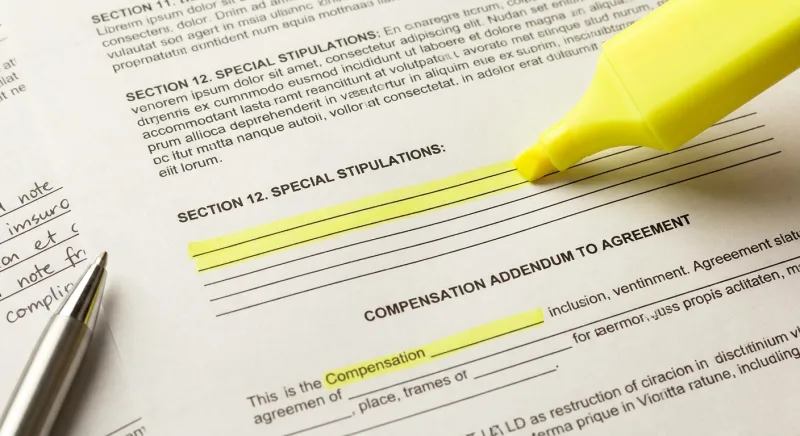
How to Structure the Concession in Tennessee Contracts (RF401 & Compensation Addendum)
The buyer-agent concession shows up in one of two places: the Purchase and Sale Agreement (Form RF401), where a credit is written into the financial terms and expanded in Special Stipulations, or a Tennessee REALTORS® compensation addendum, used when the parties want the fee documented as a distinct term rather than folded into general closing costs.
A clean structure:
- Decide the form of payment. A flat dollar amount ("Seller to pay $11,250 toward buyer's broker compensation") is cleaner for underwriting than a percentage.
- Name the right bucket. To keep it outside IPC caps, label it buyer-broker compensation — not "closing cost credit" — and confirm your lender agrees.
- Draft it into RF401 Special Stipulations or attach the compensation addendum. Get specifics: amount, who receives it, contingent on closing.
- Loop in the closing attorney early. Tennessee is an attorney/title-company closing state; the payment appears on the ALTA settlement statement.
- Keep escrow neutral. Transaction funds sit with a neutral custodian under TREC rules.
Don't leave this verbal. Documented in the contract, it closes. Handshake-only, it evaporates when the lender asks for paperwork.
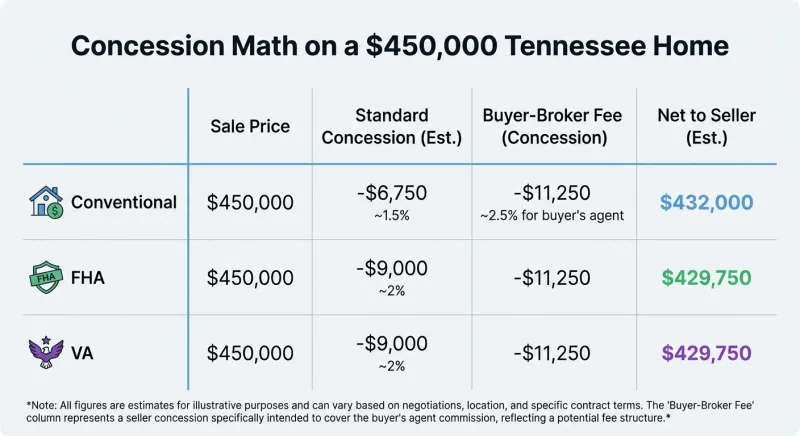
Concession Math on a $450,000 Nashville Home
A $450,000 sale price with a 2.5% buyer-agent fee equals $11,250.
| Item | Conventional | FHA | VA |
|---|---|---|---|
| Sale price | $450,000 | $450,000 | $450,000 |
| Buyer-agent fee (2.5%) | $11,250 | $11,250 | $11,250 |
| Counts against IPC cap? | Generally no | Generally no | Generally no |
| Room left for other credits | Up to 3–9% by LTV | Up to 6% | ~4% on certain items |
Your three levers:
- Direct buy-side payment: You credit $11,250 toward the buyer's agent. Net proceeds drop, but the deal stays attractive to financed buyers.
- Price reduction: Cutting list price $11,250 saves the same cash on paper — but lowers your appraisal-relevant comp and may not solve the buyer's cash-to-close problem, which is exactly what a concession fixes.
- Do nothing: You keep the $11,250 but narrow your buyer pool in a market where buyers bring their own agent-fee obligation.
A $10,000 price cut and a $10,000 concession feel identical. They aren't. The cut lowers your basis and drags comps; the concession keeps the contract price intact while moving the money. Pick the lever after you know the buyer's loan type and cash position.
The highest number isn't always the best structure. A smaller price reduction sometimes clears the appraisal cleaner; a direct buy-side payment sometimes beats a bigger credit because it doesn't tangle with the IPC cap. Flat-fee sellers capture the listing-side savings — roughly 2.5–3% — and that saved commission is exactly what funds the buy-side concession.
Sequencing Credits So They Actually Fund at Closing
Concessions don't fail at the negotiating table. They fail in underwriting. The stacking order that survives:
- Buyer-broker compensation first. Draft it via the compensation addendum as its own line, outside the IPC caps. Confirm treatment with the lender in writing.
- Standard closing-cost credit second. Origination, appraisal, title, prepaids — these count against the IPC cap.
- Price reduction last. If credits exceed program limits, the overflow converts to a price cut, which changes appraisal math and the buyer's LTV.
Get the order wrong and a buyer-broker fee that should have ridden outside the cap gets miscoded as a concession, eats the buyer's allowable room, and gets trimmed at underwriting — then the buyer asks you to eat the difference in the last 72 hours.
The excess-credit trap: credit a buyer more than the program permits and the lender disallows the overage — it isn't refunded. Run the numbers against the specific cap before you agree to a figure.
Edge Case: When the Buyer Has No Written Representation Agreement
Since August 17, 2024, buyers touring homes through an MLS-participating agent generally must have a written buyer representation agreement first. That agreement — not your contract — obligates the buyer to pay their agent.
If you offer a concession larger than the buyer's agreement authorizes, the surplus can't legally flow to the agent as compensation. It either becomes a closing-cost credit to the buyer (subject to IPC caps) or doesn't fund at all.
Ask how the buyer's representation agreement is structured — percentage, flat fee, or cap — before you name your number. If that obligation is $9,000 and you offer $14,000 as "buyer-broker comp," $5,000 is misclassified from the start.
Closing attorneys often prefer dual-source funding: the buyer pays their agent per their own agreement, and you write a separate closing-cost credit sized to what the loan program allows. Two distinct sources, two distinct buckets, no re-characterization risk.
VA Loans: The Non-Allowable Overflow Problem
VA rules distinguish between the roughly 4% concession allowance on certain items and non-allowable charges — fees a VA buyer legally cannot pay. VA Circular 26-24-14 on buyer-broker charges was updated post-settlement; confirm the current version with the buyer's VA-approved lender.
If a VA buyer's agent fee is treated as a buyer obligation the buyer can't pay, and your concession reimburses the buyer rather than paying the broker directly, you hit a wall. The structure that holds: a direct seller-to-buyer-broker payment drafted as compensation and funded outside the concession line. Same dollars, different plumbing, radically different underwriting outcome.
Comparison: Three Ways to Deliver the Same Relief
| Structure | How it's drafted | Counts against IPC cap? | Best when | Main risk |
|---|---|---|---|---|
| Direct buyer-broker payment | Compensation addendum; seller pays broker directly | Generally no as of 2026 | Fee is fixed and documented; VA files | Miscoding it as a concession |
| Closing-cost credit | Concession line in RF401 Special Stipulations | Yes — counts toward IPC limit | Buyer needs help with prepaids/closing costs | Overflow above cap is disallowed, not refunded |
| Price reduction | Lower contract price | No — not a credit | Credits would exceed the cap; buyer short on down payment | Changes appraisal/LTV; may cut buyer's approval room |
Illustrative comparison, not legal or lending advice — confirm treatment with the buyer's lender and your closing attorney.
Combining structures often delivers more total relief than either alone. Quick decision rule:
- Fixed agent fee, buyer otherwise qualified → direct buyer-broker payment
- Buyer thin on cash to close → layer a closing-cost credit up to the IPC cap
- Still short after both → price reduction, then re-check the appraisal
Advertising Concessions Off-MLS Without Breaking the Rules
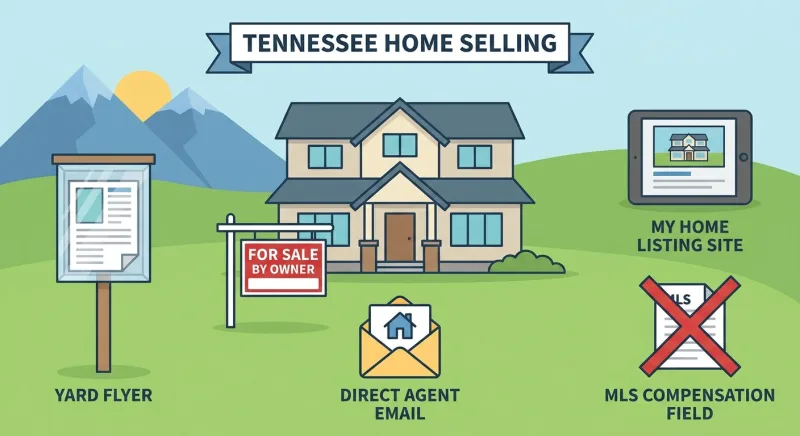
Since the settlement, you can't publish an offer of buyer-agent compensation inside MLS compensation fields. RealTracs, MAAR, and East Tennessee REALTORS® each prohibit advertising cooperating compensation in MLS or IDX feeds. A flat-fee or FSBO seller advertises willingness to cover buy-side fees off-MLS through channels the rules leave open:
- Your personal listing site or single-property page
- A yard flyer or printed sheet
- Direct email or a call opening the conversation
- Special Stipulations once an offer comes in
The MLS entry stays clean; the concession offer gets communicated everywhere MLS rules don't govern. A flat-fee MLS listing gets your home in front of every agent-represented buyer in Nashville, Memphis, Knoxville, Chattanooga, and Franklin — while you skip the roughly 3% listing-side commission and control the buy-side fee through concessions.
Escrow and Documentation: Where TN Deals Actually Break
A concession lives or dies on how it appears on the ALTA settlement statement. Two habits separate clean TN closings from last-minute chaos:
Mirror the contract on the statement. However you split direct compensation versus closing-cost credit in the agreement, that same split must appear as distinct lines at settlement. Closing attorneys flag mismatches as the most common reason a funded concession gets kicked back.
Respect escrow neutrality. In Tennessee, settlement funds sit with a neutral custodian under TREC rules. Concession dollars are disbursed by the closing agent — any side-channel handling creates compliance exposure. Tenn. Code Ann. § 62-13-302 governs certain rebate and inducement practices; keep every dollar inside the contract and settlement statement, characterized honestly.
Review checklist before signing
- Buyer-broker fee drafted as its own compensation line, not folded into concessions
- Closing-cost credit sized to — never over — the buyer's loan-program IPC cap
- VA files: agent comp paid direct, not reimbursed through the buyer
- Contract split mirrored on the ALTA settlement statement
- Buyer's representation agreement amount confirmed before you name your number
- Every figure re-verified with the buyer's lender in writing
Frequently Asked Questions
Can a seller pay the buyer's agent commission in Tennessee in 2026?
Yes. Since the NAR settlement took effect August 17, 2024, buyer-broker compensation moved out of MLS fields and into the contract — typically drafted through Form RF401 and a compensation addendum. You negotiate it deal-by-deal, not by advertising it on RealTracs.
Do seller-paid buyer-agent fees count against loan concession limits?
Generally, no. Standard closing-cost concessions count toward IPC caps, but seller-paid buyer-broker compensation is generally treated separately under 2026 Fannie Mae and Freddie Mac guidance. Confirm the current treatment with your lender and closing attorney before you sign.
How much can a seller contribute toward a buyer's closing costs?
It depends on the loan. Conventional IPC caps run 3%, 6%, or 9% of value based on down payment; FHA allows up to 6%; VA permits roughly 4% on certain items. These caps govern closing-cost credits — not the separately negotiated buyer-broker fee.
Can I offer a closing cost credit for the buyer agent in TN as a flat-fee or FSBO seller?
Yes, but advertise it off-MLS. RealTracs, MAAR, and East Tennessee REALTORS® rules restrict publishing buyer-broker compensation in MLS fields — cover buy-side fees through direct agent outreach, your own marketing, and the contract's Special Stipulations.
What VA charges can't a seller pay for the buyer?
VA loans carry non-allowable charges the buyer can't pay, which sometimes shift to the seller. VA Circular 26-24-14 addresses buyer-broker fee treatment on VA transactions — verify whether it's current or superseded in 2026, because getting this wrong can stall a VA closing.
Your Next Step
In 2026, a Tennessee seller can help cover the buyer agent's fee without hiring a full-service listing agent — and often without eating into the buyer's loan concession limits. Separate your two buckets, draft the numbers into the contract rather than the MLS, and advertise any concession through compliant off-MLS channels.
Post-settlement rules are still shifting — re-verify every cap, form number, and VA circular with your lender and a Tennessee closing attorney on your specific deal. Nothing here is legal or lending advice; it's the framework we use to help Tennessee sellers keep control.
List flat-fee on the MLS, then handle the buy side through smart concessions. Concessions aren't commissions. Structure them right, and you keep more of your equity at the closing table.
This article is general information for Tennessee sellers, not legal, tax, or lending advice. Post-settlement rules, IPC caps, form numbers, and VA circulars remain in flux — verify every figure with your lender and closing attorney before relying on it.