

A buyer just asked about your for-sale-by-owner home, and they don't have an agent. That's not a problem. Owners selling their own property are generally exempt from Tennessee's real estate licensing law under T.C.A. § 62-13-104, so a deal with an unrepresented buyer is legal and workable. It can even be simpler.
It does put more of the paperwork, timing and paper trail on you. This guide draws on the Tennessee Code, Tennessee Real Estate Commission rules, and federal guidance from the CFPB and EPA. Where the law leaves room for judgment, you'll get the honest trade-offs.
Quick Answer: What to Do When a Tennessee FSBO Buyer Has No Agent
Short version: Verify the buyer's financing before you negotiate. Judge the price on its merits, because you owe no commission unless you agreed to one in writing. Have a Tennessee real estate attorney draft or review the contract. Deliver the state disclosure form, and send the earnest money to a title company or an attorney's escrow account.
Work through it in this order:
- Vet the buyer's financing and identity
- Settle the commission question on price
- Get a properly drafted purchase contract
- Deliver required disclosures
- Move earnest money into third-party escrow and close
This guide is general information, not legal advice. For your specific transaction, consult a Tennessee real estate attorney.
Can a Buyer Purchase a Home Without a Realtor in Tennessee?
Yes. Tennessee doesn't require either side of a home sale to use a real estate agent. Owners selling their own property are exempt from the broker licensing law under T.C.A. § 62-13-104, and a buyer can purchase directly from them. The sale still needs a valid written contract, the required disclosures and a proper closing.
More buyers show up alone partly because of the NAR practice changes effective August 17, 2024. Buyers working with a member agent now sign a written agreement before touring, and offers of buyer-agent compensation no longer appear on the MLS. Most buyers still use an agent: NAR's Profile of Home Buyers and Sellers has put that share at about 88%.
Here's the Tennessee-specific part. How you listed the home decides who owes the buyer what.
In a pure FSBO sale, nobody in the deal holds a license, so no agency relationship exists. Contract law and your own disclosure duties govern. A flat-fee MLS listing adds a limited-service broker. That broker represents you within your listing agreement, not the buyer. Under T.C.A. § 62-13-403, though, it still owes the buyer baseline customer duties: honesty, reasonable care and disclosure of known adverse facts. Agency status must also be disclosed and confirmed in writing under T.C.A. §§ 62-13-405 and 62-13-406.
| Factor | Pure FSBO | Flat-fee MLS listing |
|---|---|---|
| Licensee involved? | No | Yes, a limited-service listing broker |
| Who the licensee represents | Not applicable | The seller, within the listing agreement |
| Duties a licensee owes the unrepresented buyer | None (your own legal duties still apply) | Customer-level duties under § 62-13-403 |
| Written agency disclosure | Not triggered by broker law | Required under §§ 62-13-405/-406 |
| MLS exposure | None | Yes |
That written disclosure helps you, since it records that the buyer knew nobody was on their side. The rules are the same in Nashville, Franklin, Knoxville, Memphis or anywhere else in the state.
How to Vet an Unrepresented Buyer Before You Negotiate
Short version: Ask for a lender-issued pre-approval, confirm it with the lender directly, and check the loan officer's license. For cash offers, request proof of funds. No buyer's agent is screening this buyer, so do these checks before you counter.
- Ask for a pre-approval, not a pre-qualification. The CFPB explains that a prequalification can rest on self-reported information, while a preapproval usually means the lender reviewed documents. Lenders use the terms loosely, so ask what was verified.
- Call the lender yourself, using a number you look up independently, not the one on the letter.
- Check the loan officer's license on NMLS Consumer Access.
- Request proof of funds for cash offers. A recent statement in the buyer's name, account numbers redacted, is standard.
- Pin down earnest money and timing in writing: amount, who holds it, target closing date.
Pause if the buyer won't use a title company or attorney for escrow, wants to wire money to you directly, or asks you to "help with" their down payment.
Do You Have to Lower Your Price if the Buyer Has No Agent?
No. In a Tennessee FSBO sale you owe a commission only if you signed an agreement to pay one. A buyer without an agent may ask for a lower price because no buyer's agent is being paid. That's a negotiating position, not an entitlement.
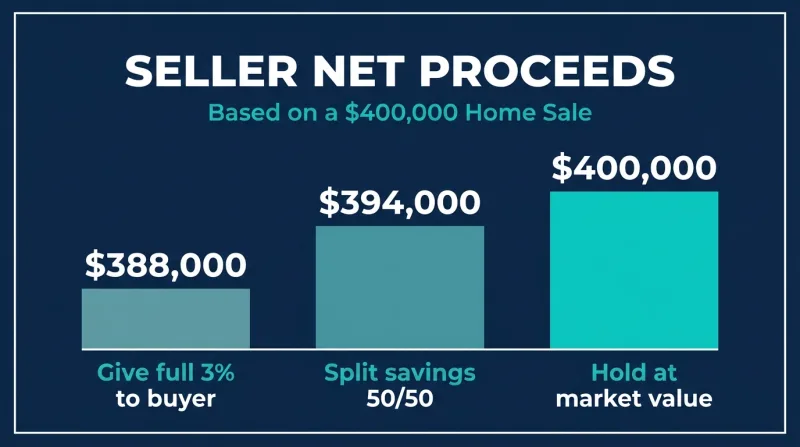
The usual anchor is "You're saving 3%, so take 3% off." Your price came from comparable sales, not commission math. Here's what each answer means on a $400,000 home with a 3% buyer-agent fee you're not paying:
| Scenario | Sale price or credit | Seller keeps of the $12,000 |
|---|---|---|
| A: Buyer gets the full 3% | $388,000 | $0 |
| B: Split 50/50 | $394,000, or $400,000 with a $6,000 credit | $6,000 |
| C: Hold at market value | $400,000 | $12,000 |
| Reference: you paid a 3% buyer-agent fee | Effective $388,000 | $0 |
Illustrative example; excludes closing costs, taxes and listing fees; outcomes depend on local comps.
Scenario A isn't a loss. It's exactly where you'd land if the buyer had brought an agent, and anything better is money you keep. Splitting the savings to keep a deal moving is reasonable, especially if you're paying for contract preparation.
If you'd rather hold firm, a few lines keep it about the property:
- "My price is based on comparable sales, not a commission line item."
- "I'm open to a specific closing-cost credit instead of a price change."
- "You'll have your own costs, like an attorney and an inspection, and I'd encourage both."
Put it in writing, every time. Any concession belongs in the signed contract or a signed amendment as a specific price or credit. A verbal "we'll split it" won't help you at closing.
Who Writes the Purchase Contract When Neither Side Has a Realtor?
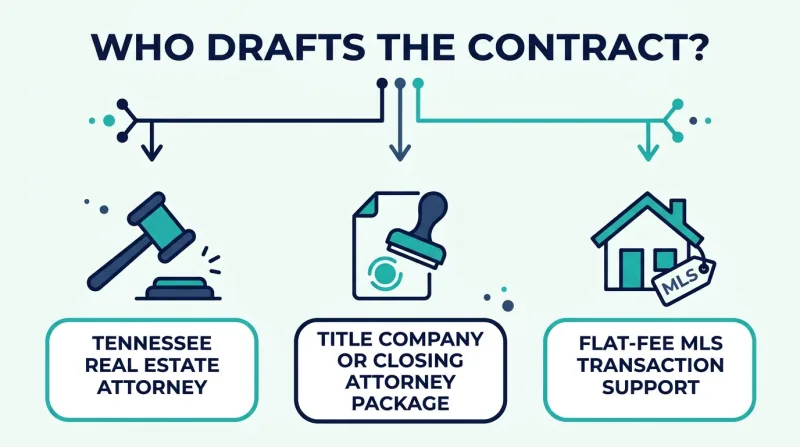
In a Tennessee sale with no agents, a real estate attorney usually drafts the purchase and sale agreement. A title company's or closing attorney's package, or a flat-fee broker's transaction support, can also help. The Tennessee REALTORS® standard purchase and sale agreement is generally licensed for member use, so don't assume you can download it and go.
Two legal boundaries apply. One is the form license: the association's purchase agreement, buyer representation agreement and Confirmation of Agency Status form all carry usage terms. The other is unauthorized practice of law. Tennessee generally limits drafting legal documents for others to licensed attorneys under T.C.A. § 23-3-101 and § 23-3-103. Filling in a contract for your own sale may be treated differently than preparing one for the buyer, so confirm where that line falls with an attorney.
Your contract does the representing now. With no agents, it carries every protection, deadline and remedy either side has.
| Option | Typical cost | Best for | Limitations |
|---|---|---|---|
| Tennessee real estate attorney | Varies; get 2–3 written quotes | Complex terms, as-is sales, seller financing | Represents you only |
| Title company or closing-attorney package | Varies; get 2–3 written quotes | Straightforward financed or cash deals | Neutral closer; may not advise either side |
| Flat-fee MLS transaction support | Varies by package | Sellers already listed with a flat-fee broker | Check exactly what the add-on covers |
Whoever drafts it, the agreement should generally cover:
- Financing contingency with a loan-approval deadline
- Appraisal contingency for a low valuation
- Inspection contingency with repair-proposal and response windows
- Title and closing terms, including who pays which costs
- A representation clause: the buyer confirms they're unrepresented and agrees to pay any broker they later hire, with mutual indemnification
- An as-is addendum, if applicable (it changes repair obligations, not disclosure duties)
A few hundred dollars of attorney time pays for itself here.
What Disclosures Does a Tennessee FSBO Seller Owe an Unrepresented Buyer?
Disclosures still apply when the buyer has no agent. The Tennessee Residential Property Disclosure Act (T.C.A. § 66-5-201 et seq.) covers most residential sales. Sellers generally provide a disclosure statement under § 66-5-202, or a disclaimer statement only where the law allows it. Pre-1978 homes add federal lead-paint rules.
The biggest myth is that "as-is" means you skip disclosure. An as-is addendum limits repairs. It doesn't let you hide known defects, and concealing a problem you know about can create liability whatever the contract says.
- State disclosure. Use the statutory form, or a valid disclaimer where § 66-5-202 permits one. Deliver it before you accept an offer and keep a signed receipt.
- Exemptions are narrow. Section 66-5-209 covers certain transfers, such as some court-ordered and foreclosure sales and some transfers between co-owners or family. A standard FSBO sale to an outside buyer usually isn't exempt.
- Lead-based paint (pre-1978 homes). Under 42 U.S.C. § 4852d and the rules at 24 CFR Part 35 and 40 CFR Part 745, sellers must give the buyer the EPA pamphlet Protect Your Family From Lead in Your Home, disclose known hazards on the federal form, and offer a 10-day inspection opportunity the buyer can waive in writing. Keep signed copies for at least three years.
In the same packet, suggest in writing that the buyer hire their own inspector and Tennessee real estate attorney. It documents that you didn't steer them.
Get the Earnest Money Into Escrow, Not Your Pocket
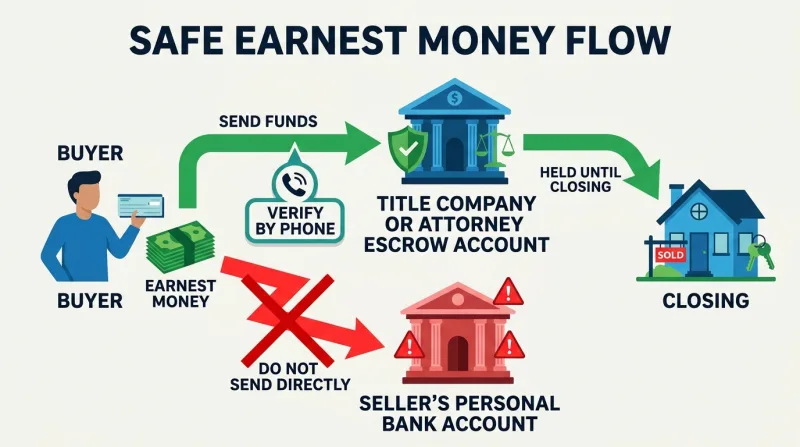
Earnest money should go straight to the title company or closing attorney named in the contract. Never hold it yourself. Escrow protects both sides if the deal falls apart and keeps you out of disputes over who's entitled to the deposit.
Wire fraud is the other risk. Before anyone sends or receives funds, confirm wiring instructions by calling the title company at a number you look up yourself. Treat any "updated" instructions by email as suspect.
Then take over the deadline tracking agents usually handle:
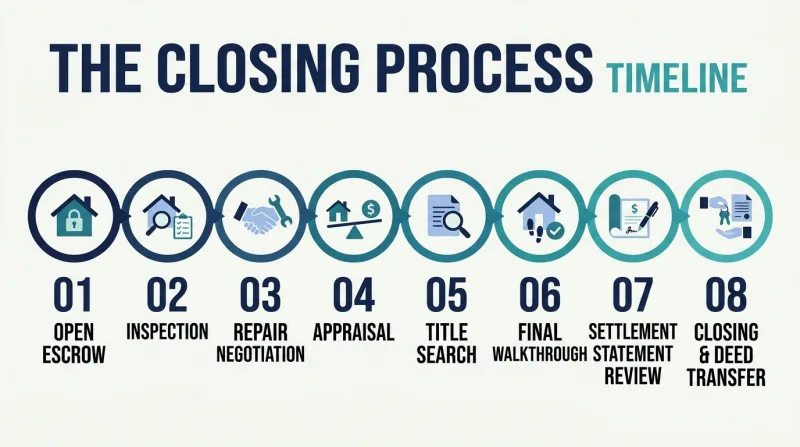
- Calendar every date the day the contract binds: inspection, repair response, appraisal, financing, title objections, closing.
- Confirm how days count (calendar or business) and any cutoff time.
- Send notices exactly as the contract specifies, and keep proof of delivery.
- Ask your attorney what a missed deadline means. Some contracts treat it as a waiver; others let you terminate.
Keep a dispute-ready file for several years: signed disclosures with delivery dates, the buyer's written confirmation they're unrepresented, every notice, repair receipts, the settlement statement and the recorded deed.
Stay Neutral: Who Does What When There's No Buyer's Agent
Short version: The work a buyer's agent would do still has to happen. It just moves to an attorney, a title company, an inspector or the buyer. Make sure every task has an owner and avoid taking on the buyer's side.
People get tripped up by the urge to help. The buyer seems nice, so you recommend an inspector or say the price is fair. You can't advise someone you're negotiating against.
| Job a buyer's agent normally handles | Hand it to | Your role |
|---|---|---|
| Advising on price and value | The buyer's research and the lender's appraisal | None. Don't comment on value. |
| Preparing the contract | A Tennessee real estate attorney | Review, negotiate, sign |
| Tracking deadlines | The contract terms plus the title company or closing attorney | Meet your own deadlines |
| Holding earnest money | Title company or attorney escrow | Never take custody |
| Inspections and due diligence | The buyer, with inspectors they choose | Provide access and disclosures |
Neutral doesn't mean silent. Answer factual questions like the roof's age, with paperwork if you have it. If asked whether to waive the inspection or whether the price is fair, point them to their own inspector, attorney or appraiser. If they ask for a lender, give several names and mention any personal connection. A one-line email ("Since you're not working with an agent, I'd encourage you to have your own attorney review the contract and hire an independent inspector") costs you no leverage.
When an Unrepresented Buyer Deal Gets Complicated
The buyer signs with an agent mid-deal. That agent may ask you for a fee. You generally owe none unless you agreed in writing, but the agent may tie the offer to it. Ask at the first showing whether the buyer has signed a buyer representation agreement, and rely on the representation clause in your contract.
The buyer holds a real estate license. Tennessee rules generally require licensees buying for their own account to disclose that status in writing. Ask for it in the contract. A licensed buyer knows deadlines and forms better than most sellers, so have your own attorney review anything they bring.
The buyer may be a wholesaler. Watch for "buyer and/or assigns" language, token earnest money, a long due-diligence period, a distant closing date and "cash" with no proof of funds. You can strike assignment rights or require your written consent, and ask that earnest money go non-refundable after inspection. Have your attorney check current Tennessee rules.
The buyer wants seller financing. You become a lender. Dodd-Frank's loan originator and ability-to-repay rules have limited exemptions for owners financing a small number of sales, with conditions on loan terms. If you proceed, use an attorney-drafted note and deed of trust, a lender's title policy and a third-party servicer.
It's a VA or FHA loan. Appraisals check minimum property standards and can require repairs even in an as-is sale. VA's temporary 2024 policy changed whether veterans can pay buyer-broker fees, so an unrepresented VA buyer may ask you to cover costs their loan restricts. Get the loan type in the offer.
You have competing offers. Compare on certainty-adjusted net, not headline price. An unrepresented offer that nets slightly less but has verified financing, short contingencies and meaningful earnest money is often the stronger deal.
Frequently Asked Questions
Do I owe a commission to an unrepresented buyer in a Tennessee FSBO sale?
No. You owe a commission only if you agreed to one in writing. A request for a lower price because the buyer has no agent is something to negotiate, not an obligation.
Can I use the Tennessee REALTORS® purchase and sale agreement for a FSBO sale?
Generally not without permission, because Tennessee REALTORS® forms are licensed for member use. A safer route is a contract drafted or reviewed by a Tennessee real estate attorney, since preparing legal documents for someone else can raise unauthorized-practice concerns under T.C.A. § 23-3-101 and -103.
Do I still owe the buyer a property disclosure if I'm selling as-is?
Yes. "As-is" doesn't cancel the Tennessee Residential Property Disclosure Act (T.C.A. § 66-5-201 et seq.). It requires a disclosure statement or the disclaimer option unless a § 66-5-209 exemption applies. Homes built before 1978 also need the federal lead-paint form and EPA pamphlet.
Can a buyer without an agent close through a title company in Tennessee?
Yes. Tennessee title companies routinely close direct buyer-seller sales. Whether an attorney also needs to be involved depends on the deal and the buyer's lender.
Should I accept the earnest money directly from the buyer?
Best practice is no. Have the buyer deposit it with the title company or closing attorney named in the contract, and confirm wiring instructions by phone at a number you look up yourself. It's a recommendation rather than a statute, but it protects both sides.
Can the buyer and I share one attorney?
That's generally inadvisable, because one attorney can't fully advocate for both sides of the same negotiation. An attorney can serve as a neutral closing agent, but each party is better served by separate contract advice.
Before You Sign
- Buyer's financing verified with the lender
- Price or credit terms written into the contract
- Contract drafted or reviewed by a Tennessee real estate attorney
- State disclosure delivered, plus the lead-paint form if pre-1978
- Earnest money with the title company or closing attorney
- Deadlines calendared and closing scheduled
Statutes, form licenses and MLS rules change, so confirm current details with your attorney or title company before closing. If you want MLS exposure while keeping control of the sale, a Tennessee flat-fee MLS listing with ResultsMLS puts your home in front of agents and unrepresented buyers alike.