
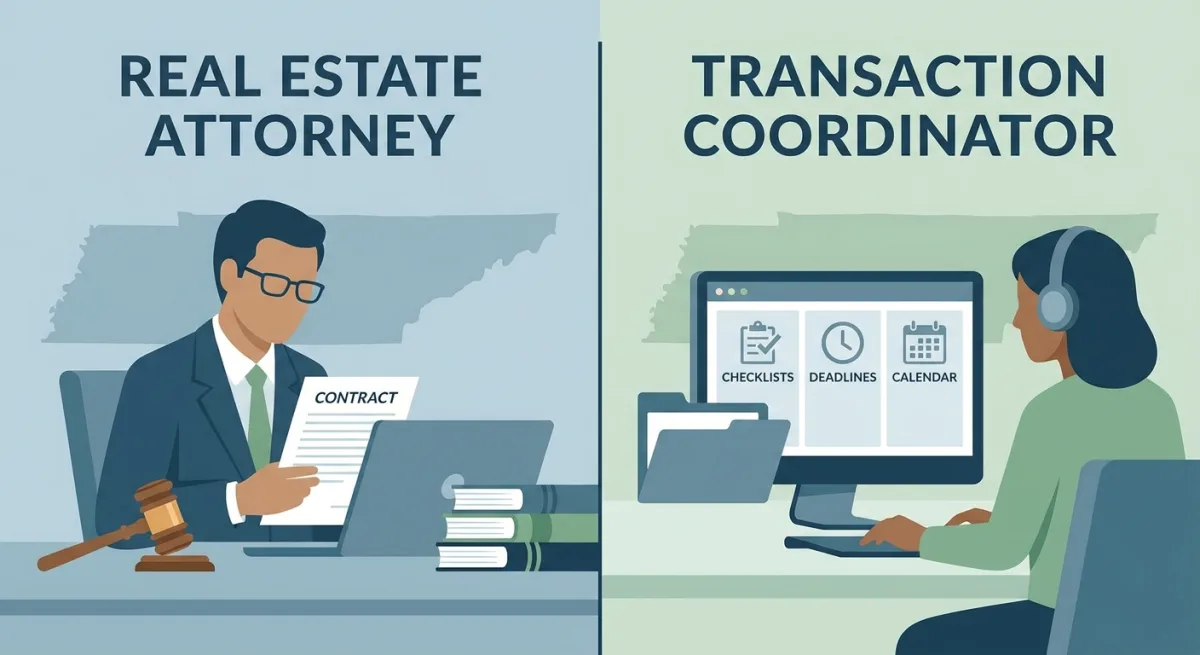
Attorney vs. Transaction Coordinator: Who Should Handle Your Tennessee FSBO Paperwork?
You've got an offer on your for-sale-by-owner home—or you're about to—and now you're staring down a stack of FSBO paperwork wondering who's actually supposed to handle it. Do you need a lawyer? A transaction coordinator? Both?
The question trips up more Tennessee sellers than almost anything else at closing, and most advice out there is quietly biased. Law firms tell you to hire a lawyer. Coordinator services tell you that you don't.
Here's what nobody explains up front: these are two different jobs, not competitors. Tennessee is a non-mandatory attorney closing state, which means you have real flexibility to build a cost-efficient stack instead of overpaying for a service you don't need—or skipping legal help you actually do.
This guide walks the line honestly: plain-English definitions of what each role can and can't legally do, the unauthorized-practice-of-law boundary a coordinator can't cross, a side-by-side table, transparent 2026 Tennessee fee ranges, and a hybrid model that pairs both with your flat-fee MLS listing.
This guide is educational and not legal advice. For your specific transaction, consult a licensed Tennessee attorney.
The Quick Answer
In Tennessee, a real estate attorney provides legal judgment—drafting custom contract terms, interpreting clauses, and resolving title problems—while a transaction coordinator handles administrative support: tracking deadlines, collecting documents, and coordinating the parties. Tennessee is a non-mandatory-attorney closing state, so FSBO sellers aren't legally required to hire either, but most benefit from both.
The coordinator keeps your closing moving. The attorney protects you when something in the deal needs a legal call. For a clean sale, a coordinator plus a title company is often enough. Add the attorney the moment legal questions appear.
What Each Role Actually Does (and Can't Do)
Both work with the same documents—the standard Tennessee REALTORS (TAR) purchase-and-sale agreement, the seller disclosures, the title paperwork—but they touch those documents in fundamentally different ways.
The transaction coordinator
A transaction coordinator (TC) is an administrative professional who manages the logistics of your closing from contract to close.
A Tennessee FSBO TC typically will:
- Fill in the blanks on standard, pre-approved forms
- Track every deadline—inspection period, financing, appraisal, closing date
- Collect and organize documents from you, the buyer, the buyer's agent, and the title company
- Coordinate scheduling among all parties
- Monitor earnest money delivery and escrow timelines
- Chase down missing signatures so nothing stalls
What they do not do is exercise legal judgment. That boundary isn't optional—it's the law.
The real estate attorney
A real estate attorney is a licensed Tennessee lawyer who provides legal representation and judgment. Where the coordinator manages the process, the attorney can change the substance.
A flat-rate real estate attorney in Tennessee can:
- Draft custom contract language and negotiate terms specific to your deal
- Interpret contingencies and clauses when the meaning is disputed or unclear
- Resolve title defects—liens, boundary questions, chain-of-title problems
- Prepare or review the warranty deed and other conveyancing documents
- Represent your interests if a dispute arises
- Advise you on your Tennessee Residential Property Disclosure obligations
A coordinator organizes what already exists; an attorney creates, interprets, and defends. That distinction is regulated by both the Tennessee Real Estate Commission (TREC) and the Board of Professional Responsibility of the Supreme Court of Tennessee.
The Unauthorized Practice of Law Line You Can't Cross
Can a transaction coordinator give legal advice or write a contract in Tennessee? No. Under Tennessee's unauthorized-practice-of-law doctrine, drafting custom contract terms, interpreting legal clauses, or advising you on your rights is the practice of law—only a licensed attorney may do it. A TC who crosses that line commits UPL.
The authority is the Tennessee Supreme Court, which regulates the practice of law through the Board of Professional Responsibility under Tenn. Sup. Ct. Rule 9. UPL isn't a technicality; it exists to protect you. If a non-lawyer gives you bad legal guidance, you have almost no recourse—no bar complaint, no malpractice claim, no professional accountability.
A coordinator may fill in blanks on a board-approved form, tell you a deadline is Friday, and forward documents. A coordinator may not tell you whether a contingency protects you, rewrite a clause to shift risk, or advise you to waive an inspection.
Any errors-and-omissions insurance a TC carries protects their business, not your legal position—it's no substitute for representation. If your gut says "I need someone to tell me what this clause means for me," that's a lawyer question, full stop.
Side-by-Side Comparison
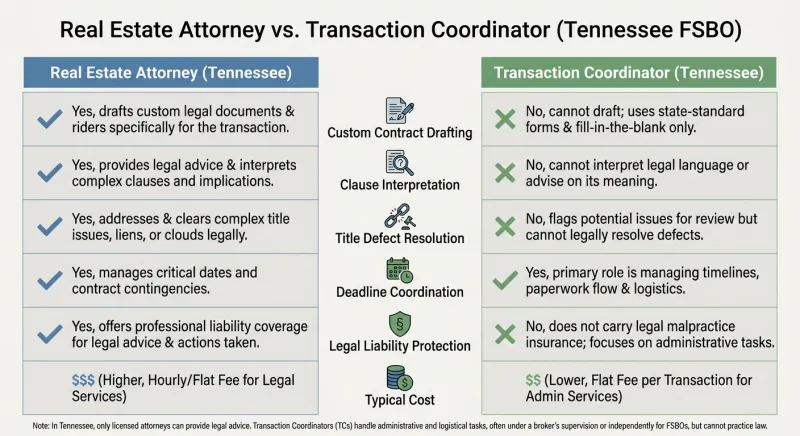
| What you need | Transaction Coordinator | Real Estate Attorney |
|---|---|---|
| Scope of work | Administrative & logistical | Legal judgment & representation |
| Custom contract drafting | ❌ (UPL) | ✅ |
| Clause / contingency interpretation | ❌ (UPL) | ✅ |
| Title defect resolution | ❌ | ✅ |
| Deadline & document coordination | ✅ (core strength) | ✅ (but expensive for this) |
| Legal liability protection / representation | ❌ | ✅ |
| E&O insurance | Varies—not a substitute for representation | Carries legal malpractice coverage |
| Who prepares the deed | ❌ (title co. or attorney) | ✅ |
| Earnest-money handling | Coordinates delivery; doesn't hold funds | Advises on disputes; title/escrow holds funds |
| Typical 2026 TN cost | $500–$700 per closed deal | $600–$750 drafting/review; $300–$800 closing |
| Best-fit scenario | Straightforward, standard-terms sale | Custom terms, title issues, or disputes |
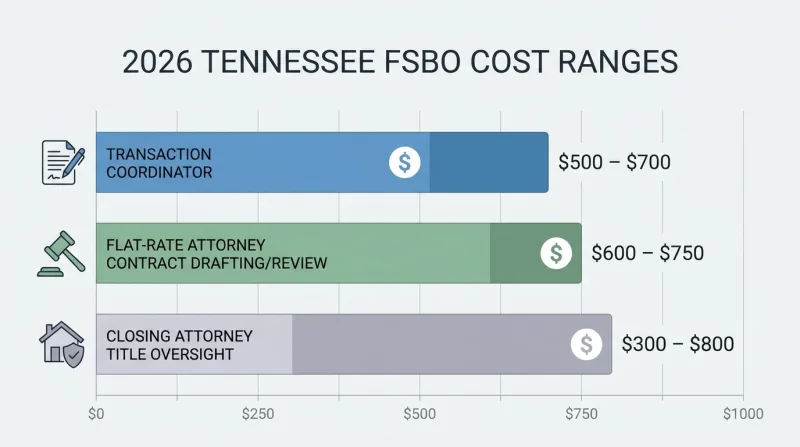
What Each Option Costs (Real 2026 Fee Ranges)
- Tennessee FSBO transaction coordinator: roughly $500–$700 per closed transaction
- Flat-rate attorney, custom drafting or review: roughly $600–$750
- Closing attorney, title and closing oversight: roughly $300–$800 depending on complexity
The coordinator fee is usually a flat per-deal charge. Attorney work is modular—you can pay a flat-rate fee for a one-time contract review without retaining them for the entire deal. That's the flexibility price-sensitive sellers miss.
Note what's not on this list: title insurance, recording fees, transfer taxes, and the title-and-escrow company's own fee are separate. A full hybrid stack—coordinator plus targeted attorney review—often lands around $1,000–$1,400 all-in, a fraction of a full-service listing commission.
The Judgment vs. Logistics Line
Every task in a FSBO closing falls on one side of a line most sellers never see.
Logistics side: tracking the inspection period, collecting disclosures, confirming earnest money is in escrow, filling blanks on a standard TAR agreement. Anyone competent and organized can do this.
Judgment side: deciding what a contingency actually obligates you to do, drafting a custom clause, weighing whether a title defect kills the deal, interpreting an ambiguous financing condition. This side requires the authority to give legal advice—only a licensed attorney holds it.
The line isn't about difficulty. It's about authority. A coordinator might understand your contract perfectly and still be legally barred from telling you what to do about it. You're not choosing a person. You're sorting your closing into logistics tasks and judgment tasks, then buying help for each side only where you need it.
Three provisions produce the most confusion in Tennessee FSBO deals:
- The inspection/resolution period—who bears cost, what triggers a valid termination, and the exact deadline mechanics.
- The financing contingency—what a "denial letter" must say, and whether a buyer's change of heart releases their earnest money.
- Time-is-of-the-essence and default language—the difference between a curable delay and a breach that costs a party the deal.
A coordinator can track those deadlines. Deciding what a missed one means is the attorney's job.
The Deed-Preparation Trap
The document that most often forces a FSBO seller to call an attorney isn't the purchase agreement—it's the deed.
In Tennessee, preparing the instrument that transfers title is squarely lawyer work under Tenn. Sup. Ct. Rule 9. A coordinator cannot do it. A title company can prepare the deed as part of the closing they're conducting, but the moment a novel ownership question appears—a deceased co-owner, a name that doesn't match the last recorded deed, property held in a trust or LLC—the title officer will route you to counsel.
Practical rule: if the vesting on your closing statement doesn't match your last recorded deed, flag it before you sign anything. That mismatch is the most common reason a "simple" FSBO closing suddenly needs a flat-rate attorney.
Who Touches the Money: The Escrow Chain
In a FSBO deal there's no listing brokerage trust account. Someone neutral must hold earnest money—in practice, the title-and-escrow company. This is why the title company is the non-negotiable member of your stack.
A coordinator should never hold your earnest money. If a TC service offers to, treat it as a red flag—they're administrative support, not a licensed escrow agent.
The chain: buyer's earnest money goes to the title/escrow officer → TC confirms the deposit landed and logs the deadline → title company runs the search and clears exceptions → at closing, escrow disburses per the settlement statement. The attorney enters only if the title search surfaces something. Notice the attorney is conditional. The title company and coordination function are not.
Edge Cases That Flip the Answer From "TC" to "Attorney"
Several fact patterns should move you to a flat-rate attorney before you sign:
- A title defect surfaces—an old unreleased lien, a mechanic's lien, or a judgment against a prior owner.
- Inherited or probate property—the deed and chain of title depend on estate documents.
- Divorce or a co-owner who won't (or can't) sign—you need counsel on authority to convey.
- A trust or LLC on title—vesting and signature authority require legal review.
- Owner financing or a land contract—custom drafting, the clearest attorney-only zone.
- A contract dispute mid-deal—the buyer alleges a failed disclosure or wants earnest money back.
- Seller-disclosure exposure—selling with known material defects. Only counsel can advise on the liability behind it.
If none of these apply—a clean-title, standard-terms sale to a cash or conventionally-financed buyer—the coordinator-plus-title stack is genuinely sufficient, and paying for full legal review is often over-buying.
The Cost-Efficient Hybrid: Unbundling
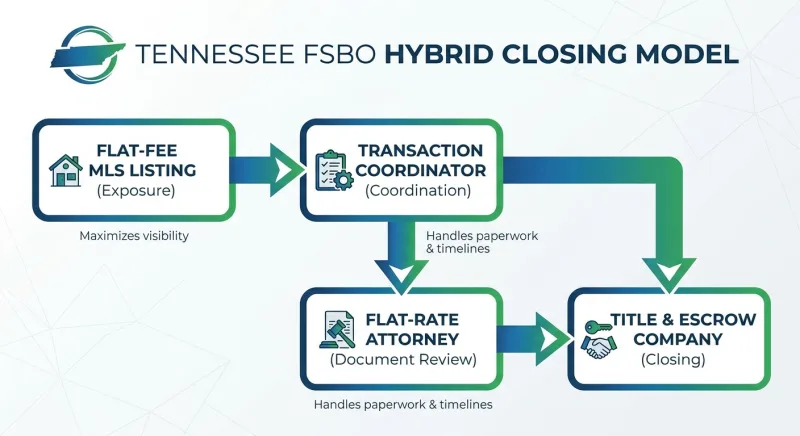
The efficient answer is unbundling—buying each piece from the cheapest party legally allowed to provide it:
- List on the MLS with a flat-fee provider first. This gets your home in front of buyers and buyers' agents.
- Bring in a transaction coordinator once you have an accepted offer, to run the logistics.
- Add a flat-rate attorney à la carte only for judgment-side moments—a custom clause, a title question, a dispute.
- Close through a title-and-escrow company, which handles the title search, escrow, the warranty deed, recording, and TILA-RESPA disclosures.
Tennessee's non-mandatory closing status is what makes unbundling legal. Mandatory-attorney states like Georgia—where a lawyer must run the closing—leave no room for it. Tennessee gives you room. Most guides never tell you that.
How to Decide
Hire a transaction coordinator if:
- Your sale is a standard cash or conventional-financing deal on a TAR agreement with no unusual terms
- You mainly need deadline tracking, document collection, and coordination
- Title is clean and undisputed
Hire (or add) a real estate attorney if:
- You need custom terms drafted or negotiated
- You don't understand a contingency and need to know what it means for you
- There's a title defect, lien, boundary issue, or ownership question
- The deal involves a trust, estate, divorce, or multiple owners
- Any dispute arises with the buyer
Do both—the hybrid—if you want day-to-day coordination handled cost-efficiently and a legal safety net for the moments that need a lawyer. For most Tennessee FSBO sellers, this is the sweet spot.
Where Your Flat-Fee MLS Listing Fits In
None of the above matters until you have an offer—and you don't get offers unless your home is on the MLS.
A flat-fee MLS listing in Tennessee puts your home in front of buyers and agents already searching, without handing over a full commission. It's the foundation the rest of the stack sits on: list flat-fee first, then line up your closing help—a coordinator for the logistics, a flat-rate attorney for the legal judgment.
If you're ready to sell your house in Nashville, Franklin, Murfreesboro, Knoxville, Memphis, Chattanooga, or anywhere else in the state without a realtor, start with the listing and build the right FSBO closing help around it.
Frequently Asked Questions
Is a real estate attorney required for a FSBO sale in Tennessee?
No. Tennessee is a non-mandatory attorney closing state, so a for-sale-by-owner seller isn't legally required to hire an attorney to close. Not required, though, doesn't mean not advisable—if your deal has any title questions, liens, or unusual terms, a licensed Tennessee attorney is worth the flat fee. This guide is educational and not legal advice; consult a licensed Tennessee attorney for your specific transaction.
Can a transaction coordinator give legal advice in Tennessee?
No. Under Tennessee's unauthorized-practice-of-law doctrine, a transaction coordinator cannot give legal advice, interpret contract clauses, or tell you what a contingency means for your rights. A TC handles administrative coordination—tracking deadlines, collecting documents, and filling blanks on the standard TAR purchase-and-sale agreement—but the moment legal judgment enters, that's attorney territory.
How much does a flat-rate real estate attorney cost in Tennessee?
Current Tennessee ranges run roughly $600–$750 for a flat-rate attorney to draft or review a custom purchase agreement, and about $300–$800 for a closing attorney to oversee title and closing. Fees vary by county, complexity, and provider, so get a quote before you commit.
Can a transaction coordinator write a contract in Tennessee?
Not a custom one. A TC may fill in the blanks on a standard TAR agreement, but drafting original terms or custom clauses crosses into the unauthorized practice of law in Tennessee. Anything beyond a standard form belongs to a licensed attorney.
Do you need a lawyer to sell a house by owner in Tennessee?
Not by law—a title-and-escrow company can handle a straightforward closing, and a transaction coordinator can manage the paperwork flow. But for anything with a title defect, a dispute, or non-standard terms, hiring a flat-rate Tennessee attorney is the safer call. This is general information, not legal advice for your situation.
The Bottom Line
Two roles, two very different jobs. A transaction coordinator keeps your FSBO deal moving—deadlines, documents, disclosure forms, coordination. A real estate attorney supplies what a TC legally can't: legal judgment, from custom drafting to clause interpretation to title-defect resolution. Because Tennessee doesn't force an attorney into your closing, you build the stack that fits your sale instead of overpaying for one you don't need.
For a straightforward cash offer with standard terms, a coordinator plus a reputable title company is usually enough. Add a financed buyer, a lien, or a contract question, and a flat-rate attorney earns their fee fast. The two aren't rivals—they're complementary tools, and the smartest sellers use each for exactly what it does.
Start with exposure. Get your home in front of buyers with a flat-fee MLS listing first, then line up the right closing help around it.
This guide is educational, not legal advice. Confirm your own transaction with a licensed Tennessee attorney before you sign.