

What Seller Disclosures Are Required When You List on a Flat-Fee MLS in Tennessee?
Choosing a flat-fee MLS listing in Tennessee changes how much you pay to sell your house. It does not change what you're legally required to tell buyers. The mandatory seller disclosures for a flat fee MLS listing in Tennessee are the exact same disclosures a full-service agent's client would make — because the duty attaches to the property transfer, not to how you listed it.
That trips up a lot of FSBO sellers. They assume going the discount route means fewer forms and less exposure. The opposite is closer to the truth. When you represent yourself, you're the one signing the Tennessee Residential Property Disclosure and the one on the hook if a known defect goes unmentioned.
Whether you pay a broker 3% or a flat fee to sit on the MLS, the legislature drew the line at the sale itself. Skip the paperwork and you carry the liability. The good news: the forms are standardized, the exemptions are narrow but real, and the upload step is mechanical once you know where the button is.
Is Tennessee a Disclosure State?
Yes. Tennessee is a mandatory disclosure state. Under the Tennessee Residential Property Disclosure Act (Tenn. Code Ann. § 66-5-201 through § 66-5-210), the seller of residential real property must give the buyer a written disclosure of known material defects before the buyer becomes contractually bound.
A material defect is a condition a reasonable buyer would consider important in deciding whether to buy — or how much to pay — and that a seller actually knows about. The Act isn't asking you to hire an inspector or guarantee the house is perfect. It's asking you to be honest about what you know.
Two things trip up FSBO sellers here.
First, the timing rule. Under § 66-5-202, you deliver the disclosure to the buyer before the buyer is bound by a contract. Failing to deliver it on time can trigger costly delays, price renegotiations, or serious post-closing liability. On a flat-fee listing, the cleanest move is to attach it to the listing itself so every prospective buyer sees it up front.
Second, the duty is about your knowledge. You disclose what you actually know. You're not liable for a hidden defect you had no reason to know about — but the moment you're aware of something (the basement floods, the roof leaks, the addition was never permitted), silence becomes a legal problem.
This applies to houses, condos, and most one-to-four-unit residential sales. New construction and certain transfers fall outside it — covered in the exemptions section below.
What Disclosure Forms Do Tennessee Sellers Use?
Tennessee doesn't make you draft your own document. The Tennessee Realtors association publishes a standardized set of "RF" forms that satisfy the statutory requirements:
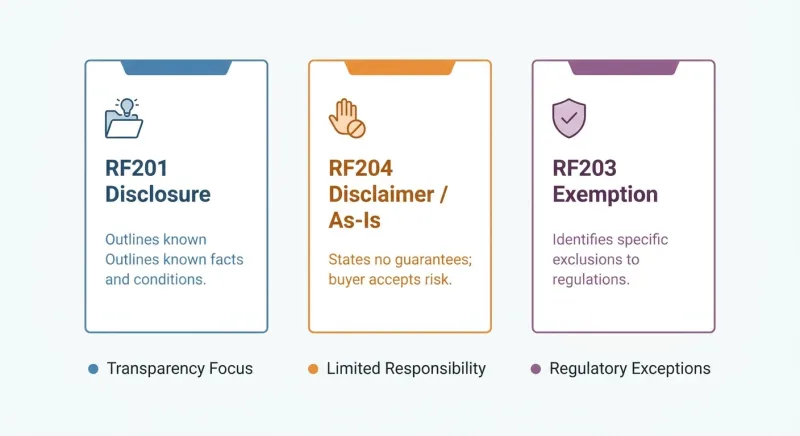
- RF201 — Tennessee Residential Property Condition Disclosure. The main event. The full condition disclosure that satisfies § 66-5-201 for the vast majority of resale homes.
- RF202 — Disclosure Update / Amendment. Used when something changes or you learn of a new defect after delivering RF201.
- RF203 — Residential Property Disclosure Exemption. Filed when your transaction qualifies for a statutory exemption under § 66-5-209.
- RF204 — Disclaimer Statement ("as-is"). Lets you sell without giving the full condition disclosure — but does not erase your duty to disclose known material defects.
- RF207 — Notification of adequate facilities taxes / impact fees. Applies in counties that levy them.
- RF208 — Subsurface (Septic) Sewage Disposal System notice. For properties on septic rather than municipal sewer.
For a standard resale, you'll almost always be working with RF201. RF207 and RF208 bolt on when your county or property setup requires them. RF203 and RF204 are the two "instead of RF201" paths — and mixing them up is where sellers create liability.
RF201 vs. RF204 vs. RF203: Which Form Do You Actually Use?
| Form | What it is | Who uses it | Does it waive the duty to disclose known defects? |
|---|---|---|---|
| RF201 | Full residential property condition disclosure | Nearly all resale sellers | N/A — you're disclosing everything you know |
| RF204 | Disclaimer / "as-is" statement | Sellers selling without warranties of condition | No. You still must disclose known material defects |
| RF203 | Disclosure exemption | Sellers whose transaction is exempt under § 66-5-209 | Yes — the exemption removes the disclosure obligation itself |
The "as-is" myth (RF204)
This is the single most expensive misunderstanding in Tennessee FSBO sales. Sellers hear "as-is" and assume it means "buyer beware, I owe nothing." It doesn't.
RF204 lets you decline to provide the detailed condition rundown — you're telling the buyer you make no representations about condition; inspect it yourself. But it does not let you hide a defect you already know about. If you know the foundation is cracking and conceal it behind an "as-is" disclaimer, you're still exposed to buyer remedies under § 66-5-208. The mental model that keeps sellers out of court: "as-is" governs the unknown, disclosure governs the known. RF204 protects you from the surprise leak neither of you saw coming. It does nothing for the leak you painted over last spring.
When you're actually exempt (RF203 and § 66-5-209)
Tennessee's statutory exemptions under § 66-5-209 are narrow. They typically cover:
- Transfers by an executor, administrator, or trustee administering an estate
- Court-ordered transfers and transfers to satisfy a decree
- Foreclosure sales and transfers by a lender who acquired the property through foreclosure
- Transfers between co-owners or to a spouse/direct family member
- Transfers to or from a government entity
If — and only if — your sale fits one of these, you file RF203 instead of RF201. "I want to sell as-is" is not on that list. And even a valid exemption removes the form, not the common-law floor: ordinary fraud and misrepresentation principles keep running underneath. An heir who learned of a defect from a caretaker, a prior inspection, or the deceased's repair records can't hide behind the exemption. When in doubt, disclosing what you know via RF201 is almost always the lower-risk path.

Do You Have to Disclose Lead Paint When Selling FSBO in Tennessee?
Yes — if the home was built before 1978, federal law requires lead-based paint disclosure regardless of whether you use an agent, a flat-fee MLS, or sell entirely on your own. This is a federal rule (42 U.S.C. § 4852d, implemented at 24 CFR Part 35 and 40 CFR Part 745), sitting on top of Tennessee's state requirements.
For any pre-1978 residential property, you must:
- Disclose any known lead-based paint or lead hazards in the home
- Provide the buyer with any records or reports you have on lead paint
- Give the buyer the EPA pamphlet "Protect Your Family From Lead in Your Home"
- Include the required lead warning statement and signatures in the contract
- Offer the buyer a 10-day period to conduct a lead paint inspection or risk assessment (the buyer can waive it, but you must offer it)
Skip this on a pre-1978 home and you're exposed under federal law — separate penalties from anything in § 66-5-201.
Tennessee-Specific Hazards You Should Disclose
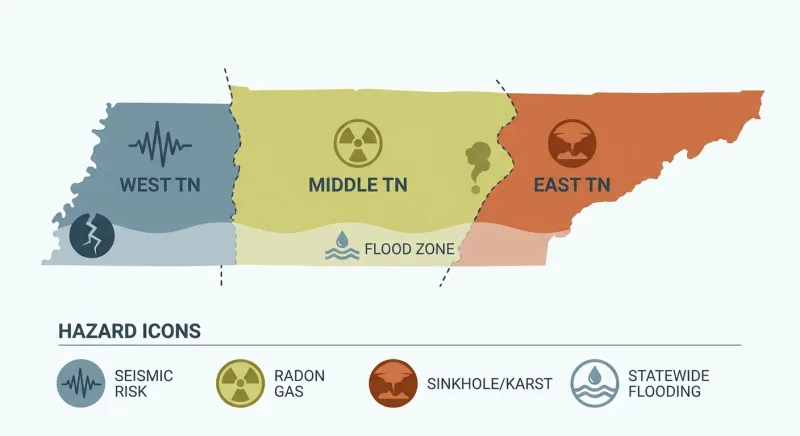
National disclosure guides treat every state like it's Ohio. Tennessee has geology that generic checklists miss.
East Tennessee (KAAR territory) — karst and sinkholes
The Valley and Ridge and the Cumberland Plateau sit on karst topography — soluble limestone and dolomite that dissolves into sinkholes and underground voids. If your property has a known sinkhole, prior sinkhole repair, or documented subsidence, that's a material defect you disclose. Tennessee amended its sinkhole disclosure requirements in 2024, tightening what sellers must reveal about known sinkhole activity.
Middle Tennessee (RealTracs territory) — limestone and radon
The Central Basin around Nashville is limestone country, associated with elevated radon gas. Much of Middle Tennessee falls into higher EPA radon zones. If you know your home has tested high, that's a known condition you disclose. Nashville, Franklin, Murfreesboro, and Brentwood sellers who've run a radon test should say so, and say what it showed.
West Tennessee (MAAR territory) — New Madrid seismic risk
Memphis and the western counties lie near the New Madrid Seismic Zone, one of the most significant earthquake risk areas in the eastern United States per USGS. Disclose what you know about the property — prior earthquake damage, foundation issues — not a generic regional risk lecture.
Statewide — FEMA flood zones
If your property sits in a FEMA-mapped special flood hazard area, or you know it has flooded, disclose it. The FEMA Flood Map Service Center will confirm your zone. Getting ahead of it protects your deal.
The "Known" Standard: What Tennessee Actually Requires You to Know
Tennessee's Act doesn't obligate you to investigate your home before you sell it. It obligates you to disclose what you know. That actual-knowledge standard baked into § 66-5-201 decides most disclosure disputes — and it cuts both ways.
You are not required to open a wall, hire a geotechnical engineer, or run a radon test just to complete the form. But the moment a fact enters your knowledge — the plumber who mentioned the slab crack, the water stain you painted over, the neighbor's comment about the sinkhole two lots down — the form's protection depends on whether you wrote it down.
The problem is constructive knowledge — facts you can't credibly claim you didn't have. If a prior inspection report in your closing folder flagged a foundation issue, "I forgot" is not a legal category. If you filed an insurance claim for water intrusion, that claim is a paper trail.
Selective disclosure is the real trap
Sellers rarely get sued for saying nothing. They get sued for saying some things. When you check "no known defects" across an entire form but knew about one bad thing, you haven't just omitted a fact — you've made an affirmative misrepresentation on a signed statutory document. Every material item on RF201 gives you a real "unknown" option. Use it honestly and it's a legitimate answer. Use it to sidestep something you actually know, and you've converted a defense into an exposure.
The framework for a tricky item isn't "disclose or hide." It's three real choices:
- Disclose the known condition in plain language (safest).
- Mark it genuinely unknown — only if that's true.
- Attach the underlying document (old inspection, repair invoice) and let it speak.
That last move is underused. A completed repair, disclosed with the invoice attached, often strengthens a listing.
Latent vs. Patent Defects: The Distinction That Decides Liability
Tennessee disclosure fights almost always turn on whether a defect was latent (hidden, not reasonably discoverable by the buyer) or patent (open and obvious). The remedy structure under § 66-5-208 is built for latent defects.
A cracked driveway the buyer walked across twice is patent. A recurring basement seep that only shows after heavy Middle Tennessee spring rain, managed for years with a sump pump, is latent. Guess which one drives post-closing claims.
Because latent defects carry the real exposure, thorough disclosure buys you the most protection there. Disclosing a latent condition transfers the knowledge to the buyer — and once the buyer knows and proceeds anyway, the "reliance" element of a § 66-5-208 claim gets much weaker. You can't be liable for hiding what the buyer plainly saw.
Timing Edge Cases the Standard Guides Skip
The new-defect-after-signing problem. You delivered RF201, the buyer signed, and then a pipe bursts during the inspection period. Issue an updated disclosure — RF202 exists precisely for material changes. A condition that arises or is discovered after your original delivery but before closing is new knowledge, and the "known" standard is a moving target right up to the closing table. Don't overwrite the original — keep both, dated. That chronological record is evidence of good-faith disclosure.
The pre-inspection dilemma. Some flat-fee sellers get their own inspection before listing to speed things up. Smart move — with a catch. Once that report exists, its contents are known to you. You can't read the bad news and then leave those items blank. A pre-listing inspection is a marketing asset and a knowledge event at the same time.
The Post-NAR Disclosure Advantage: Turning Compliance Into Deal Speed
Since buyer-agent compensation moved off the MLS in 2024, buyer-side representation has become more variable. For a flat-fee seller, that shift changes what a disclosure does.
When the buyer's side is thinner, buyers compensate with scrutiny. Inspection contingencies get more aggressive. A vague disclosure reads, to a cautious buyer, as risk — priced into their offer or extracted during the inspection period. A thorough disclosure removes that argument at the source.
The contrarian move: the less representation you're buying, the more you disclose.
Reactive disclosure is the default — you wait for an offer, then produce your paperwork because you have to. Any defect you reveal now reads as something you "held back until forced."
Active disclosure means the completed RF201 is uploaded as an "Associated Document" when the listing goes live, available to any buyer's agent pulling the listing on RealTracs, KAAR, or MAAR. The defects aren't a reveal — they're already priced in. Buyers self-select; the ones who make offers have already accepted the roof's age or the crawlspace moisture note.
The framework in one line: reactive disclosure satisfies the law; active disclosure sells the house.
Documenting Your Disclosure Defense
The upload mechanics — attaching completed PDFs as Associated Documents on RealTracs (Middle TN), KAAR (East TN), or MAAR (West TN) — are the tactical baseline. The advanced move is building a defensible record.
A signed RF201 proves you filled it out. It doesn't prove the buyer received it before binding — and § 66-5-202's timing rule cares about receipt. Build the paper trail:
- Buyer acknowledgment signature and date on the disclosure itself
- Email or platform timestamp showing when disclosures were made available
- The MLS Associated Documents attachment date, which timestamps public availability to every prospective buyer
A clean, chronological record is the single best answer to a future "you hid it" claim.
Frequently Asked Questions
Is Tennessee a disclosure state?
Yes. Under the Tennessee Residential Property Disclosure Act (Tenn. Code Ann. § 66-5-201 et seq.), most sellers of residential real property must give buyers a written disclosure of known material defects before a binding contract is signed. The listing method doesn't change the duty.
Do flat-fee MLS and FSBO sellers have to disclose in Tennessee?
Yes. The disclosure duty attaches to the property transfer, not to whether you hired a full-service agent. A flat-fee MLS or For Sale By Owner seller owes the exact same RF201 disclosure a traditionally represented seller does, under § 66-5-201.
Does disclosing a defect obligate me to fix it?
No. The Act requires disclosure of known material conditions — not repair. You can disclose a condition and sell as-is. What you can't do is know about a material defect, leave it off the form, and let the buyer discover it later; that's the exposure under § 66-5-208.
If my buyer waives the inspection, do I still have to disclose?
Yes. The disclosure duty and delivery timing in § 66-5-202 stand independent of whether the buyer inspects. A waived inspection limits the buyer's discovery; it does not waive your obligation to deliver an accurate disclosure before the contract becomes binding.
Can a buyer sue for a defect I genuinely didn't know about?
A § 66-5-208 claim generally requires that the seller knew of the defect and failed to disclose it. A truly unknown latent condition — one you had no actual knowledge of and no reason to suspect — typically doesn't create disclosure liability. This is why the honest "unknown" checkbox exists and why documenting the limits of your knowledge matters.
I'm selling a rental I've never lived in. What do I disclose?
You disclose what you actually know. A landlord-seller often knows plenty — tenant complaints, repair histories, a roof replacement, a recurring plumbing issue. Never having lived there doesn't reset your knowledge to zero. Complete RF201 based on your real knowledge as owner, mark genuinely unknown items as unknown, and attach any records you hold.
Do I have to disclose lead-based paint if my house is pre-1978?
Yes. Federal law (42 U.S.C. § 4852d) requires sellers of homes built before 1978 to disclose known lead-based paint hazards, give the EPA lead pamphlet, and offer buyers a 10-day inspection window. This applies to FSBO and flat-fee sales too.
Where do I upload disclosures on a flat-fee MLS listing?
You attach the completed PDFs as "Associated Documents" inside the MLS platform — RealTracs in Middle Tennessee, KAAR in East Tennessee, MAAR in West Tennessee — so buyer agents can pull them with the listing.
Complete your RF201 based on what you actually know — or the right RF203/RF204 for your situation — attach any supporting inspection or repair records, and get it uploaded as an Associated Document the moment your flat-fee listing goes live. Every buyer sees the same honest disclosure from day one, no inspection surprise reopens your price, and you keep the money you saved on commission. Disclosed, documented, done.