
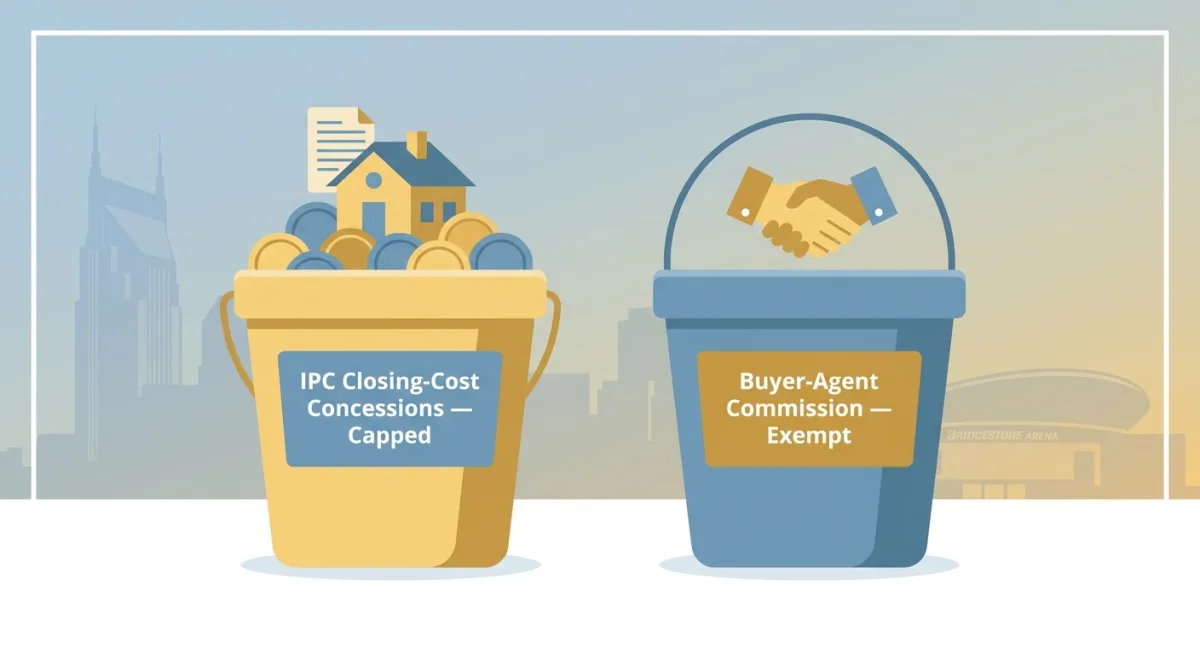
Your lender says seller concessions are capped at 6%. The buyer's agent wants you to pay a 2.5% commission on top of that. So which bucket does the commission come out of — and did you just blow past the cap and tank the loan?
Short version: those are two separate buckets. Closing-cost concessions (called interested party contributions, or IPCs) sit in one bucket with a hard cap set by the loan type. A customary seller-paid buyer-agent commission sits in a completely different bucket the caps don't touch. As of 2026, Fannie Mae (Selling Notice, April 15, 2024), Freddie Mac (Industry Letter, April 15, 2024), HUD (FHA INFO 2024-12), and the VA (Circular 26-24-14) all confirmed that customary buyer-agent compensation is excluded from IPC limits.
We run a flat-fee MLS operation in Tennessee, and this is the question that lands in our inbox most from FSBO sellers structuring a first offer. Mix the buckets and you can accidentally shrink a buyer's maximum insurable loan dollar-for-dollar.
Last reviewed: 2026.
What Counts as an Interested Party Contribution (IPC)?
An IPC is money paid toward the buyer's closing costs by anyone with a financial stake in the sale closing — the seller, the builder, the agents, or an affiliated lender. The federal underwriting guides treat all of it as one capped pool because too much help can artificially inflate the price a buyer is willing to pay.
That inflation risk is why underwriters call an over-the-limit IPC an inducement to purchase. When contributions cross the cap, the excess reduces the value the loan is calculated against, dollar for dollar.
What sits inside the capped bucket
- Loan origination and discount points
- Interest rate buydowns (temporary or permanent)
- Prepaid property taxes and homeowners insurance (escrows)
- Title insurance and settlement fees
- Recording fees, transfer taxes, and other standard closing costs
What doesn't
- Sales concessions — cash back to the buyer, personal property, or paying off the buyer's non-mortgage debt. These get deducted from value entirely.
- The buyer-agent commission, when it's standard and customary. That's Bucket 2.
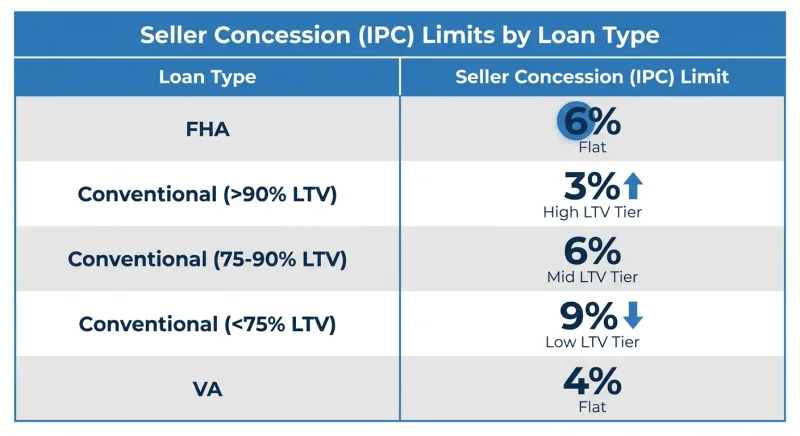
FHA, Conventional, and VA IPC Limits — The Matrix
| Loan Type | LTV / Condition | IPC Limit (Bucket 1) | Primary Source |
|---|---|---|---|
| FHA | Any LTV, owner-occupied | 6% flat | HUD Handbook 4000.1 II.A.4 |
| Conventional | LTV > 90% | 3% | Fannie Mae B3-4.1-02 / Freddie Mac 5501.5 |
| Conventional | LTV 75.01%–90% | 6% | Fannie Mae B3-4.1-02 |
| Conventional | LTV ≤ 75% | 9% | Fannie Mae B3-4.1-02 |
| Conventional | Investment property | 2% | Fannie Mae B3-4.1-02 |
| VA | Seller concessions | 4% (separate rule) | VA Lenders Handbook M26-7 |
FHA is flat. Six percent regardless of down payment for a primary residence.
Conventional scales with skin in the game. Most Tennessee first-time buyers land in the 3% tier because they're putting down less than 10%.
VA is its own animal. Its 4% rule is narrower and defined differently than the IPC framing on conventional and FHA loans. Don't assume the conventional math applies.
None of these caps includes the buyer-agent commission.
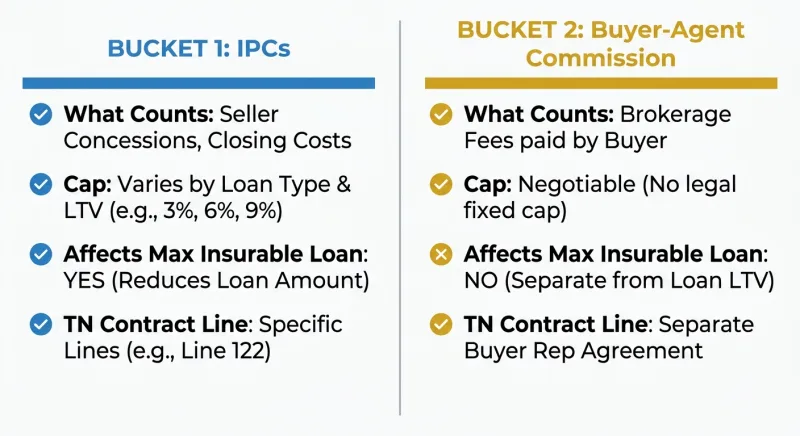
The Second Bucket: Buyer-Agent Commission Is Exempt
Before August 2024, buyer-agent pay rarely showed up as a seller concession on the buyer's loan. The NAR settlement changed the plumbing — buyer-agent compensation now gets negotiated openly and often lands on the seller's side of the closing statement, raising the obvious fear: does that eat into my 6% cap?
It doesn't. Current guidance, stacked for verification:
- Fannie Mae — Selling Notice, April 15, 2024
- Freddie Mac — Industry Letter, April 15, 2024
- HUD / FHA — FHA INFO 2024-12, March 28, 2024
- VA — Circular 26-24-14, effective August 10, 2024
All four confirmed that a seller-paid buyer-agent commission is excluded from IPC limits as long as it's common and customary for the market. Paying the buyer's agent doesn't count against your 3%, 6%, or 9% pool.
What "common and customary" actually means
The exemption isn't unlimited. The commission must reflect what's typical for buyer representation in your area — not a padded number designed to funnel extra cash to the buyer. If a seller pays an outrageous fee that clearly exceeds the market, an underwriter can reclassify the excess as an IPC or a sales concession. Standard Tennessee buyer-agent compensation — commonly 2% to 3% — sits comfortably inside "customary."
Two Buckets, Side by Side
| Bucket 1: IPC Concessions | Bucket 2: Buyer-Agent Commission | |
|---|---|---|
| What it covers | Closing costs, points, prepaids, rate buydowns | Compensation to the buyer's brokerage |
| Cap applies? | ✅ Yes — 3/6/9% (Conv), 6% (FHA), 4% (VA) | ❌ No, if common & customary |
| Affects max eligible loan? | ✅ Yes, if exceeded | ❌ No |
| Underwriting category | Financing concession | Excluded compensation |
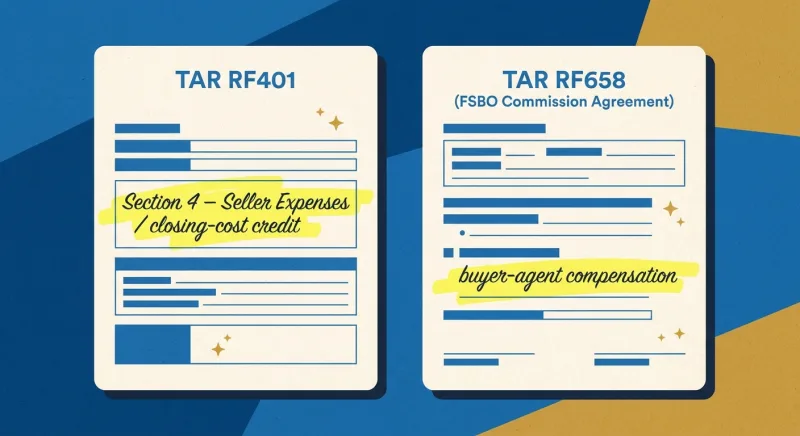
| Where it lives on TN paper | TAR RF401 §4 (Seller Expenses) | RF658 / compensation addendum |
| Source | B3-4.1-02 / 4000.1 / M26-7 | SEL-2024-03 et al. |
The two buckets don't just live in different underwriting sections — they live on different lines of your Tennessee contract.
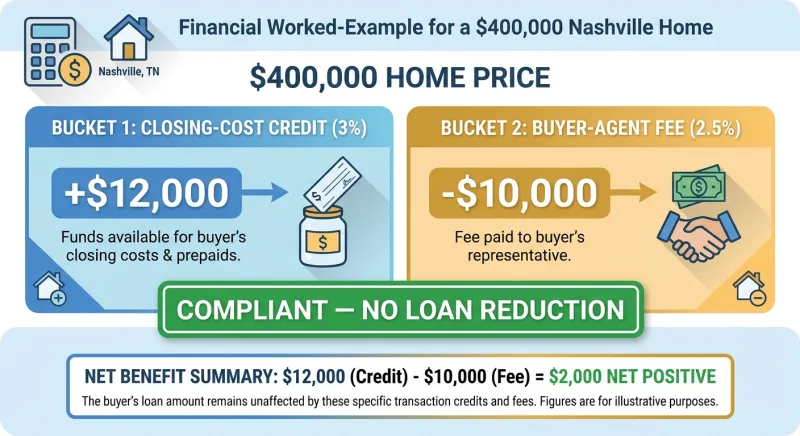
A Nashville Example: $400K, Both Buckets, Fully Compliant
A Nashville home lists at $400,000 and the buyer uses a conventional loan with 10% down. LTV is 90%, landing the deal in the 6% IPC tier.
Bucket 1 — IPC closing-cost concession: Seller pays 3%.
3% × $400,000 = $12,000 — well under the $24,000 ceiling. Compliant.
Bucket 2 — Buyer-agent commission: Seller pays 2.5%.
2.5% × $400,000 = $10,000 — customary, excluded from the IPC cap.
Combined seller-paid total: $22,000 — fully compliant, with zero reduction to the buyer's maximum loan. Lump both into one 6% bucket and you'd have counted $22,000 against a $24,000 cap and talked yourself out of a perfectly clean deal.
What Actually Happens When You Overfund the Cap
Most sellers assume exceeding an IPC cap just gets the excess "disallowed." It's worse. The overage gets reclassified as an inducement to purchase and subtracted dollar-for-dollar from the sales price before LTV is calculated.
A Memphis buyer at 96.5% LTV on an FHA loan against a $300,000 price has a 6% cap of $18,000. The seller agrees to $21,000.
- Excess over cap: $3,000
- Adjusted value: $300,000 − $3,000 = $297,000
- New max loan at 96.5%: ~$286,605 instead of $289,500
- Buyer's new cash gap: roughly $2,895 they weren't planning on
The seller "gave" more and the buyer ended up needing more cash. That's the trap — and it usually surfaces late, after the appraisal, when leverage has already shifted.
The Sales-Concession Trap FSBO Sellers Miss
Furniture, a car, decorating allowances, moving costs — Fannie Mae treats these as sales concessions and deducts them dollar-for-dollar from the sales price regardless of whether you're under the IPC cap.
Toss in the riding mower and patio set to sweeten a stalled offer and you may have created a sales concession that reduces the appraised-value basis, even though you never touched the IPC ceiling. Keep personal property off the contract and handle it in a separate bill of sale.
Rate Buydowns: The Concession That Eats the Cap Fastest
A 2-1 buydown on a $400,000 loan can run $10,000–$14,000 as a lump-sum subsidy — sitting squarely in the IPC bucket. On an FHA deal with a 6% cap of $24,000, a $12,000 buydown leaves only $12,000 for everything else: title, prepaids, points, origination.
The failure pattern: seller agrees to a buydown in the offer, then agrees to "cover closing costs" in a later addendum, and the stacked total quietly clears the cap. Price the buydown first, then see what's left in the bucket.
Where the Two Buckets Live on Your Tennessee Paperwork
Bucket 1 flows through TAR Form RF401, Section 4 (Financial Convention / Seller Expenses) — closing-cost help, prepaids, points, and buydown funding. That figure, and only that figure, is what the underwriter measures against the IPC cap.
Bucket 2 belongs on a separate compensation instrument — the buyer-broker compensation addendum (RF658 family) — not buried inside the RF401 seller-expense line. Write a customary commission into Section 4 and it can get swept into the IPC math and blow the cap. Documented on its own form as compensation for services, it stays outside the limit.
Escrow neutrality: the Tennessee wrinkle
Tennessee closings run through a title company or closing attorney as a neutral escrow agent. Under Tenn. Code Ann. § 62-13-302, the settlement agent disburses exactly what the signed documents instruct — they won't reallocate buckets for you. If RF401 and the compensation addendum don't cleanly separate the two buckets, the ALTA statement reflects exactly what you wrote, cap violation and all.
The two-column check before you sign
FSBO sellers on a flat-fee listing don't have a listing agent auditing the contract lines. Run this before you accept any offer:
- Capped: Is the seller-paid closing-cost figure alone under the buyer's IPC limit — 6% FHA, or LTV-based 3/6/9% conventional?
- Exempt: Is the buyer-agent commission on its own compensation instrument, described as customary compensation for brokerage services?
If a line doesn't clearly belong to one column, it's a problem waiting for underwriting to find.
Frequently Asked Questions
Can a seller pay the buyer's agent commission and closing-cost concessions on the same deal in Tennessee?
Yes. A standard, customary seller-paid buyer-agent commission sits outside the IPC cap, so you can offer it alongside capped closing-cost concessions on the same contract (FNMA SEL-2024-03; HUD ML 2024-06).
What is the seller concession limit on an FHA loan in Tennessee?
FHA caps interested-party contributions at a flat 6% of the sales price, regardless of loan-to-value (HUD Handbook 4000.1 II.A.4). Anything over 6% reduces the maximum insurable loan dollar-for-dollar.
How much can a seller contribute on a conventional loan?
IPC limits are tiered by LTV: 3% when LTV exceeds 90%, 6% between 75.01% and 90%, and 9% at 75% or below for a primary or second home (Fannie Mae B3-4.1-02; Freddie Mac 5501.5). Investment properties cap at 2%.
Are buyer-agent commissions counted against the IPC cap after the NAR settlement?
No. Fannie Mae, Freddie Mac, HUD, and the VA all confirmed in 2024 that customary seller-paid buyer-agent compensation is excluded from IPC limits (SEL-2024-03; Bulletin 2024-E; ML 2024-06; VA Aug 2024 policy).
Which TAR form do I use to offer these concessions as a Tennessee FSBO seller?
Closing-cost concessions go in TAR Form RF401 Section 4 (Seller Expenses); buyer-agent compensation is documented separately via RF658 or an addendum. Keeping them on separate lines mirrors the two-bucket accounting your buyer's underwriter uses.
What is the VA seller concession limit, and is it the same as the IPC cap?
The VA applies a separate 4% seller-concession rule covering specific items like prepaids and points (VA Lenders Handbook M26-7). It's distinct from the conventional IPC framing, and customary buyer-agent commission stays outside that 4%.
Get the Buckets Right on the Front End
Two separate buckets — that's the whole trick. Closing-cost concessions live in the capped IPC bucket, sized by loan type and LTV. The buyer's agent commission lives in its own bucket the caps don't touch when it's standard and customary.
Your next move as a Tennessee FSBO or flat-fee seller: decide what you'll offer in each bucket before you list. Put closing-cost help in RF401 Section 4, handle buyer-agent compensation on its own line, then advertise both openly on RealTracs — a stated buyer-agent offer and a concession range widen your buyer pool without hiring anyone full-service.
One honest caveat: loan limits, FHA county floors, and post-settlement guidance shift. Confirm current figures with your lender or closing attorney before you sign.
Last reviewed: 2026 — verify all cited limits with your lender before structuring an offer.