

A buyer walks through your Nashville house, loves it, and then mentions their agent. You didn't hire that agent. You never signed anything. So why does it suddenly feel like you owe someone 3%?
Here's the short version: you don't. Learning to negotiate a buyer agent representation agreement as a Nashville FSBO seller starts with one fact — that signed buyer-broker agreement (usually Form RF141 in Tennessee) is a contract between the buyer and their broker. It's not a contract with you. You set the terms of what, if anything, you pay toward that agent's fee.
I run flat-fee listings in Middle Tennessee, so I've watched this standoff play out across Davidson, Williamson, and Rutherford counties. The August 2024 NAR settlement changed the rules, and most sellers still don't realize how much leverage that shift handed them.
Quick note: This is general information, not legal advice. Have a Tennessee real estate attorney review your specific contract before you sign anything.
Are You Legally Bound by the Buyer's Representation Agreement?
Short version: no. A signed buyer-broker agreement is a private contract between the buyer and their brokerage. You aren't a party to it, and it creates no obligation for you to pay a commission.
The buyer's agent had their client sign Form RF141 before showing homes. That form spells out what the buyer owes their agent. It says nothing that reaches into your pocket. What you're really negotiating is one question: do you want to contribute toward the buyer's agent fee to help this specific deal close? Sometimes yes, because it makes the buyer's numbers work. Sometimes no. Either way, you set the terms.
What the NAR Settlement Changed (and Why It Matters to You)
Effective August 17, 2024, three changes matter here:
- Offers of buyer-broker compensation can no longer be advertised on the MLS. On Realtracs, you can't post a commission offer in the listing itself. Compensation is handled off-MLS, in the negotiation and the contract.
- Buyers must sign a written representation agreement before touring homes. That's why your buyer arrived with a signed RF141. It's now standard practice, not a red flag.
- Seller-paid buyer-agent compensation is optional and negotiable in every deal. Zero is a legitimate starting number.
In plain English: nobody can point to the MLS and say "the seller always offers 3%." That norm is gone. The commission is now a line item you negotiate directly, the same way you'd negotiate price or closing date.
The RF141 Shortfall Clause: Your Biggest Point of Leverage
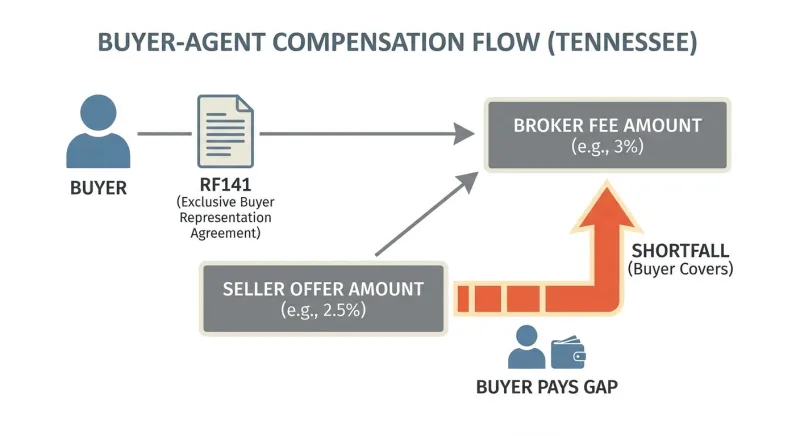
When the buyer signed Form RF141, they agreed to pay their agent a set amount — say 3%, or a flat fee. The agreement typically includes a commission shortfall provision: if the seller contributes less than that agreed amount, the buyer personally covers the difference.
Read the actual RF141 to confirm the exact shortfall language, since form revisions change over time — but the structure is consistent: the buyer, not you, is responsible for any gap between what you offer and what they agreed to pay their agent.
Real numbers: purchase price is $500,000, buyer agreed to pay their agent 3% — that's $15,000. If you offer a $7,500 contribution, the remaining $7,500 doesn't fall back on you. Under the terms the buyer signed, the buyer owes it.
That single fact reframes the whole negotiation. When an agent tells you "the commission is 3%," the honest response is: that's between you and your client.
A few practical realities:
- The buyer may not realize they're personally on the hook. That explains why some agents push hard on the seller — it's easier than telling their client to write a check.
- Some agents will ask the buyer to sign Form RF641 (Amendment to Buyer Agency Agreement) to reduce the fee so the buyer isn't stuck with a shortfall. You don't sign RF641 — it's between the buyer and their broker — but you can say plainly: "I'm offering 1.5%. Whatever you two work out on the rest is between you."
- Confirm the agent's status in writing using Form RF302 (Confirmation of Agency Status).
Have your closing attorney review how the RF141 terms interact with your purchase agreement.
What Do Buyer Agents Actually Charge in Nashville Right Now?
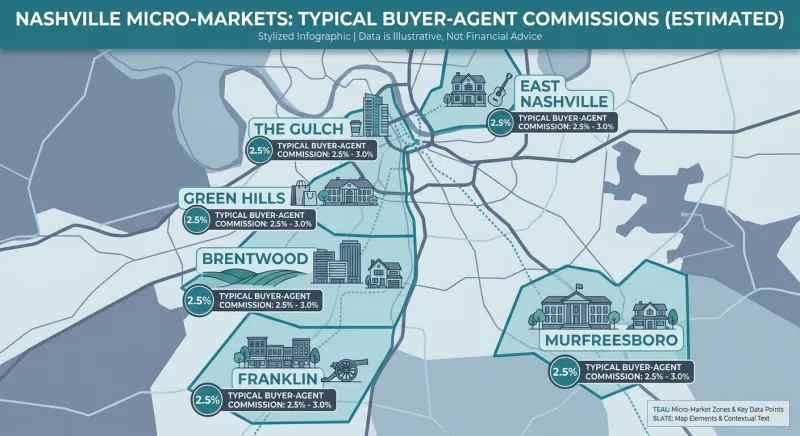
The figures below are typical observed ranges for 2026 — not statutory rates, not required amounts, and not something the MLS sets. Every one is negotiable.
| Nashville-area market | Typical 2026 buyer-agent range | County |
|---|---|---|
| East Nashville | ~2.5% or flat fee | Davidson |
| Green Hills / The Gulch | ~3% or flat fee | Davidson |
| Franklin | ~2.75% | Williamson |
| Brentwood | ~2.75% | Williamson |
| Murfreesboro | ~2.5%–3% | Rutherford |
| Clarksville | ~2.5%–3% | Montgomery |
Ranges are typical 2026 observations and vary by price point, property type, and individual agreement. They are not fixed rates.
On higher-priced Williamson County homes, a flat fee often makes far more sense than a percentage. Three percent of an $850,000 Brentwood house is $25,500 — hard to justify against the actual work involved. A flat buyer-broker fee of $5,000–$10,000 is reasonable and increasingly common. Use the benchmark to frame your offer, not to cap your leverage.
Your Three Options for Handling the Buyer's Agent Fee
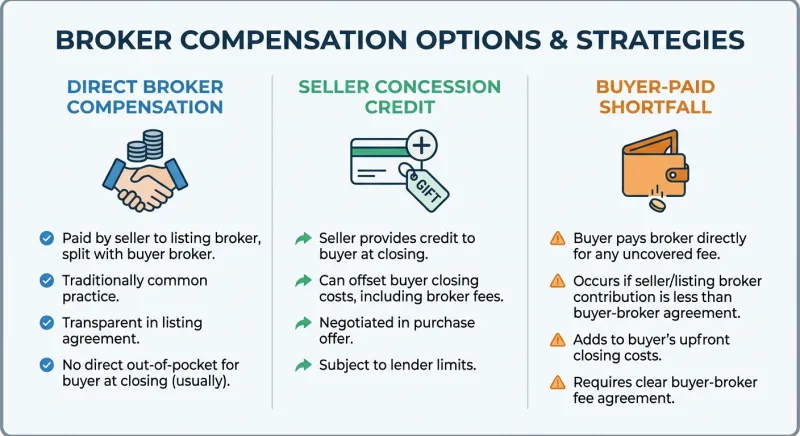
- Pay the buyer's agent directly. You agree to a specific dollar amount or percentage paid to the buyer's brokerage at closing, written into the purchase agreement.
- Offer a seller concession the buyer applies as they choose. You credit the buyer a set amount at closing via Form RF707 (Additional Contract Language). The buyer can apply it toward their agent's fee, closing costs, or rate buy-down.
- Offer nothing toward the agent and let the buyer cover it. You hold your price firm and contribute zero. The buyer pays their agent per their RF141.
| Option | Who pays the agent | Impact on your net proceeds | Best when |
|---|---|---|---|
| Direct payment to buyer's broker | You (at closing) | Reduces net by the exact fee | Buyer is tight on cash; you want the deal locked |
| Seller concession credit (RF707) | Buyer, using your credit | Reduces net by the credit amount | Buyer wants flexibility across fee + closing costs |
| Buyer covers shortfall | Buyer (out of pocket or via price) | No reduction — or offset by higher price | You have a strong price and a motivated buyer |
Match the structure to your buyer's real constraint
| If the buyer's real problem is… | Best structure | Why |
|---|---|---|
| Short on cash to close | Direct seller-paid buyer-broker comp | Keeps their cash intact without touching the capped concession allowance |
| Tight on down payment, fine at closing | Raise price, route difference as buyer-broker comp | Finances the fee into the loan — verify appraisal supports it |
| Fine on cash, anchored to "3%" | Flat buyer-broker fee (e.g., $6,000, not a %) | Reframes from percentage to dollars; lands lower on higher-priced homes |
| Wants max help but IPC-capped | Split: buyer-broker comp separate + smaller concession | Uses both buckets deliberately instead of overloading one |
A percentage demand is almost never really about the percentage — it's about liquidity, LTV, or an anchor the agent set months ago. Solve that and "we need 3%" softens fast.
One hard ceiling on the price-raise move: the appraisal. If you bump $525,000 to $531,500 and the house appraises at $525,000, the loan is short and someone brings cash — or the deal dies. On a home with appraisal headroom, it's often the cleanest path. On an aggressively priced home, don't lean on it.
The 2026 Double-Bucket IPC Rule (The Financing Trap Nobody Explains)
Under 2026 GSE guidance, buyer-broker compensation paid by the seller is treated separately from standard seller concessions — the "double-bucket" approach. Fannie Mae's Selling Guide addresses it in the Interested Party Contributions (IPC) section (B3-4.1-02).
- Bucket one — standard IPC/seller concessions: closing costs, prepaids, discount points, rate buydowns. Capped by loan program.
- Bucket two — buyer-broker compensation: a seller contribution toward the buyer's agent fee that does not count against the standard IPC concession cap.
Before this treatment, a seller contribution toward the buyer's agent could eat into the buyer's limited concession allowance and blow past the loan cap — tanking the deal. Now those dollars live in a separate bucket.
The labeling matters: routing a $6,000 shortfall as a "concession" is not the same as agreeing to pay a $6,000 buyer-broker fee. Same cash to you — very different financing treatment for the buyer. If you casually agree to "just add it to the seller credit," you may quietly push them over their IPC cap and trigger an underwriting problem nobody saw coming. Get the structure named correctly from the start: buyer-broker compensation documented as buyer-broker compensation, general closing help documented as a seller concession.
Confirm the exact treatment with the buyer's lender before you finalize numbers. Loan type, occupancy, and LTV all change the caps and the bucketing.
Confirm Agency Status Before You Negotiate Anything
Not every buyer who arrives with an agent has a signed exclusive agreement. Some have a non-exclusive arrangement. "I represent the buyer" and "the buyer owes me a fee" are two different statements — the second only holds if the compensation terms are actually in force.
Request confirmation in writing using Form RF302 (Confirmation of Agency Status). A simple, direct line does the work:
"Before we talk compensation, can you send over written confirmation of your agency status? I want to make sure I understand who you represent and what the buyer's agreement actually obligates."
Two things happen: you learn whether a shortfall obligation even exists, and you signal — politely — that you've read the forms. Agents negotiate differently once they know that.
The Net-Proceeds-First Script
Buyer's agents anchor you on a percentage because percentages sound like rules. They're not — they're opening offers dressed up as policy. Stop negotiating the percentage. Negotiate the number that lands in your pocket at closing.
- Start from your walk-away net, not their ask. Decide the number you need in hand. Everything else is math from there.
- Convert every percentage to a flat dollar figure out loud. "So you're asking for $13,750 on this one?" Saying it plainly resets the frame.
- Offer a flat buyer-broker fee, not a percentage. A flat $5,000 or $7,500 is defensible, easy for a lender to document, and caps your exposure. Percentages scale against you as price climbs; flat fees don't.
- Route any remaining gap to the buyer via RF141. If their contract says 3% and you offered a flat fee, the shortfall is the buyer's contractual obligation — not yours.
The contrarian move: offer compensation on RF707, unprompted, at a flat figure you chose. It signals good faith, keeps the agent engaged, and locks the negotiation on your terms before they anchor you on a percentage. You look generous while capping your exposure — give a little, on purpose, on paper you control.
Edge Cases That Break the Standard Script
The dual-fee ask. Occasionally an agent frames it as "my buyer's fee plus a transaction fee." Buyer-broker compensation and any separate "transaction coordination" or "document fee" are distinct line items — the second is fully negotiable or refusable. Ask for every proposed charge itemized, in writing, before you agree to a number.
The verbal-only offer. Post-settlement, compensation you offer a buyer's agent belongs in the contract — typically through Form RF707 attached to your Form RF401 (Purchase and Sale Agreement) — not promised over the phone. A verbal "yeah, I'll take care of you" gives you zero control over financing treatment and is a lawsuit waiting to happen. If it's not written into the deal, it doesn't exist.
Two agents claiming the same buyer. If the buyer viewed your home with Agent A but wrote the offer through Agent B, you may face a procuring-cause dispute between the two agents. Keep a dated log of every showing, who accompanied whom, and every inquiry. You compensate whoever is named in the accepted contract.
The above is general information, not legal advice. Contract structure, agency status, and procuring-cause disputes are fact-specific — have a Tennessee real estate attorney and the buyer's lender review the actual terms before closing.
How Your Listing Structure Multiplies Your Leverage
Your leverage is directly tied to how the buyer found you. A buyer's agent who found your home on Realtracs and brought a ready buyer wants this deal to close as much as you do — shared incentive is where fair, low-shortfall deals get made.
Broad Realtracs exposure means agents come to you, already committed to your specific property, which lets you offer a flat fee instead of a percentage. A Nashville flat fee listing puts your house in front of every agent in Middle Tennessee at 0% listing commission — the same exposure, without handing over a percentage of your equity to sell your house in Nashville without a realtor.
Frequently Asked Questions
Am I liable for the shortfall if the buyer's agent's fee is more than what I offer?
No — under a signed exclusive buyer representation agreement (Form RF141), the buyer is personally responsible for covering any shortfall between what you offer and what they agreed to pay their broker. That contract is between the buyer and their agent, not you.
Does a Nashville FSBO seller have to pay the buyer's agent at all?
No. Nothing in the buyer's RF141 obligates you to pay their agent anything. You choose whether to offer buyer-broker compensation, a seller concession, or nothing — and the buyer covers whatever their agreement requires beyond that.
How much do buyer's agents typically charge in Nashville in 2026?
Typical observed 2026 buyer-broker fees in Middle Tennessee run roughly 2.5% to 3% of purchase price, though flat-fee arrangements are increasingly common. These are negotiable ranges, not fixed rates.
Can I use seller concessions to cover the buyer's agent fee instead of paying it directly?
Yes, but be careful. Under 2026 GSE guidance, buyer-broker fees and standard closing-cost concessions fall into separate "buckets" for loan-limit purposes. Always confirm the structure with the buyer's lender before finalizing.
What is a buyer-broker agreement in Tennessee?
In Tennessee, a buyer-broker agreement (Form RF141) is a contract between a homebuyer and their brokerage that sets what the buyer owes their agent. It binds the buyer to their broker — not the seller — and post-settlement, buyers must sign one before touring homes.
What Tennessee form confirms who represents the buyer?
Form RF302, the Confirmation of Agency Status, documents the agency relationship in the transaction. Requesting it early clarifies exactly who the agent represents and what their client agreed to pay.
Is this legal advice?
No. This is general information for Nashville FSBO sellers — have a Tennessee real estate attorney review your specific contract before you sign anything.
The Bottom Line
A buyer's signed representation agreement is their problem to solve, not yours. Form RF141 ties that buyer to their broker — it doesn't reach across the table and put its hand in your net proceeds. You decide what, if anything, you contribute toward their agent's fee. If a shortfall exists between your offer and their agreement, the buyer covers it. That's the leverage you walked in with, whether you knew it or not.
Pick the structure that protects your bottom line: a direct buyer-broker fee, a concession through RF707, or letting the buyer absorb the gap. Get the terms into RF401 correctly, and let your closing attorney and the buyer's lender confirm the details before anyone signs.
Know your numbers. Read your forms. Negotiate from strength, and keep the money you earned.