

Managing Multiple Offers as a Tennessee FSBO Seller: Why a Dashboard Wins
Three offers land in two days. Now what?
When you're selling by owner in Tennessee and the offers start stacking up, a good offer management dashboard for FSBO Tennessee sellers turns a stressful pile of PDFs into a clear, side-by-side decision. Not a gut call. A comparison you can actually defend.
Here's the rule most sellers miss:
The number on the offer is not the money you keep. Compare net proceeds, not list price. A financed $420,000 offer asking for $8,000 in concessions nets you less than a clean $412,000 cash offer closing in 14 days. Highest offer rarely wins.
This guide is for the seller running their own sale through a flat-fee MLS listing — unrepresented, managing the paperwork, comparing multiple offers in TN without guessing.
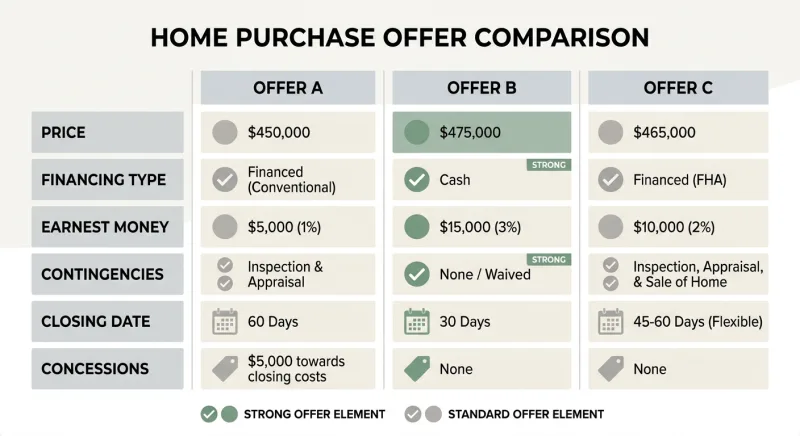
What an Offer-Management Dashboard Actually Does
An offer-management dashboard is any organized view — digital or built by hand — that collects every offer and displays them side by side using the terms that actually matter. As an FSBO seller, the dashboard is your agent for this one task. A good FSBO offer management tool for Tennessee sellers does five things:
- Captures each offer — price, financing type, earnest money, contingencies, requested concessions, closing date.
- Normalizes the terms so you compare apples to apples, not a cash offer against a financed one on price alone.
- Calculates net proceeds after transfer tax, concessions, prorations, title charges, and loan payoff.
- Tracks deadlines — offer expiration, inspection periods, financing contingency dates, binding agreement date.
- Stores documents — the offer PDF, proof of funds, pre-approval letter, and any counters you send.
The dashboard doesn't make the decision. It strips away the emotion so you decide on facts. One honest limit: no tool reads intent. A dashboard can't tell you a buyer is stretched thin or that a lender is slow — that judgment stays yours.
How Offers Reach a Tennessee FSBO Seller
When a buyer is represented, their agent usually sends the offer on the Tennessee REALTORS Purchase and Sale Agreement — commonly Form RF401. It isn't legally mandatory — you may use an attorney-drafted contract instead — but you'll see RF401 constantly because buyer's agents default to it.
A complete offer packet includes:
Proof the buyer can actually close
- Proof of funds (POF) for cash offers — a recent bank or brokerage statement.
- Pre-approval letter for financed offers — ideally underwritten, not just a prequalification. A prequal is a guess; an underwritten approval is close to a promise.
The money and the terms
- Offer price and financing type (this drives risk).
- Earnest money deposit amount and who holds it.
- Requested closing concessions (buyer costs you're asked to cover).
- Contingencies — inspection, appraisal, financing, sale-of-home.
- Proposed closing date and possession terms.
A common pattern: a strong-looking price arrives with no POF and a shaky prequal. Log what's missing as its own column — "docs complete?" — because an incomplete packet is a negotiating point, not a dealbreaker. A buyer putting down a larger earnest money deposit has more skin in the game, which usually means a lower chance they walk after the binding agreement date.
How to Compare Multiple FSBO Offers in Tennessee (Step by Step)
Don't rank offers by price. Rank them by what you net and how likely it closes.
1. Log every offer in one place. Price, financing, earnest money, concessions, contingencies, closing date, and whether the docs are complete. One row per offer.
2. Convert each price to net proceeds. Subtract transfer tax, concessions, prorated taxes, title/escrow charges, and your loan payoff. This is where many "winning" offers drop to second place.
3. Score financing certainty. Cash with verified POF is the gold standard. Underwritten financed approval is strong. A bare prequal is a question mark. A sale-of-home contingency is weakest.
4. Weigh the contingencies. Fewer contingencies means fewer exit ramps. Watch for escalation clauses, broad inspection outs, and short financing deadlines that quietly extend the risk window.
5. Check timeline fit. A 14-day cash close helps if you've already bought elsewhere. A 45-day financed close with flexible possession might suit a Franklin new-build seller waiting on their next home.
6. Rank by net + certainty, then move. Top net proceeds with solid financing wins. If two are close, the tiebreaker is whichever buyer is likeliest to reach the closing table.
Calculating True Net Proceeds in Tennessee
Your net is the sale price minus every cost that comes off the top at closing.
The Tennessee Realty Transfer Tax
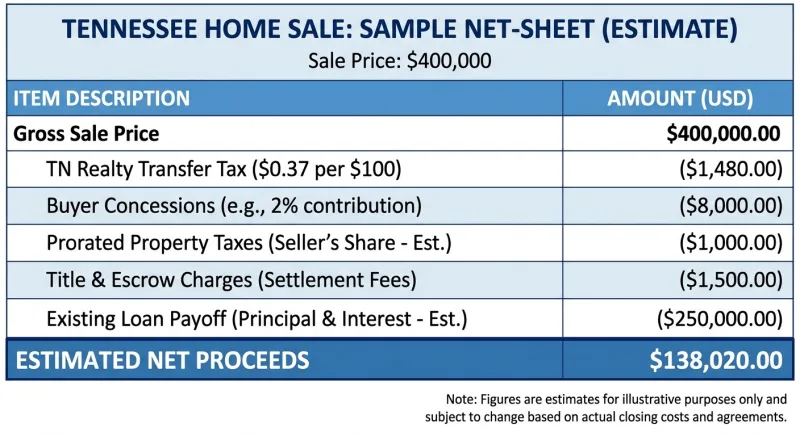
Tennessee charges a Realty Transfer Tax of $0.37 per $100 of value (Tenn. Code Ann. § 67-4-409; Tennessee Department of Revenue). On a $400,000 sale:
$400,000 ÷ 100 × $0.37 = $1,480.
Confirm the current rate with the Department of Revenue, and check which party the contract assigns the tax to — that's negotiable.
A worked $400,000 Tennessee net sheet
| Line item | Amount | Notes |
|---|---|---|
| Sale price | $400,000 | The offer number |
| Realty Transfer Tax | –$1,480 | $400,000 ÷ 100 × $0.37 |
| Buyer closing concessions | –$6,000 | If the offer includes them |
| Prorated property taxes | –$1,100 | Seller's share through closing (varies by county and date) |
| Title / escrow / recording | –$1,800 | Depends on who pays what in the contract |
| Buyer's agent compensation | –$10,000 | Only if you agreed to it; many FSBO deals do |
| Mortgage payoff | –$250,000 | Illustrative; yours comes from your lender's payoff statement |
| Estimated net to seller | $129,620 | What actually lands in your account |
A few things quietly move the net:
- Concessions are a price cut in disguise. A buyer asking $7,000 toward closing costs on a $410,000 offer is really offering $403,000 of net value.
- Proration follows the closing date. Tennessee property taxes are paid in arrears. A mid-December close shifts a different slice onto you than one closing in March.
- Buyer's agent compensation is a line item, not a surprise. Price it in before you rank.
Reading Past the Price Line: An Offer's Durability
A dashboard forces you to score the durability of each offer — the probability that the price on paper survives to the closing table.
Build a closing-risk score
Score each offer across five factors, 1 (low risk) to 5 (high risk):
- Financing type. Cash removes appraisal and lender risk. Conventional with 20%+ down is low-risk. FHA/VA carries appraisal sensitivity and stricter property-condition standards.
- Appraisal gap coverage. A financed buyer who agrees in writing to cover a gap behaves more like cash. No gap language on a high offer in a thin-comp neighborhood is a flag.
- Earnest money ratio. A buyer putting 1% at risk walks more easily than one putting 3%.
- Contingency load. Count the live contingencies — inspection, appraisal, financing, sale-of-buyer's-home. Each is an exit the buyer keeps.
- Timeline fit. An aggressive closing date can be a feature or a trap, depending on the buyer's lender.
Sum the five. A $415,000 cash offer scoring 9 beats a $425,000 FHA offer scoring 19 for most sellers who need certainty.
Two offers that look identical and aren't
| Line item | Offer A (cash) | Offer B (financed) |
|---|---|---|
| Contract price | $415,000 | $422,000 |
| Buyer concessions | $0 | –$7,000 |
| Transfer tax ($0.37/$100) | –$1,535 | –$1,562 |
| Appraisal risk | None | Live |
| Est. days to close | 14 | 40 |
| Approx. net before payoff/title | ~$413,465 | ~$413,438 |
Nearly the same net. Radically different certainty. Compare net, then let risk break the tie.
The home-sale contingency deserves its own rule
Treat it as a different species of offer: it makes your sale depend on a transaction you can't see or control. Either reject it, or accept it only with a kick-out clause — language letting you keep marketing and bump that buyer if a cleaner offer arrives.
Countering Multiple Offers Legally: Form RF651 and the Binding-Counter Trap
You rarely accept an offer exactly as written. You counter — commonly on Form RF651, the Tennessee REALTORS Counter Offer, though an unrepresented seller may use attorney-drafted language instead.
The multiple-binding-counter trap
When you have three offers, the instinct is to counter all three. The danger: a counteroffer is itself an offer, and the buyer's signature can form a contract. Send firm, acceptable counters to two buyers and have both sign and return before you withdraw either, and you may owe the same house to two buyers. Three defensible approaches:
- Counter one at a time, sequentially. Counter the strongest offer with a short expiration (24–48 hours). If it dies, move to the next. Slow, but you're never exposed to two live acceptances.
- Call for highest-and-best. Notify all buyers you've received multiple offers and ask each to submit their best terms by a deadline. You're inviting offers, not making them — which shifts the binding risk back to the buyers and often raises price.
- Counter multiple offers only with explicit non-binding language reserving your right to accept any one offer at your sole discretion, binding only when you separately sign.
Because this is where real liability lives, confirm the current RF651 language and your specific wording with a licensed Tennessee real estate attorney before countering multiple buyers at once. Respond to every offer, even weak ones — a quick counter keeps a backup buyer warm while your lead offer works through inspection and financing.
Escalation Clauses: The Edge Case FSBO Sellers Mishandle
An escalation clause says a buyer will beat any competing offer by a set increment, up to a ceiling: "We'll pay $2,000 above the highest bona fide offer, up to $430,000."
They look clean. They create three problems:
- Proof obligation. The escalating buyer is entitled to see the competing offer that triggered it.
- You can't manufacture a floor. Using a weak or non-existent "competing offer" to push a buyer to their ceiling invites a dispute.
- The ceiling is a tell. It reveals the buyer's true top. A sharp counter asks them to simply offer that ceiling as a firm number, removing the contingent machinery.
In a dashboard, log escalation offers at their ceiling for comparison, but flag it as conditional. Never treat the ceiling as committed until it's a signed, fixed number.
Sequencing Offers Against Your Showing Pipeline
Offer management and showing management are the same workflow when demand is live. Build a decision cadence into your dashboard:
- Response SLA. Acknowledge every offer within hours, even if your answer is "we're reviewing through Sunday at 6 PM."
- Deadline tied to showing volume. Eight showings scheduled? A highest-and-best deadline is defensible. Two showings? It isn't — an artificial deadline on thin traffic reads as a bluff.
- A backup-offer row. Tennessee contracts allow backup offers in a secondary position. Logging an accepted backup keeps a live buyer attached if your primary deal collapses in inspection.
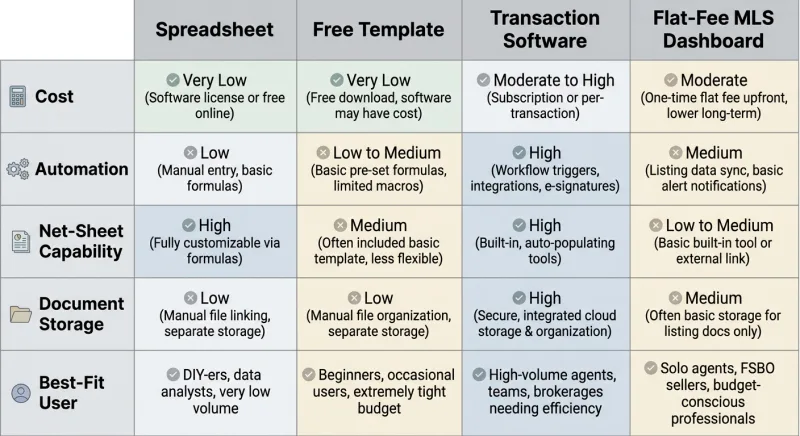
Offer-Management Tools Compared
| Spreadsheet (DIY) | Free template | Transaction software | Flat-fee MLS dashboard | |
|---|---|---|---|---|
| Cost | Free | Free | Paid subscription | Usually bundled with the listing |
| Automation | None — you build it | None | High | Moderate to high |
| TN net-sheet math | Only if built correctly | Rarely TN-specific | Generic; not TN-tuned | Can be built for TN figures |
| Document storage | Manual folders | Manual | Yes | Usually yes |
| Best fit | One or two offers, formula-comfortable | A single simple offer | Investors / high volume | FSBO seller fielding several offers |
Where each one breaks:
- A spreadsheet is free and flexible, and exactly as accurate as your formulas. Enter the transfer tax wrong once and every comparison inherits the error.
- A free template gets you moving, but almost none are tuned to Tennessee — no RF401/RF651 awareness, no $0.37-per-$100 line, no county proration.
- Transaction software automates beautifully but is overkill for one property, and the net-sheet logic is generic anyway.
- A flat-fee MLS dashboard keeps offers, net sheets, and documents next to the listing that generated the demand. Its limit: it manages offers; it doesn't give legal advice.
Verify the Tennessee numbers no matter which tool you pick.
No Offers Without Exposure
You can't compare multiple offers you never received. A multiple-offer situation isn't a tool feature — it's the result of enough buyers seeing your home to compete for it. That means getting your property in front of agents and buyers searching the MLS, through syndication to Realtracs statewide and regional associations like Greater Nashville REALTORS and East Tennessee REALTORS.
A dashboard holding a single lowball offer isn't a negotiation. Exposure comes first; offer management comes second.
Frequently Asked Questions
How do I compare multiple offers as a Tennessee FSBO seller?
Compare net proceeds, not list price — subtract each offer's concessions, Realty Transfer Tax ($0.37 per $100 under Tenn. Code Ann. § 67-4-409), prorated taxes, and title charges to see what you actually keep. Then weigh financing type, earnest money, contingencies, and closing timeline using a dashboard or a simple side-by-side worksheet.
How much is the Tennessee transfer tax on a $400,000 home sale?
Tennessee charges a Realty Transfer Tax of $0.37 per $100 of value (Tenn. Code Ann. § 67-4-409), so a $400,000 sale incurs $1,480. It's one of several closing costs that separate an offer's headline number from your true net.
What form does a buyer use to submit an offer to a Tennessee FSBO seller?
Buyers and their agents commonly use the Tennessee REALTORS Purchase and Sale Agreement (Form RF401), though it isn't legally mandatory — an unrepresented seller may use an attorney-drafted contract. The packet typically includes earnest money terms, a pre-approval or proof-of-funds letter, and contingencies.
Can I counter more than one offer at the same time in Tennessee?
Be careful: countering multiple buyers simultaneously can create a binding-counteroffer risk if more than one accepts, potentially obligating you to two contracts. Tennessee REALTORS Form RF651 (Counter Offer) is commonly used, but consult a licensed Tennessee real estate attorney before issuing simultaneous counters.
Do I need software to manage offers, or is a spreadsheet enough?
A spreadsheet works for two or three offers if you build a net-proceeds column; dedicated FSBO offer management tools add automation, document storage, and built-in net sheets for busier situations. Match the tool to your volume.
Why do I need an MLS listing before worrying about managing offers?
Multiple offers only happen when enough buyers see your home. A flat-fee MLS listing syndicates your property through Realtracs and regional associations like Greater Nashville REALTORS and East Tennessee REALTORS, generating the demand that makes an offer-management dashboard useful.
The Bottom Line
Managing multiple offers solo isn't about picking the biggest number. It's about knowing which offer leaves the most money in your pocket after Tennessee's closing math — and which buyer is most likely to actually close.
An offer management dashboard for FSBO Tennessee sellers lines up price, financing, earnest money, contingencies, and closing dates side by side, then runs each through a true net sheet. On a $400,000 sale, the $1,480 Realty Transfer Tax, plus concessions and prorations, can reshuffle which offer wins.
Build a net-proceeds view for every offer. Confirm each buyer's pre-approval or proof of funds. When you counter, use the current Tennessee REALTORS forms — commonly RF401 and RF651 — and before issuing simultaneous counters, talk to a licensed Tennessee real estate attorney about binding-counteroffer risk. Rates and form numbers change; verify both when you sell.
None of this matters without buyers at the table. List first, syndicate wide, then let the dashboard do the comparing. An offer is a conversation, not a verdict — run the numbers and answer with confidence.