

Average Real Estate Commission in Tennessee 2026: Rates, Ranges & How to Pay Less
The Quick Answer
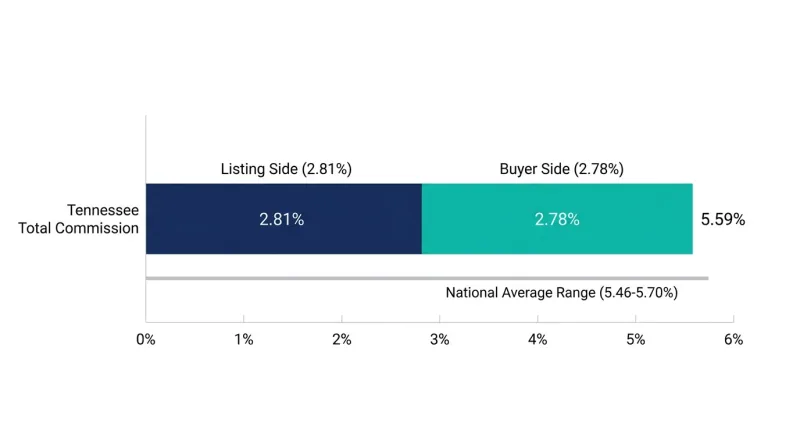
The average real estate commission in Tennessee 2026 runs about 5.59% of the sale price, split roughly 2.81% to the listing agent and 2.78% to the buyer's agent. On the state's median home price of $427,600, that works out to $23,902 gone at closing.
For most Tennessee sellers, it's the single largest cost of the entire sale.
Two 2026 realities quietly reshape your math. The 2024 NAR settlement rewired how buyer-agent pay works. And Tennessee is one of roughly nine states where buyer commission rebates are flat-out illegal under T.C.A. § 62-13-302. Together, they mean the only reliable lever you control is the listing-side commission — and we'll show you exactly how to pull it.
What Is the Average Realtor Commission in Tennessee Right Now?
Commission isn't set by law, and it isn't a fixed number. But across Tennessee listings in 2026, the typical total runs around 5.59%:
| Commission piece | Typical 2026 rate |
|---|---|
| Total commission | 5.59% |
| Listing agent side | 2.81% |
| Buyer's agent side | 2.78% |
That puts Tennessee right in line with the national average, which sits in the 5.46%–5.70% range for 2026.
Three things worth knowing:
Commission is a percentage, not a flat invoice. Sell for more, you pay more — same rate, bigger dollar figure.
The total gets split between two brokerages. That split isn't always even, and in 2026 it's increasingly negotiated separately for each side.
Every rate is negotiable. Tennessee law mandates no commission percentage. The 5.59% figure is a market average — a starting point, not a rule.
How Much Commission Will You Actually Pay?
On the Tennessee median home of $427,600 at 5.59%:
$427,600 × 5.59% = $23,902 total commission
Of that, about $12,016 is the listing side (2.81%) and $11,887 is the buyer's side (2.78%). The listing side is the piece you control.
| Sale price | Total commission (5.59%) | Listing side (2.81%) | Buyer side (2.78%) |
|---|---|---|---|
| $300,000 | $16,770 | $8,430 | $8,340 |
| $427,600 (TN median) | $23,902 | $12,016 | $11,887 |
| $600,000 | $33,540 | $16,860 | $16,680 |
| $850,000 | $47,515 | $23,885 | $23,630 |
| $1,475,000 (Brentwood median) | $82,443 | $41,443 | $41,005 |
A seller in Brentwood pricing at the local median could hand over more than $82,000 in commission — with the listing side alone north of $41,000. The higher your home's value, the more a single percentage point weighs.
Average Commission by Tennessee City & Market
| City | Median home price (2026) | Est. total commission @ 5.59% | Governing MLS |
|---|---|---|---|
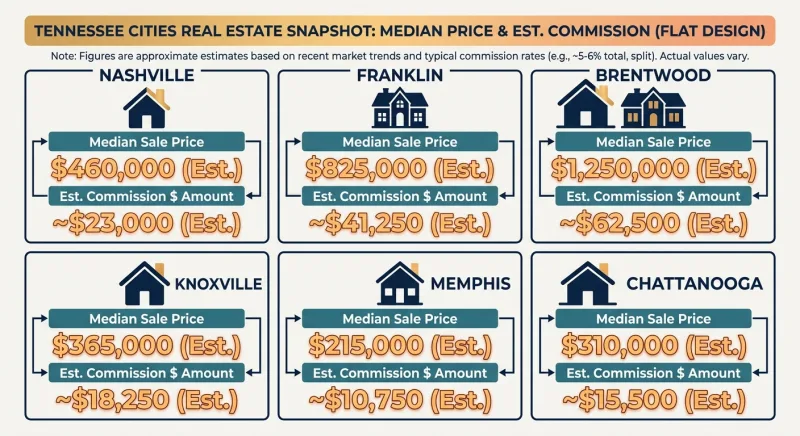
| Nashville | ~$460,000 | ~$25,714 | RealTracs |
| Franklin | ~$850,000 | ~$47,515 | RealTracs |
| Brentwood | ~$1,475,000 | ~$82,443 | RealTracs |
| Murfreesboro | ~$430,000 | ~$24,037 | RealTracs |
| Clarksville | ~$340,000 | ~$19,006 | RealTracs |
| Knoxville | ~$375,000 | ~$20,963 | KAARMLS |
| Chattanooga | ~$360,000 | ~$20,124 | Greater Chattanooga REALTORS MLS |
| Memphis | ~$265,000 | ~$14,814 | MAAR |
Middle Tennessee carries the heaviest load. Nashville, Franklin, Brentwood, and Murfreesboro all list through RealTracs, and higher price points mean the largest dollar commissions in the state.
East and West Tennessee run leaner on price, not rate. Knoxville (KAARMLS) and Chattanooga sellers pay the same percentage on lower medians, landing closer to $20,000. Memphis (MAAR) sees totals under $15,000.
The rate doesn't care which city you're in. Your home value does. And no matter which MLS governs your sale, the listing-side commission is the lever you can actually pull.
The Negotiation Levers Most Sellers Never Pull
A listing agent's floor is set by three things: expected days on market, price point, and whether the agent double-ends the deal. On a $1,475,000 Brentwood home, 2.81% is $41,448 for roughly the same labor as a $427,600 listing that pays $12,016 — high price points are where percentage pricing stops matching the work.
| Lever | Negotiable? | Why |
|---|---|---|
| Listing-side percentage | Yes | Not set by law or TREC; the single biggest lever. |
| Buyer-side concession offered | Yes | You choose what, if anything, to offer. |
| Length of listing agreement | Yes | A 90-day term gives leverage a 12-month term surrenders. |
| Cancellation terms | Yes | Negotiate an easy out before you sign, not after. |
| "Transaction" or admin fees | Sometimes | The $300–$500 brokerage junk fee is often waivable. |
| TREC-required disclosures | No | Statutory. Nobody waives these. |
Most sellers accept the first number because they never knew the term length and cancellation clause were on the table too.
The 2026 Rules That Change Your Math
The August 2024 NAR settlement's practical change: buyer-agent compensation is no longer advertised inside the MLS, and buyers now sign a written buyer representation agreement before touring a home. The old automatic "the seller always pays both sides" assumption is gone. Buyer-side pay is now negotiated off-MLS, usually through seller concessions written into the purchase contract.
When a buyer has no agent. More Tennessee buyers now tour unrepresented to avoid signing a buyer agreement. If an unrepresented buyer brings a strong offer, there's no buyer-side commission to pay — the 2.78% evaporates. On a $427,600 sale, that's roughly $11,887 that stays in your pocket.
When a buyer's agent demands a concession. A represented buyer may write their offer contingent on you covering their agent's 2.5–3% as a seller concession. You can now counter the concession separately from the price — sellers who treat it as negotiable routinely do better than sellers who wave it through.
The dual-agency trap. If one agent represents both sides, scrutinize it. Tennessee allows designated agency, but ask flatly: who do you represent, and what are you being paid by each side? Get it in writing.
Why the Rebate Ban Makes Listing-Side Savings the Only Real Lever
Rebates are illegal. Under T.C.A. § 62-13-302, a Tennessee agent cannot hand a buyer cash back from their commission. In most of the country, a buyer can pocket 1–2% of the purchase price at closing through a rebate. Not here.
The buyer-side lever is dead. In rebate-legal states, savvy buyers squeeze savings from the ~2.78% buyer-agent side. In Tennessee, that door is closed by statute.
That leaves exactly one lever: the listing side. The ~2.81% listing commission is the only portion a Tennessee seller can legally reduce. Everything else is fixed by market practice or forbidden outright. Most "save on commission" advice is copy-pasted from national templates that assume rebates are legal — in Tennessee, half that playbook is literally against the law.
Commission Gravity: The Bigger Your Sale Price, the Heavier the Case to Unbundle
Percentage-based fees have a quiet property that works against sellers: the cost grows with your home's value, while the work doesn't.
| Sale price | Listing-side commission (~2.81%) | What that money buys |
|---|---|---|
| $300,000 | ~$8,430 | MLS listing + agent services |
| $427,600 (TN median) | ~$12,016 | MLS listing + agent services |
| $650,000 | ~$18,265 | MLS listing + agent services |
| $1,475,000 (Brentwood tier) | ~$41,448 | MLS listing + agent services |
The far-right column never changes. The photos, the showings, the paperwork — none of it gets four times harder because your house is worth four times more. The flat fee doesn't grow. The percentage does. If you're selling above the Tennessee median, gravity is working hardest against you — and that's exactly where unbundling the MLS listing saves the most.
Unbundling vs. Discounting: Why "Negotiating the Rate" Is the Weaker Move
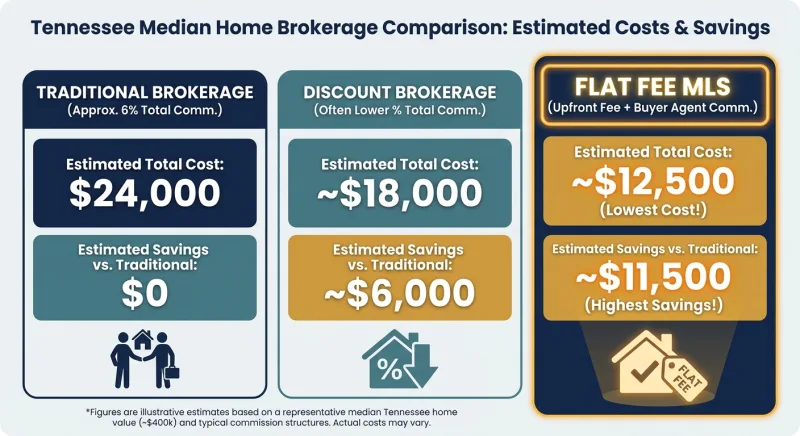
- Discounting keeps the percentage model and shaves it. On the median home, trimming the listing side from 2.81% to 2% saves roughly $3,463. Real money — but the gravity problem still applies.
- Unbundling throws out the percentage entirely. You pay a flat fee for the MLS listing — the one service you genuinely can't replicate — and handle showings and negotiation yourself.
Discounting is a smaller slice of the same pie. Unbundling is a different pie.
The honest trade-off: unbundling only pays off if you're a confident seller willing to manage showings, field buyer-agent calls, and handle your own negotiation. Full-service commission buys hand-holding, marketing muscle, and a professional negotiator — and for some sellers, on some homes, that's worth every dollar. But if you're comfortable running your own sale, unbundling beats discounting every time.
Is Flat-Fee Right for Your Commission Math?
Flat-fee MLS keeps the ~2.5–3% listing side in your pocket if most of these are true:
- Your home is priced near or above your city's median, so the saved percentage is a meaningful dollar figure.
- You're comfortable scheduling showings and fielding offers directly.
- Your market is balanced-to-hot, so pricing and marketing do more of the selling than negotiation.
- You can read a purchase contract and handle a counteroffer — or you'll pay a flat-fee attorney for closing review.
Lean full-service if your home needs heavy staging strategy, sits in a slow submarket, or you simply won't have time to manage inquiries.
The break-even nobody calculates. Take your expected sale price × 2.81% = your listing-side commission. Subtract a flat-fee listing cost. On the median home: $427,600 × 2.81% ≈ $12,016 against a few hundred dollars flat — a gap of roughly $11,500+. The real question isn't "is flat-fee cheaper" (obviously). It's "is the marketing and hand-holding I'm forgoing worth $11,500 on this sale?"
Watch the hidden offsets. A lower listing-side commission can quietly raise your effective cost two ways. First, weaker buyer-agent interest — if you offer little or no concession, some agents steer clients elsewhere, so budget a competitive concession if your market demands it. Second, deal-management gaps — the listing agent's 2.81% buys inspection-negotiation and appraisal-defense labor; go flat-fee and you own that work, or pay a transaction attorney. Factor both into the break-even.
Frequently Asked Questions
What is the average real estate commission in Tennessee in 2026?
About 5.59% of the sale price — roughly 2.81% to the listing side and 2.78% to the buyer's side. On the state median home of $427,600, that's about $23,902 out of your proceeds at closing.
How much commission will I pay to sell a $450,000 house in Tennessee?
At 5.59%, a $450,000 Tennessee home costs about $25,155 in total commission. The listing side alone (~2.81%) runs about $12,645 — and that's the piece you can cut with a flat-fee MLS listing instead of a full-service agreement.
Are real estate commission rebates legal in Tennessee?
No. Buyer commission rebates are illegal under T.C.A. § 62-13-302, making Tennessee one of roughly nine states that ban them. Because buyers can't get cash back, the only reliable way to save is to reduce the listing-side commission upfront.
Who pays the buyer's agent commission in Tennessee after the NAR settlement?
Buyer-agent compensation can no longer be advertised in the MLS, and buyers now sign a written buyer representation agreement before touring. In practice, Tennessee sellers often still cover the buyer's side through negotiated seller concessions in the purchase contract.
Is the commission rate set by law in Tennessee?
No — commission is always negotiable and is never set by the Tennessee Real Estate Commission or any state law. The 5.59% figure reflects a typical 2026 statewide average, not a required rate.
How much can I save with a flat-fee MLS listing in Tennessee?
On the median home, cutting the ~2.81% listing-side commission (about $12,000) down to a one-time flat fee of a few hundred dollars is where the savings live. You still typically offer the buyer's side via concessions, but the listing side is the lever you control.
The Bottom Line
The average Tennessee real estate commission sits near 5.59% in 2026 — roughly 2.81% listing side, 2.78% buyer side. On a median $427,600 home, that's about $23,902 gone at closing.
Two 2026 facts change your math more than the headline rate. The NAR settlement means buyer-agent pay is now negotiated off the MLS through seller concessions. And under T.C.A. § 62-13-302, buyer rebates are illegal — so there's no cash-back workaround. The only lever you fully control is the listing-side commission.
Full-service commission buys marketing, negotiation, and hand-holding, and for plenty of sellers it's worth every dollar. But if you're confident handling showings and offers, a flat-fee MLS listing lets you keep that ~2.81% and pay a one-time fee instead.
Your next step: run your own number — likely sale price × 2.81% — and compare it to a flat fee. Then check the MLS that governs your market: RealTracs in Nashville, KAARMLS in Knoxville, or MAAR in Memphis. Commission is negotiable, not fixed by law. Know your number, know the rules, and keep the thousands that don't have to leave your closing table.