
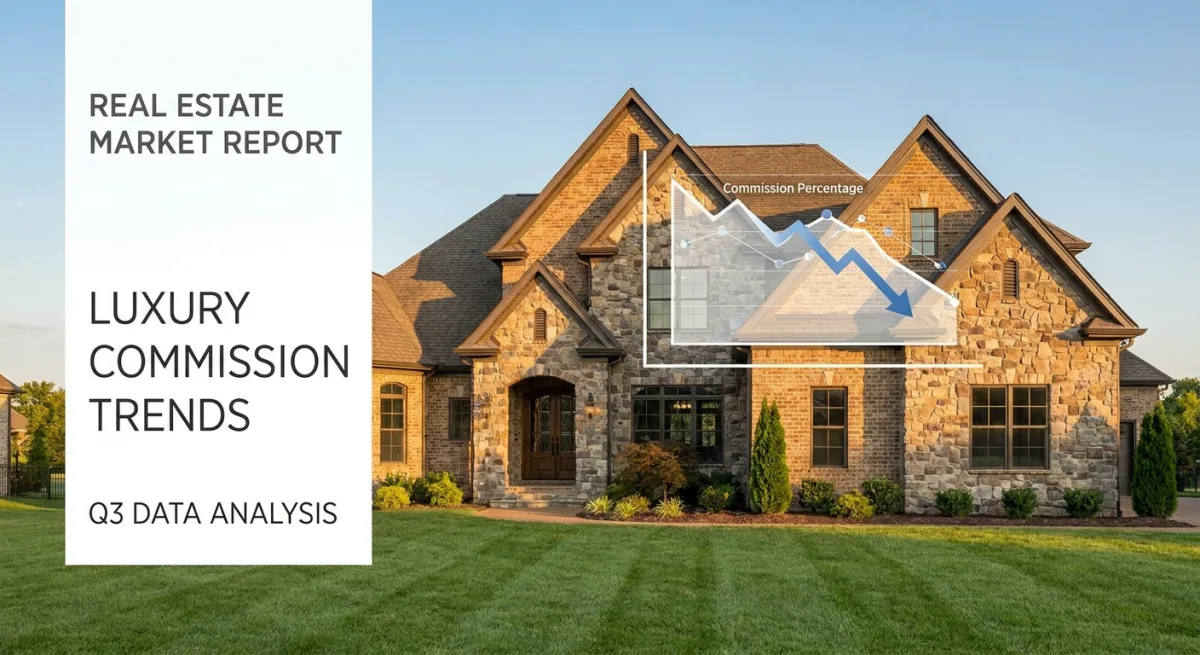
Buyer-Agent Commission Trends in Brentwood & Franklin (Late 2026): What Sellers Are Actually Paying
The short version: the buyer agent commission in Brentwood and Franklin in 2026 is not the 5–6% you'll read on national comparison sites. At Williamson County price points, those percentages are compressing hard — and above $1M, sellers are quietly switching to flat-dollar caps instead of percentages entirely.
Here's why that gap matters. The statewide Tennessee "average" gets anchored to a median home price near $390K. But Brentwood's median listing price sits closer to $1.8M (with sold medians around $1.4M–$1.5M) and Franklin's median sale price is near $1.1M. A percentage that feels normal on a $390K starter home becomes an enormous dollar figure at $1.5M — and buyers, sellers, and agents all know it.
We watch these numbers weekly at closing tables across Brentwood and Franklin. RealTracs stopped publishing cooperative compensation after the NAR settlement, so what follows is grounded in transactions we've actually observed, sitting on top of the real regulatory and underwriting rules that govern how any of it gets paid.
What Are Sellers Actually Paying Buyer's Agents Right Now?
In late 2026, most Williamson County sellers are offering buyer's agents between 1.5% and 2.5% of the sale price — and above $1M, that percentage often converts to a flat-dollar cap. That's meaningfully lower than the 5%–6% total commission figures national directories still quote.
Buyer-agent commission (also called buyer-agent compensation or co-op commission) is the fee a seller agrees to pay the agent representing the buyer. Post-settlement, it's negotiated privately, not advertised on the MLS.
As price climbs, the percentage compresses even while the dollar amount holds steady or rises. A 3% buyer-side offer on a $400K home makes sense in many markets. On a $1.5M Brentwood home, 3% is $45,000 — and sellers at that price point are quietly saying no to that math.
A caveat: off-MLS offers aren't fully visible to anyone anymore, so treat these as directional observations from our own transactions, not published market statistics. Nobody can publish a clean county-wide co-op average now — anyone who claims to is guessing.
Why Statewide Tennessee Averages Are Useless in Williamson County
Statewide Tennessee commission averages are built on a median home price near $350K–$390K — roughly a quarter of Brentwood's median. Applying a 5.1%–5.59% statewide rate to a $1.5M home overstates the real market by tens of thousands of dollars.
The national directories — Clever, Houzeo, UpNest — all quote some version of a "Tennessee average" anchored to a statewide median that has nothing to do with Williamson County. Brentwood's median listing price sits near $1.8M, with sold medians between $1.4M–$1.5M. Franklin's median sale price is around $1.1M (RealTracs, 2026). At those numbers, commission behaves differently because the dollar stakes force a different negotiation.
Commission compression is a function of dollar volume, not seller charity. When a buyer's agent earns $12,000 on a $400K sale at 3%, the fee feels proportional. When that same 3% produces $45,000 on a $1.5M sale, sellers push back — and buyer's agents, competing for high-end business, accept less. The work isn't 3.75x harder because the house costs 3.75x more.
One more thing national pages miss: Williamson County isn't one market. Franklin's historic-district buyers behave differently than the new-construction crowd in Berry Farms or Westhaven, and Brentwood's higher median lifts the dollar value of even a shrinking percentage. A statewide blend turns all of that into mush.
The Williamson County Buyer-Agent Commission Tier Table (Late 2026)
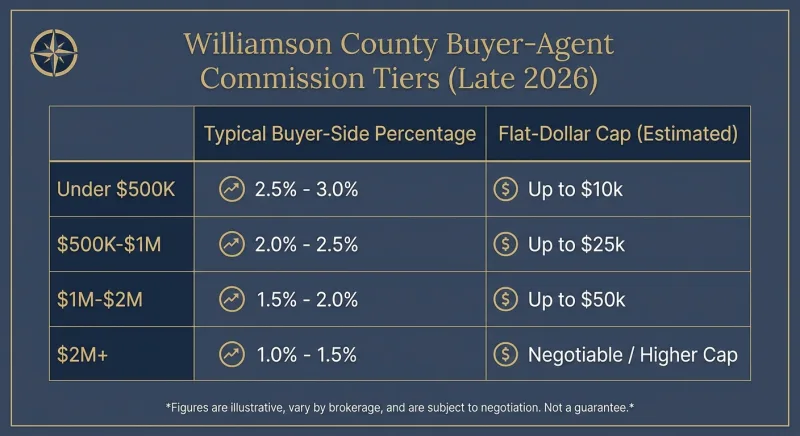
Buyer-agent offers scale down by percentage as price rises, with the $1M line marking the shift from percentages to flat-dollar caps. This is first-hand observation from ResultsMLS-listed Brentwood and Franklin transactions, not a RealTracs statistic.
| Sale Price Band | Typical Buyer-Agent Offer (%) | What We Actually See |
|---|---|---|
| Under $500K | 2.25% – 3.0% | Percentage still standard; closest to statewide norms |
| $500K – $1M | 2.0% – 2.5% | Percentage holds; sellers start negotiating harder |
| $1M – $2M | 1.5% – 2.0% or flat cap | Flat caps ($20K–$30K) increasingly replace the % |
| $2M+ | Flat cap dominant | $25K–$40K flat; percentage largely abandoned |
As of late 2026. Source: ResultsMLS observed transactions, Brentwood & Franklin — directional, not a published MLS average.
These are ranges, not rules. A well-priced home in a competitive segment can attract buyers with a leaner offer; a home past 60 days may need a fuller concession to pull agent attention back.
The Franklin nuance: new-construction buyers in the $500K–$900K band often arrive with an agent already under contract, keeping offers in the 2%–2.5% range. Higher-end historic and estate buyers negotiate harder — that's where the lower band and flat caps appear. Brentwood's story is the compression thesis in one line: 1.75% on a $1.8M home is still $31,500. The agent gets paid well; you just don't overpay to make that happen.
How Luxury Fee Compression Works Above $1M
Luxury fee compression is the observed tendency for buyer-agent percentages to shrink as home price rises, because the dollar amount of a fixed percentage grows faster than the actual work required to earn it.
A buyer's agent showing homes, writing an offer, and managing a transaction does broadly similar work whether the home is $600K or $1.6M. The marginal effort between a $900K and a $1.4M sale is close to nothing. So above roughly $1M, sellers stop thinking in percentages and start thinking in flat dollars. A 2% offer on a $1.6M home reads as $32,000, and a buyer's agent will accept that number whether it's expressed as 2% or a fixed cap.
The percentage falls precisely because the dollar figure has already crossed the threshold of "enough." $25,000 flat on a $1.8M home is a healthy payday. The compression trend was underway before the NAR settlement; the settlement just made it visible and negotiable in the open.
What Changed After the NAR Settlement: Off-MLS Compensation on RealTracs
Under the NAR settlement, effective August 17, 2024, cooperative compensation can no longer be advertised on the MLS, and buyers must sign a written buyer representation agreement before an agent tours homes with them (National Association of REALTORS®, settlement practice changes).
Before the settlement, the seller's co-op offer was posted right on the RealTracs listing, visible to every buyer's agent — and standards clustered around 3%. Removing that public number did two things. First, it ended the anchoring effect: with no visible "everyone offers 3%," offers get negotiated deal by deal. Second, it shifted leverage. Buyers arrive having already agreed to pay their own agent under a signed buyer representation agreement, then frequently ask the seller to cover that fee as a seller concession. The compensation didn't disappear — it moved from a public MLS field into a contract line item.
For Williamson County sellers, the practical result: you decide your offer privately, communicate it off-MLS, and formalize it in the contract if a buyer's agent brings an offer. Because these offers are now private, no MLS can publish a clean county co-op average — which is why our tier table is framed as first-hand observation rather than a cited statistic.
Off-MLS Compensation Signaling: How Buyers' Agents Actually Learn Your Offer
Post-settlement, the offer travels through three channels, none of them the old MLS field.
Channel 1: Direct broker inquiry. The buyer's agent asks the listing source what the seller will contribute. On a ResultsMLS listing, that routes to you. You can answer differently per buyer — something the old public MLS field never allowed.
Channel 2: The compensation ask inside the purchase agreement. Many buyer's agents write the request into the offer itself as a seller concession. You counter it like any other term — price, closing date, inspection period, and co-op fee all sit on the same table.
Channel 3: Third-party display sites. Some off-MLS platforms show compensation outside RealTracs. Visibility is patchy, which is why these numbers stay hard to survey.
Because the offer is now negotiable per-buyer and travels through the contract, you have more control than the old system gave you — and less obligation to lead with your maximum.
The Concession-to-Price Ratio: The Number That Predicts Your Net
Most sellers fixate on the headline percentage. The number that matters more is the concession-to-price ratio — total seller-paid concessions (buyer-agent fee plus any closing-cost help) divided by contract price.
At $1.5M, a 2% buyer-agent offer plus a 1% closing-cost concession is a 3% ratio — $45,000 out of your equity. Sellers who negotiate these two buckets separately routinely give away more than they intended because they never summed them.
Think of it as one equity number, then split it. Decide your total tolerance first — say $40,000 on a $1.5M sale — then allocate. If a buyer needs closing help to qualify, that comes out of the same envelope, not on top of it.
The edge case: cash buyers. In late 2026's rate environment, a meaningful slice of top-end Williamson County buyers are cash or near-cash. Cash buyers rarely need closing-cost help, which frees your entire envelope for the buyer-agent fee — or lets you offer less overall.
The Overpricing Penalty That Quietly Doubles Your Real Cost
A stale, overpriced listing costs you more than any commission line item — because it forces a bigger concession later and a lower final price.
Watch the sequence. A seller lists high to "leave room." Weeks pass with no offers. The only tool left is concession — a larger buyer-agent offer, closing help, or a price cut, often all three. The final net lands well below what a correctly priced home would have produced with a normal concession.
We'd rather see a seller price accurately and offer a competitive 1.5%–2% concession than price aggressively and be forced into 3% plus a price cut sixty days in. The market reads days-on-market as weakness, and weakness invites lowball offers that assume you'll cover the buyer's agent too.
The Real Mechanics: Tennessee Forms and Sequence
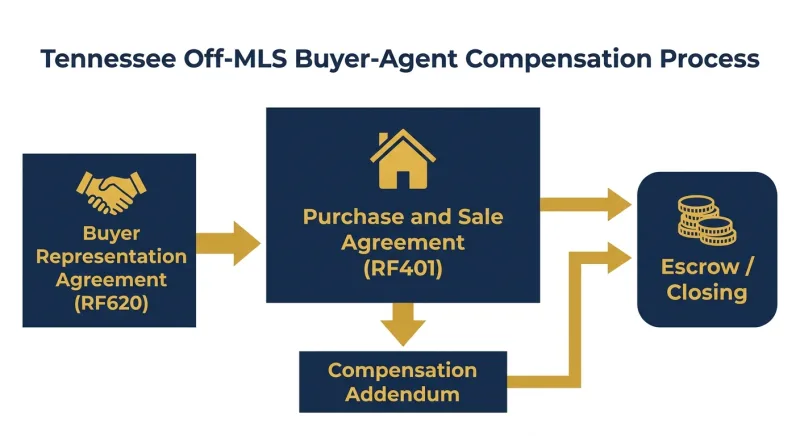
In Tennessee, seller-paid buyer-agent compensation flows through the purchase agreement and its addenda — not the MLS — using the Tennessee REALTORS® forms library.
- Buyer Representation Agreement (typically Form RF141) — the buyer and their agent set the agent's fee between themselves, before showings, per post-settlement rules.
- Purchase and Sale Agreement (Form RF401) — the buyer's offer, where a request for the seller to pay some or all of the buyer-agent fee typically appears as a concession.
- Compensation Addendum (typically Form RF620) — documents the seller-paid amount so the closing attorney and lender can reconcile it on the settlement statement.
Confirm current form numbers against the live Tennessee REALTORS® forms library before relying on them — form numbers get revised.
Here's the leverage point sellers miss: the buyer's obligation to their agent exists independent of your offer. If you offer less than the buyer's agreement specifies, the buyer covers the gap, not the deal. You're deciding how much of a pre-existing obligation you'll absorb to make your listing competitive. Get the number into the executed purchase agreement at the offer stage — not a handshake, not a text. Once you've agreed to sell to a specific buyer, your negotiating position on the fee collapses.
The 'Double Bucket' Rule: Why Buyer-Agent Fees Sit Outside Your IPC Caps
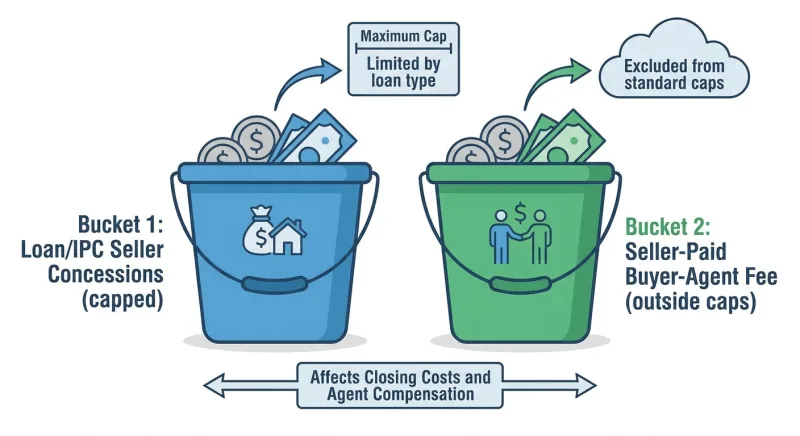
Seller-paid buyer-agent commissions are treated as a separate bucket from Interested Party Contributions (IPC) — meaning they generally do not count against the loan's seller-concession caps, per post-settlement guidance from the major agencies.
Normally, how much a seller can contribute is capped by the loan. Fannie Mae limits IPCs to 3%–9% depending on LTV and occupancy. FHA (HUD Handbook 4000.1) caps concessions at 6%. VA caps them near 4%. After the settlement, Fannie, Freddie, FHA, and VA issued guidance treating reasonable seller-paid buyer-agent fees as outside those caps — a second, separate bucket. So paying a buyer's agent doesn't eat into the concession room a buyer might also need for closing costs or a rate buydown.
The edge cases are where deals die.
"Reasonable and customary" ceiling. The exclusion applies to reasonable compensation. An outsized co-op fee well above local norms can draw underwriter scrutiny. Staying inside the observed range keeps the file clean.
Stacking with closing-cost help. The buyer-agent fee sits outside IPC caps. Closing-cost help does not. Keep the two concessions labeled separately in the contract — or you risk pushing the closing-cost portion past the loan's ceiling days before closing.
Cash deals. No loan, no IPC caps. The framework simplifies to one question: what will you contribute to the buyer's agent?
A Decision Framework: Setting Your Offer by Price Band and Buyer Type
- $500K–$1M (more common in Franklin): A percentage offer reads naturally. Competitive is roughly 2%–2.5%. On $850K, 2.5% is about $21,250 — enough to keep buyer-agent volume flowing.
- $1M–$2M (the Brentwood/Franklin overlap): Flat-cap territory. Think in dollars. An offer landing the agent between roughly 1.5% and 2% equivalent is where deals clear without leaving equity on the table.
- $2M+ (upper Brentwood): Nearly always a flat cap, increasingly a cash negotiation. The dollar figure is what the agent evaluates.
Then adjust. Financed buyer stretching to qualify? Reserve envelope for closing help and hold the co-op modest. Cash buyer? Consider whether you need to offer much at all. Slow market or a home with a flaw? A slightly stronger co-op buys showing volume — cheaper than a price cut, and it doesn't reset your list price publicly.
The one rule underneath all of it: decide your total equity-out number first, then split it between buckets.
The Equity Play: Fund the Concession With Your Flat-Fee Savings
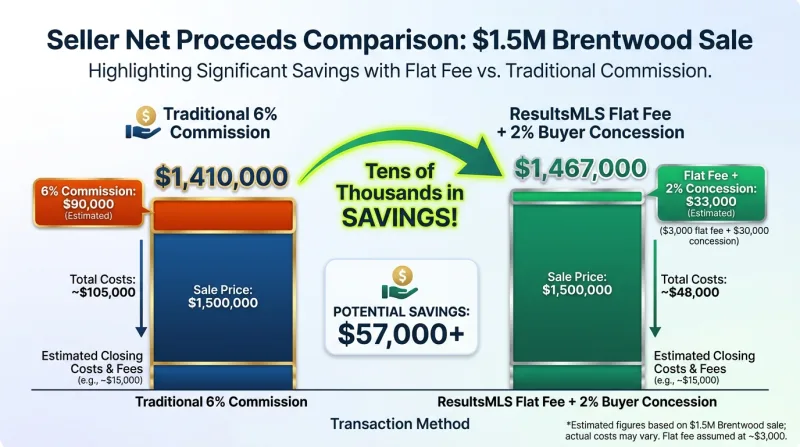
A flat-fee listing controls the listing-side commission — the roughly 3% a traditional arrangement would take — and lets you redirect that money toward the buyer concession.
In plain numbers — a $1.5M Brentwood sale:
| Traditional 6% | Flat-Fee + 2% Buyer Concession | |
|---|---|---|
| Listing-side commission (~3%) | $45,000 | ~$0 (flat fee, a few hundred dollars) |
| Buyer-agent concession | $45,000 (3%) | $30,000 (2%) |
| Total commission cost | $90,000 | ~$30,000 |
| Kept vs. traditional | — | ~$60,000 |
The buyer concession stays competitive enough to keep buyer's agents bringing offers, and you've eliminated the listing-side commission by putting your home on RealTracs directly. Offer the buyer's agent what the market expects, and stop paying a percentage to list the home yourself.
Frequently Asked Questions
Do you have to pay a buyer's agent in Franklin or Brentwood in 2026?
No. Since the NAR settlement took effect August 17, 2024, offering buyer-agent compensation is optional and negotiated per transaction. Most Williamson County sellers still offer something because a competitive concession keeps buyer traffic strong.
How much do sellers offer buyer agents in Middle Tennessee right now?
Across ResultsMLS-listed transactions in Brentwood and Franklin during late 2026, sellers typically offered 1.5%–2.5%, with flat-dollar caps often replacing percentages above $1M. Treat this as first-hand observation, not a published statistic.
Can buyer-agent compensation still be posted on RealTracs MLS?
No. Under the NAR settlement, cooperative compensation can no longer be advertised on the MLS. Sellers now negotiate that offer off-MLS — through the listing broker, showing instructions, or a compensation addendum tied to the offer.
Does a seller-paid buyer-agent fee count against loan concession caps?
No. Seller-paid buyer-agent compensation sits in a separate bucket from Interested Party Contributions (IPC), so it does not eat into Fannie Mae, FHA, or VA seller-concession limits.
Is a flat fee MLS listing worth it on a $1M+ Williamson County home?
Yes, if maximizing equity is the goal. Eliminating the roughly 3% listing-side commission on a $1.5M sale frees up around $45,000 — enough to fund a competitive buyer-agent concession and still keep tens of thousands more than a traditional 6% arrangement.
What Tennessee forms handle buyer-agent compensation now?
The workflow runs through the Tennessee REALTORS® buyer representation agreement and the purchase agreement, with compensation handled via a separate addendum rather than the MLS field. Confirm current form numbers (RF401, RF620, RF141) with your closing attorney before signing, since form libraries update.
Conclusion
The 5–6% statewide average was built on a $327K–$390K median — it has almost nothing to do with a Brentwood or Franklin closing table. At Williamson County price points, buyer-agent commission is compressing: roughly 1.5%–2.5% in late 2026, with flat-dollar caps stepping in above $1M.
That compression is your leverage. The post-settlement world moved cooperative compensation off the MLS, so you decide what to offer — and the double-bucket rule keeps that fee outside your buyer's IPC caps, so a reasonable concession keeps showings strong without breaking underwriting.
Run the net-to-seller math on your own number. Take your expected sale price, subtract a flat-fee listing cost instead of the full ~3% listing commission, then subtract the buyer concession you're comfortable offering. On a $1.5M Brentwood sale, that swap alone routinely keeps five figures in your pocket. Confirm current form numbers and concession caps with your closing attorney, since guidelines shift — but the core play holds.