
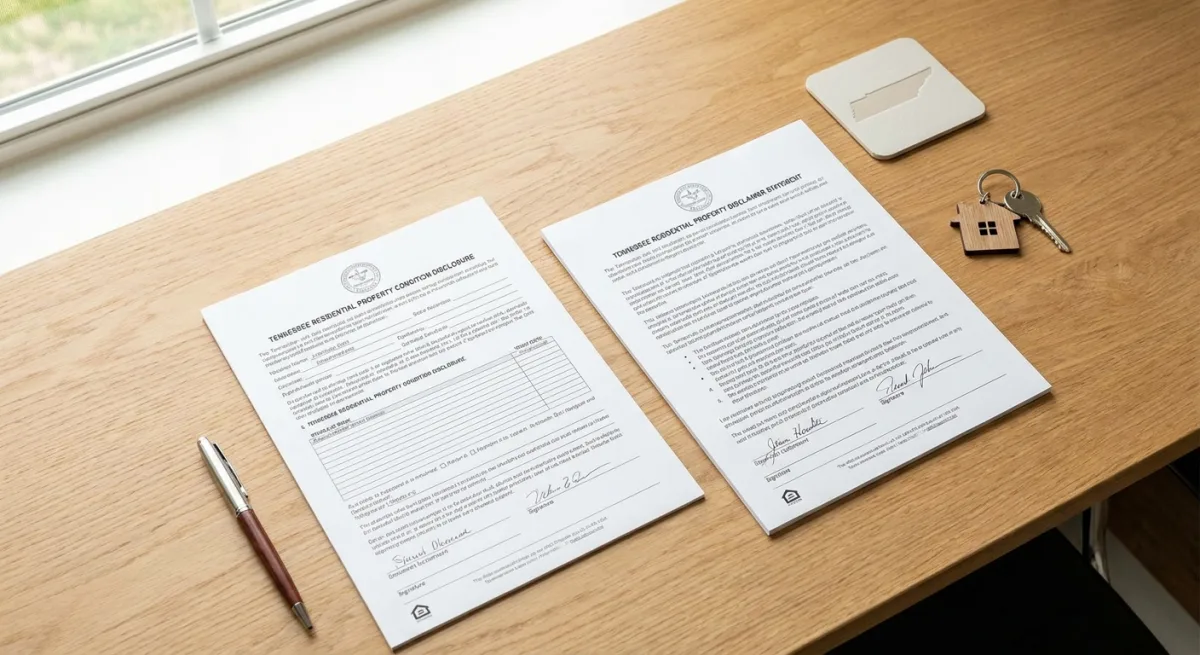
Property Disclosure vs. Disclaimer in Tennessee: Which One Protects You When Selling FSBO?
In Tennessee, a property disclosure (Form RF 201) tells your buyer what you actually know about the home's condition, while a disclaimer (Form RF 204) says you're making no representations at all and the buyer takes the property "as-is." Under the Tennessee Residential Property Disclosure Act (T.C.A. § 66-5-201 et seq.), the disclosure is the default. The disclaimer is only valid when the buyer knowingly waives their right to receive it.
Most FSBO sellers get this backwards.
If you're selling your own home, you've probably run into three confusingly similar form numbers — RF 201, RF 203, and RF 204 — and blog posts that mislabel them. Half the internet calls RF 203 a "disclaimer." It isn't. That mix-up can leave you exposed at closing or months after it.
Disclosure vs. Disclaimer: Quick Comparison
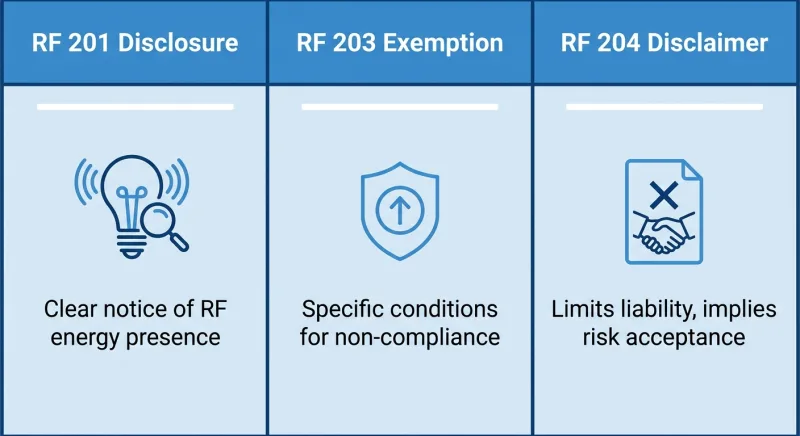
| Form | What it actually is | What it does | When it applies |
|---|---|---|---|
| RF 201 | Residential Property Condition Disclosure | You disclose known conditions in good faith (T.C.A. § 66-5-201) | The default for almost every FSBO resale |
| RF 203 | Disclosure Exemption Notification | Notifies the buyer your sale is exempt from disclosure entirely (T.C.A. § 66-5-209) | Only for statutorily exempt transfers |
| RF 204 | Property Condition Disclaimer Statement | Sells "as-is" with no representations — valid only when the buyer waives disclosure (T.C.A. § 66-5-202) | When the buyer agrees to take the property with no condition statement |
RF 203 is not the disclaimer. It's the Exemption Notification. The disclaimer is RF 204. In plain English: RF 201 says "here's what I know." RF 203 says "the Act doesn't apply to my sale at all." RF 204 says "the Act applies, but my buyer chose to waive it."
What Is a Tennessee Property Disclosure (Form RF 201)?
The Residential Property Condition Disclosure (Form RF 201) is the written statement where you report what you actually know about the home's condition. It's required for most residential resales under T.C.A. § 66-5-201.
The form walks through the property system by system — roof, foundation, plumbing, electrical, HVAC, water and sewer, known pests, drainage, prior repairs. You answer based on your actual knowledge.
The Act asks for good faith, not perfection. You're not warranting the home's condition, and the disclosure isn't a substitute for a home inspection (T.C.A. § 66-5-201 / § 66-5-206). But you can't hide what you do know. Known latent defects — problems a buyer can't spot on a normal walkthrough — belong on that form.
What Is a Disclaimer Statement (Form RF 204) — and the As-Is Myth
The Property Condition Disclaimer Statement (Form RF 204) tells the buyer you're making no representations about the property. The buyer takes it as-is, no disclosure provided.
For that disclaimer to be valid, the buyer must knowingly waive their right to disclosure in writing before the contract is accepted (T.C.A. § 66-5-202). A disclaimer produced after mutual acceptance has no legal effect on the transaction (T.C.A. §§ 66-5-204, 66-5-205). Sequence matters as much as the signature.
Now the myth: "I sold it as-is with a disclaimer, so I can't be sued." Not true.
A disclaimer does not shield you from fraudulent concealment. Under T.C.A. §§ 66-5-202 and 66-5-208, it covers defects you didn't know about — it does not cover actively hiding a defect you did know about. Paint over the water stain, deny the leaky basement in writing, and that disclaimer won't save you. The disclaimer is a raincoat, not a bunker. Use it when the condition genuinely isn't yours to represent — an inherited house you never lived in, an investment property you never occupied.

Where Does RF 203 Fit? Disclosure Exemptions Explained
Some sales are exempt from the disclosure requirement entirely. The Exemption Notification (Form RF 203) notifies the buyer that no RF 201 disclosure is required because a statutory exemption applies under T.C.A. § 66-5-209. Common exemptions:
- Transfers by court order or foreclosure
- Transfers by a fiduciary administering an estate, trust, or conservatorship
- Transfers between co-owners, spouses, or family in a divorce or settlement
- The first sale of a newly built home never occupied
- Transfers to or from a government entity
If your sale fits one of these, you may deliver RF 203 instead of a full disclosure. If it doesn't — and most standard FSBO resales don't — you're back to RF 201. One caution: an exemption from the form is not a license to defraud. Tennessee's fraudulent-concealment principles still apply.
Which Form Actually Protects You? The FSBO Decision Framework
For most FSBO sellers, the RF 201 disclosure protects you best — not the disclaimer. Work through these questions in order:
- Am I statutorily exempt? Estate sale, foreclosure, transfer between co-owners, a home never occupied? If yes under § 66-5-209 → RF 203 Exemption Notification.
- Did I actually live in and know this home? If yes → RF 201 Disclosure. A completed, good-faith disclosure is a documented record that you didn't hide anything (§§ 66-5-201, 66-5-206). That record wins cases. Blank forms lose them.
- Do I genuinely lack knowledge of the condition, and will my buyer waive? Only then → RF 204 Disclaimer, with the buyer's written waiver. No waiver, no valid disclaimer.
Sellers want the disclaimer because it feels like saying less. But under a fraudulent-concealment theory, the seller who disclosed honestly is far harder to sue than the one who stayed silent. Transparency is the armor.
The Disclosures That Survive Every Disclaimer
Certain disclosures are required by other laws and don't disappear because you handed over a disclaimer or claimed an exemption.
Law update — effective July 1, 2024: Tennessee Public Chapter 510 amended the sinkhole disclosure requirement under T.C.A. § 66-5-212, refining how a "sinkhole" is defined for disclosure purposes. If your source doesn't mention Chapter 510, it's stale for a 2026 sale.
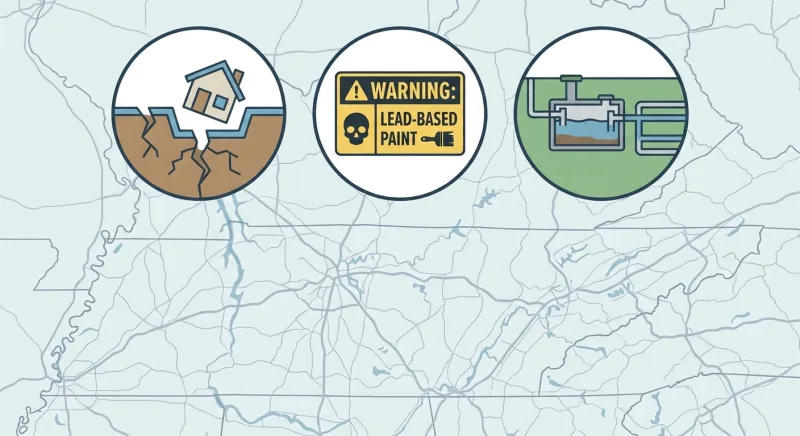
Three obligations that outlive any "as-is" clause:
- Sinkholes. Actual knowledge of a sinkhole requires disclosure under amended § 66-5-212 — as-is, disclaimer, or exemption notwithstanding.
- Lead-based paint. Homes built before 1978 require the federal lead-paint disclosure, the EPA pamphlet, and a 10-day inspection window (42 U.S.C. § 4852d; 24 CFR Part 35 / 40 CFR Part 745). No Tennessee form waives it.
- Septic and bedroom count. Advertising more bedrooms than your septic permit authorizes can trigger Tennessee's consumer protection statute (T.C.A. § 47-18-104). Pull the septic permit from your county before you write the listing.
How to Fill Out the Tennessee Disclosure Form (Step by Step)
- Use the current 2026 form — a 2021 PDF may omit post-Chapter 510 sinkhole language.
- Answer every line from actual knowledge. Mark Yes, No, or Unknown honestly (T.C.A. § 66-5-201). "Unknown" is legitimate; a blank box reads as evasion.
- Cover the big-ticket systems — roof, foundation, HVAC, plumbing, electrical, water intrusion, prior repairs, known defects.
- Add the mandatory extras where applicable: lead-paint disclosure, sinkhole notes, septic permit details.
- Sign and date it.
- Deliver it before the buyer signs the purchase contract. Under T.C.A. §§ 66-5-204 and 66-5-205, delivery must occur before contract acceptance — deliver late and the buyer may gain the right to rescind.
- Keep a signed copy in your closing file.
The disclosure is a pre-contract document, not a closing document. Deliver early, answer honestly, keep the record.
Documenting Good Faith: The Evidence Layer
Good faith is only useful if you can prove it later.
- Timestamp delivery. Keep dated proof the buyer received RF 201 (or signed the RF 204 waiver) before contract acceptance.
- Preserve source documents. Septic permit, plat map, prior inspection reports, contractor invoices — these show how you formed your answers.
- Update if conditions change. A defect appearing between disclosure and closing requires a supplement. A stale disclosure invites the fraudulent-concealment argument you're trying to avoid.
This is general information, not legal advice. For your specific sale, consult a licensed Tennessee real estate attorney.
Getting the Correct 2026 Forms Without a Full Commission
Using an outdated RF 201 — or pre-Chapter 510 sinkhole language — undercuts the protection the form is supposed to give you. When you list flat-fee, you get the current standard RF 201 / RF 203 / RF 204 forms plus MLS exposure without a full-service listing commission. If you're weighing the mechanics, our guide on how to list on the MLS without an agent in Tennessee walks the full path.
Frequently Asked Questions
What's the difference between a disclosure and a disclaimer in Tennessee? A disclosure (Form RF 201) is a good-faith statement of known condition — the default under T.C.A. § 66-5-201. A disclaimer (Form RF 204) sells the home "as-is" with no representations — valid only when the buyer waives disclosure in writing.
Is RF 201 or RF 204 required for an FSBO sale? RF 201 (disclosure) is the default. RF 204 (disclaimer) is only valid if your buyer signs a written waiver before contract acceptance (T.C.A. § 66-5-202). No waiver, no valid disclaimer.
Do I have to disclose a sinkhole in Tennessee in 2026? Yes, if you have actual knowledge of one. Public Chapter 510 updated the sinkhole definition in T.C.A. § 66-5-212 effective July 1, 2024, and the disclosure duty survives an as-is sale.
Can a buyer sue over hidden defects even in an as-is sale? Yes. An "as-is" clause or RF 204 disclaimer does not protect a seller from fraudulent concealment or misrepresentation (T.C.A. §§ 66-5-202, 66-5-208).
What is Form RF 203 used for? RF 203 is the Exemption Notification — it tells the buyer your sale is exempt from disclosure under § 66-5-209 (estate, foreclosure, first-occupancy transfer, etc.). It is not the disclaimer.
How much does it cost to get the Tennessee disclosure forms? The current RF 201, RF 203, and RF 204 forms are typically bundled into a flat-fee MLS package at no separate charge. Using outdated templates is where sellers get into trouble.
The disclosure (RF 201) is your default, the disclaimer (RF 204) is the narrow exception, and RF 203 is a separate exemption notice unrelated to either. Pick the right form, fill it out honestly, deliver it before your buyer accepts the contract, and keep a signed copy. When an exemption or unusual defect has you unsure, consult a licensed Tennessee real estate attorney before you sign anything.
This article is general information, not legal advice. When you're ready to list, see our guide on how to list on the MLS without an agent in Tennessee.