

This guide is general information for Tennessee homeowners, not legal advice. For contract language specific to your sale, talk to a licensed Tennessee real estate attorney.
The short version: When a buyer works with a Realtor® in Tennessee, that buyer must sign a written buyer representation agreement (Form RF141) before touring your home. But you, the FSBO seller, are not a party to that agreement. You are not automatically on the hook for the buyer agent's commission — you decide what, if anything, you offer, and you write it into the purchase contract.
What Actually Changed After the NAR Settlement
Under the National Association of REALTORS® settlement, effective August 17, 2024, any buyer working with a Realtor® must sign a written buyer agreement before that agent tours a home with them. That reshaped how agents operate across the country, Tennessee included.
What it did not do is force you to pay anyone. A common fear from FSBO sellers is that the settlement means "I have to pay a 3% buyer's agent commission now." Not true. The old industry-standard seller-paid buyer-side commission was decoupled — compensation is now openly negotiable, and you're a non-party to the buyer's contract with their broker.
So the real question isn't whether you can host showings. It's how to host them cleanly, whether the buyer arrives with an agent or without one.
The One Thing Every Competitor Gets Wrong
Read this twice: you are not a party to the buyer's representation agreement.
When a buyer signs Form RF141 with their agent, that's a private contract between two people — the buyer and their broker. Your name isn't on it. You didn't agree to its terms. And the compensation number written inside it is their deal, not your obligation.
Every incumbent article on this topic explains buyer-rep agreements from the buyer's side of the table. Nobody turns the camera around to face the FSBO seller and says the calm thing: this document does not bind you.
The Tennessee Forms You'll Hear About
Learn five form names before you host a single tour. These are all standard Tennessee REALTORS® (TAR) instruments.
- Form RF141 (Exclusive Buyer Representation Agreement) — the contract between the buyer and their broker. Sets the agent's compensation and duties. You are not a party.
- Form RF161 (Agreement to Show Property) — a short, transaction-specific instrument that lets a buyer's agent show your home and spells out compensation for that showing or sale.
- Form RF301 (Working with a Real Estate Professional) — an agency-disclosure document explaining the difference between a client and a customer. Relevant when a buyer arrives unrepresented.
- Form RF302 (Confirmation of Agency Status) — confirms in writing who represents whom, nailing down that an unrepresented buyer is a customer, not a client.
- Form RF401 (Purchase and Sale Agreement) — the actual contract to buy your house. This is where you, the seller, control any concession or buyer-agent compensation.
The move to remember: RF141 is the buyer's private deal with their agent. RF401 is your deal. The commission conversation belongs in RF401, on your terms.

The Dual-Pathway Showing Framework
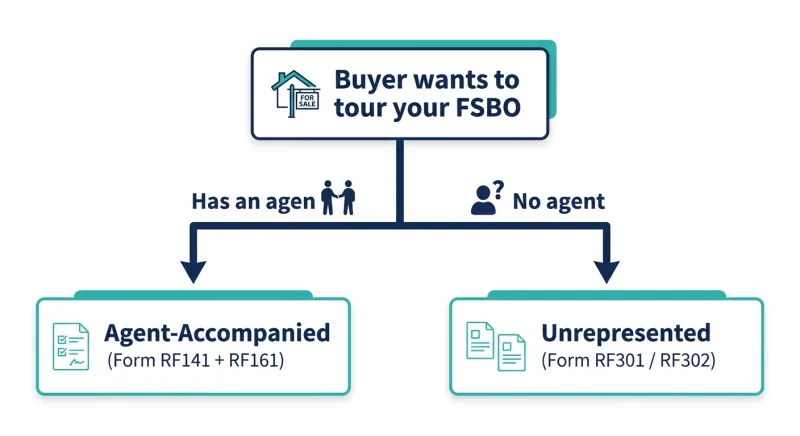
Sort every showing into one lane before you unlock the door. The deciding question is one sentence: Does this buyer have an agent representing them, yes or no?
Pathway A — Agent-Accompanied Showing
The buyer already signed RF141 with their agent. The clean instrument here is Form RF161 — a non-exclusive showing agreement negotiated broker-to-broker that sorts out compensation for that specific showing without turning you into that agent's client.
Here's the part competitors bury: the RF141 shortfall clause. Tennessee REALTORS® buyer-rep forms typically provide that if the seller offers less than what the buyer agreed to pay their agent, the buyer covers the gap. Say the buyer's RF141 obligates them to pay 3% and your listing offers a cooperating broker 2%. That 1% gap falls on the buyer — not you.
You decide what, if anything, you'll offer, and you write it into Form RF401 as a negotiated concession.
Pathway B — Unrepresented Buyer Showing
No agent. No RF141. This is where FSBO sellers save the most — but there's a trap. Form RF301 and Form RF302 exist to make agency crystal clear, and the moment you start advising an unrepresented buyer, you can trigger unintended agency.
Tennessee agency law (Tenn. Code Ann. Title 62, Ch. 13) draws a hard line between a client and a customer — and it can arise from conduct, not just forms. As a FSBO seller you can hand facts all day — square footage, roof age, disclosure documents. Don't counsel. When a buyer asks for advice, the clean line is: "I can't advise you on that — you'd want your own agent or a Tennessee real-estate attorney."
The Contract-Boundary Table Nobody Else Publishes
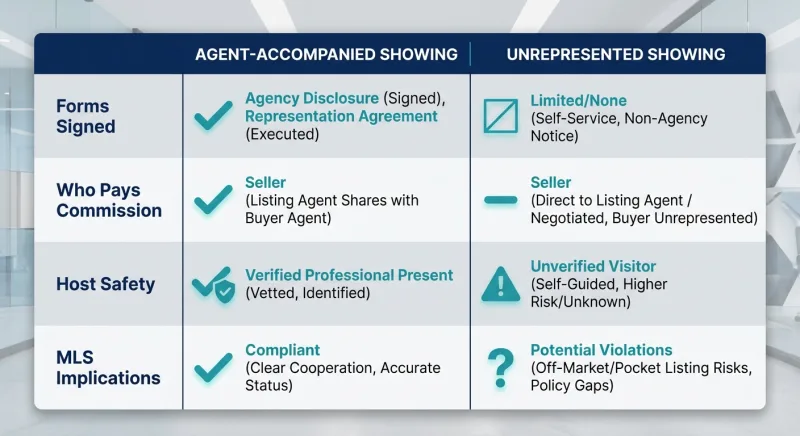
| Agent-Accompanied (Pathway A) | Unrepresented Buyer (Pathway B) | |
|---|---|---|
| Buyer signed RF141? | Yes — with their broker (you're a non-party) | No |
| Form you engage | RF161 (Agreement to Show Property) | RF301 / RF302 (status disclosure) |
| Who pays the buyer's agent | Negotiated; shortfall typically falls on the buyer | N/A — no buyer's agent involved |
| Your commission control | Full — you set any concession in RF401 | Full — no cooperating broker to compensate |
| Host safety | Agent present; agent pre-screened the buyer | You screen; verify ID, tour in daylight |
| MLS implication | Flat-fee listing routes request via ShowingTime | Direct inquiry — you schedule manually |
The commission you "have to pay" isn't a rule — it's a choice you make in RF401. Compensation got decoupled and openly negotiable. You're the one holding the pen.
Edge Cases the Incumbents Skip
The buyer shows up "unrepresented" but their agent is texting from the car. Get the buyer's status in writing before the tour. RF301 and RF302 document that they came to you unrepresented. If the buyer does have an agent working remotely, that agent gets on record before showing — through a broker-to-broker instrument. No signed showing arrangement, no accompanied showing.
The non-exclusive RF141. Not every buyer signs an exclusive agreement. Some sign a single-property showing form tied to your address only. A buyer under a non-exclusive arrangement can tour with one agent and still write the offer to you directly, unrepresented — which collapses the whole commission question. Ask: "Is your agreement exclusive, or just for this property?"
How to Decide What You'll Pay
When a buyer's agent asks what you'll offer, run the request through four filters before committing a number to RF401.
- Is it already covered by my MLS listing? If you listed flat-fee and set a cooperating broker figure, requests above it are negotiation, not obligation.
- What does it cost me in net proceeds? Convert to dollars. A $6,000 concession on a $300,000 Franklin home reads differently than the same $6,000 on a $180,000 Clarksville home.
- Is this a concession or a commission? A buyer-side payment written as a seller concession in RF401 is a negotiable term — leverage against price, timeline, and repairs.
- Would walking cost me more than paying? Buying down a buyer agent's shortfall by $3,000 to hold the deal can beat re-listing and eating another 45 days of carrying costs. That's a net-proceeds decision, not a fear response.
Open Houses vs. Private Showings
The written-agreement-before-touring requirement has a carve-out: open houses generally don't require a buyer to have signed a written buyer agreement to walk through. That's a real advantage when you're hosting your own open house in Tennessee.
The trade-off: open houses are where the unintended-agency trigger bites hardest. Two safeguards:
- A sign-in sheet with agency status. Capture name, contact, and whether each visitor has an agent — your procuring-cause record.
- A facts-only posture. Hand out the disclosure packet and the RF301 explainer. Answer questions about the house, not about their offer strategy.
Private showings are appointment-based, more often agent-accompanied, and where RF141 status and showing agreements actually apply. Knowing which rulebook you're under keeps you from over-papering an open house or under-papering a private tour.
Where Flat-Fee Listing Removes the Guesswork
When your home sits on Realtracs (Middle Tennessee — Nashville, Franklin, Murfreesboro) or Flexmls through East Tennessee REALTORS® (Knoxville and East TN), buyer agents find you through their own MLS search and every showing request routes through ShowingTime. The broker-to-broker RF161 negotiation happens agent-to-agent. Your listing broker fields the compensation question so you're not improvising legal language on your porch.
Listing flat-fee doesn't take decisions away from you — you still control the concession number and RF401 terms. And offering a competitive buyer-agent commission inside that listing is precisely what keeps agents willing to bring buyers to a FSBO home. That's not a cost. That's your marketing.
Frequently Asked Questions
Does a buyer's signed representation agreement force me to pay a 3% commission?
No. Form RF141 is a private contract between the buyer and their agent — you're a non-party. Any buyer-agent compensation you offer is negotiable, and the RF141 shortfall clause typically shifts any pay gap to the buyer, not you.
Can I show my FSBO home to a buyer who has no agent?
Yes, and no buyer representation agreement is required. Have the unrepresented buyer sign Form RF301 or confirm status via RF302, screen for ID, and avoid advice that could trigger unintended agency.
Do I have to sign the buyer agent's representation agreement to let them tour?
No. RF141 is signed by the buyer and their broker, not by you. If an agent asks you to sign anything before showing, it's usually Form RF161 — a separate, negotiable showing-and-compensation instrument.
What happens at an open house — do buyers still need a written agreement?
Under the NAR settlement effective August 17, 2024, a buyer touring an open house without an agent generally doesn't need a signed buyer agreement, which is why hosting your own open house as a FSBO seller in Tennessee stays simple.
How does flat-fee MLS make managing showings easier?
Listing flat-fee on Realtracs (Middle TN) or Flexmls (East TN) routes agent requests through ShowingTime and runs RF161 negotiation broker-to-broker, keeping scheduling organized and shielding you from filing forms directly.
Should I offer buyer-agent compensation in my listing?
You don't have to, but a competitive, clearly stated buyer-agent commission is what keeps agents willing to show your home. You control the number you write into the listing and later into RF401.
The Bottom Line
The rule that spooked so many Tennessee FSBO sellers — that buyers must sign before touring — doesn't drag you into a commission you never agreed to. That RF141 is the buyer's contract with their agent. You're standing outside it. You decide whether to offer buyer-agent compensation and how much, then hold that line through RF401.
Two ways to handle every tour. Agent brings the buyer? Let RF161 and RF141 do their work broker-to-broker, and keep your concession control. Buyer shows up solo? Disclose via RF301/RF302, screen for ID, host safely, and don't slip into giving advice.
Listing flat-fee on Realtracs or Flexmls puts your Nashville, Franklin, Murfreesboro, or Knoxville home in front of every agent, routes requests cleanly through ShowingTime, and keeps the paperwork off your kitchen table. That's how you save the listing-side commission and still control who walks through your door.
One honest caveat: before you sign or write specific contract language — especially any RF141 shortfall or RF401 concession wording — have a licensed Tennessee real estate attorney read it. Then host your tour like the owner you are: informed, unbothered, and in charge of the number.