

The Short Answer Starts Here
If you're a Tennessee homeowner wondering how the NAR settlement affects FSBO sellers, here's the honest version: you can still get your house on the MLS without hiring a full-service realtor. That didn't change. What did change is how buyer-agent pay gets handled — and a few of those changes trip up sellers who read national advice written for no state in particular.
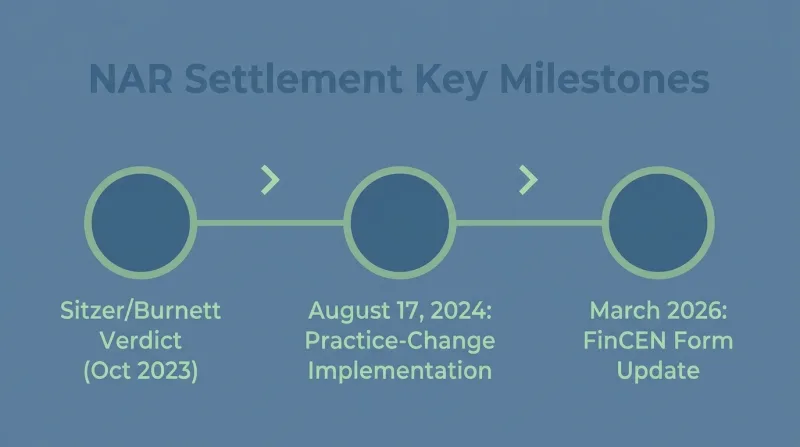
Since the settlement took effect on August 17, 2024, the MLS — the shared database agents use to market homes — no longer displays offers of buyer-agent commission. Headlines made it sound like the door slammed on for-sale-by-owner sellers. It didn't. In Tennessee, the mechanics just moved.
This guide is written from the vantage point of how the limited-service, flat-fee path actually works here — the licensing rules under the Tennessee Real Estate Commission, the field changes on RealTracs and Flexmls, and the exact Tennessee REALTORS® forms that come into play when a buyer's agent asks to be paid.
This article is general information, not legal or tax advice.
What the NAR Settlement Actually Changed (and What It Didn't)
The settlement came out of the Sitzer/Burnett v. NAR litigation, a class action over how buyer-agent commissions were set and displayed. Three changes matter for Tennessee sellers.
1. The MLS can no longer display buyer-agent commission. Before the settlement, listings carried a "cooperative compensation" field. That field is gone — not on RealTracs, not on Flexmls.
2. Buyers now sign written agreements before touring. A buyer's agent must have a signed written agreement with their client before showing homes, spelling out how the buyer's agent gets paid and by whom.
3. Compensation moved off the MLS. Buyer-agent pay didn't vanish. It moved into the negotiation, the purchase contract, and seller-concession mechanics.
What did not change:
- Commissions were always negotiable. The settlement reinforced that; it didn't invent it.
- You can still offer to pay a buyer's agent — agent-to-agent, in the contract, or through concessions.
- FSBO sellers can still get on the MLS through a licensed flat-fee brokerage.
The settlement changed the plumbing of buyer-agent pay. It didn't close the door on the MLS.
Can You List on the MLS Without a Realtor in Tennessee?
Yes — but with one legal detail national portals gloss over.
MLS access runs through licensed real estate brokerages. RealTracs, the dominant MLS across Middle Tennessee, and Flexmls in the Chattanooga/East Tennessee region both grant listing access only to participating licensed brokerages regulated by TREC.
"Without a realtor" doesn't mean "without a brokerage in the loop." It means without the full-service package — the 2.5%–3% listing-side commission, the agent running your showings, the agent negotiating for you.
A flat-fee MLS service bridges that gap. A licensed Tennessee brokerage places your listing on the MLS for a flat fee, typically $99–$499 as of 2026, and you handle the rest — pricing, showings, negotiation, paperwork. You get the exposure. You skip the listing commission.
Some national "flat-fee MLS" portals are not licensed brokerages in Tennessee. To legally place your listing on RealTracs or Flexmls, the company must be — or must partner with — a licensed Tennessee brokerage. Before you pay anyone, ask: Are you a licensed Tennessee brokerage, and will my listing appear on RealTracs (or my local MLS)? If the answer is fuzzy, keep looking.
How Tennessee's MLS Systems Changed: RealTracs and Flexmls
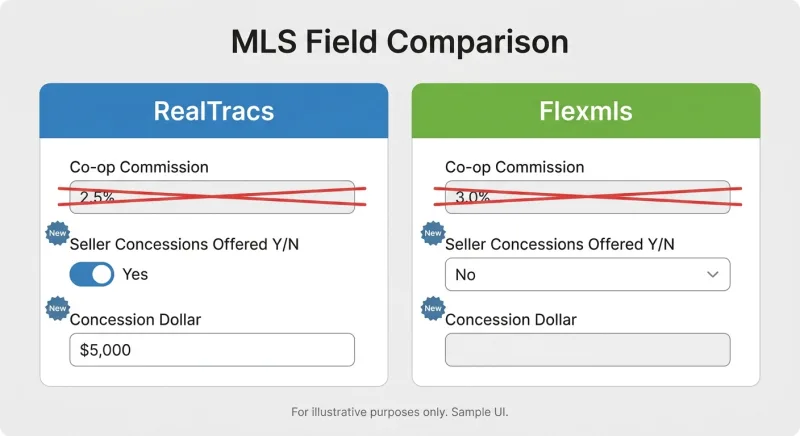
Tennessee runs on regional MLSs, and each rewrote its listing fields after the settlement. If you're selling in Nashville, Franklin, Brentwood, Murfreesboro, or Clarksville, your listing lives on RealTracs. In Chattanooga or parts of East Tennessee, you're likely on Flexmls through Greater Chattanooga REALTORS®.
Before August 17, 2024, a listing had a Co-op Commission field advertising the cut offered to whoever brought the buyer. That field is gone. In its place, Tennessee MLSs now display a Seller Concessions field — typically a Yes/No toggle paired with a dollar or percentage entry.
The distinction in one line: The old field advertised pay to the buyer's agent. The new field advertises money toward the buyer's costs. One is banned on the MLS. The other is fully allowed — and it's a broader, more flexible tool.
(Field names and layouts vary by MLS and change over time. Confirm the current screen with the licensed brokerage placing your listing.)
A FSBO seller listing through a flat-fee brokerage still gets a fully featured listing — same syndication to Zillow, Realtor.com, and Redfin, same field access. You're not on some watered-down FSBO tier.
Commission vs. Concession: The Distinction That Protects Your Bottom Line
A buyer-agent commission is money paid to the buyer's agent for their work. A seller concession is money the seller credits the buyer at closing — usually toward closing costs, prepaids, or a rate buydown. Different buckets. Different rules. Different tax and lending treatment.
Compensation now routes through a few channels:
- Direct off-MLS compensation — you agree to pay the buyer's agent a set fee, documented in the purchase contract.
- Seller concessions — you credit the buyer a dollar amount, and the buyer uses part of it to pay their own agent under their written buyer agreement.
- Buyer pays their own agent — if you offer nothing, the buyer owes their agent per that signed contract.
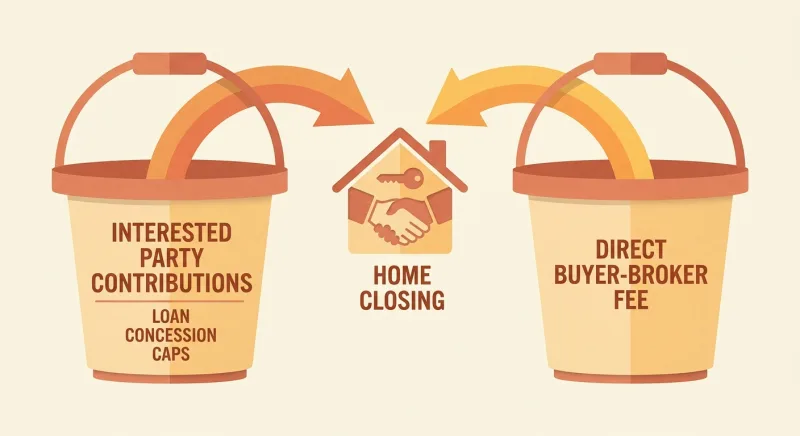
Here's the catch many sellers miss: seller concessions are capped by mortgage underwriting; direct buyer-broker fees generally are not.
Lenders treat concessions as Interested Party Contributions (IPCs). Under the Fannie Mae Selling Guide (B3-4.1-02), IPCs are limited by the buyer's loan type and down payment — commonly around 3% for low-down-payment conventional loans, scaling toward 6%–9% with larger down payments. Freddie Mac and FHA/VA loans have their own caps. Exceed the cap and the lender disallows the overage, which can blow up your closing. Always verify current limits with the buyer's lender.
That's the double-bucket rule: concessions (IPCs) live in one capped bucket; a direct off-MLS buyer-broker fee lives in a separate bucket the concession cap generally does not touch. If a buyer needs both closing-cost help and wants their agent paid, structuring both as one lump concession can breach the IPC cap. Splitting them keeps the deal inside underwriting guidelines.
Concession and IPC treatment depends on the buyer's specific loan — have your closing attorney and the buyer's lender confirm the numbers before you sign.
The double-bucket rule applied to real Tennessee deals
The low-down-payment FHA buyer in Memphis. Say your buyer is putting 3.5% down on an FHA loan, with IPCs capped around 6%. If you've already agreed to cover $8,000 in closing costs and the buyer's agent wants a 2.5% fee routed as a concession, you can slam into the cap on a modest-priced home. The fix: pay the buyer-broker fee through the off-MLS direct channel — same money, different lane, under the ceiling.
The cash buyer in Franklin. No loan means no IPC cap. The negotiation shifts entirely to price versus fee. A direct off-MLS fee or a straight price reduction is usually the cleaner structure.
The dual-cap problem on a conventional loan. Conventional IPC caps run by down-payment tier — often 3% under 10% down, scaling to 9% higher up. A seller who offers exactly the cap leaves no room for a rate buydown the buyer also wanted. Wait for the offer, then structure.
Where Steering Risk Actually Lives — and How to Neutralize It
If you don't offer a buyer-agent fee, will agents skip your listing? Some might try. That behavior — routing buyers away from listings that pay less — is called steering, and it's exactly what the written-buyer-agreement rule was built to expose. When a buyer signs a fee agreement up front, the agent's compensation is fixed by that contract, not your listing. An agent steering a client away from a well-priced home purely because you aren't paying is now steering against the buyer's own signed interest. That doesn't make steering vanish. It makes it visible and contestable.
Your practical defense as a Tennessee FSBO:
- Offer compensation off-MLS if your market is agent-heavy. In many Middle Tennessee price bands, a competitive buyer-broker fee still widens your buyer pool. Communicate it privately.
- Let the buyer's written agreement do the work. If a buyer's agent claims your listing "won't pay," the buyer already knows what they signed.
The Licensing Line: Why "MLS Access" Isn't Something You Buy Direct
You cannot access the MLS directly as a homeowner — not in Tennessee, not anywhere. The MLS is a members-only database, and membership runs through licensed brokerages regulated by TREC.
When you see a national website advertising "MLS access," ask: is the entity actually placing your listing a licensed Tennessee brokerage?
Some national flat-fee portals aren't brokerages in Tennessee at all. They collect your money, then hand the listing to a partner brokerage. That handoff is where sellers lose control, lose response time, and sometimes lose their listing if the referral chain breaks. A genuine flat-fee service is a licensed brokerage, or works directly through one that holds the participation.
| What you're checking | Licensed TN flat-fee brokerage | National portal / lead-gen site |
|---|---|---|
| Who places the RealTracs/Flexmls listing | The licensed TN brokerage itself | Often a third-party partner brokerage |
| TREC accountability | Directly regulated in Tennessee | Frequently out-of-state; unclear |
| Local form fluency (RF401/RF201/RF707) | Built into the workflow | Generic national templates common |
| Seller-concession field set up correctly | Yes — knows the current TN field | Varies; may misuse the field |
| Who answers when a TN issue hits | A Tennessee broker | A support ticket queue |
Always verify a company's Tennessee brokerage license through TREC before you pay.
Why the Contract Layer Is Your Real Protection
Getting on the MLS is the easy part. The paperwork after a buyer shows up is where FSBO sellers actually win or lose money.
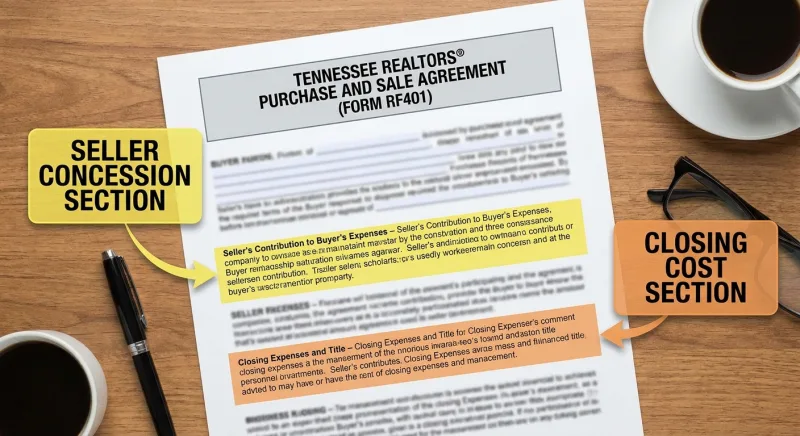
RF201 sets the frame. Tennessee REALTORS® Form RF201 (the purchase and sale agreement) is the spine of the deal. Closing costs, concessions, and financing terms are defined here.
RF401 handles the fee request. When a buyer's agent requests compensation from you, Form RF401 documents it — the amount, who pays, how it's satisfied at closing. If you agree to a buyer-broker fee, it belongs here in black and white, not in a text message.
RF707 addresses the disclosure layer. RF707 fits into the compensation-disclosure and confirmation picture. Confirm current subject matter with Tennessee REALTORS® or your closing attorney, since form content is revised over time.
The sequencing matters because a fee you "agreed to" verbally that never lands on RF401 or in RF201 doesn't bind the closing. The closing attorney disburses from the signed contract stack — not from good intentions.
One more wrinkle: under the FinCEN Residential Real Estate Rule, certain non-financed residential transfers to legal entities and trusts carry reporting obligations at closing. Confirm current status with your closing attorney — the rule faced court challenges, and your closing attorney or title company handles the reporting analysis.
Tennessee closings involve an attorney or title company — use them to review your forms before signing.
Frequently Asked Questions
Does the NAR settlement mean FSBO sellers can't offer buyer-agent commission in Tennessee?
No. You can still offer buyer-agent compensation as a Tennessee FSBO seller; you just can't advertise it on the MLS. Any offer of compensation to a buyer's broker happens off-MLS, through direct negotiation or the purchase contract.
Can you still put your house on RealTracs without an agent?
Yes — but only through a licensed Tennessee brokerage. RealTracs and other Tennessee MLS systems require a participating licensed broker to place a listing, which is exactly what a flat-fee MLS service provides. You skip the full-service agent, not the license.
How much are seller concessions capped at in Tennessee?
Concession caps depend on the buyer's loan, not a state rule. Under conventional Fannie Mae and Freddie Mac guidelines, interested-party contributions typically run 3% to 9% of the sale price depending on the down payment. Confirm the current limit with the buyer's lender before agreeing to anything.
Do I have to pay the buyer's agent as a FSBO seller?
No — buyer-agent compensation is fully negotiable in Tennessee. You can offer to pay it, offer a seller concession the buyer applies toward their own agent, or offer nothing and let the buyer cover it.
Is a flat-fee MLS company a licensed brokerage in Tennessee?
It has to be. Only a licensed brokerage can legally place a listing on RealTracs or Flexmls, regulated by TREC. Some national "portals" aren't licensed here and legally can't list your home directly — a real distinction worth checking before you pay.
What Tennessee forms do FSBO sellers need after the NAR settlement?
Most flat-fee sellers use Tennessee REALTORS® Form RF201 (the purchase agreement), alongside RF401 and RF707 for compensation and disclosure details. These are where buyer-broker fees and seller concessions get documented now that the MLS no longer carries a commission field.
Conclusion
The NAR settlement stripped buyer-agent commission fields off the Tennessee MLS as of August 17, 2024, but it never took away your right to list without a full-service agent or to negotiate compensation on your own terms. You can still put your home on RealTracs or Flexmls. You can still offer a buyer's broker a fee or a concession. You just do it off the MLS now, in the contract, where you control it.
The one rule that hasn't budged: MLS access in Tennessee runs through a licensed brokerage. A legitimate flat-fee service is a TREC-licensed brokerage placing your listing for a set fee — no percentage, no listing-side commission.
Your next steps: decide how you'll handle buyer-broker compensation, get comfortable with Form RF401 and how concessions work under your buyer's loan, then choose a licensed flat-fee brokerage in your market — Nashville, Franklin, Knoxville, Memphis, Chattanooga, Murfreesboro, Brentwood, Clarksville, or anywhere in the state. Confirm concession caps with the buyer's lender and any contract questions with a Tennessee closing attorney.
The path is clear, legal, and open.