

Short answer: a legit flat fee MLS company shouldn't spring a surprise fee on you at the closing table — but three very real costs catch Tennessee sellers off guard, and only one of them is actually the broker's.
Here's the pattern we see across Tennessee flat-fee closings. A seller signs up for a $95 or $399 listing, feels great about it, then gets a settlement statement weeks later with a number thousands of dollars higher than expected. Most of it isn't a hidden fee. It's the gap between what a flat fee MLS company advertises and what it actually costs to close a home sale in Tennessee. On a $380,000 home (roughly the Tennessee median), that "$399 flat fee" can land as several thousand dollars at closing — not because the broker lied, but because three separate cost buckets got quietly blended into one number.
So we're going to unblend them.
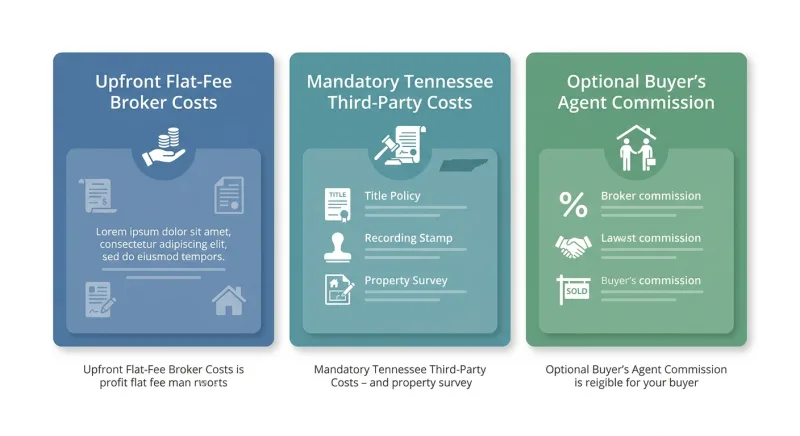
The 3 Cost Buckets Every Tennessee Flat Fee Seller Pays
Almost every "hidden fee" complaint disappears once you sort your costs into three buckets.
Bucket 1 — Upfront flat-fee broker costs. What you pay the entry-only brokerage to get your home on the MLS (RealTracs in Middle Tennessee, plus KAAR, MAAR, and River Counties boards across the state). It's the advertised number: $95, $399, whatever the plan says. Some companies also add a broker compliance fee — a charge collected at closing that's still the broker's fee, just deferred. That deferral is where most "hidden" complaints start.
Bucket 2 — Mandatory third-party Tennessee costs. These aren't the flat fee company's fees at all. State transfer tax, document recording, title services, escrow. Every seller in Tennessee pays these whether they use a flat fee MLS, a full-service agent, or a hand-painted sign in the yard.
Bucket 3 — Optional buyer's-agent commission. Post-NAR-settlement rules changed how this gets advertised, but to attract buyers who have agents, many Tennessee sellers still offer a buyer-agent commission (often 2–3%). This is a choice, not a hidden fee — but it's usually the single biggest line on the sheet.
The line item that trips people up: Bucket 1's compliance fee gets mistaken for a scam, and Bucket 2's statutory costs get blamed on the flat fee company. Neither is accurate.
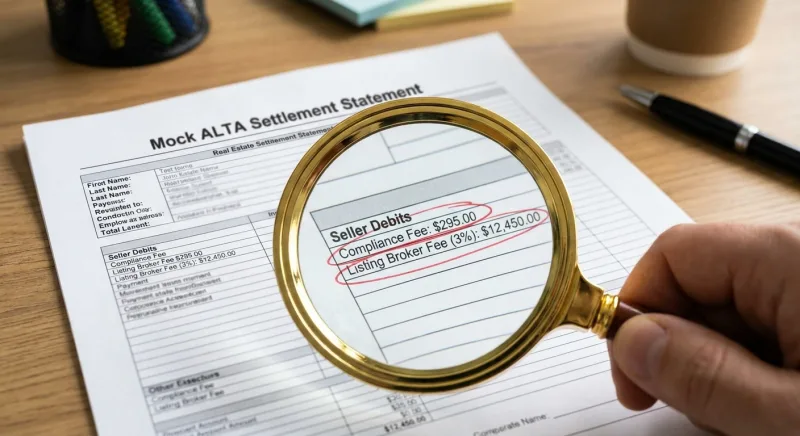
Where Hidden Charges Actually Hide (On the ALTA Settlement Statement)
If a flat fee MLS company is going to surprise you, here's where it happens: the seller-debit column of the ALTA settlement statement, revealed only after you're under contract.
That timing is the whole trick. When you sign up, you see a marketing page. When you go under contract, the deal moves to a title or escrow company, and they prepare the ALTA statement — the standardized document listing every dollar in and out. It arrives days before closing. By then, you're emotionally and legally committed.
Scroll to the seller's side and you'll see: mortgage payoff, buyer-agent commission (if you offered one), title and escrow charges, transfer tax, recording fees — and, if it's there, the broker's compliance fee or a "minimum commission" clause you didn't notice in the listing agreement.
A reputable broker's charges match, dollar for dollar, what you agreed to upfront. A shady one buries a percentage-based fee or flat compliance charge that never appeared on the pricing page — and counts on you not scrutinizing the seller-debit column while you're focused on the sale price.
The defense is simple: get your listing agreement in writing, and ask for a preliminary net sheet before you list. Any broker who won't put every fee on paper up front is telling you something.
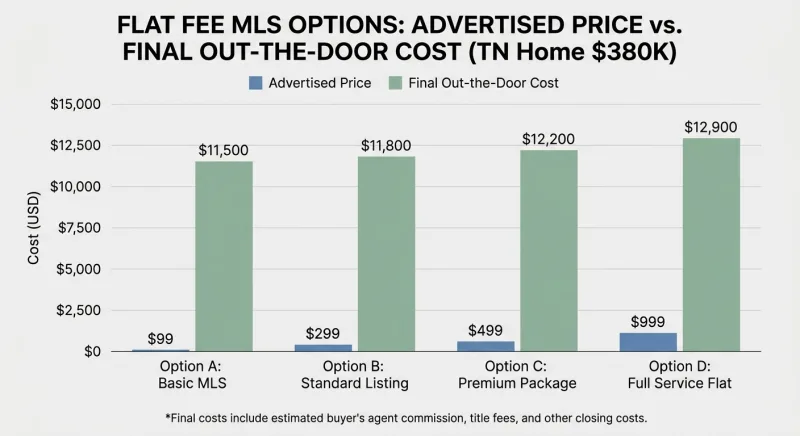
The Real Cost Breakdown: Advertised vs. Final on a $380,000 Tennessee Home
| Cost line | Bucket | Advertised? | Cost on a $380K TN sale |
|---|---|---|---|
| Flat fee MLS listing | 1 (broker) | Yes | $95–$399 |
| Broker compliance fee (if any) | 1 (broker) | Sometimes buried | $0–$995 |
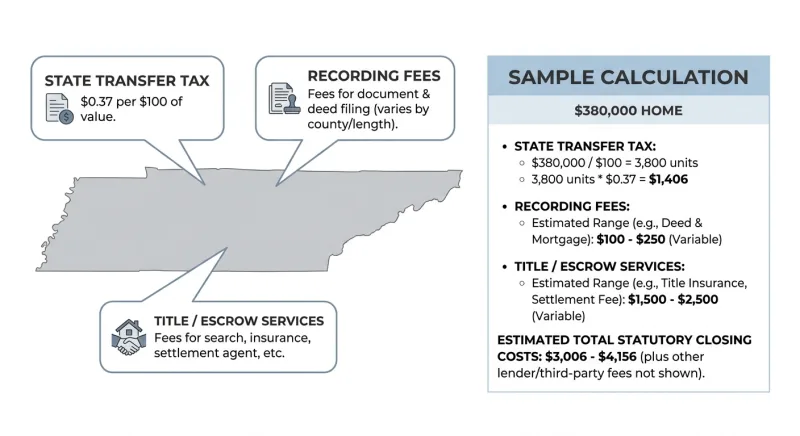
| State transfer tax ($0.37/$100) | 2 (statutory) | No | ~$1,406 |
| Document recording fees | 2 (statutory) | No | ~$15–$100 |
| Title & escrow services | 2 (third-party) | No | ~$800–$1,500 |
| Buyer agent commission (optional) | 3 (optional) | No | $0 or ~$7,600–$11,400 (2–3%) |
The gap explained: a seller who "signed up for $399" and offered a 2.5% buyer-agent commission is looking at roughly $399 broker + ~$2,300 statutory/third-party + ~$9,500 buyer commission = around $12,200 at closing. That feels like a $399 promise turned into $12K of "hidden fees." It isn't. Only a surprise compliance fee would qualify as genuinely hidden. The rest is Bucket 2 and Bucket 3, and you'd pay most of it any way you sold.
Methodology note: figures reflect published pricing and Tennessee statutory rates as of early 2026 and assume a $380,000 sale price. Transfer tax is calculated at the Tennessee Department of Revenue rate of $0.37 per $100 of value. Broker fees vary by plan — verify current pricing on each company's site before you list. Title and escrow ranges reflect typical Tennessee practice and vary by provider and county.
On this same home, a traditional listing-side commission (3%) would run about $11,400 — before Buckets 2 and 3. Flat fee MLS deletes Bucket 1's biggest cost. The confusion comes entirely from failing to separate the buckets.
Why "Flat Fee" and "Hidden Fee" Aren't Opposites
A flat fee is a pricing model. A hidden fee is a disclosure failure. A company can nail one while failing the other completely.
Watch the trigger. The listing fee fires at signup. A "compliance fee" fires at closing. A "transaction fee" fires when you go under contract. Same company, same seller — but the second charge is bolted to a different moment in the timeline. You paid in March; the $495 shows up on a settlement statement in June.
The real question isn't "does this company charge extra?" It's "is every charge disclosed in the listing agreement I sign before I pay anything?" If the number appears in the agreement — even in a schedule on page 6 — it's a disclosed fee, not a hidden one. If it only appears on the ALTA statement, you got surprised.
Don't audit the pricing page. Audit the listing agreement and the broker's fee schedule.
The Three Fee-Trigger Points Across the Listing Timeline
Trigger 1 — At signup (the advertised fee)
The number you shopped on. The edge case: some brokers advertise a base tier that excludes photos, listing changes, or open-house additions most sellers actually need — so the signup cost inflates before you go live. Read what's in the base package, not just its price.
Trigger 2 — At contract (the transaction/processing fee)
Some brokerages charge a transaction fee — often $100 to $500 — the moment you accept an offer. It's framed as "processing the paperwork." This one hides best because it's disconnected from both signup and closing.
Trigger 3 — At closing (the compliance/success fee)
The biggest surprise category. A "compliance fee," "success fee," or undisclosed percentage at closing shows up as a seller debit on the settlement statement. Some entry-only brokers advertise a flat listing price, then collect a minimum commission — say, 0.5% or a $995 floor — at the table. That's not a flat fee anymore. That's a discount commission wearing a flat-fee costume.
The framework: before you sign, ask one question per trigger — "What do I owe at signup, at contract acceptance, and at the closing table?" Three numbers. If a broker can't give you three clean numbers, that's your answer.
The Post-NAR Wrinkle: Unilateral Broker Fees
Since the 2024 NAR settlement changed how buyer-agent commissions get advertised, a new gray area opened up. Buyer-agent commission is no longer posted in the MLS the way it was — you negotiate that number offer-by-offer now. But some brokers quietly inserted a "unilateral broker fee" into their agreements to recapture buyer-side revenue: a clause stating that if a buyer's agent brings the deal, the listing brokerage collects a small percentage or flat amount from you as a "cooperation" or "administrative" charge, separate from anything the buyer's agent gets.
In a true limited-service model, the broker's job ended when your listing went live. If the agreement contains a broker-side fee that triggers only when a co-op agent is involved, you're paying twice for the buyer side. Ask specifically: "Does your brokerage collect anything at closing if a buyer's agent is involved?" Get it in writing.
When the "Hidden Fee" Is Actually the Title Company
Not every surprise on the settlement statement is the broker's fault. A chunk of what looks like padded closing costs comes from the title and escrow provider. Escrow fees, title search, courier/wire fees, document prep — these live in the seller-debit column right next to any broker fee, so they blur together.
Here's how to tell them apart on the ALTA statement:
- Broker-originated fees name the brokerage or use terms like compliance, transaction, listing, or administrative fee.
- Statutory/third-party fees name a government body or title function — state transfer tax, recording fee, title insurance, escrow/settlement fee.
The third-party costs are real and mostly non-negotiable — but in Tennessee, escrow and closing fees vary between title companies, and you can shop the title company if you're paying for it. Comparing two escrow providers can move the seller-side number by a few hundred dollars. That's a legitimate lever the hidden-fee panic makes people forget.
A Decision Framework for Vetting Any Flat Fee Broker
Run this ten-minute test on any company before you sign.
1. Total-cost-to-close, not sticker price. Add all three trigger points into one number for a $380,000 sale. The lowest signup fee frequently isn't the cheapest at the table.
2. The percentage test. Search the pricing page and agreement for the "%" symbol and the words minimum and commission. Any percentage or commission floor that survives to closing means a discount-commission model, not a true flat fee.
3. The written-agreement test. Ask for the actual listing agreement before you pay. A reputable broker sends it without friction. Hesitation is the tell.
4. The cancellation test. What happens if you cancel or your listing expires unsold? Some brokers keep the signup money (fair) but also charge an early-termination fee (read this closely).
5. The co-op test. Confirm in writing whether the brokerage collects anything at closing when a buyer's agent is involved.
A company that passes all five isn't hiding closing fees — it's just charging you the statutory costs every Tennessee seller pays regardless.
The Contrarian Truth: "Hidden Fees" Are Usually Just Fees You Read in the Wrong Order
A genuinely hidden fee — one the broker had no legal basis to charge and never disclosed anywhere — is rare with a reputable company. What's common is the timing problem. A seller reads a big "$95" or "$399" headline, files it as "the cost of selling my house," and moves on. The Bucket 1 add-ons are disclosed — but they're in the listing agreement, not the headline. The Bucket 2 statutory costs aren't disclosed by the flat fee company at all, because they aren't its costs — they appear for the first time on the ALTA statement, three or four weeks after you're already under contract.
Nothing was technically hidden. Everything was just revealed in an order engineered to make the smallest number the loudest.
The question isn't "Does this company have hidden fees?" It's "What's my Bucket 1 total, and is it worth it?" — because Buckets 2 and 3 are nearly identical no matter which flat fee route you pick.
If mandatory Tennessee closing costs run roughly the same on a $380,000 home regardless of who lists it, and the buyer-agent commission is a number you choose, then the only variable you're actually shopping is Bucket 1 — usually a few hundred dollars between companies, not the thousands the headline-vs-final gap implies.
The Operator's Tell for Any Surprise Line
There's a 24-to-72-hour window where trust breaks. You go under contract, you're relieved, then the title company sends a preliminary net sheet and every Bucket 2 cost lands at once. If your broker had an "at closing" charge, it appears here too, right beside costs that have nothing to do with them.
Internalize this test: a legitimate cost shows up with a named third-party collector — the county Register of Deeds for recording, the Tennessee Department of Revenue for transfer tax, the title/escrow provider for title services. A questionable Bucket 1 fee shows up as a vague broker-side debit that wasn't in the agreement you signed.
Can I name who collects this, and was it in my agreement? That single question sorts almost every surprise into "legitimate and unavoidable" or "go ask your broker about this line, today."
Frequently Asked Questions
Do flat fee MLS companies in Tennessee charge hidden closing fees?
A reputable flat fee MLS company shouldn't charge a hidden closing fee — you pay an upfront listing fee and that's it from the broker. The surprise charges sellers report usually come from optional add-ons (like a broker "compliance fee" of $495–$995) or a minimum buyer-agent commission buried in the fine print, not from a secret line item at the closing table.
What did I actually pay a flat fee MLS broker versus what shows up at closing?
The flat fee (often $95–$399) covers only getting your home on the MLS. At closing you'll also see mandatory third-party Tennessee costs — the state transfer tax of $0.37 per $100 of value (about $1,406 on a $380,000 home), recording fees, and title/escrow charges — plus any buyer-agent commission you agreed to offer.
Does ResultsMLS have hidden fees?
Based on published pricing, ResultsMLS charges a flat upfront listing fee with no percentage taken at closing and no separate broker compliance fee — verify the current package on ResultsMLS.com before you list. The costs you'll still see at closing are the standard Tennessee statutory items every seller pays, regardless of which brokerage lists the home.
Do FSBO companies have hidden fees?
Some do — the two to watch for are a broker "compliance" or "transaction" fee added after you're under contract, and a minimum commission clause that overrides the advertised flat rate on lower-priced homes. Read the MLS listing agreement line by line and ask, in writing, whether any percentage or additional broker fee is deducted at closing.
Where do hidden charges actually hide?
They hide in the seller-debit column of the ALTA settlement statement, which you don't see until you're under contract and approaching closing. That's why you ask about every possible broker fee before you sign the listing agreement — not after an offer comes in.
Conclusion
A legit Tennessee flat fee MLS listing is exactly what it sounds like — you pay the upfront fee, you get on RealTracs (or KAAR, MAAR, River Counties), and no broker quietly skims a percentage at the closing table. The dollars that surprise sellers aren't hidden broker fees. They're mandatory third-party Tennessee costs — the $0.37-per-$100 transfer tax, recording fees, and title/escrow charges — plus whatever buyer-agent commission you chose to offer.
Separate the three buckets before you sign anything. Get the broker's upfront fee in writing. Ask whether any compliance fee, transaction fee, or minimum commission applies. Request a net sheet before you're locked in under contract. Do that, and the advertised number and the final number line up. In Tennessee, transparency isn't a perk. It's the whole point of going flat fee.