
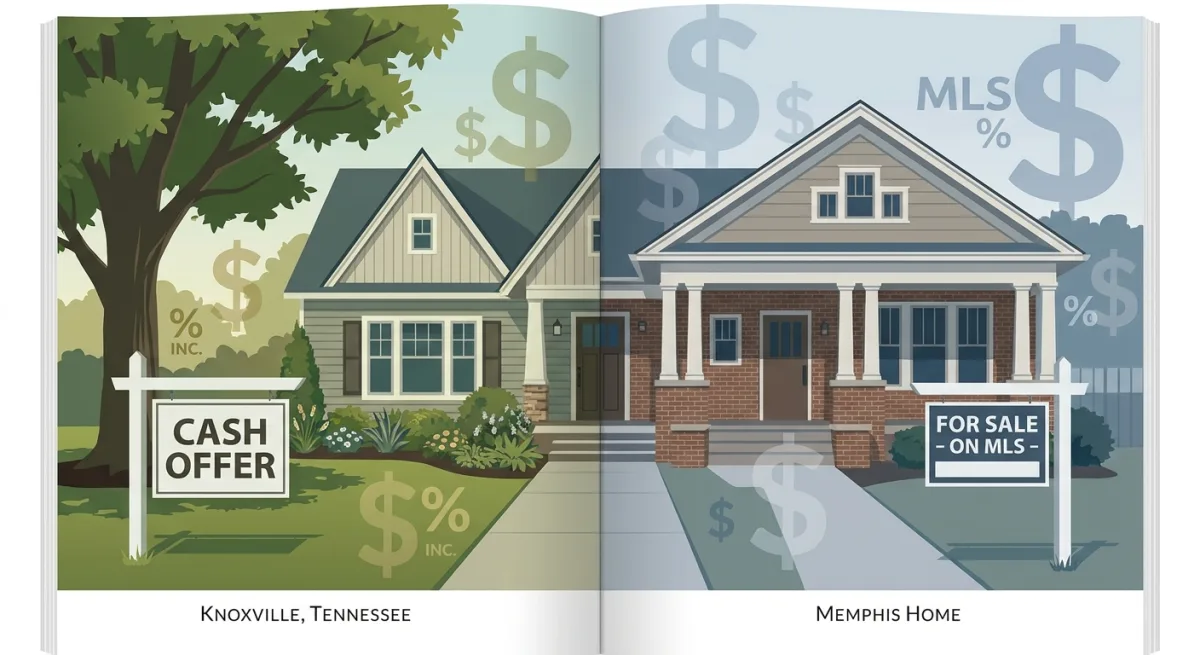
Cash Offer vs. MLS Listing in Knoxville & Memphis: The Net-Proceeds Question
A cash offer buys certainty; an MLS listing buys price. The right choice is whichever gap is bigger for your house. For a clean, sellable home in a decent Knoxville or Memphis ZIP, listing on the MLS almost always nets more — often tens of thousands more. For a distressed, inherited, or out-of-state property you need gone in seven days, a cash offer can be the smarter trade.
Here's what most comparisons get wrong: they pit cash offers against a 6% full-service agent and call it a day. There's a third column — list it yourself flat-fee on the same MLS agents use, pay $99–$399 upfront instead of a listing commission, and keep the difference.
Below, we run the math for a $350k Knoxville home and a $165k Memphis home, three ways each, using sourced market inputs. Rates and fees are current as of Q1 2026.
The Two Models (and the Third Everyone Forgets)
Cash-offer platforms: who's actually buying
iBuyers — Opendoor and Offerpad buy near fair market value, then charge a service fee. Opendoor's charge typically runs around 5%, plus repair deductions. iBuyer availability is spottier in these metros than in Phoenix or Atlanta.
Local flippers and "We Buy Houses" networks run the 70% rule. They buy at a steep discount because their model requires margin for rehab, holding, and resale — expect 70–85% of After-Repair Value minus repairs.
Buy-and-hold landlords underwrite to cash flow and yield, which is why they're thick on the ground in Memphis.
Wholesalers don't want the house — they want your contract to flip to an investor for an assignment fee. Their offer carries two margins, so it's usually the lowest.
Limited-service flat-fee MLS: the third column
A flat-fee MLS broker lists your home on the same KAAR or MAAR MLS a full-service agent would use — same Zillow, Realtor.com, and Redfin syndication — for $99–$399 upfront instead of a percentage listing commission. You handle showings and talk to buyers directly. Because the NAR settlement (effective August 2024) made buyer-agent commission separately negotiable, you decide what, if anything, to offer a buyer's agent.
The result: you retain roughly 97% of your equity while still getting open-market offers — including cash offers. This isn't cash or MLS. You can list flat-fee and still accept a cash buyer who finds you on the MLS.
Why Knoxville and Memphis Aren't the Same Market
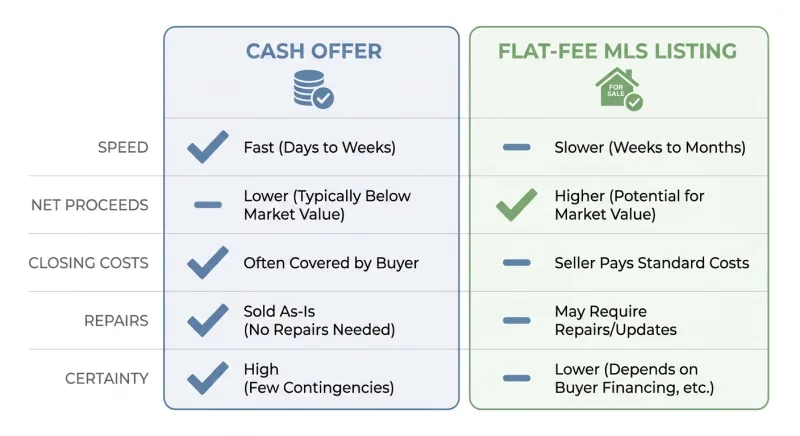
Knoxville is an owner-occupant market — prices are higher, demand is steady, and a well-priced listing moves. KAAR's reported median sits in the $320k–$380k range. When most buyers are owner-occupants paying retail, open-market exposure pays off.
Memphis is an investor-heavy market. Shelby County has one of the deepest rental-investor pools in the Southeast. Median prices in core city submarkets run $150k–$180k (broader MAAR metro median near $230k). More investor demand means more cash offers — but investor cash is yield-driven and discounts hard.
| Factor | Knoxville (Knox County) | Memphis (Shelby County) |
|---|---|---|
| MLS / platform | KAAR / Flexmls | MAAR / Paragon |
| Median price (2026) | ~$320k–$380k | ~$150k–$230k |
| Dominant buyer | Owner-occupants | Investors / landlords |
| Cash-offer source | iBuyers, some flippers | Flippers, buy-and-hold, wholesalers |
| iBuyer availability | Limited | Limited |
| What open-market exposure buys you | Retail owner-occupant pricing | Competition against investor lowballs |
In Knoxville, the MLS taps a wall of retail buyers willing to pay fair market value. In Memphis, the MLS is your best defense against the investor discount — it forces cash buyers to compete with owner-occupants instead of naming their own number.
Cash Offer vs. iBuyer vs. Flat-Fee MLS: The Honest Comparison
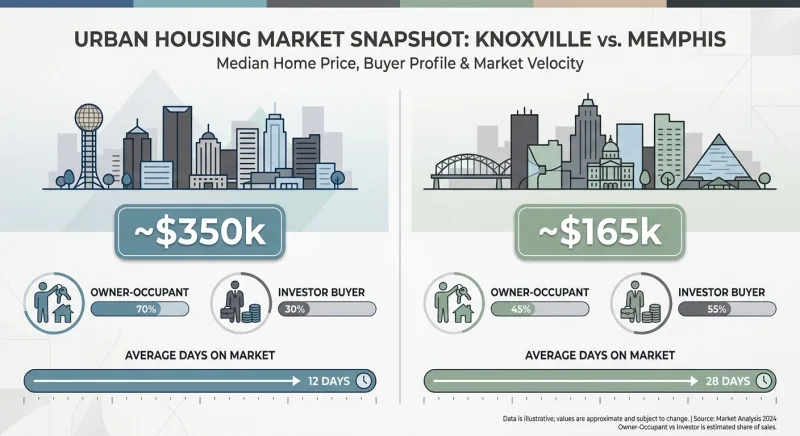
| Cash Offer (Flipper/Wholesaler) | iBuyer (Opendoor/Offerpad) | Flat-Fee MLS | |
|---|---|---|---|
| Typical net | ~70–85% of ARV minus repairs | ~90–95% minus 5%+ fee & repairs | ~97% of sale price |
| Speed to close | 7–14 days | 14–30 days | 30–60+ days |
| Upfront cost | $0 | $0 | $99–$399 |
| Listing commission | None | None | None |
| Buyer-agent commission | None | None | Negotiable |
| Repairs required | None (as-is) | Deducted from offer | Your call |
| Showings | None | Minimal | You host them |
| Certainty of close | High | High | Market-dependent |
| Who it fits | Distressed, urgent, as-is | Clean home, convenience over max price | Sellable home, max net proceeds |
Knoxville Net-Proceeds Example: A $350k Home
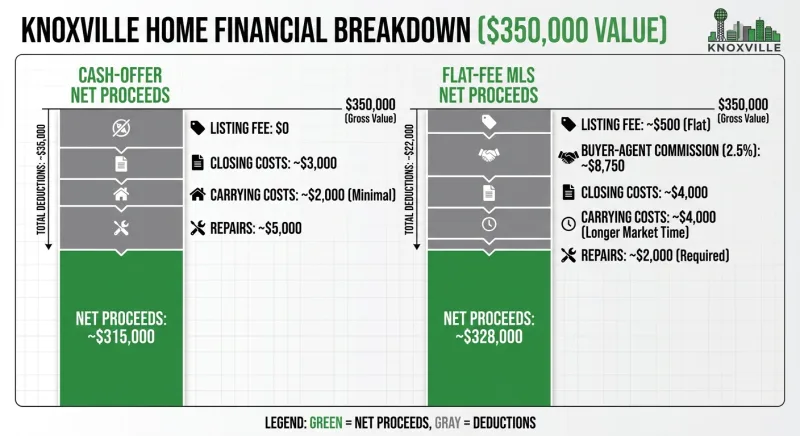
Illustrative, reproducible math using cited market inputs — not records of actual ResultsMLS transactions.
Path 1 — Flipper cash offer (70% rule):
- ARV $350,000 × 70% = $245,000
- − estimated repairs ($15,000) = $230,000 to you
Path 2 — iBuyer:
- Offer near FMV: $340,000
- − service fee 5% ($17,000) − repair credits ($8,000) − seller closing costs 1.5% ($5,100) = **$309,900 to you**
Path 3 — Flat-fee MLS listing:
- Sale price: $350,000
- − flat-fee package ($399) − buyer-agent commission (2.5% = $8,750) − seller closing costs 1.5% ($5,250) = **$335,601 to you**
The spread between the flipper cash offer and the flat-fee listing exceeds $105,000. Even against the iBuyer, the MLS listing nets roughly $25,000 more — with a buyer-agent commission built in that you can now negotiate down.
Memphis Net-Proceeds Example: A $165k Home
Same discipline — illustrative, reproducible, sourced inputs.
Path 1 — Investor/flipper cash offer:
- ARV $165,000 × 75% = $123,750
- − repairs ($10,000) = $113,750 to you
Path 2 — iBuyer (where available):
- Offer near FMV: $160,000
- − service fee 5% ($8,000) − repair credits ($6,000) − closing costs 1.5% ($2,400) = **$143,600 to you**
Path 3 — Flat-fee MLS listing:
- Sale price: $165,000
- − flat-fee package ($399) − buyer-agent commission (2.5% = $4,125) − closing costs 1.5% ($2,475) = **$158,001 to you**
The flat-fee listing nets about $44,000 more than the investor cash offer and roughly $14,000 more than the iBuyer. On a $165k home, every repair deduction and investor discount eats a bigger share of a smaller pie — which is exactly why the MLS is your defense in Memphis. That $14,000 is real money on a $165k house.
How Cash Buyers Actually Build Your Offer
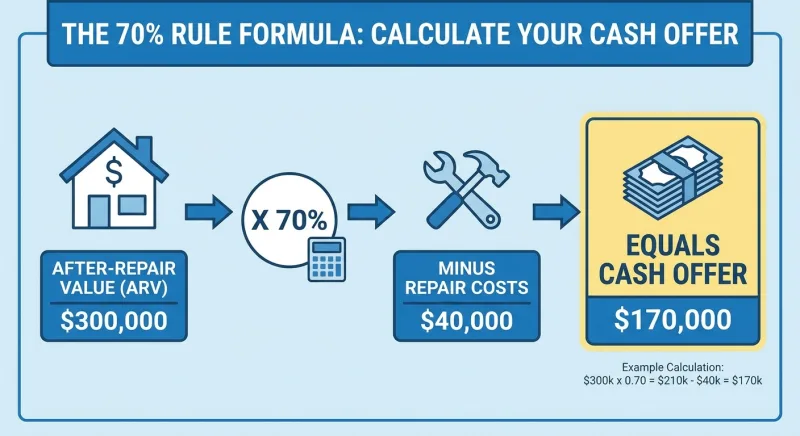
Flippers and most "We Buy Houses" investors run the 70% rule:
Offer = (After-Repair Value × 70%) − Estimated Repairs
They multiply by ~70% (sometimes 75–80% in a hot market) to bake in profit, holding costs, and resale commissions, then subtract repairs. That 30% gap isn't greed — it's their entire business margin, stacked in distinct layers:
- Repair reserve — the literal cost to bring the house to resale condition.
- Holding cost — taxes, insurance, utilities, loan interest across rehab and resale.
- Exit transaction cost — commissions and closing costs they'll pay when they sell.
- Profit and risk premium — their margin plus a cushion for surprises behind the drywall.
When you sell on the open market, you unbundle that stack. You pay for the repairs you choose, absorb holding cost only for your actual days on market, and capture the profit the flipper would have taken. That's the structural reason a sellable home nets more on the MLS.
Wholesalers go lower still, tacking on an assignment fee to flip your contract to that same flipper. iBuyers play a different game — they aim near fair market value and monetize through a service fee (~5% for Opendoor, up to 13% across platforms per published schedules) plus post-inspection repair deductions.
Where the formula bends by metro
In Memphis, investors often underwrite to cash-on-cash return rather than flip resale. A landlord buyer on a rent-ready house is more competitive than a flipper; on a house needing cosmetic work they'll never recoup in rent, they're less competitive.
In Knoxville, the flipper's exit is a retail sale to a family — higher ARV ceiling, but higher finish expectations. A flipper buying a dated Knoxville home underwrites for granite, LVP, and a staged resale, which swells the repair reserve and widens the discount.
Certainty Isn't Binary: Read the Contract
"Cash offer = guaranteed close" is the most oversold claim in this space. Three clauses quietly erode it:
The inspection contingency. Many "as-is" cash offers still carry an inspection window with a re-trade right. The headline offer was never the real offer.
The assignment clause. If the buyer is a wholesaler, watch for "and/or assigns" after their name. If their end-buyer walks, your deal can evaporate. This runs high in the lower-price Memphis market.
The funding-proof gap. "Cash" sometimes means hard-money — a short-term loan that still has to fund. Ask for proof of funds dated within the week.
The counter-move: listing flat-fee doesn't forfeit cash buyers — it auctions them against each other. When your house hits KAAR's Flexmls or MAAR's Paragon, it syndicates to the same investor feeds cash buyers scrape daily. You don't lose the cash offer; you force it to compete with retail demand.
The Decision Framework: Price Gap vs. Certainty Gap
Step 1 — Estimate your Price Gap. What the open market nets you minus what the best cash offer nets you, after all costs on both sides. For a sellable home this gap is often substantial because you're recapturing the flipper's margin. For a heavily distressed house it narrows — the repair reserve covers real work you'd otherwise fund yourself.
Step 2 — Price your Certainty Gap. Quantify it:
- Carrying cost — mortgage, taxes, insurance, utilities across extra days on market.
- Risk of a double mortgage if you've already bought your next home.
- Probate / out-of-state burden — the real cost of managing a listing remotely.
- Emotional and time cost — soft, but honest sellers price it anyway.
Step 3 — Compare. If your Price Gap is larger, list it. If your Certainty Gap is larger, take the cash.
Knoxville, turnkey, $350k, no urgency: Price Gap wide, Certainty Gap small. → List flat-fee, keep the difference.
Memphis, inherited, $165k, needs $25k of work, out-of-state heir: Price Gap narrows (the cash discount absorbs repairs you'd coordinate remotely), Certainty Gap widens sharply. → The cash offer may genuinely win.
Edge Cases Where the Standard Advice Breaks
The 2026 iBuyer availability gap. Coverage is uneven and shifts quarterly. A standard Knoxville subdivision home may get a clean algorithmic offer; a historic Midtown Memphis property with a non-conforming layout often won't qualify. Don't assume the national iBuyer number is available to your house.
The low-equity seller. When you owe 85%+ of value, retaining ~97% of equity can be the difference between walking away with money and bringing money to close.
The genuinely distressed house. If the home needs structural, roof, or systems work you can't finance, the open market will price those defects brutally through buyer re-trades and failed financing. For a house with a caving foundation, the cash buyer's bundled repair reserve is a real service. For a turnkey home in a hot ZIP, it rarely pencils out.
Market figures reflect KAAR and MAAR reporting as of Q1 2026, plus published iBuyer fee schedules. All worked examples are illustrative and reproducible from cited inputs — not records of actual ResultsMLS transactions. Verify current numbers before deciding.
Keep the Exposure, Keep the Option
Can you list flat-fee on the MLS and still accept a cash offer? Yes — and in an investor-dense market like Memphis, it's often the strongest move available. A flat-fee listing doesn't shut cash buyers out; it invites them to compete on the open market, where they can see each other. Investors scan the MLS daily. List it right and the same cash buyer who'd have offered 70% off-market now has to bid against other investors and owner-occupants. You haven't given up certainty; you've auctioned for it.
Frequently Asked Questions
How much do cash buyers pay versus market value in Tennessee?
Local investors typically offer 70–85% of after-repair value minus estimated repairs. iBuyers pay closer to market but deduct a service fee of roughly 5–13%. The gap is your price for speed and certainty.
Is an iBuyer worth it in Memphis?
Rarely for a sellable home. Memphis's lower city price points (~$150k–$180k) mean iBuyer service fees eat a meaningful slice of already-modest equity — and major iBuyers have limited coverage in many Shelby County ZIPs, pushing you toward local flippers who discount harder.
Can I list flat-fee on the MLS and still accept a cash offer?
Yes — and that's the underrated move. A flat-fee MLS listing exposes your home to the entire market, including investors who shop the MLS daily, so you often get genuine cash offers plus competing financed offers without surrendering the listing-side commission.
Does a cash sale skip the Tennessee property disclosure requirement?
Not automatically. The Tennessee Residential Property Condition Disclosure Act (Tenn. Code Ann. § 66-5-201 et seq.) generally applies regardless of buyer type, though certain transfers qualify for exemptions or an "as-is" disclaimer form. This is general information, not legal advice — confirm your situation.
How much does flat-fee MLS cost in Knoxville or Memphis?
Packages generally run $99–$399 upfront, letting you keep roughly 97% of your equity instead of paying a 2.5–3% listing-side commission. On a $350k Knoxville home, that savings alone can exceed $8,000.
What's the biggest difference between selling in Knoxville and Memphis?
Price point and buyer pool. Knoxville leans toward owner-occupants at a ~$320k–$380k median (KAAR), where open-market exposure drives competitive offers; Memphis skews investor-heavy with core city medians around ~$150k–$180k, where repair deductions and fees hit harder proportionally.
The Bottom Line
For a turnkey home in a hot Knoxville ZIP, cash offers rarely pencil out — the discount an investor needs to profit is almost always larger than the hassle you're avoiding. For a distressed, inherited, or out-of-state property in Memphis where repairs are real and timing is tight, a cash buyer's seven-day close can genuinely be the smarter net.
But don't accept the false binary. List flat-fee on the MLS, get full market exposure, and let cash buyers compete alongside financed offers — while skipping the listing-side commission. You keep roughly 97% of your equity and still capture speed if a strong cash offer appears.
Run your own numbers using the line-item framework above. Pull your estimated repairs honestly. Compare what actually lands in your bank account under each path, verify figures against current KAAR or MAAR data and your own quotes, and decide with math — not pressure.