
The NAR Settlement and Middle Tennessee's 2026 Spring Market: What FSBO Sellers Should Do Now
The NAR settlement didn't make selling your home yourself harder. For most Middle Tennessee FSBO sellers heading into the 2026 spring market, it quietly handed you more control — specifically, the right to decide case-by-case whether you pay a buyer's agent at all. That's the opposite of what a lot of listing agents are telling you.
Two rule changes from the National Association of REALTORS settlement reshaped how commissions get negotiated: buyer-agent compensation came off the MLS, and buyers now sign a written agreement before touring. Pair that with a Nashville-region spring where inventory keeps climbing across Davidson, Williamson, Rutherford, Wilson, Sumner, and Maury counties, and the moment favors a smart flat-fee seller who knows the new rules.
This piece pairs the actual post-settlement rules with county-level market context, names the exact Tennessee REALTORS forms you'll need, runs transparent net-proceeds math on a $550,000 home, and shows you where FSBO wins — and where it's the wrong call.
What the NAR Settlement Actually Changed for Tennessee Sellers
The NAR settlement — tied to the Burnett/Sitzer litigation — rewrote two things that touch every Tennessee listing on RealTracs, the MLS that covers the Nashville region.
The two changes that matter most:
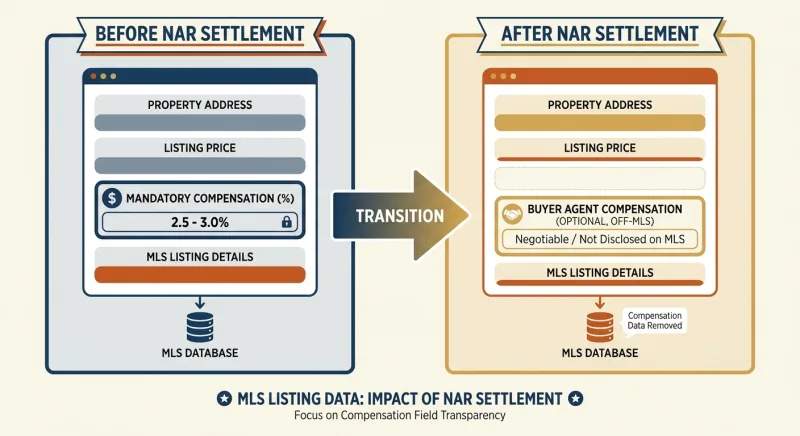
- Offers of buyer-agent compensation were removed from the MLS. You can no longer advertise a co-op commission inside RealTracs, and the public or private remarks fields can't be used as a workaround.
- Buyers must sign a written representation agreement before an agent tours them through a home. That agreement spells out what the buyer owes their own agent — a number on paper before they ever walk your property.
What stayed the same matters too. You can still offer to pay a buyer's agent. You can still offer closing cost credits or seller concessions. The difference is where and how: compensation is now negotiated off-MLS, deal by deal, and written into the contract instead of standing as a public offer.
Agency relationships and disclosures still run through TREC, and Tennessee's licensing statute (T.C.A. § 62-13-312) still governs broker conduct. What changed is your leverage over that one line item — the buyer-agent commission — that used to be baked in automatically.
The settlement didn't take a tool away. It took away an automatic expense and replaced it with a decision.
Does the Settlement Hurt FSBO Sellers? Myth vs. Reality
Does a Nashville seller have to pay a buyer's agent in 2026? No. Compensation is now negotiated case-by-case and written into the purchase and sale agreement.
The fear goes like this: "Now that buyers sign agreements with their own agents, those agents will steer clients away from FSBO homes that don't guarantee a commission." It sounds plausible. It's mostly backwards.
The written buyer agreement — the thing agents say hurts you — actually shifts the obligation onto the buyer. If a buyer signs an agreement promising their agent 2.5%, that's the buyer's commitment. When they find your home, the conversation becomes: who covers that 2.5%? That's negotiable in the offer, as a concession, or paid by the buyer directly.
The old system hid this. The co-op commission was a default you paid without thinking. Now it's a line you negotiate. You can offer 2%, offer a flat buyer-agent fee, offer nothing, or roll it into a closing cost credit. On a mid-range Middle Tennessee home, that flexibility is worth real money.
The honest answer: the settlement made FSBO easier to run profitably, and marginally harder to run lazily.
Middle Tennessee's 2026 Spring Market: County-by-County Data
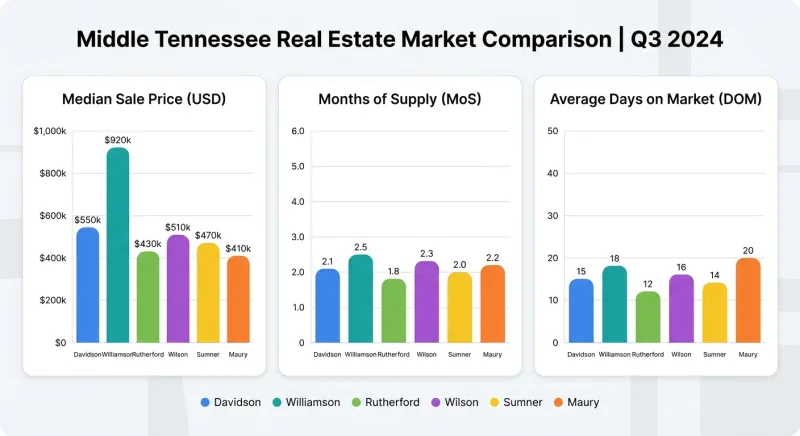
The 2026 spring market is doing something that helps prepared FSBO sellers: inventory is recovering, which means buyers have more patience — and sellers who price well and stay flexible on terms win.
The number that matters most is months of supply. Under roughly 4 months favors sellers; 4–6 is balanced; above 6 tilts toward buyers. Middle Tennessee sits in that middle band in most counties this spring — exactly where negotiation leverage, including who pays the buyer's agent, becomes the deciding factor.
| County (key cities) | Approx. median sale price | Months of supply | Median days on market | Listings with a price reduction |
|---|---|---|---|---|
| Davidson (Nashville) | Check current local report | Check current local report | Check current local report | Check current local report |
| Williamson (Franklin, Brentwood, Nolensville) | Check current local report | Check current local report | Check current local report | Check current local report |
| Rutherford (Murfreesboro, Smyrna) | Check current local report | Check current local report | Check current local report | Check current local report |
| Wilson (Mt. Juliet, Lebanon) | Check current local report | Check current local report | Check current local report | Check current local report |
| Sumner (Hendersonville, Gallatin) | Check current local report | Check current local report | Check current local report | Check current local report |
| Maury (Spring Hill, Columbia) | Check current local report | Check current local report | Check current local report | Check current local report |
Source: RealTracs / Greater Nashville REALTORS, spring 2026 reporting.
Williamson County carries the region's highest median by a wide margin. On higher price points, the dollar value of a saved commission is larger, which is why flat-fee listing pencils out strongest there — a single percentage point is thousands of dollars. Davidson County moves the most volume and sees the shortest typical days on market, but also one of the higher price-reduction rates; overpricing gets punished even in Nashville. Rutherford and Maury keep drawing first-time and relocating buyers, many of whom bring agents under the new rules.
The through-line: this is a market where terms matter as much as price. And buyer-agent compensation is now a term you control.
How to Handle Buyer-Agent Compensation as a FSBO Seller Now
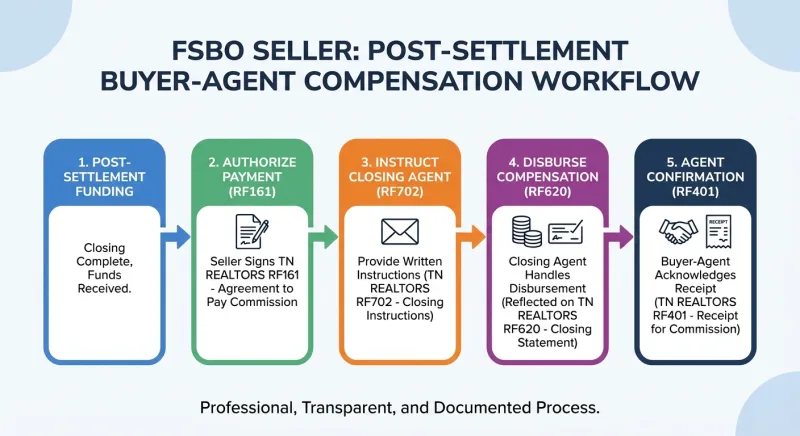
When an offer comes in and the buyer has an agent, follow a compliant workflow using the correct Tennessee REALTORS forms.
- Keep the compensation offer off the MLS. Your RealTracs flat-fee listing can't advertise a co-op commission, and private remarks can't signal one either. Handle it at the offer stage.
- Let interested agents request showing terms. Tennessee REALTORS maintains an Agreement to Show Property (Form RF161) that documents terms before a tour.
- Negotiate compensation inside the offer, not before it. When the Purchase and Sale Agreement (Form RF401) arrives, any buyer-agent compensation gets addressed there.
- Document compensation with the correct addendum. Use the dedicated Compensation Agreement (Form RF702) or Compensation Addendum (Form RF620) — never a verbal promise.
- Consider a seller concession instead. Offer a closing cost credit the buyer uses toward their agent's fee. Watch the caps — FHA and VA limit allowable concessions, so confirm the loan type first.
- Handle unrepresented buyers cleanly. You owe no buyer-agent commission, but still provide required TREC disclosures and keep everything documented.
Real Net Proceeds Math: Three Scenarios on a $550K Home
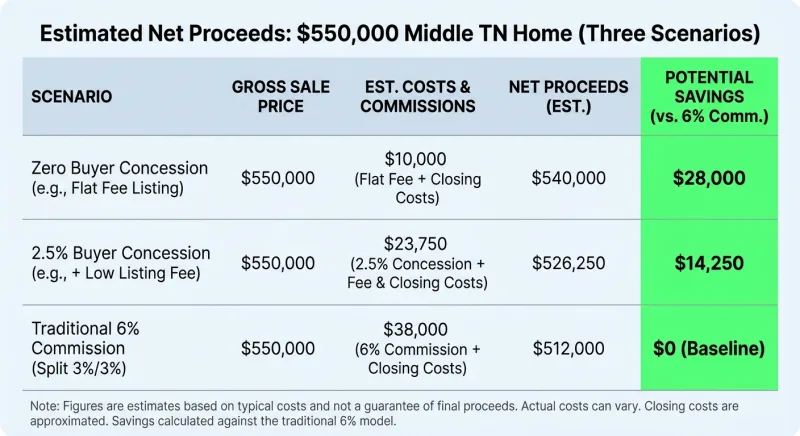
Here's a transparent comparison on a $550,000 Middle Tennessee sale — illustrative assumptions, not a guarantee. Same sale price in each case, comparing cost structures only.
| Full-service agent | Flat-fee MLS, you pay buyer agent 2.5% | Flat-fee MLS, unrepresented buyer | |
|---|---|---|---|
| Sale price | $550,000 | $550,000 | $550,000 |
| Listing-side commission | ~3% ($16,500) | Flat fee (~$400–$600) | Flat fee (~$400–$600) |
| Buyer-agent compensation | ~2.5–3% ($13,750–$16,500) | 2.5% ($13,750) | $0 |
| Est. commission/fee total | ~$30,250–$33,000 | ~$14,250 | ~$500 |
| Approx. savings vs. full-service | — | ~$16,000–$18,750 | ~$29,750–$32,500 |
Illustrative only. Commission rates are negotiable and not fixed by law; closing costs, title, and concessions are excluded.
Even if you pay a full buyer-agent commission, the flat-fee route saves roughly the entire listing-side commission. Your biggest savings — the unrepresented-buyer scenario — depends on your market and how you handle showings. In the old world, that middle column's 2.5% payout was essentially automatic. Now it's a decision you make per offer.
The Mechanics of Off-MLS Compensation
You can still pay a buyer's agent. You just can't broadcast the offer inside RealTracs. That changes the sequence of how a deal comes together, not whether you can close one.
When compensation is advertised, you've anchored the number before anyone writes an offer. When it's not, the buyer and their agent have already decided they want your house before the fee enters the conversation. That reorders the psychology — and the leverage.
The concession route most sellers miss: You don't have to label a payment "buyer-agent compensation" at all. Offer a seller concession — a closing-cost credit — and let the buyer apply it however their lender allows. Financing rules matter: FHA caps seller contributions at 6% of sale price; VA allows concessions up to 4%; conventional caps vary by down payment. A concession keeps you out of a direct compensation relationship with someone else's agent, but reduces the buyer's cash-to-close. Run it both ways before committing.
Should You Offer Buyer-Agent Compensation At All?
Skip the blanket rules. Use a filter.
Filter 1 — Months of supply in your exact submarket. Not the county. Your price band, your zip, your property type. Under ~3 months: offer nothing or a modest flat credit only when an offer is already strong. 3–5 months: offer a defined concession in response to offers, as a tiebreaker. Over ~5 months: assume you'll contribute something and build it into your net expectations from day one.
Filter 2 — How agent-dependent is your buyer pool? First-time buyers under FHA/VA financing lean heavily on agents and concessions; a concession is a conversion tool. Luxury cash buyers in Brentwood or Forest Hills? Far less agent-dependent, more likely to come unrepresented.
Filter 3 — Your tolerance for fielding negotiations. This is where FSBO is sometimes the wrong call. The settlement gave you control. But control is a job.
| Signal | Lean toward offering compensation | Lean toward offering nothing / flat credit |
|---|---|---|
| Submarket supply | Over ~5 months | Under ~3 months |
| Buyer financing mix | Mostly FHA/VA | Mostly conventional/cash |
| Competing listings | Most offer co-op credits | Few do, inventory tight |
| Your availability | Limited | High, hands-on |
| Appraisal risk | High (hot comp growth) | Low (stable comps) |
The Appraisal Gap Problem Is Now a Compensation Problem
In submarkets where competitive bidding drives offers above list, a buyer covering their own agent's fee out of pocket has less cushion to cover an appraisal gap. If you refuse any contribution and the buyer is already stretched, a $12,000 gap can blow up a deal that would have closed in 2023.
Price the home to appraise, not to impress. Mt. Juliet and Hendersonville buyers cross-shop against new builds with builder incentives — your concession competes against a builder's rate buydown, not just other resales. Set price and concession strategy together to protect the deal from the appraisal-gap trap while giving budget-constrained buyers a reason to write on your listing.
The Unrepresented-Buyer Scenario Almost Nobody Models
Removing advertised co-op fees quietly makes one buyer type more valuable: the unrepresented buyer. Some Middle Tennessee buyers may shop without an agent this cycle, partly because written buyer-rep agreements force them to confront representation costs upfront. When a buyer comes directly, there's no buyer-agent fee at all — that's not a discount you're giving, it's a cost that never exists.
The edge case: you now owe that buyer a cleaner, more careful process. Build in a transaction coordinator or real estate attorney for closing mechanics. The money saved on listing commission can generally fund a $500–$1,500 professional backstop, leaving you well ahead.
Why Flat Fee MLS Is the Smart Spring 2026 Play
Is spring 2026 a good time to sell FSBO in Middle Tennessee? Yes, for sellers who price correctly and stay flexible on terms. Rising inventory gives buyers choices, but motivated, well-presented listings with clear compensation terms stand out — and the settlement lets you keep the commission you'd otherwise pay by default.
Flat fee MLS connects the two forces in this article. The settlement unbundled the buyer-agent commission from your listing. A flat-fee listing unbundles the listing-agent commission from the sale. Together, you get full RealTracs exposure — the same database agents and buyers search — while keeping both commission decisions in your hands.
A yard sign reaches your street. A RealTracs listing reaches every agent and portal feeding off the MLS across the Nashville region. In a spring market with more inventory, visibility separates a home that sells from one that joins the price-reduction column.
The leverage math is micro-local. In a higher-price Williamson County submarket where buyers often come represented, a competitive concession can shorten days on market. In faster, more affordable Rutherford, Wilson, or Maury submarkets, you may see more unrepresented buyers and may not need a full concession at all. Different county, different lever position, same rule change working in your favor.
The Honest Downside: When FSBO Isn't the Right Call
The settlement gives you control over the compensation decision. It does not give you buyer traffic, pricing judgment, or time. If your micro-market is genuinely slow and you need maximum exposure engineered by someone working it full-time, a bare-bones listing underperforms no matter how smartly you handle compensation. If you have complex title, an estate situation, or a short sale, the forms and negotiation load are real. And if you can't respond to buyer's agents and offers within hours during a competitive spring week, the leverage you technically hold goes unused.
The settlement made FSBO mechanically easier by removing the pre-set co-op expectation. It did not make FSBO free of work. The seller who wins in spring 2026 gets full RealTracs exposure through a flat-fee listing and is ready to manage the compensation conversation the settlement finally put in their hands.
Before you sign anything, verify current Tennessee REALTORS form numbers against the live library — forms get renumbered, and the wrong reference on a real contract is a problem.
Frequently Asked Questions
Do I still have to offer a buyer's agent commission in Tennessee in 2026?
No. Compensation is now negotiated case-by-case and written into the purchase and sale agreement or a separate compensation addendum, rather than advertised as a mandatory field on RealTracs.
Is it worth selling FSBO in Nashville this spring?
For many Nashville-area sellers, yes — especially with active inventory rising and more homes competing for buyers, keeping listing-side costs low protects your margin. FSBO works best when your home is clean-title, reasonably priced, and you have time to field buyer-agent offers and negotiate compensation directly.
How much can flat fee MLS save me after the settlement?
A flat fee MLS listing replaces the traditional listing-side commission (historically around 2.5–3% of sale price) with a one-time flat fee. On a $550,000 Middle Tennessee home, that difference alone can be roughly $13,000–$16,500 in listing-side savings before any buyer-agent compensation you choose to offer.
Did the NAR settlement make FSBO easier or harder?
Easier, in practical terms. Removing the required co-op compensation field means you now decide whether, and how much, to offer a buyer's agent — control FSBO sellers didn't have under the pre-settlement rules.
What forms do I need to handle buyer-agent compensation as a FSBO seller?
The key Tennessee REALTORS forms are the Compensation Agreement and Compensation Addendum, which document any amount you agree to pay a buyer's agent, plus the standard Purchase and Sale Agreement. Your flat fee service or closing attorney can confirm current form numbers and the compliant workflow before you sign.
Can a buyer without an agent still buy my FSBO home?
Yes. An unrepresented buyer can purchase directly, which removes buyer-agent compensation from the deal entirely. You'll still want a real estate attorney or title company to handle disclosures and the contract so the closing is clean.
Conclusion
The NAR settlement didn't close the door on Middle Tennessee FSBO sellers for the 2026 spring market — it handed them the keys to a decision they never fully controlled before. The old default payout is gone. What replaces it is choice: offer buyer-agent compensation when it helps you compete, skip it when it doesn't, and write the terms into the contract either way.
Pair that leverage with a spring market where inventory is climbing across Davidson, Williamson, Rutherford, Wilson, Sumner, and Maury counties, and the math gets clearer. Every dollar you don't spend on a listing-side commission is margin you keep.
So here's what to do now: verify your title is clean, price against real county comps, decide your buyer-agent compensation strategy before you list, then list on RealTracs yourself for a flat fee. FSBO isn't right for everyone — if your home has title complications or you can't field buyer-agent calls, a different path may serve you better. But for most prepared sellers, it's a smart, legitimate play this spring.
Confirm every form number and current rule with your closing attorney before signing. Then sell on your terms.
Sources & last verified: NAR settlement materials, RealTracs rule bulletins on compensation-field removal and private-remarks prohibition, the Tennessee REALTORS form library, and county market reports from RealTracs and Greater Nashville REALTORS — all figures dated to publish month. Reconfirm before publication. Commission and legal specifics change; confirm current Tennessee practice before listing.