
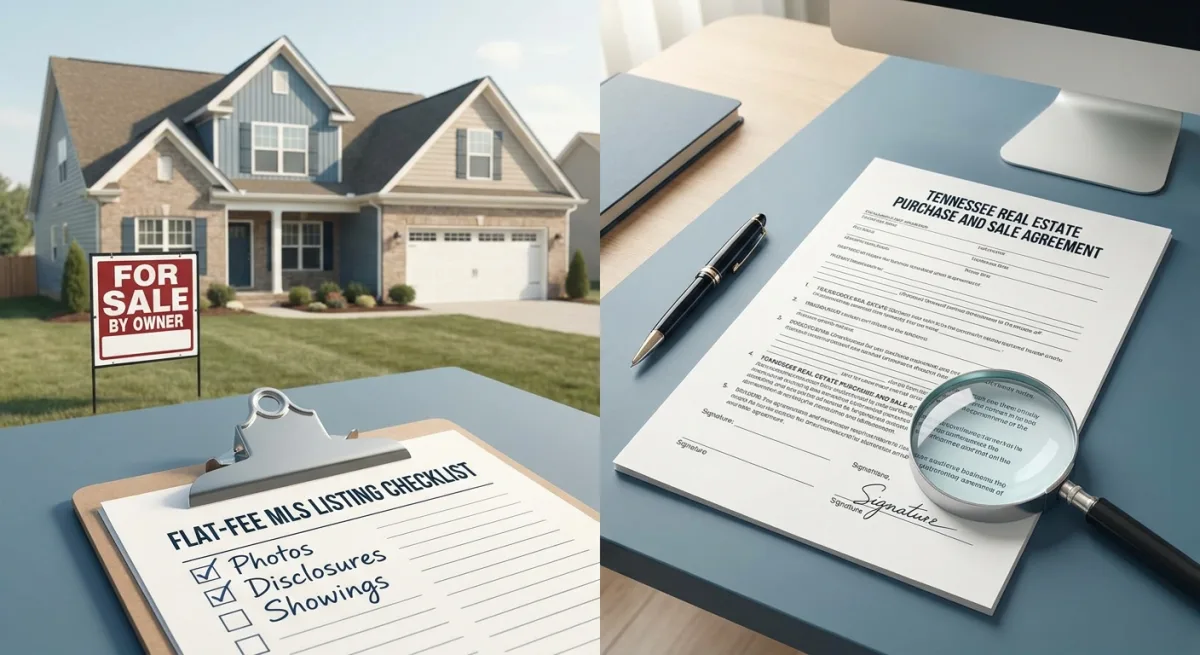
Here's the straight answer: most Tennessee flat-fee MLS listings do NOT include licensed legal support or true contract review. What companies market as "contract review" is almost always broker administrative checking — confirming your forms are filled in, not advising you on legal risk. Some platforms offer attorney access as a paid add-on; a licensed broker, by law, cannot give you legal advice.
If you're selling on the MLS without a full-service agent, that distinction is the whole ballgame. Tennessee is an attorney-optional closing state, which means nobody is automatically watching your legal interests unless you hire someone to.
We stay in one lane: the limited-service, flat-fee listing funnel. We don't provide legal advice, and we'll tell you plainly when something sits outside what a broker can do. Too many competitors blur the line between "we checked the form was filled in" and "a lawyer protected you."
Below, you'll learn what "legal support" actually means across three service tiers, how broker admin review differs from attorney legal review, what Tennessee's attorney-optional closings expose unrepresented sellers to, which forms you'll sign, and what independent attorney contract review really costs — typically $400–$600 in markets like Nashville as of 2026.
This article is general information, not legal advice.
What "Legal Support" Actually Means in a Flat-Fee Listing
"Legal support" and "contract review" get used loosely across flat-fee MLS marketing, and the words rarely mean what a seller assumes. There are three real tiers:
- DIY (zero help). You list on the MLS, download your Tennessee forms, fill them out yourself, and handle offers alone. Cheapest tier, most exposure.
- Broker administrative support. A licensed flat-fee broker checks that your paperwork is complete and consistent — correct addresses, matching dates, signatures where they belong. This is administrative review. It is not legal advice.
- Attorney legal review. A licensed Tennessee real estate attorney reads your purchase and sale agreement, flags risky clauses, explains your obligations, and can draft or revise terms. This is the only tier that is actually legal support.
When a flat-fee company advertises "contract review and negotiation support," read it carefully. In most cases that phrase describes tier two — broker admin help — not tier three. The gap between "my listing includes contract review" and "my listing includes someone checking my forms are complete" is the single most expensive misunderstanding a Tennessee flat-fee seller can make.
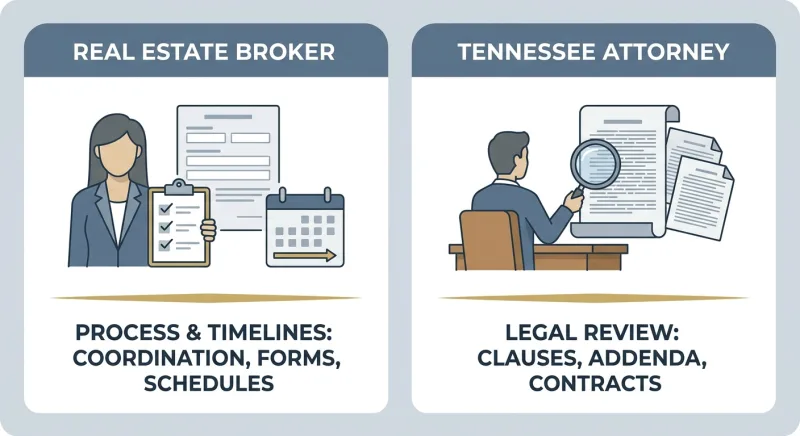
Broker Administrative Review vs. Attorney Legal Review
A licensed broker and a licensed attorney operate under different legal authority. The line isn't about how helpful or experienced your broker is — it's about what the law lets them do.
What a licensed broker CAN do
- Fill in standardized, pre-approved form fields (price, dates, parties)
- Confirm your paperwork is complete and internally consistent
- Explain, in general terms, how the standard forms are commonly used
- Present and relay offers and counteroffers
- Track deadlines and keep the file organized
What ONLY a Tennessee attorney CAN do
- Give you legal advice about your rights, risks, and obligations
- Draft custom addenda or special stipulations tailored to your deal
- Interpret an ambiguous clause and tell you what it means for you
- Advise on how to respond when a buyer breaches or disputes terms
- Represent your legal interests at closing or in a dispute
Under Tennessee Real Estate Commission licensee scope, a broker handling your flat-fee listing is performing a ministerial function: getting your property on the MLS and processing paperwork. The moment that broker says "I think this inspection contingency is bad for you, strike it," they've crossed into legal advice — what Tennessee Code Annotated treats as the unauthorized practice of law.
The honest framing: a flat-fee broker handles the listing; an independent attorney handles the legal. Complementary, not interchangeable.
Three questions that reveal which "review" you bought
- Who performs it? A named licensed TN attorney, or "our transaction team"? If it's a team, it's admin.
- Will they tell you what a clause means for your risk? If the answer is "we can't give legal advice," you have administrative review.
- Can they draft a custom clause for your situation? Only an attorney can.
If the answer to 2 and 3 is no, you bought form-field checking — not legal protection.
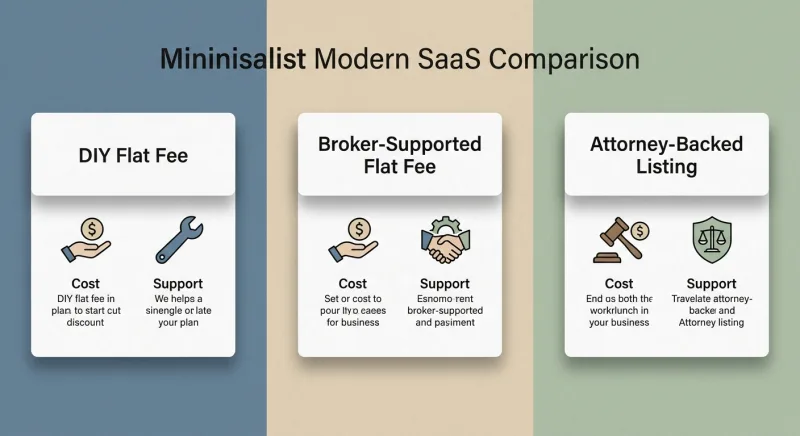
DIY vs. Broker-Supported vs. Attorney-Backed: The Comparison
| DIY Flat-Fee | Broker-Supported | Attorney-Backed Combo | |
|---|---|---|---|
| Support level | None after listing | Administrative only | Admin + licensed legal |
| Who reviews your contract | You | Broker (completeness) | Licensed TN attorney |
| Actual legal advice? | No | No (UPL boundary) | Yes |
| Custom addenda drafted | No | No | Yes |
| Typical upfront cost | $99–$199 | $399–$499+ | Listing fee + $400–$600 |
| Possible closing compliance fee | Varies | 0.25%–0.5% in some cases | Varies by provider |
| Best-fit seller | Experienced, risk-tolerant | Wants help with paperwork | Wants legal protection on terms |
Watch the closing compliance fee row. Several platforms advertise a low upfront price, then charge a percentage at closing. On a Nashville home, a 0.5% compliance fee is real money — a "cheap" listing with a back-end percentage can cost more than a mid-tier flat fee with none.
Be skeptical of the phrase "attorney backed flat fee MLS Tennessee." "Backed" can mean an attorney is available as a paid add-on — or nothing beyond a brand's own compliance review of its forms. Ask the only question that matters: will a licensed Tennessee attorney read my specific contract and advise me?
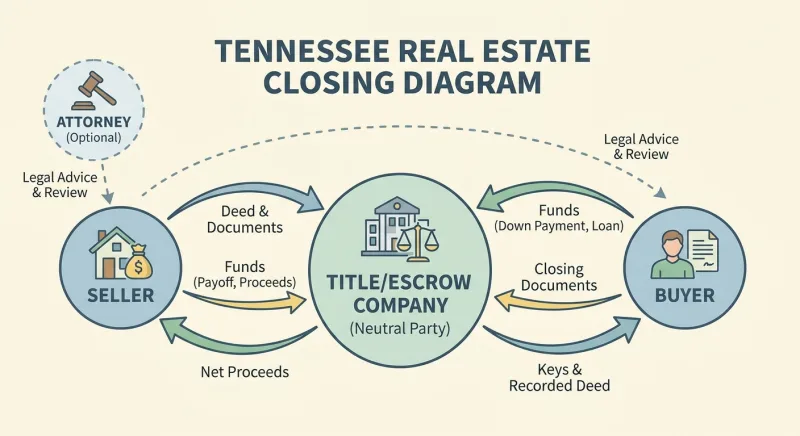
Why Tennessee's Attorney-Optional Closings Leave FSBO Sellers Exposed
Tennessee doesn't require an attorney at closing, and in most of the state a title company runs the show. A title company or escrow agent handles the title search, prepares closing documents, holds earnest money, and disburses funds. They're efficient. They're also neutral — their job is to make the title clean enough to insure, not to tell you whether the terms you agreed to weeks earlier were a good deal.
At a typical Nashville closing table: the buyer may have an agent, the lender has its own interest, the title company protects the insurer, and the FSBO seller who bought a DIY listing has nobody assigned to their legal interests. That's not a flaw in flat-fee selling — it's a structural reality of attorney-optional closings that applies to every FSBO transaction in Tennessee.
Edge Cases Where Broker-Admin Review Quietly Fails
Most clean, standard-form deals close without anyone needing an attorney. The exposure shows up in non-standard deals. The pattern: the failure point is never the standard deal. It's the clause someone added.
The buyer's agent writes the special stipulations. On the RF401 Purchase and Sale Agreement, the "Special Stipulations" section is open-text. A buyer's agent can draft language that shifts risk — extended possession after closing, seller-funded repair escrows, soft financing deadlines. Your broker will confirm the section is filled in. They can't tell you whether a clause hands the buyer 30 days of free occupancy with no holdover penalty. That's an attorney's job.
Seller financing or lease-to-own. The instant your deal involves owner carry-back, a note, or a lease-option, you've left standard-form territory. These require instruments a broker can't draft and a title company won't opine on. The clearest "stop and hire an attorney" trigger in a flat-fee transaction.
Title defects discovered mid-escrow. If a boundary dispute, old lien, or heirship gap surfaces, the title company cures it enough to insure. Whether the cure terms are good for you is a question nobody at that table is paid to answer.
The inspection repair contingency. After inspection, the buyer sends a repair request. A broker can relay the request and insert the agreed amendment. The judgment call — "is this demand reasonable, and what's my leverage?" — is part market strategy, part contract interpretation. The interpretation half is attorney territory.
A Decision Framework: Match Your Risk to Your Support Tier
| Your situation | Risk level | Recommended support |
|---|---|---|
| Standard sale, pre-approved buyer with agent using RF401, clean title | Low | Flat-fee listing + broker admin; attorney optional |
| First-time unrepresented seller, standard forms, no unusual terms | Low–Medium | Listing + one-time attorney review of signed offer |
| Buyer unrepresented too (no agent either side) | Medium | Listing + attorney review before signing RF401 |
| Custom stipulations, repair haggling, tight contingency timelines | Medium–High | Attorney engaged through contingency period |
| Seller financing, lease-option, probate/estate, title cloud, divorce/multiple owners | High | Attorney retained from the start |
On timing: the highest-leverage moment is before you sign the RF401. A signed purchase and sale agreement is a binding contract in Tennessee; review afterward can only tell you what you already agreed to. The second-best window is during the inspection/contingency period, while you still have contractual outs.
For most limited-service sellers, the clean combo is: flat-fee listing + a single à-la-carte attorney review of the first serious offer, typically $400–$600 as of 2026. One fixed fee, at the one moment it matters most.
Reading the Fine Print: How to Audit "Legal" Claims
The disclaimer tells the truth the headline doesn't. Marketing headlines say "contract review & negotiation support." The terms of service almost always say "we are not a law firm and do not provide legal advice." Both are true simultaneously — because the "review" advertised is administrative. Read the disclaimer first.
Three red-flag phrases:
- "Full support, just like a traditional agent." A limited-service broker is required to disclose limited-service status. If the marketing erases that line, be skeptical of everything else.
- "We'll handle negotiations for you." A flat-fee broker typically facilitates communication; genuine contract strategy is attorney work or your own call. Ask what "handle" means in writing.
- "Attorney-backed." Ask whether an attorney reads your deal.
The green flag most sellers miss: a platform that names its own limits. A service that says plainly "we list you on the MLS and process documents; for legal advice, engage an independent Tennessee attorney" is giving you the accurate map.
The Liability Gap Nobody Puts in Writing
A traditional full-service agent carries fiduciary duty and E&O exposure tied to advising you. A limited-service flat-fee broker's duty is scoped to listing and administration. The title company's duty runs to the insurer. A buyer's agent's duty runs to the buyer.
Count the parties whose job is to protect the unrepresented seller on a custom contract term: zero.
That's not a flaw in flat-fee MLS — it does exactly what it promises. The liability gap only matters when a term goes non-standard, and the proportionate fix isn't "pay 3% to solve a $500 problem." It's to plug the one gap with the one specialist who exists to fill it: an independent licensed Tennessee real estate attorney, engaged à-la-carte, at the moment of actual exposure.
Flat-fee listing covers the marketing and access. Attorney review covers the legal judgment. Stacked together, you get full protection without full-service pricing.
Frequently Asked Questions
Does a Tennessee flat fee MLS listing include contract review by an attorney?
No. A flat-fee MLS listing covers getting your home on the MLS, not licensed legal work. Any "contract review" a limited-service broker provides is administrative checking for completeness — genuine legal review requires an independent Tennessee real estate attorney, typically $400–$600.
Can a flat fee MLS broker give me legal advice on my purchase and sale agreement?
No. Under Tennessee Real Estate Commission rules and the state's unauthorized-practice-of-law statutes, a licensed broker cannot give legal advice, draft custom clauses, or interpret contract terms for you. They can explain which form fields are standard; only a licensed attorney can advise on legal consequences.
Is an attorney required to close a home sale in Tennessee?
No. Tennessee is an attorney-optional closing state, and most residential closings run through a title or escrow company. But the title agent represents the title insurer's interests, not yours — which is why many unrepresented sellers add independent attorney review voluntarily.
How much does it cost to add attorney contract review to a flat fee listing?
À-la-carte attorney contract review in Tennessee generally runs $400–$600, depending on complexity and whether negotiation support is included. That's separate from your listing fee (often $399–$499+) and any closing compliance fee that varies by platform.
What's the difference between broker "review" and attorney "review"?
A broker confirms forms are filled out correctly and signatures are present — administrative review. An attorney reads the contract for legal risk, drafts or revises special stipulations, and advises you on contingency timelines and liability. The words sound similar; the protection is not.
When should I have a Tennessee attorney look at my contract?
Before you sign the RF401 purchase and sale agreement, and again if terms change during the inspection or repair contingency period. Catching an issue before signatures is far cheaper than fixing one after you're legally bound.
The Bottom Line
A Tennessee flat fee MLS listing gets your home on the MLS — it does not buy you licensed legal support or true contract review. What some competitors label "contract review and negotiation support" is, in practice, broker administrative checking, and the TREC plus unauthorized-practice-of-law boundary is why.
Build the combination that actually protects you: a flat-fee listing to control your marketing costs, plus independent review from a licensed Tennessee real estate attorney for the parts that carry legal risk. Budget roughly $400–$600, and engage the attorney before you sign the RF401.
Three concrete next steps: confirm in writing exactly what "review" your broker provides; line up an attorney early so you're not scrambling once an offer lands; and remember that in Tennessee's attorney-optional closings, the title company is neutral escrow — nobody is watching your interests unless you've hired them to.
This article is general information, not legal advice. Form numbers (RF401, RF201), TREC rules, and Tennessee statutes are periodically updated, and pricing reflects 2026 ranges that vary by provider and county. For advice on your specific transaction, consult a licensed Tennessee real estate attorney. Our brand provides limited-service flat-fee MLS listings only and does not provide legal advice or contract representation.