

You listed your house, got an offer, signed it. Now what?
That gap — between an accepted contract and cash in your account — is where most for-sale-by-owner sellers in Middle Tennessee feel lost. The national FSBO guides don't help much either. They're written for states where a lawyer runs the closing, or they assume a listing broker holds the buyer's deposit. Neither is true here.
A Tennessee FSBO closing workflow is the chronological, contract-to-close process by which a self-represented seller moves an accepted purchase agreement to a recorded deed — earnest money held in escrow by a licensed title company, a title search clearing the property, disclosures delivered under state law, and settlement completed at a title company (not a lawyer's office) in roughly 30 to 45 days when the buyer is financing.
This walkthrough covers both Davidson County (Metro Nashville) and Williamson County (Franklin, Brentwood, Spring Hill, Nolensville) — because the recording offices, fees, and local rhythms aren't identical, and the difference matters on closing day.
One note: this is informational, not legal advice. Statutes and fees change. We cite the law so you can verify it yourself.
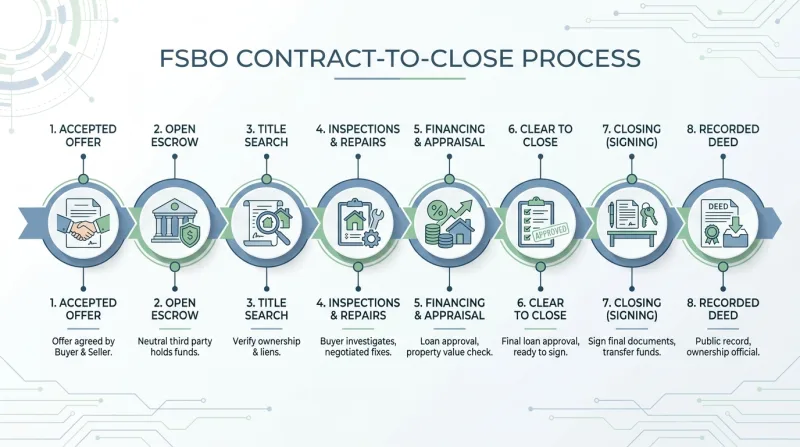
The FSBO Closing Workflow, Start to Finish
- Accepted offer. Both parties sign the Tennessee Real Estate Purchase Agreement (TAR Form RF 401). The contract names the title/escrow company and sets the earnest money amount.
- Earnest money deposited. The buyer wires the good-faith deposit to the title company's escrow account, usually within 1–3 business days of signing.
- Escrow file opened. The title company opens the file, orders the title search, and becomes the neutral closing agent.
- Disclosures delivered. You provide the Residential Property Condition Disclosure required under Tennessee law, if not already done.
- Title search and commitment. The title company examines the chain of title and issues a commitment showing what must be cleared.
- Curative work. Any liens, unreleased mortgages, or defects get resolved. Your existing loan payoff is ordered.
- Buyer's financing and appraisal. If the buyer has a loan, their lender orders an appraisal and underwrites the file.
- Closing scheduled. Once title is clear and the loan is approved, the title company sets a date and prepares the deed, ALTA Settlement Statement, and Closing Disclosure.
- Closing day. You sign the warranty deed and settlement documents. Buyer's funds arrive by wire.
- Recording and disbursement. The deed is recorded with the county Register of Deeds. You get paid.
Most of those steps run in the background. Your real job as a self-represented seller is narrower than you'd think: sign the right documents, deliver your disclosure, pick a title company, and keep your payoff and wire information accurate. Where sellers trip up is thinking they have to run the closing. You don't. You hire a neutral settlement professional and stay organized.
Who Holds the Earnest Money in a Tennessee FSBO Sale
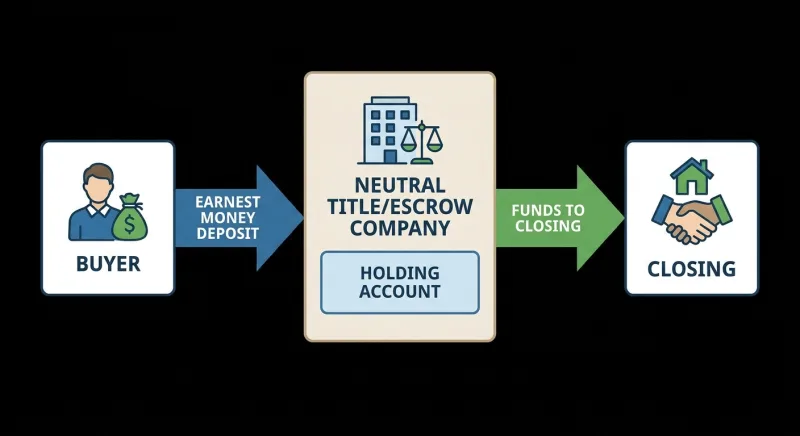
In a brokerless Tennessee FSBO sale, the earnest money is held by the licensed title or escrow company named in the purchase contract — not the seller, and not a listing broker's trust account. This is the single biggest thing the national guides get wrong.
In a traditional sale, a brokerage holds the deposit in its trust account. When there's no listing broker, there's no broker trust account. So the contract designates a neutral third party — in Tennessee, almost always a licensed title/escrow company. The buyer wires the deposit to that company, which issues a written Earnest Money Receipt and holds the funds under an Escrow Agreement. At closing, the deposit gets credited toward the buyer's total due.
When does it get deposited? As specified in your contract — commonly within 1 to 3 business days after signing. Name the title company and name the timeline in the contract. TAR Form RF 401 has a field for exactly this.
Never take the earnest money into your own hands, and don't let the buyer "just bring it to closing." Holding it yourself puts you in a conflicted position if the deal falls apart. A deposit that never got deposited isn't really a deposit — it's a promise, and promises don't survive a cold-feet buyer.
In the deals we see, a clearly named escrow holder in the contract prevents most of the earnest-money disputes that blow up FSBO sales.
Choosing and Opening Your Title Company
Nashville and Williamson County are title-company closing territory. Picking your title/escrow company is the most consequential decision you make after accepting the offer. This company holds the earnest money, searches the title, prepares the deed, runs the closing, records the documents, and disburses your proceeds.
What to look for
- Licensed and insured in Tennessee, with an active agency relationship to a title underwriter.
- Experience with FSBO transactions specifically. Some firms handle mostly agent-driven deals and expect a broker to quarterback the file.
- Clear fee quotes up front — an itemized estimate covering escrow fee, title insurance, and recording costs before you commit.
Opening the file
Send the signed purchase agreement to the title company to open the escrow file. The title company confirms the earnest money instructions, orders the title search, and sends opening communications to both sides.
Title Search and the Title Commitment
The title commitment tells everyone what has to happen before the policy issues, following the ALTA standard:
- Schedule A — the basics: who's insured, policy amount, current owner, legal description.
- Schedule B-1 — requirements that must be done before closing: pay off your existing mortgage, release old liens, resolve judgments.
- Schedule B-2 — exceptions the policy won't cover: easements, restrictive covenants, matters a survey would reveal.
Owner's vs. lender's policy
Two policies often appear at closing. The lender's policy protects the buyer's mortgage company and is required if they're financing. The owner's policy protects the buyer's ownership stake. In Middle Tennessee, allocation is negotiable and usually set by the contract.
Reading Schedule B-2
Routine — leave them alone: standard survey exceptions, recorded subdivision plat restrictions, existing utility easements, current-year property taxes not yet due.
Stop and read carefully:
- Access easements across your parcel — a recorded neighbor's right-of-way needs buyer disclosure.
- Encroachments — a fence or driveway over the property line; common on older Davidson County lots.
- Unreleased deeds of trust — flagged as exceptions until cleared.
- Mechanic's liens — if you had major work done recently without lien waivers, Tennessee's mechanic's lien window may still be open.
When the title company "clears to close," it has moved items off Schedule B-1 so the final B-2 is clean enough to insure.
Seller Disclosures and the Purchase Contract
Under T.C.A. § 66-5-201 et seq., residential sellers must provide a Residential Property Condition Disclosure — a written statement of known material defects. This obligation is identical whether an agent lists your home or you list flat-fee.
Timing matters. Deliver the disclosure at or before contract formation. The cheapest insurance against a post-closing dispute is an accurate, complete form.
The purchase contract — TAR Form RF 401 — ties the rest of the workflow together. It names your escrow holder, sets the earnest money amount and deposit deadline, states the closing date, and allocates closing costs. Get the contract right and the closing follows the script.
The Contingency Architecture Behind Earnest Money
Each contingency is a trapdoor the buyer can use to walk and keep their deposit.
Financing contingency. The buyer gets their money back if they can't secure the loan described in the contract. After the financing contingency date passes, a buyer who then can't close risks forfeiting the deposit. A buyer asking for a long financing window is asking you to hold the house off-market with minimal downside to them.
Inspection and repair contingency. A broadly worded clause lets a buyer terminate for almost any reason and recover their money. Tighten the language or shorten the window if you want the deposit to mean something.
Appraisal contingency. If the home appraises below contract price, the buyer can renegotiate or terminate with their deposit intact.
How a disputed deposit actually gets released
The title company holds funds as a neutral escrow holder — it does not decide who's right. If there's a disagreement, the holder needs either a signed mutual release from both parties or a court order. Without one, the money sits. In a true standoff, the holder can file an interpleader action, depositing funds with the court and letting a judge sort it out.
Your contract's default and termination language is your earnest-money protection. By the time money's in escrow, the contract has already decided the fight.
When the Standard Workflow Breaks: Edge Cases Self-Represented Sellers Actually Hit
The unreleased mortgage from a loan you already paid off
You paid off a HELOC in 2019, but the title search pulls a lien that was never released. This is the most common curative item in Middle Tennessee title work — lenders are supposed to record a release after payoff, but backlogs happen and servicers merge. The title company contacts the servicer for a recorded release or zero-balance payoff letter. Your job: dig up payoff documentation before you accept an offer and tell the title company at file-open, not at Schedule B review.
Selling a property inherited through a Tennessee estate
If the deed still reads in a deceased person's name, or an estate that never fully closed through probate, a title company can't insure that chain. You'll need a recorded probate court order, a properly executed executor's or administrator's deed, or evidence of transfer under Tennessee's small-estate procedures. This is one of the clearest cases where an attorney is genuinely warranted. If the word "estate" or "heirs" touches your deal, line up an estate attorney the day you decide to list.
Divorce, co-owners, and the missing signature
If the property is marital property, both spouses typically need to sign the warranty deed even when only one name sits on the loan. Sellers sometimes sign a purchase agreement alone, then discover at closing that an ex-spouse's signature is still required. If a divorce decree awards the property to you, it needs to be recorded or presented to the settlement company.
Solar panels, HVAC leases, and UCC fixture filings
Leased solar is a quiet deal-killer across Williamson County's newer subdivisions. A financed solar system often carries a UCC fixture filing recorded against the property — effectively a lien on equipment attached to your roof. The buyer's lender won't fund over it. You'll either pay off the solar loan at closing or get the buyer to formally assume the lease. Start that process early; solar lenders move at their own pace.
The County Is Not a Detail — It's the Workflow
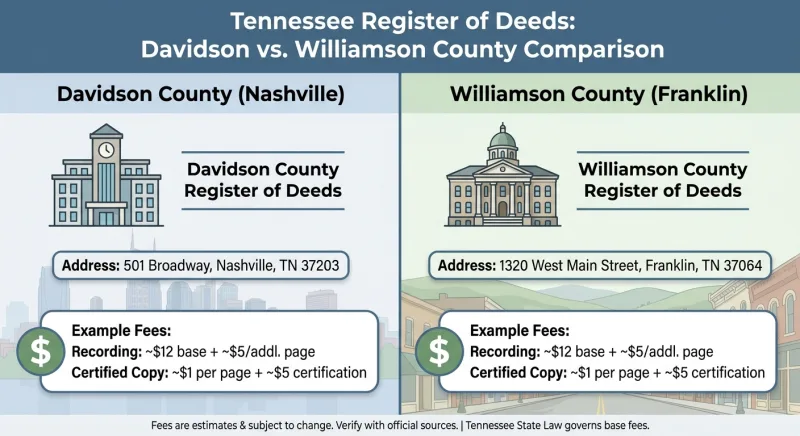
Davidson County and Williamson County run separate Register of Deeds offices with their own fee schedules. The statewide facts (transfer tax, disclosure law) stay the same. The county facts don't.
Davidson vs. Williamson at a Glance
Fees and office details verified [Month 2026] — confirm each against the current published Register of Deeds fee schedule before relying on a dollar figure.
| Item | Davidson County (Nashville) | Williamson County (Franklin) |
|---|---|---|
| Office | Davidson County Register of Deeds, Metro courthouse complex (Deaderick area) | Williamson County Register of Deeds, 1320 W Main St, Franklin |
| Governing body | Metropolitan Government of Nashville and Davidson County | Williamson County government |
| Deed recording fee | per current fee schedule | per current fee schedule |
| e-Recording | Simplifile / CSC eRecording | Simplifile / CSC eRecording |
| Property tax cycle | Metro rate; proration at settlement | County (plus city) rate; proration at settlement |
Timing the two counties against your closing date
Both counties accept e-recording through Simplifile and CSC. A closing that signs at 4:45 p.m. may miss the Register's same-day e-recording window, pushing recording — and sometimes your proceeds — to the next business day. If you're counting on wired funds the day of closing, sign in the morning.
Property tax proration differs between the counties because the rate differs. Tennessee taxes are paid in arrears, so the seller owes the buyer a credit for the portion of the year you owned the home but haven't paid. Ask to see the proration line on your preliminary net sheet before closing day.
The One Fee That's Fixed by Law
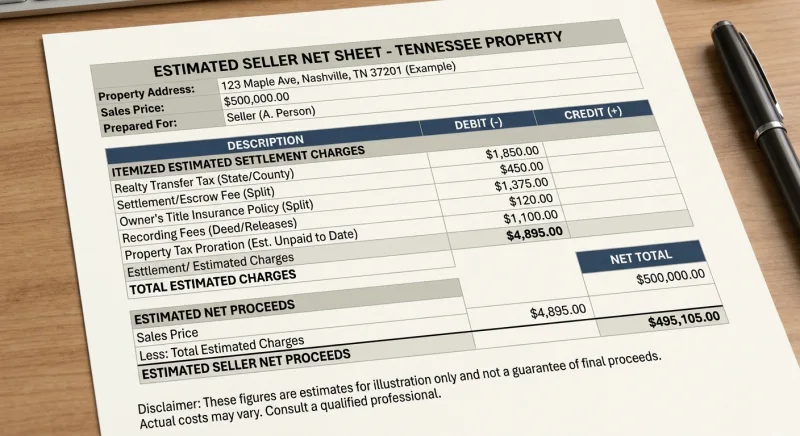
Under T.C.A. § 67-4-409, Tennessee's realty transfer tax is $0.37 per $100 of value. On a $500,000 sale:
$500,000 ÷ 100 × $0.37 = $1,850
That's not an estimate — that's the statute doing arithmetic. Settlement fees, title insurance, and recording costs all vary by company and county, so treat any dollar figure without a statute behind it as an estimate until your title partner's net sheet confirms it.
When You Actually Need an Attorney
An attorney is optional for most FSBO closings. Use this test — if any of these are true, get an attorney involved early:
- Title runs through an estate, trust, or deceased owner. Probate deed work is legal procedure, not settlement procedure.
- Divorce, contested co-ownership, or a missing signatory.
- A dispute is already live — a boundary fight, a lien contest, an earnest-money disagreement.
- Unusual contract terms — seller financing, a land contract, a lease-option, or a 1031 exchange.
- Any title defect the company flags as beyond standard curative.
If none apply — conventional sale, clean chain, standard financing, cooperative buyer — the settlement company's deed preparation and the standard purchase agreement carry the deal.
What you're buying when you pay an attorney isn't the closing. The title company handles that. You're buying judgment on the specific legal question your deal raises. Pay for the question, not the paperwork.
Frequently Asked Questions
Who holds earnest money in a Tennessee FSBO sale?
In a brokerless FSBO deal, the licensed title or escrow company named in the purchase contract holds the earnest money — not the seller and not a listing broker. The holder issues a written Earnest Money Receipt and keeps the funds in a neutral escrow account until closing.
Do you need a lawyer to close a FSBO home in Nashville?
An attorney is optional for most FSBO closings. Tennessee is a title-company closing state, so the settlement company handles deed preparation and the mechanics. Complex title issues — a contested estate, a boundary dispute, an unreleased lien nobody can trace — may warrant hiring one.
How much does title and escrow cost for FSBO sellers in Williamson County?
A Williamson County FSBO seller typically pays $500–$750 in settlement/escrow fees, plus owner's title insurance and recording costs. Under T.C.A. § 67-4-409, realty transfer tax runs $0.37 per $100 of sale price — about $1,850 on a $500,000 home.
What's the difference between recording in Davidson and Williamson County?
Both counties record the warranty deed through their Register of Deeds and accept e-recording via Simplifile/CSC. Davidson's office is near Metro's Deaderick-area courthouse complex; Williamson's is at 1320 W Main St in Franklin. Each publishes its own fee schedule.
How long does a FSBO closing take in Williamson County?
Plan on 30–45 days from accepted offer to closing when the buyer is financing. A cash purchase can close faster — sometimes two to three weeks — because there's no lender underwriting or appraisal on the timeline.
Conclusion
A Davidson or Williamson County FSBO sale closes on the same rails every Middle Tennessee deal runs on: earnest money lands with a neutral title or escrow company named in your contract, the title search clears, disclosures get delivered under T.C.A. § 66-5-201, and the Register of Deeds records your warranty deed. You don't need a listing broker. You do need to understand each step well enough to stay on schedule and protect your proceeds.
Your next moves are concrete. Pick a licensed title/escrow partner early and get them the contract the day it's signed. Confirm who holds the earnest money, in writing. Request the title commitment and read Schedule B. Verify wire instructions by phone — voice to voice, a number you looked up yourself — before sending a dollar. Treat every figure here as a starting estimate except the statutory transfer-tax rate.
Our lane is the flat-fee MLS listing that starts the whole thing; the title company handles the closing table. When the title gets tangled, call a Tennessee real estate attorney. The deposit clears, the deed records, you get paid. That's the whole job.
This article is informational and not legal advice. Statutes and fee schedules change; verify current figures with the applicable Register of Deeds and a licensed Tennessee title/escrow company before relying on them. Fees and tax figures verified [Month 2026].