
How to Write a Legally Compliant FSBO Purchase Contract in Tennessee (Step-by-Step, 2026)
General information, not legal advice. Statute-referenced below; confirm specifics with a licensed Tennessee closing attorney or title company before you sign. Last updated: 2026.
A legally compliant FSBO purchase contract in Tennessee must be in writing and signed by both parties to be enforceable — that's the Statute of Frauds under T.C.A. § 29-2-101. Leave out a signature or skip a required disclosure and a signed deal can unravel at the closing table.
You don't need a real estate license, and you don't need the Tennessee REALTORS® RF401 form to write a valid agreement. What you need is the right structure, the right clauses, and the right Tennessee-specific disclosures. This guide walks through every required element, cites the actual statutes, and flags when to loop in a closing attorney.
What Tennessee Law Requires for an Enforceable Contract
A purchase contract becomes enforceable when it's written, signed by both parties, and contains enough definite terms that a court could enforce it. The writing must show, at minimum, the parties, the property, the price, and the essential terms, plus signatures.
Two more principles matter.
The binding agreement date. The date the last party signs acceptance of the final terms. It starts most deadlines — inspection, financing, closing. Define it clearly.
The merger doctrine. Once the deed is delivered, the purchase contract generally "merges" into it. Most contract promises don't survive closing unless written as survival clauses or embodied in the deed. Say what you mean in writing before closing.
The RF401 Myth: You Don't Need "The Realtor Form"
An unrepresented Tennessee seller does not need the Tennessee REALTORS® RF401 purchase and sale agreement — and legally, you generally shouldn't use it.
The RF401 is copyrighted by the Tennessee REALTORS® association and licensed to its members. It's not a statute, not a state-mandated form, and not a legal requirement. There is no single government-issued purchase contract in Tennessee. FSBO sellers who borrow a copy from a friend in the business and reuse it risk a licensing and copyright problem no template site warns about.
The clean path is a non-TAR purchase agreement — a contract with the same legally required elements, minus the association's letterhead. The enforceability comes from Tennessee contract law, not a particular form.
Step-by-Step: The Required Clauses in a Tennessee FSBO Contract
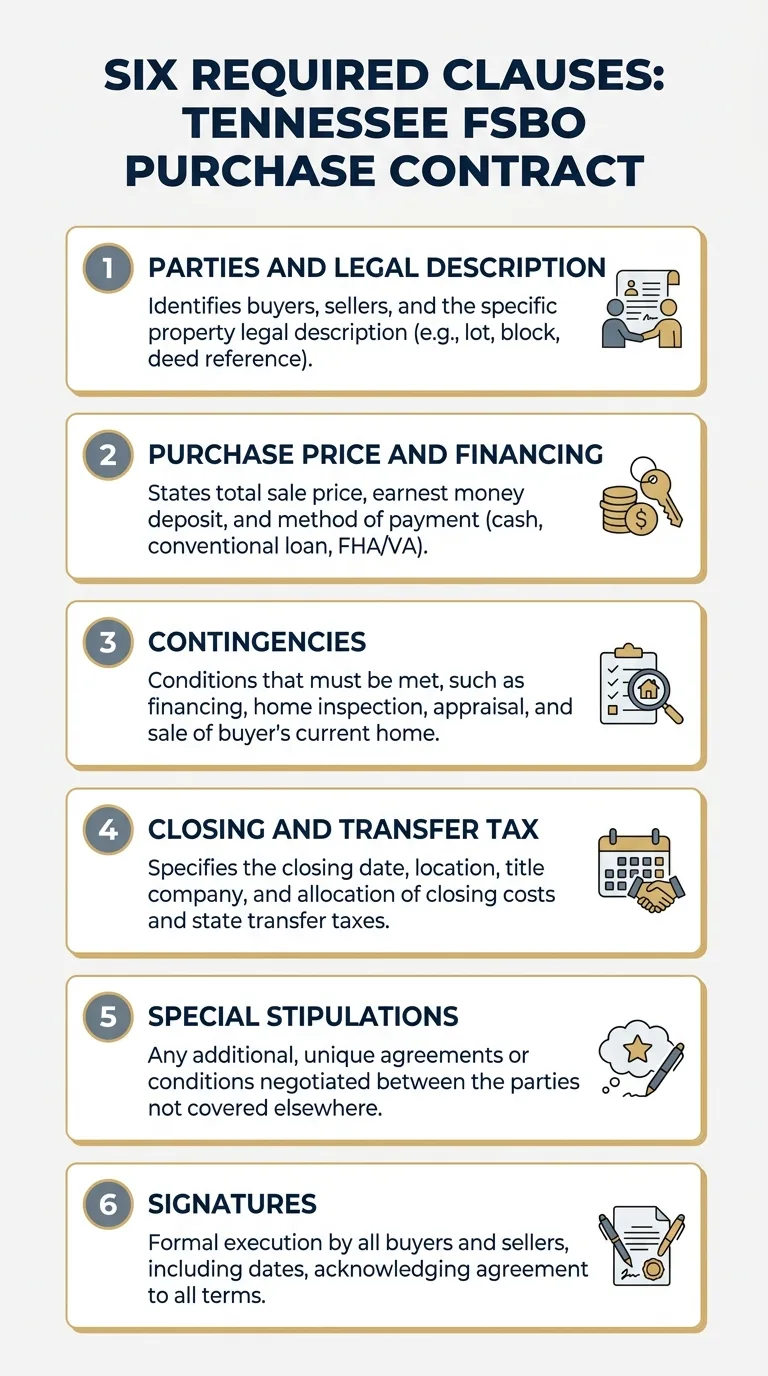
Step 1: Identify the Parties and the Property
Name every buyer and seller exactly as they'll appear on the deed — full legal names, and the capacity if a trust or LLC is involved. Identify the property with more than a street address: include the legal description and the county tax map and parcel ID. The legal description (found on your current deed or at the County Register of Deeds) is what a title company and a court rely on.
Step 2: State the Purchase Price and Earnest Money
Spell out the full price in numbers and words. State the earnest money amount, who's holding it, and when it's deposited. Earnest money in Tennessee is typically 1–3% of the purchase price — on a $400,000 home, roughly $4,000–$12,000.
Step 3: Write Your Contingencies Carefully
The three that matter most:
- Inspection contingency — the buyer's right to inspect within a set number of days and request repairs, renegotiate, or terminate.
- Appraisal contingency — protects a financed buyer if the home appraises below contract price.
- Financing contingency — ties the deal to the buyer securing a loan by a stated date on stated terms.
Give each a hard deadline tied to the binding agreement date. Vague financing language — "subject to buyer getting a loan" with no date or loan type — is one of the top causes of blown-up FSBO deals.
Step 4: Set Dates — Closing, Possession, and Prorations
State the closing date, the possession date (not always the same), and how you'll prorate taxes, HOA dues, and similar recurring costs as of closing.
Step 5: Address Default, Remedies, and As-Is Condition
Decide what happens if someone breaches. Many Tennessee contracts use a liquidated damages / sole remedy clause — the seller's sole remedy for buyer default is to keep the earnest money. Spell out the condition of sale: are you selling as-is, or making repairs? An as-is disclaimer limits certain post-closing claims, but it does not waive your statutory disclosure duties.
Step 6: Signatures and Special Stipulations
Both parties must sign and date. Use a special stipulations section for anything custom — included appliances, a survey requirement, a home warranty, a contingency on the buyer selling their current home. If it's not in writing, under the merger doctrine, assume it won't survive.
Advanced Clause Engineering: Where TN FSBO Contracts Actually Break
Sequencing Your Contingency Deadlines
Think of contingencies as a waterfall — each should resolve before the next commits real money or burns market time:
- Inspection period — typically 7–14 days from binding agreement date.
- Inspection resolution — 3–5 days to agree, amend, or terminate.
- Appraisal contingency — usually resolving 2–3 weeks out.
- Financing contingency / loan commitment — the final gate, often 21–30 days.
The common failure: the financing deadline lands before the appraisal returns. Now the buyer is contractually committed to a loan that hasn't cleared appraisal. Order deadlines so each closes before the next locks in.
The "Time Is of the Essence" Trap
If your contract says time is of the essence (most TN agreements do), every deadline is hard. A buyer who lets the inspection objection deadline pass without a written request may have accepted the property as-is. Calendar every date from the binding agreement date.
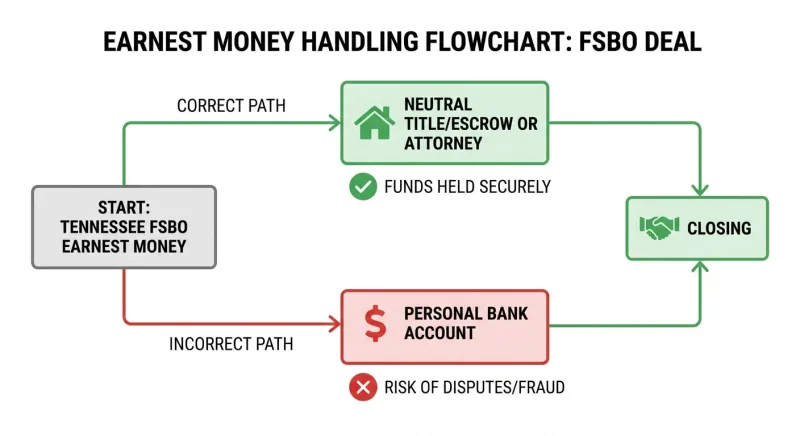
How Earnest Money Must Be Held
Never let earnest money go into the seller's personal bank account. For a FSBO deal, the neutral holder is almost always your title company, escrow agent, or closing attorney. Name the holder in the contract and specify what happens to the money on default. One sentence of neutrality now prevents a lawsuit later.
Liquidated Damages vs. Specific Performance: Choosing Your Remedy
Tennessee enforces liquidated damages clauses only if the amount is a reasonable pre-estimate of actual harm — not a penalty. Earnest money at 1–3% reads as reasonable; an absurdly high amount reads as a penalty a judge can strike.
| Remedy structure | What it means | Best for |
|---|---|---|
| Liquidated damages (sole remedy) | Non-breaching party keeps the earnest money; no further suit | Sellers wanting certainty and a clean exit |
| Liquidated damages + election | Non-breaching party chooses earnest money OR other legal remedies | Parties wanting flexibility |
| Specific performance | Court can order the breaching party to complete the sale | Buyers facing a seller who walks for a better offer |
As a FSBO seller, "liquidated damages as sole remedy" usually protects you best. As a buyer who suspects the seller might bail, preserve specific performance — keeping earnest money does a jilted buyer little good. A contract that lists remedies ambiguously ("the parties shall pursue available remedies") invites litigation.
As-Is Sales Don't Erase the Disclosure Duty
Selling "as-is" limits your obligation to repair. It does not waive your obligation to disclose.
Under the Tennessee Residential Property Condition Disclosure Act (T.C.A. § 66-5-201 et seq.), disclosure duty runs to known defects. A seller who conceals a known foundation crack or flooding crawl space faces fraud liability no as-is clause survives. Pair an as-is clause with more thorough disclosure — it's your cleanest protection.
Edge case: Exemptions under T.C.A. § 66-5-209 still require written notice to the buyer. An exemption claimed silently is no exemption at all.
Required Tennessee Disclosures for FSBO Sellers
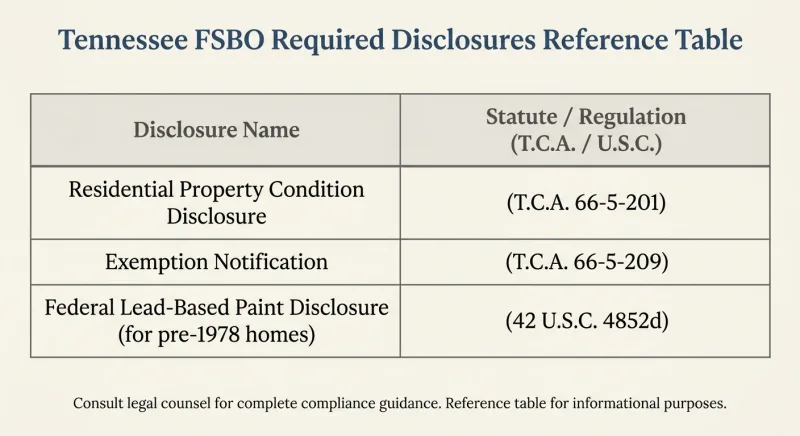
Residential Property Condition Disclosure. Under T.C.A. § 66-5-201, most residential sellers must furnish a written disclosure of known condition — systems, structure, known defects — before the contract is binding.
The exemption notice. Some transactions qualify for a disclaimer instead of a full disclosure under T.C.A. § 66-5-209, but exemption status doesn't erase every obligation and generally doesn't license concealing a known material defect.
Federal lead-based paint disclosure. If the home was built before 1978, federal law (42 U.S.C. § 4852d) requires disclosing known lead hazards, providing the EPA-approved pamphlet, including required disclosure language in the contract, and giving the buyer a 10-day inspection window. This applies regardless of state exemptions.
Deliver all disclosures in writing, keep signed copies, and deliver before the contract becomes binding.
The Assignment Clause: The FSBO Seller's Blind Spot
Unless your contract says otherwise, purchase agreements are generally assignable — the buyer who signed can transfer their rights to a third party. Wholesalers specifically target unrepresented sellers: they offer near asking with a fast close, the contract is silent on assignment, they assign it to an end-buyer for a markup, and the deal may collapse late if the assignee can't perform.
If you want to control who buys your home, add: "This Agreement may not be assigned without the prior written consent of the Seller."
The Contingency-Waiver Paper Trail
Document every waiver and amendment in writing, signed by both parties. Because of the merger doctrine and the Statute of Frauds, a verbal agreement to extend the inspection deadline or waive the appraisal contingency is legally shaky. Build an amendment template before you need it: date, clause being modified, new terms, both signature lines.
Prorations and Closing-Cost Allocation
Your contract should explicitly name how each of these splits at closing:
- Property taxes — Tennessee taxes are billed in arrears; you typically credit the buyer for the portion of the year you owned the home.
- HOA dues — prorated to the day.
- Prepaid utilities or fuel — propane tanks are a classic rural-TN surprise.
Transfer tax. Tennessee's realty transfer tax is $0.37 per $100 of the greater of the sales price or value (Tennessee Department of Revenue). On a $400,000 sale, roughly $1,480. By custom the seller pays it, but custom is not law. Name every cost in the contract: transfer tax, recording fees, title search, title insurance (owner's vs. lender's), closing/settlement fee, and survey if ordered.
Post-NAR Settlement: Buyer-Broker Compensation
Following the NAR settlement effective August 2024, buyer-broker compensation is negotiated separately rather than assumed. If a buyer arrives represented, decide up front whether you'll contribute to that agent's fee and put it in the contract. There is no default anymore. Any template that still treats buyer-agent commission as automatic is out of date.
Closing, the Closing Attorney, and Recording the Deed
A Tennessee sale finishes when the signed warranty deed is recorded with the County Register of Deeds in the county where the property sits. Tennessee does not legally require a closing attorney, but for a FSBO deal involving title search, title insurance, deed preparation, and escrow, using one or a title company is money well spent.
Why "Cheap and Compliant" Beats the $3,000 Coordinator Upsell
A Tennessee FSBO seller needs two things:
- A statute-compliant contract — confirmed with a closing attorney for anything consequential. A few hundred dollars of review, not thousands.
- MLS exposure so buyers and agents can find the home — without surrendering a full commission.
A flat-fee MLS listing provides the second: your property on the same MLS full-commission listings use, syndicated to the major portals, for a flat fee.
| Approach | TN Statute-Specific? | Typical Cost | MLS Exposure | Upsell Pressure |
|---|---|---|---|---|
| National template site | No — generic 50-state language | $0–$40 | None | Low |
| Lead-gen / coordinator package | Partial | ~$3,000 | Varies | High |
| Full-service agent | Yes | ~5–6% commission | Yes | N/A |
| Flat-fee MLS + attorney-reviewed contract | Yes (you control it) | Flat fee + optional legal review | Yes | None |
Costs vary; confirm current figures before relying on them.
Frequently Asked Questions
Can an unrepresented seller write their own purchase contract in Tennessee?
Yes. Tennessee law doesn't require a licensed agent to draft a purchase agreement, but under the Statute of Frauds (T.C.A. § 29-2-101) the contract must be in writing and signed by both parties to be enforceable.
Is the TAR RF401 form required for a FSBO sale in Tennessee?
No. The RF401 is copyrighted by Tennessee REALTORS® and licensed for use by its members. FSBO sellers who aren't members should use a separate, legally compliant agreement.
Who should hold the earnest money in a Tennessee FSBO deal?
A neutral third party — a title company, escrow agent, or closing attorney — to protect both sides if the deal falls through.
How much is the transfer tax on a Tennessee home sale?
Tennessee's realty transfer tax is $0.37 per $100 of the greater of the sales price or value. On a $400,000 home, roughly $1,480. Confirm the current rate with the Tennessee Department of Revenue before closing.
Do you need a closing attorney to sell a house FSBO in Tennessee?
Tennessee does not legally mandate a closing attorney, but using one or a title company is standard practice. The deed must be properly executed and recorded with the County Register of Deeds.
Does an exempt seller still have to make property disclosures?
Often, yes. An exemption under T.C.A. § 66-5-209 may change which disclosure applies rather than eliminate the obligation, and lead-based paint disclosure under 42 U.S.C. § 4852d applies to pre-1978 homes regardless.
Conclusion
A legally compliant FSBO purchase contract in Tennessee requires: put it in writing, get both signatures, include a legal description and clear contingencies, route earnest money to a neutral holder, and make every required disclosure. Draft against the six required clauses, confirm the current transfer tax rate with the Tennessee Department of Revenue, and line up a title company or closing attorney to hold funds and record the deed. For a pre-1978 home, attach the federal lead-based paint disclosure and EPA pamphlet. When a clause involves real money or real risk, a one-hour sit-down with a Tennessee closing attorney is cheaper than a deal that blows up at the table.
This is general information grounded in Tennessee statute, not legal advice for your specific situation.
Get the paperwork right. Get the MLS exposure. Keep the equity that's yours.