
How to Complete the Tennessee Residential Property Condition Disclosure Form (RF 201) Without an Agent — Field-by-Field 2026 Walkthrough
Reflects Tennessee law as of 2026. Verify the current statute text at the Tennessee General Assembly code site before you rely on it. This is general information, not legal advice — consult a Tennessee real estate attorney for your specific situation.
If you're selling your house yourself in Tennessee, you'll complete the Tennessee property condition disclosure form without an agent. That's exactly where most first-time FSBO sellers freeze. The form looks official, the legal language feels heavy, and one wrong box can feel like a lawsuit waiting to happen.
Here's the reassuring part. Under the Tennessee Residential Property Condition Disclosure Act (T.C.A. §66-5-201 et seq.), you report what you actually know about the home, in good faith — nothing more. You're not an inspector. You're not guessing. You're reporting.
The Short Version (TL;DR)
You must give the buyer a written property condition disclosure in good faith, based on the best of your knowledge, before the buyer accepts a written contract (T.C.A. §66-5-201; §66-5-202). You do not need a real estate agent, and you do not have to hire an inspector — "Unknown" is a valid answer for anything you genuinely don't know. The REALTOR® form called RF 201 is one version of this disclosure, but the required contents come from the statute (§66-5-210), so an unrepresented seller can use a compliant statutory form instead.
Do I Need an Agent to Fill Out the Tennessee Disclosure? (No)
Tennessee law puts the disclosure duty on the seller, not on an agent (T.C.A. §66-5-201). Nothing in the statute requires a licensed professional to complete, review, or sign off on it. An agent would just hand you the same form and ask you the same questions.
The standard the law holds you to is reasonable: you disclose in good faith and to the best of your knowledge (§66-5-201). You're not warranting the home is perfect. You're being asked to tell the truth about what you know.
RF 201 vs. the Free Statutory Form: What Most TN FSBO Guides Get Wrong
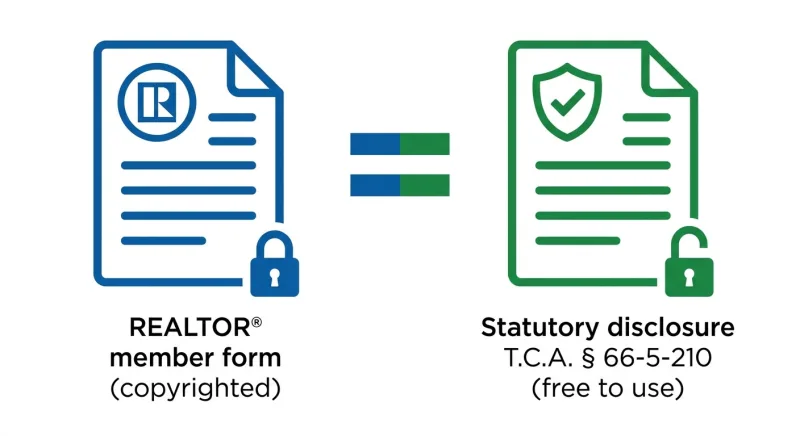
You do not need Form RF 201 to disclose legally in Tennessee. RF 201 is a copyrighted product published by Tennessee REALTORS® for its members. If you're an unrepresented seller, you don't have a license to that document.
Tennessee law doesn't require that specific branded PDF. It requires disclosure in good faith to the best of your knowledge (§66-5-201 et seq.), and §66-5-210 sets out the contents the state actually mandates. Think of it as three layers:
- The law — §66-5-201 through §66-5-210 (what you must disclose).
- The content — the fields that satisfy the law (systems, structure, environmental hazards).
- The container — whichever compliant document carries those fields.
If your document captures every statutory field honestly, you've satisfied Tennessee law whether or not the header says "RF 201."
Short version: The statute is the authority. The form is just the envelope.
Where unrepresented sellers legally get a compliant form
- A flat-fee MLS broker typically provides a current, compliant Tennessee disclosure form as part of the listing package.
- A Tennessee real estate attorney can supply or review a statutory-compliant form.
- The Tennessee General Assembly code site sets out the required contents in §66-5-210.
One caution: form versions get updated. Pull the current statutory language from the state code site rather than a cached copy.
Before You Start: Three Rules That Decide Everything
1. The standard is good faith, best of your knowledge
The statute requires disclosure made "in good faith" and based on "the best of the seller's knowledge" (§66-5-201). You're not warranting the home is perfect. You're stating what you actually know, honestly, at the time you fill it out.
2. You are not required to inspect
Tennessee does not require you to hire an inspector or investigate hidden conditions before completing the disclosure (§66-5-201). If you don't know something, you say so.
3. Delivery timing — this is where sellers get burned
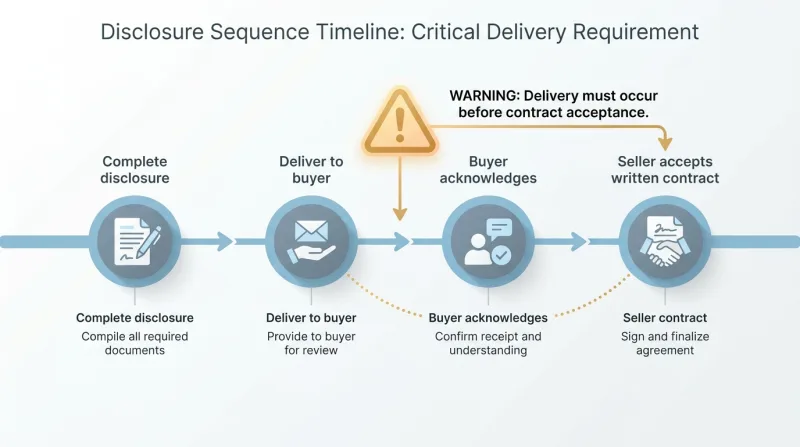
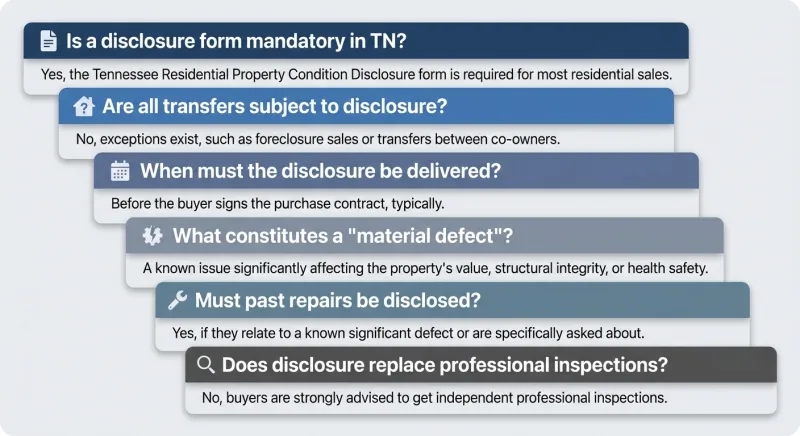
The disclosure must be delivered before the buyer accepts a written purchase contract (§66-5-202). Deliver it late and the buyer may have a right to terminate.
Sequence: Complete → Deliver → Buyer acknowledges → Seller accepts the written contract.
Step 1: Header, Seller Info, and Occupancy
Fill in the property address, the seller name(s) exactly as you'll sign, and the date. Then answer the occupancy questions — how long you've owned and lived in the home, and whether you currently occupy it.
Occupancy sets up credibility for everything that follows. A seller who's lived in the house 14 years and reports "no known foundation issues" reads differently than an investor who's never set foot inside and marks "Unknown" throughout. Both can be completely honest — but occupancy context supports your answers.
Step 2: Section A — Systems and Appliances
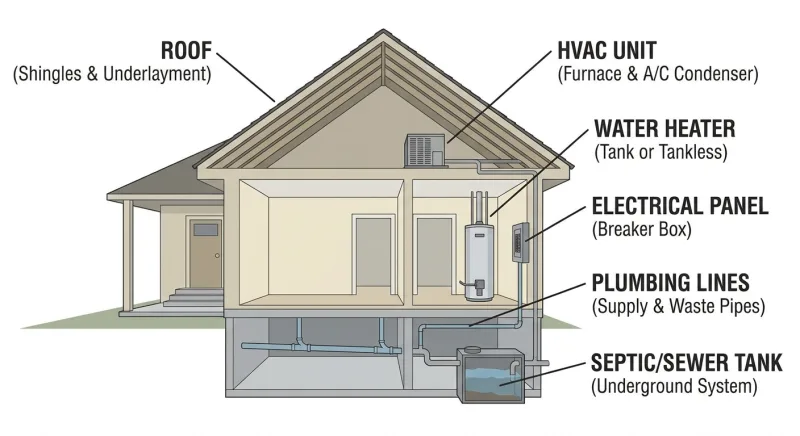
Section A covers HVAC, roof, electrical, plumbing, water heater, and sewer or septic — condition and approximate age where asked. Answer from what you know. Don't know the roof age? "Unknown" is legitimate.
The septic wrinkle: If your home is on septic, Tennessee restricts how a septic system is marketed relative to its permitted bedroom count (see T.C.A. §47-18-104(b)). Don't describe the house as a 4-bedroom if the septic permit is for 3. No permit? "Unknown" plus a note to check with the local health department or TDEC is the honest move. Align the disclosure, the listing, and the permit before you go live.
Step 3: Section B — Structural Conditions
Section B covers foundation, basement or crawlspace leakage, water intrusion, and soil settlement. Report known conditions — cracks you've seen, water that enters after heavy rain, a corner that's settled.
Actively concealing a known defect is a different legal animal than simply not knowing about one. Tennessee treats fraudulent misrepresentation and concealment seriously (§66-5-208). Silence about something you don't know is fine. Painting over a known water stain is not.
Step 4: Section C — Environmental and Other Conditions
Section C covers sinkholes, flood zone status, radon, injection wells, and HOA or PUD membership. Answer each from your knowledge; "Unknown" is fine if you genuinely don't know.
Two statutory notices people miss:
- Condominiums: Tennessee's Horizontal Property Act requires specific disclosures including certain association and governing-document information (§66-27-502). A standard form may not fully cover condo-specific obligations.
- Impact fees: If an impact fee or development tax may apply, there's a separate notice requirement (§66-5-211).
When "Unknown" Protects You vs. When It Exposes You
"Unknown" is a real, legal answer under the good-faith standard (§66-5-201) — but it's two different tools.
True unknown: You genuinely have no information. Clean Unknown.
"I'd rather not say": If you've watched the basement flood every spring for six years, "Unknown" on water intrusion isn't good faith — it's evasion, and that's what §66-5-208 punishes.
Run this test:
- Did you see it or were you told it? → Disclose.
- No observation and no report — just missing data? → Unknown is honest and defensible.
Also: Unknown answers that pattern together — ten in a row — read as evasive even when each is technically true. Your form should reflect what you actually know and don't know.
The "Fixed It Already" Problem
The most common question: I had a defect and fixed it — do I still disclose it?
The form asks you to report known conditions (§66-5-210) — not only currently-active problems. A repaired condition is still disclosable if it's material.
Disclose in three layers: the defect, the repair, and the recurrence status. "Roof leak in NE corner, 2019; flashing replaced, no recurrence since" is stronger than silence — and keep the receipts, permits, and invoices. Over-disclosing a fixed issue protects you more than it costs you. Buyers rarely walk over a resolved repair with a paper trail. They walk over discovering an unmentioned one during inspection.
A Decision Framework for Every Field
- Do I have actual knowledge — observed or reported? No → Unknown is defensible (§66-5-201). Yes → continue.
- Is the condition material? Yes → disclose fully.
- Is it a non-material exclusion? Tennessee excludes certain stigma facts — deaths on the property, prior occupants' conditions like HIV/AIDS — from required disclosure (§66-5-207).
- Was it fixed? Disclose the condition, the repair, and recurrence status. Attach proof.
- Would I be comfortable explaining this answer to a judge? If an answer only works because nobody will check, it's the wrong answer.
Material Change After Delivery — The Addendum Most Sellers Miss
What happens when a defect appears after you deliver the disclosure but before closing? Say you deliver a clean disclosure in March. In April, a storm reveals a roof leak. Silence is the trap — you've re-created a concealment exposure even though your first form was honest.
The fix is a material change notice — a short written update documenting the new condition and the date you learned of it, delivered the same way the original was.
Three rules:
- Document the date of discovery.
- Deliver it — provable delivery before closing, same as the original.
- Keep your copy. Your file should tell a clean chronological story: disclosure, change, delivery, acknowledgment.
Disclosure vs. Disclaimer vs. Exemption: Which One Is You?
- Standard disclosure — complete the property condition disclosure per statutory contents. The default for a normal owner-occupied resale.
- Disclaimer / "as-is" — in certain circumstances you may provide a disclaimer rather than a full disclosure (§66-5-202). This doesn't erase your duty to disclose known material defects and never cancels concealment liability.
- Exemption — some transfers are exempt entirely (§66-5-209), handled via an exemption notification.
The quiet part worth saying: reaching for a disclaimer or exemption to avoid disclosing a known problem doesn't protect you. Concealment liability under §66-5-208 doesn't care which form you chose.
Frequently Asked Questions
Do I need a real estate agent to fill out the Tennessee disclosure form?
No. Tennessee law requires the seller — not an agent — to complete the disclosure in good faith and to the best of the seller's knowledge (§66-5-201).
Can I use Form RF 201 if I'm not a REALTOR®?
Form RF 201 is a copyrighted Tennessee REALTORS® form restricted to members, but the statutory disclosure described in §66-5-210 is legally equivalent, so unrepresented sellers simply use a §66-5-210-compliant version instead.
Is "Unknown" an acceptable answer on the Tennessee disclosure?
Yes. Because the standard is good faith and the "best of the seller's knowledge" (§66-5-201), "Unknown" is valid for conditions you genuinely don't know about, and the law does not require you to inspect or test the property.
When must I give the disclosure to the buyer?
You must deliver the completed disclosure before you accept the buyer's written purchase offer (§66-5-202); deliver it late and the buyer may have a right to terminate.
What if something changes after I complete the form but before closing?
Provide the buyer an updated disclosure (a Material Change Addendum), because the disclosure must remain accurate under the good-faith standard of §66-5-201.
Are there situations where I don't have to give a full disclosure?
Yes. Certain transfers are exempt under §66-5-209 (for example, some court-ordered or estate transfers), and sellers may use a disclaimer under §66-5-202 in limited circumstances — but most ordinary FSBO home sales require the full disclosure.
The Bottom Line
You don't need an agent to complete the Tennessee disclosure. You need the right form, an honest accounting of what you know, and correct timing.
Three things carry the most weight: use a §66-5-210-compliant statutory form rather than the copyrighted RF 201 if you're unrepresented; answer in good faith and to the best of your knowledge (§66-5-201); and deliver the completed form before your buyer signs a written offer (§66-5-202).
When in doubt, disclose. Over-disclosing protects you far more than it costs you, because concealment is where liability lives (§66-5-208).
Fill it out like your signature means something. It does.
This article reflects Tennessee law as of 2026 and is general information, not legal advice. Statute numbers and official RF form versions change — verify current text at the Tennessee General Assembly code site (T.C.A. Title 66, Chapter 5) and use the current official form. For your specific situation, consult a licensed Tennessee real estate attorney.