
Do You Have to Pay a Buyer's Agent Commission in Tennessee After the NAR Settlement? (2026 FAQ)
Last reviewed: 2026. This article explains how buyer-agent commissions work for Tennessee sellers after the NAR settlement. It is general information, not legal advice — for contract specifics, consult a licensed Tennessee real estate attorney.
Do You Have to Pay a Buyer's Agent Commission in Tennessee After the NAR Settlement?
No — neither Tennessee law nor NAR rules require a seller to pay a buyer's agent commission. Since the NAR settlement took effect August 17, 2024, it is 100% voluntary and fully negotiable.
There's no statute that forces it. There's no MLS rule that forces it. You can offer a buyer's agent 3%, 1%, or nothing at all and let the buyer sort out their own agent's fee.
Here's what most national articles skip: offering something is often still smart in Tennessee because a large share of buyers are represented and their agents are watching. But smart and required are two very different things.
What the NAR Settlement Changed for Tennessee Sellers (Pre- vs. Post-2024)
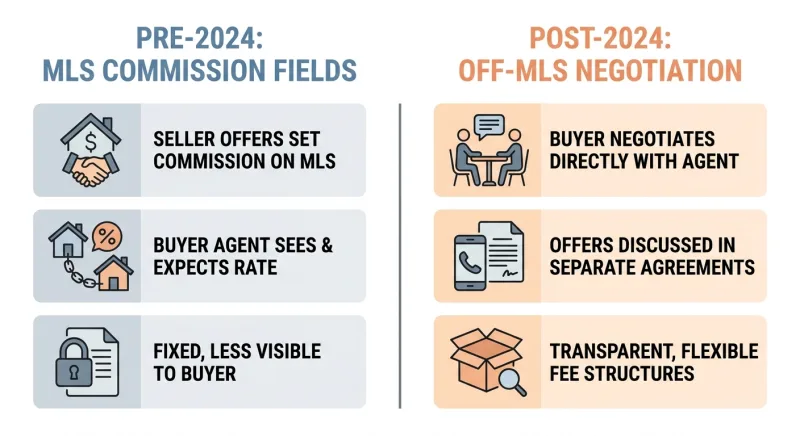
The NAR settlement, effective August 17, 2024, removed buyer-agent commission offers from MLS listing fields and required buyers to sign a written representation agreement before touring homes. Compensation didn't disappear — it moved off the MLS and became openly negotiable.
Before August 17, 2024:
- Listing brokers published a buyer-agent commission offer in the MLS (RealTracs, MAAR, NETAR)
- Buyers typically toured homes without a signed fee agreement
- Compensation was assumed, standardized, and rarely discussed out loud
After August 17, 2024:
- Buyer-agent compensation cannot be advertised in MLS commission fields
- Buyers must sign a written buyer representation agreement before an agent shows them a home
- Any seller contribution toward the buyer's agent is negotiated off-MLS, property by property
- Nothing is standardized; the number is a term of the deal, like price or closing date
The commission is no longer baked in by default. It's a line item you control — a real shift in leverage toward sellers. One thing the settlement did not change: it's still legal to offer buyer-agent compensation. The rule changed where and how you advertise it, not whether you're allowed to.
What Tennessee Law and TREC Actually Require
No Tennessee statute requires a seller to pay a buyer's agent. The Tennessee Real Estate Broker License Act of 1973 (Tennessee Code Annotated, Title 62, Chapter 13) governs agency relationships and disclosures — but it contains no provision mandating seller-paid buyer commission.
Tennessee Code Annotated § 62-13-404 sets out the duties a licensee owes to clients — loyalty, disclosure, accounting. It says nothing about forcing a seller to fund the other side's agent.
Tennessee Code Annotated § 62-13-312 lists grounds on which TREC can discipline a licensee — nothing about requiring a commission payment from a seller to a buyer's broker.
TREC regulates licensees; it does not set your commission. Commission in Tennessee is, and always has been, a private contract term. If an agent tells you a buyer-side commission is "required," ask them to point to the statute. There isn't one.
How Buyer Agent Fees Are Negotiated and Paid Off-MLS in Tennessee
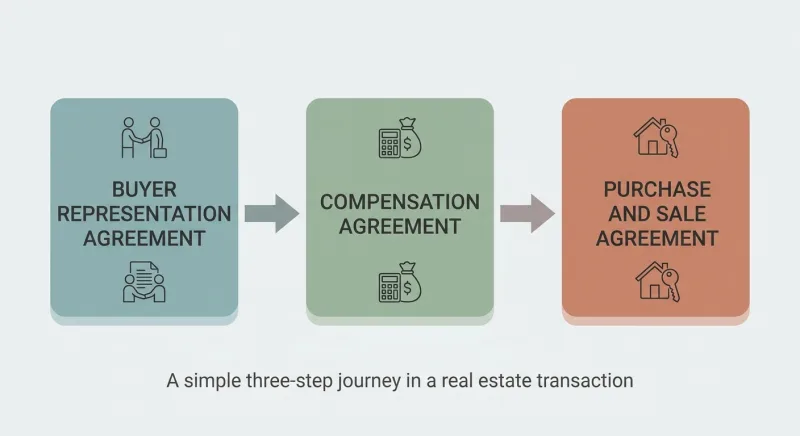
Since commission offers left the MLS, Tennessee buyer-agent fees are negotiated through standard Tennessee REALTORS® forms — typically a buyer representation agreement, a compensation agreement, and the purchase and sale contract — then paid at closing.
Step 1 — The buyer signs a representation agreement. Before touring, a represented buyer signs Form RF141, the Buyer Representation Agreement, which sets what the buyer's agent will be paid and by whom.
Step 2 — Compensation gets confirmed in writing. If a seller agrees to contribute, that's documented on Form RF702 (Compensation Agreement) or Form RF620 (Compensation Addendum) — the off-MLS replacement for the old MLS commission field.
Step 3 — It lands in the purchase contract. The amount flows into Form RF401, the Purchase and Sale Agreement. Tennessee's buyer representation documentation includes a shortfall clause (Paragraph E in Form RF141) addressing what happens if the agreed compensation exceeds what a seller contributes — the buyer covers the gap.
A buyer's agent can still ask you to pay their fee. You can say yes, no, or counter. Because it's written into the offer, you see exactly what you're agreeing to before you sign.
Form names reflect current Tennessee REALTORS® forms as of 2026 and are periodically revised — confirm the latest version with your closing attorney or title company.
Seller Concessions vs. Direct Commission: The Double-Bucket Rule Most Guides Miss
Paying a buyer's agent and giving a closing-cost concession are two different buckets of money, and lenders cap them differently.
A seller concession (interested-party contribution, or IPC) is money credited toward closing costs, prepaids, or a rate buydown. A seller-paid buyer-agent commission is compensation to the cooperating broker. As of 2026, both Fannie Mae and FHA have issued guidance treating customary, reasonable seller-paid buyer broker fees as outside standard IPC limits — a change made specifically in response to the post-settlement landscape. National posts that lump commission into the concession cap tell sellers they're more limited than they actually are.
For the concession bucket — closing costs, prepaids, discount points:
| Loan scenario | IPC / concession cap |
|---|---|
| Conventional, >90% LTV | 3% |
| Conventional, 75–90% LTV | 6% |
| Conventional, <75% LTV | 9% |
| FHA | 6% |
| VA | 4% (plus normal closing costs) |
If a buyer asks you to cover both their agent and credit closing costs, know which dollars fall into which bucket — blowing past the IPC cap can force a re-structure days before closing. A closing attorney or the buyer's lender will confirm the split in writing.
The Shortfall Clause: Your Protection When a Buyer Over-Asks
If a buyer's agent fee is written into the contract but the buyer's representation agreement promised their agent more, the gap is the buyer's problem — not yours — as long as the paperwork is built correctly.
If a buyer signed Form RF141 promising their agent 3%, and you agree to contribute 2%, the buyer owes the 1% shortfall. Form RF401 includes language addressing exactly this scenario. You're one party to a contract deciding how much of someone else's fee you'll subsidize — a cleaner position than most sellers realize.
Edge case — the buyer with no agent: An unrepresented buyer owes no commission to anyone. If you've priced in a 2.5% contribution and an unrepresented buyer shows up, that 2.5% becomes negotiable. Smart sellers hold a portion as price flexibility and credit the rest.
Should a Tennessee Flat-Fee Seller Offer Buyer Agent Commission? (The Decision Matrix)
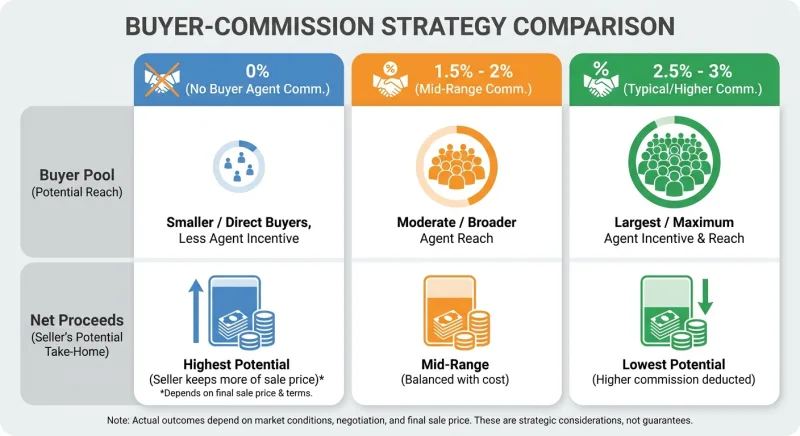
Offering a buyer's agent commission is now a pure math-and-leverage decision — not an obligation. The question stopped being "how much do I owe?" and became "how much (if anything) buys me a bigger, faster buyer pool without eating my net proceeds?"
| Offer 0% | Offer 1.5–2% | Offer 2.5–3% | |
|---|---|---|---|
| Buyer pool reached | Narrowest — mostly unrepresented / cash / investor buyers | Broad — most agents still show it | Widest — zero friction for any buyer's agent |
| Your leverage | Highest list-price control | Balanced | Lowest; matching the old norm |
| Net on a $420k sale | Keep the full ~$12,600 | Pay ~$6,300–$8,400 | Pay ~$10,500–$12,600 |
| Primary risk | Longer days on market; some agents steer around it | A buyer's agent may counter for more | Overpaying in a strong seller's market |
| Best when | Hot market, unique home, investor-heavy area | Most Tennessee sellers, most of the time | Slow market or season, need speed |
0% is a legitimate strategy now, not a liability. Before August 2024, declining to offer buyer compensation flagged your listing inside the MLS commission field. That field is gone from RealTracs, MAAR, and NETAR. "No offer" no longer broadcasts to every agent in the system — it's a private negotiation when an offer comes in.
The Leverage Test: Three Questions Before You Decide
1. How deep is your buyer pool without an incentive? A move-in-ready 3-bed in a hot Nashville or Franklin submarket with ten showings the first weekend doesn't need to bribe anyone. A dated home on a busy road in a cooling market does.
2. Who is actually buying this house? Investor and cash buyers frequently come unrepresented — offering commission to a pool that doesn't use agents is money set on fire. First-time buyers in a $280K Murfreesboro starter home almost always come with an agent they now owe a fee to under a written buyer agreement.
3. What does each percentage do to your walk-away number? A 2% offer on $420k is ~$8,400; a 3% offer is ~$12,600. That $4,200 spread is only worth paying if it meaningfully speeds the sale or drives a higher final price.
The "Fold It Into Price" Move Most Guides Skip
You don't have to choose between "offer commission" and "offer nothing." A represented buyer whose fee isn't covered will often ask for it back as a seller concession toward closing costs instead of a direct cooperating-broker payment. A concession is negotiated per-deal with a specific buyer, not broadcast to the market. You stay at 0% publicly, keep every unrepresented buyer's offer clean, and still have room to solve a represented buyer's fee problem when it shows up — without overpaying everyone else to get there.
The real savings isn't shaving the buyer-side number — it's what you don't pay on the listing side. A flat-fee MLS listing runs a few hundred dollars instead of roughly 3% of your sale price. On a $420k Nashville home, a traditional listing-side commission would be another ~$12,600. List flat-fee, set your buyer-agent contribution deliberately, and you control both halves of the commission equation.
If you're deciding how to get your home onto RealTracs without a listing agent, that's exactly what a flat fee MLS Tennessee listing does — and we cover the city-specific steps on our Nashville, Franklin, Murfreesboro, Knoxville, Memphis, and Chattanooga pages.
Frequently Asked Questions
Do I have to pay a buyer's agent commission in Tennessee?
No. Neither Tennessee law nor NAR rules require a seller to pay a buyer's agent commission — since the NAR settlement took effect August 17, 2024, it is 100% voluntary and fully negotiable. You can offer a full cooperating commission, a partial amount, or nothing at all.
Is a buyer's agent commission required for a FSBO or flat-fee seller in TN in 2026?
No. An unrepresented or flat-fee seller has zero obligation to compensate a buyer's agent. If one asks, you're free to say yes, no, or counter — the number lives in the contract, not in any statute.
Can the buyer still ask me to pay their agent?
Yes, and many will. A buyer's agent now negotiates their fee through a written representation agreement, and that buyer may ask you to cover it through a seller concession written into the purchase agreement (Form RF401). You decide whether to agree.
How much should a Tennessee flat-fee seller offer a buyer's agent?
It depends on your leverage and local buyer pool. In a hot Nashville-area market with low inventory, 0% or a modest 1.5–2% can still attract strong offers; in a slower market, matching the local norm of roughly 2.5–3% widens your pool. Run the net-proceeds math on your specific sale.
Does offering $0 reduce the buyers who see my home?
Potentially, but less than it used to. Commission offers can no longer be advertised in RealTracs, MAAR, or NETAR MLS fields, so the question surfaces during negotiation rather than in upfront listing filters.
What's the cheapest way to get my Tennessee home on the MLS?
A flat-fee MLS listing — typically a few hundred dollars versus roughly 3% of your sale price — puts your home in front of every agent and buyer searching RealTracs, while you keep full control over what, if anything, you offer a buyer's agent.
Conclusion
In Tennessee, no law, no TREC rule, and no NAR mandate forces you to pay a buyer's agent commission. Since August 17, 2024, that number is fully negotiable — a line in your purchase agreement, not a tax on your sale.
Offer a competitive cooperating commission to widen your buyer pool, offer a reduced amount, or offer nothing and let a represented buyer ask their own agent to cover the gap. Each path trades reach for net proceeds, and the right choice depends on your price point, local inventory, and how fast you need to close.
Run the real numbers — compare a flat-fee MLS listing against roughly 3% of your price. Decide your buyer-agent offer before you list so you negotiate from a plan. And read the compensation and concession language carefully when an offer lands.
This is general information, not legal advice. Run your actual agreement past a licensed Tennessee real estate attorney before you sign.
Last reviewed 2026.