
Earnest Money & Escrow for Tennessee FSBO Sellers: How to Handle It Without a Listing Agent (2026)
Here's the question that keeps for-sale-by-owner sellers up at night: when the buyer hands over a deposit, where does it actually go?
Short answer: In a Tennessee FSBO, the earnest money deposit (EMD) goes to a neutral third party — a licensed title/settlement company or a closing attorney — named right in the purchase and sale agreement. It does not go to you. The one rule that trips up most self-represented sellers: you cannot legally hold the buyer's deposit in your personal account. Not the seller. Never the seller's account.
That's the whole game. Who holds it matters more than how much.
You'll name your escrow holder in the earnest money section of TAR Form RF 401 (the standard Tennessee Purchase and Sale Agreement), the buyer delivers funds inside the contract's deadline, and the money sits in an escrow trust account until closing. If the deal closes, the deposit applies to the buyer's cash to close. If it blows up, the funds can't move without a signed mutual release or a court order.
This isn't legal advice — have your closing attorney confirm your terms.
What Is Earnest Money vs. the Down Payment?
Earnest money is a good-faith deposit the buyer puts down when they sign the contract. If the buyer walks for a reason the contract doesn't allow, the seller may be entitled to keep it. If the buyer follows the contract and closes, that money gets credited back to them at the table.
The down payment is a bigger number, tied to the buyer's mortgage, and it shows up at closing — not when the offer is accepted.
At a normal closing, the EMD becomes part of what the buyer owes. Say the deposit is $5,000 and the buyer owes $60,000 cash to close. The settlement statement shows the $5,000 already paid, so the buyer wires the remaining $55,000. Same total — the deposit just got there early.
How Much Earnest Money Is Typical in Tennessee?
Short answer: There's no legally required amount in Tennessee. Earnest money is negotiable, and in practice it usually runs 1%–3% of the purchase price in higher-demand markets, or a flat $1,000–$5,000 in smaller counties.
| Market | Customary earnest money |
|---|---|
| Nashville / Davidson County | ~1%–3% of price |
| Williamson County (Franklin, Brentwood) | Often 1%–2%+, higher on competitive listings |
| Knoxville, Chattanooga, Memphis metros | ~1%–2% or flat $2,000–$5,000 |
| Murfreesboro, Clarksville, smaller counties | Flat $1,000–$5,000 common |
A bigger deposit signals the buyer is committed and better financed. A thin one — a few hundred dollars on a $400,000 home — is worth noticing. You're allowed to counter for more. As an unrepresented FSBO seller, deposit size is one of your few real levers to filter weak offers before you tie up your house for 30–45 days.
One caution: a larger deposit cuts both ways. If the buyer has a valid contingency and walks, that larger sum goes back to them.

Who Holds Earnest Money in a Tennessee FSBO?
Short answer: A neutral third party — almost always a licensed Tennessee title/settlement company or a closing attorney. Not the seller. Never the seller's personal account.
Most guides say the deposit goes to "the listing brokerage's escrow trust account." That assumes there's a listing agent. In a true FSBO deal, there is no listing broker — so that default holder doesn't exist.
Why you can't hold it yourself
Tennessee regulates who may hold other people's money in a real estate transaction through the Tennessee Real Estate Broker License Act (T.C.A. § 62-13-321) and the escrow rules enforced by the Tennessee Real Estate Commission (TREC). Licensed brokers who hold earnest money must deposit it into a dedicated escrow trust account and are prohibited from commingling it with their own funds.
You, the FSBO seller, aren't a licensed broker — and you're a party to the deal, not a neutral. Dropping the buyer's $5,000 into your checking account is textbook commingling. No sane buyer should agree to it, and no title company will close around it cleanly.
The lawful options are:
- A Tennessee title/settlement company — the most common choice. They'll run title, hold the EMD, and handle closing.
- A real estate closing attorney — common in parts of East and West Tennessee; holds funds in a trust account.
Both maintain escrow trust accounts, both are neutral, and both disburse funds according to the contract. Pick your holder before you accept an offer so you can write the name straight into the contract.
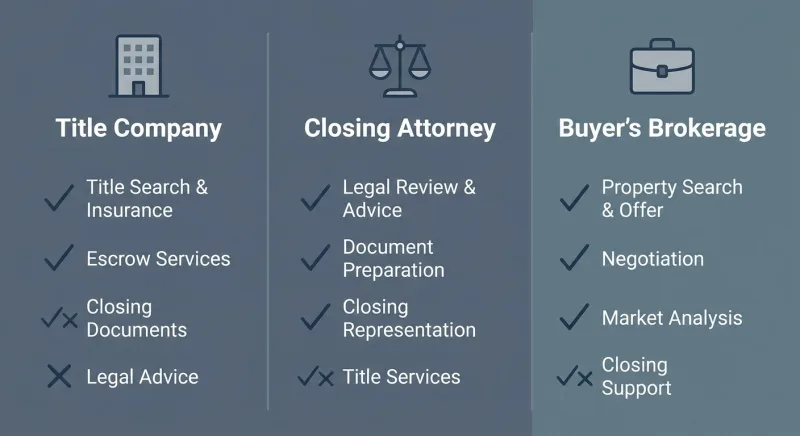
Title company vs. closing attorney vs. buyer's brokerage
| Title / Settlement Company | Closing Attorney | Buyer's Brokerage | |
|---|---|---|---|
| Neutral to both parties? | Yes | Yes | Leans to the buyer |
| Holds funds in escrow trust account? | Yes | Yes (attorney trust account) | Yes (broker trust account) |
| Also does your closing? | Usually yes | Usually yes | No |
| Runs title search / issues policy? | Yes | Often yes | No |
| Best when | One neutral vendor handles escrow + closing | You want legal review alongside closing | Buyer insists, you're comfortable |
| Watch-outs | Pick an established, insured TN company | Confirm they handle FSBO closings | Not neutral; harder on a dispute |
Our take for most FSBO sellers: name a reputable local title company. One neutral vendor runs title, holds the deposit, and closes — fewer moving parts, one point of contact wherever your home sits.
Using the buyer's brokerage as holder is legal and happens, but that broker represents the buyer's interests. If you end up in an earnest money dispute, you'd rather the money sit with a party that owes loyalty to neither side.
How to Set Up Earnest Money in Form RF 401, Step by Step
Short answer: You name the holder, state the amount, and set the delivery deadline inside the earnest money section of TAR Form RF 401 — before anyone signs.
Form RF 401 is the standard Tennessee REALTORS® Purchase and Sale Agreement. (Section numbering gets revised between form versions — confirm the current section with your title company or closing attorney; the heading reads Earnest Money / Trust Money.)
- Name the escrow holder. Write in the exact title company or closing attorney — full legal name — not "TBD."
- State the amount. Match it to the offer.
- Set the delivery deadline. Delivery is commonly set at 24 to 72 hours from the binding agreement date — the date the last party signs and acceptance is communicated. Shorter is stronger for you.
- Specify the form of funds. Wire transfer or cashier's check to the holder's trust account. Avoid personal checks.
- Confirm the binding agreement date is filled in. Every downstream deadline — delivery, due diligence, financing — counts from this date.
Once signed, the buyer delivers the deposit by the deadline. The holder deposits it into their escrow trust account and gives written confirmation of receipt. Keep that confirmation. If the buyer misses the delivery deadline, that can itself be a breach — talk to your closing attorney before you do anything.
Delivering the Deposit Safely: The Wire-Fraud Protocol
Short answer: Before anyone wires a dollar, verify the wiring instructions by calling the title company at a number you looked up yourself — never a number from the email.
Fraudsters watch for pending deals, spoof the title company's email, and send the buyer "updated" wiring instructions pointing to the thief's account. The buyer wires. The money vanishes. Federal and industry guidance — the FBI/IC3, the CFPB, and the American Land Title Association (ALTA) — all point to the same defense: verify by voice.
Hand your buyer this protocol:
- Find the holder's phone number independently — from the signed contract or official website, not from any email.
- Call and confirm the wiring instructions out loud: account number, routing number, receiving bank. Match every digit.
- Be suspicious of any "change." A last-minute update email is a red flag until proven otherwise.
- Prefer a cashier's check for smaller deposits — delivered in person to the holder.
- Confirm receipt in writing that funds landed in the escrow trust account.
- Act fast if something's off. Call the bank and the FBI immediately.
When Is Earnest Money Refundable in Tennessee?
Short answer: Earnest money is generally refundable to the buyer when they terminate under a contingency the contract allows, and generally at risk when they walk for a reason it doesn't.
Form RF 401 deals typically give the buyer these exit ramps:
- Due diligence / inspection period. During the negotiated due diligence period, the buyer can walk for essentially any reason and recover the deposit.
- Financing contingency. If the buyer's mortgage falls through and the contract protects it, the deposit typically returns.
- Appraisal contingency. If the home appraises below price and the contract allows termination, the buyer can usually back out and recover.
The deposit tilts toward you, the seller, when the buyer defaults — walks after contingencies expire or gets cold feet with no contractual cover. But "entitled to keep it" is not the same as "it's in your account tomorrow."
Disputed Earnest Money: Mutual Release and Interpleader
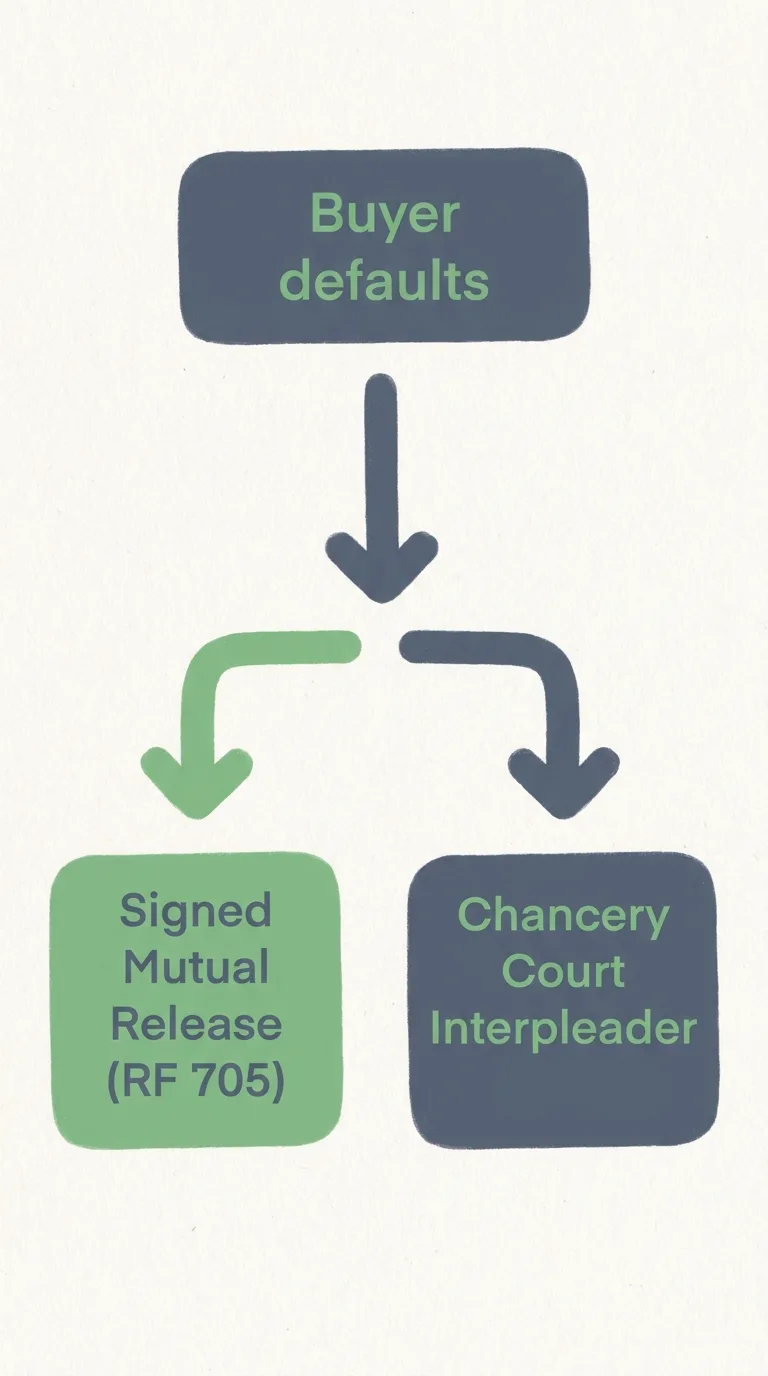
Short answer: Even when you're clearly right, your escrow holder generally cannot hand you the deposit on your say-so. It takes a signed mutual release from both parties — or a court decides.
The clean path: a signed mutual release
Both parties sign a mutual release — commonly TAR Form RF 705 (and related disbursement forms such as RF 481) — agreeing on who gets what. The holder disburses per the signed release. Most disputes end here, often with a compromise split, because the alternative costs both sides time and money.
The contested path: chancery court interpleader
If you can't agree, the holder will typically file an interpleader action in the county chancery court — depositing the disputed funds with the court and asking a judge to decide. A few realities to price in:
- Cost can exceed the deposit. Fighting over $3,000 in chancery court can run more than $3,000 in fees.
- TREC's disbursement window applies to licensed holders — commonly cited as roughly 21 days after a dispute arises; confirm the current figure with your closing attorney.
- The county matters. You file where the property sits — Davidson for Nashville, Williamson for Franklin and Brentwood, Rutherford for Murfreesboro, Shelby for Memphis, Knox for Knoxville, Hamilton for Chattanooga, Montgomery for Clarksville.
You avoid interpleader with clean contingency deadlines, a neutral holder named up front, and a documented timeline so a defaulting buyer sees the writing on the wall and signs the release.
Reading the Contract's Remedy Language
Contingency release points are sequential
A standard TN purchase and sale agreement stacks contingencies the buyer can exit under: due diligence/inspection, financing, and appraisal. A buyer who terminates through an open door gets the deposit back. A buyer who walks after every door has closed is typically in default. Your deadline calendar is the record that proves it.
Liquidated damages vs. actual damages
Some contracts cap the seller's recovery at the earnest money; others preserve the right to sue for actual damages beyond the deposit. If your EMD is $3,000 and a liquidated-damages clause caps you there, a buyer walking on a $450,000 deal costs you far more than the deposit — and you waived the rest. Know which approach your form uses before you sign.
Edge Cases That Break the Standard FSBO Playbook
The deposit that never arrives. If the buyer misses the delivery window, you may have a breach before the inspection even starts — but only if the contract makes timely delivery a condition. Confirm with your escrow holder in writing the moment funds land, and calendar the deadline.
Multiple deposits. In higher-price Nashville and Williamson County deals, buyers sometimes structure earnest money in two parts — an initial deposit at binding agreement, then an additional deposit that goes "hard" (non-refundable) once due diligence ends. Track each tranche separately.
Assignable contracts and wholesalers. If the buyer's name reads "[Name] and/or assigns," you may be dealing with a wholesaler who intends to flip the contract. Require a deposit large enough to hurt — a thin EMD on an assignable contract is a red flag.
Title snags at closing. If a title defect surfaces — an unreleased lien, a boundary problem, a missing heir — the closing can stall with the deposit still parked. Draft a cure period for title objections and a clear statement of what happens to the EMD if the defect can't be cured.
How a Flat-Fee Listing Keeps Your Escrow Clean from Day One
The earnest money problem is really a paperwork problem. Name the wrong holder, leave the earnest money section blank, or miss the deposit deadline, and you've created a dispute before closing even starts.
A flat fee MLS listing gives you the same TAR contract package a licensed agent would use — including Form RF 401 — so the earnest money section is structured correctly from the start. You fill in the holder, the amount, and the delivery deadline. That's the difference between "self-represented" and "unprotected" — and those are not the same thing.
Once the contract is signed, the buyer wires or delivers a cashier's check, the holder confirms receipt, and the funds sit in a dedicated escrow trust account until closing or a signed release. The mechanics hold statewide: neutral holder, trust account, no unilateral disbursement. What changes city to city is which title companies and attorneys sellers use — and that's where a local flat fee setup earns its keep.
You list it yourself. The deposit is handled by a neutral professional. The commission that would've paid a listing agent stays in your pocket.
Frequently Asked Questions
Who holds earnest money in a Tennessee FSBO sale?
A neutral third party — a licensed title/settlement company or a closing attorney — holds the EMD in an escrow trust account. Not the seller. Never the seller's personal account. Holding buyer deposits personally runs into the commingling prohibitions under the Tennessee Real Estate Broker License Act (T.C.A. § 62-13-321) and TREC escrow rules.
Can a Tennessee title company hold earnest money for an FSBO deal?
Yes. A licensed Tennessee title company can hold the EMD in its escrow trust account whether or not it's also closing the sale — though naming your closing title company keeps everything in one file. Confirm up front that the company accepts deposit escrow and ask about its wiring and ID verification requirements before you write them into the contract.
How does earnest money work in a TN FSBO, step by step?
The buyer deposits earnest money with a neutral holder shortly after the contract becomes binding, it sits in escrow through the contingency periods, and it's credited toward the buyer's cash to close at closing. If the buyer terminates under an open contingency, it's refunded; if they default after contingencies close, retention gets authorized by a signed mutual release or a court order.
How much earnest money is customary in Tennessee?
Customarily 1%–3% in Nashville and Williamson County markets, and often a flat $1,000–$5,000 in smaller counties. These figures are negotiable, not statutory.
Can the seller keep the earnest money if the buyer backs out?
Only if the buyer defaults after their contingencies have closed — and even then, the holder can't hand it to you automatically. You need the buyer's signed mutual release (TAR Form RF 705 / RF 481) or a chancery court order through an interpleader. A buyer who terminates within an open contingency generally gets the deposit back.
Do I need a title company if I'm selling by owner in Tennessee?
Yes, practically speaking — a Tennessee title company or closing attorney handles the escrow account, title search, and settlement even without agents. Naming one as your escrow holder in Form RF 401 is the cleanest way to hold the deposit lawfully and get to closing.
The Bottom Line
You can run a Tennessee FSBO deal yourself, but you cannot hold the deposit yourself. Name a neutral title company or closing attorney as the escrow holder in Form RF 401, set the delivery deadline from the binding agreement date, and let that account park the money until closing.
Pick a licensed Tennessee title or settlement company before you accept an offer. Fill in the earnest money amount and deadline clearly. Verify any wiring instructions by phone using a number you independently confirmed. If a deposit gets disputed, the two lawful exits are a signed mutual release or a chancery court interpleader — not a unilateral grab.
Set up the escrow holder right, keep the funds in a proper trust account, and the rest of the FSBO becomes paperwork you can absolutely handle — commission savings included.
This isn't legal advice — have your closing attorney confirm the exact terms and current form numbers for your deal.