
Tennessee Flat Fee MLS Pricing: What You Actually Pay in 2026
Here's the honest math before we go deep. Upfront flat fee MLS plans in Tennessee run roughly $99 to $499+ as of 2026 — but the headline price is rarely the whole bill. The line item most sellers miss is the fee at closing: Houzeo's higher tiers can add a 0.5%–1.25% back-end charge, which quietly turns a "flat fee" into a partial commission on a $400,000 home.
I run limited-service flat-fee listings in Tennessee, so I read these pricing pages the way a seller forced to pay the invoice does — not the way a national blog skims them. National comparison pages gloss over three things that matter here: back-end closing fees, local MLS board photo caps (RealTracs in Nashville, MAAR in Memphis, KAAR in Knoxville), and à-la-carte add-ons buried under a tempting $99 price.
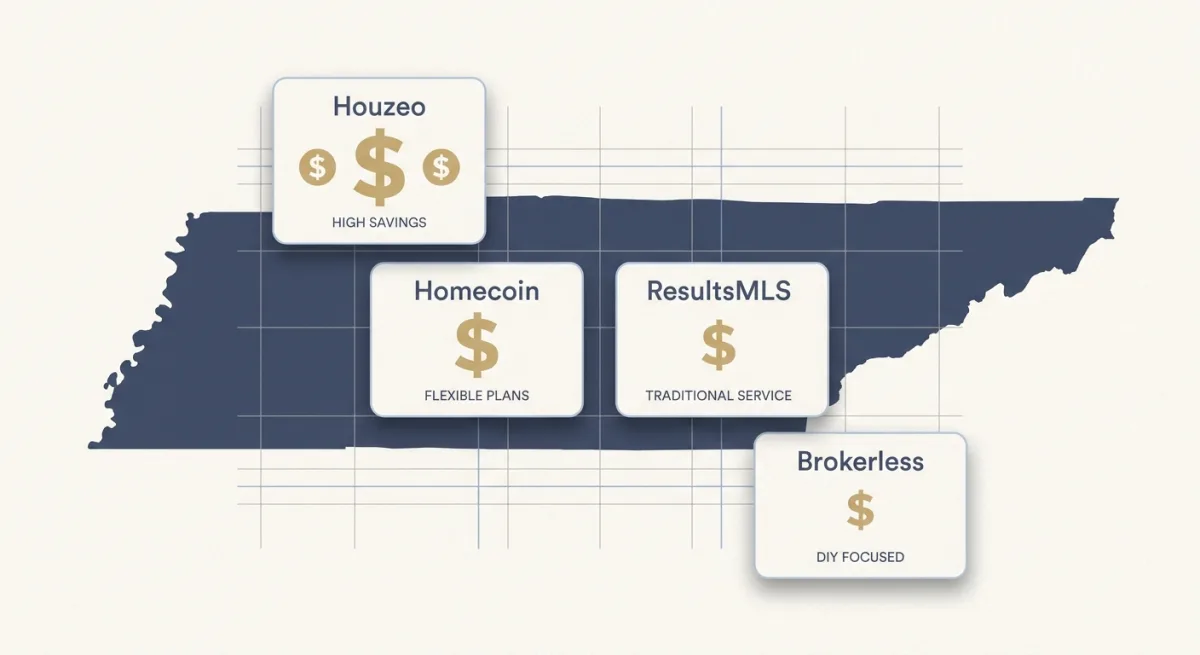
This guide fixes that. You'll get an auditable master pricing matrix comparing Houzeo, Homecoin, Brokerless, and ResultsMLS across eight real decision columns, a teardown of each, a Houzeo-vs-Homecoin verdict, the TN board photo rules, CDOM facts, and FAQs. Every number traces to a provider's own pricing page or official board rule. Compare the plans, then list when you're ready.
Tennessee Flat Fee MLS Pricing at a Glance (2026)
A flat fee MLS listing in Tennessee runs roughly $99 to $499+ upfront as of 2026, depending on provider and tier. That's the headline figure most plans lead with. It's also the number that hides the most — because some national plans tack on a back-end closing fee of 0.5%–1.25% or a minimum commission threshold, while others keep the base cheap and charge à-la-carte for extra photos, showing management, and listing changes.
The short version:
- Cheapest upfront: Brokerless, starting around $99.
- Watch the back end: Houzeo's higher tiers can add a closing-fee percentage.
- Most à-la-carte: Homecoin — low $149 base, costs stack as you add features.
- Flattest "flat fee" (no closing %): ResultsMLS and Brokerless both generally publish no closing fee, though terms may vary.
Every price below is published and subject to change — verify at checkout before you list.
The Master Pricing Matrix: Tennessee Flat Fee MLS Compared (2026)
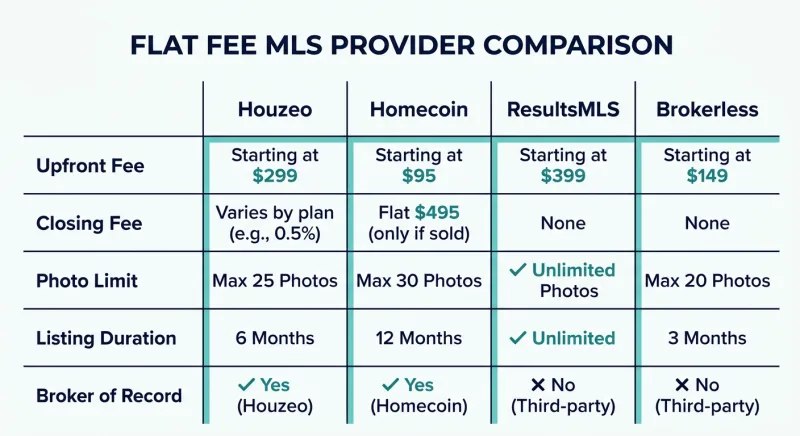
This is the spine of the comparison. Most national pages give you an upfront price and stop. The columns that actually decide your net proceeds — closing fee, photo cap, duration, change fees — get buried. So we built all eight into one table.
| Decision factor | Houzeo | Homecoin | Brokerless | ResultsMLS |
|---|---|---|---|---|
| Upfront fee (entry tier) | ~$399 Bronze–Core | ~$149 base | ~$99 | Flat upfront (published at checkout) |
| Closing / back-end fee | 0.5%–1.25% on higher tiers | None on base | $0 — no closing fee | No closing % — compliance fee disclosed |
| Photo limit | Varies by tier (can be below board cap) | Varies by add-on | Varies by tier | Up to board maximum |
| Listing duration | 6–12 months by tier | 6 months typical | 6–12 months | 6–12 months |
| Change / price-revision fees | Varies by tier | Often à-la-carte | Varies by tier | Disclosed upfront |
| Showing tool | ShowingTime integration | Add-on | Varies | Supported |
| Broker of record | Nationwide network / referral model | Nationwide | Nationwide | Direct TN broker of record |
| Buyer-lead pass-through | Platform-filtered | Varies | Varies | Unfiltered, direct to you |
A neutrality note, because it matters: every figure comes from each provider's published pricing or the official board rule — not our opinion of what they should charge. Prices and caps move. Re-check them at checkout.
Two patterns jump out. First, the cheapest upfront number rarely stays cheapest once you add the closing fee and the features you'll actually need. Second, the photo cap and the broker-of-record model — the two columns national pages love to skip — are where Tennessee sellers get pinched. Both get their own section below.
How Flat Fee MLS Pricing Actually Works in Tennessee
A flat fee MLS service is a limited-service listing. You pay a licensed broker a set upfront fee to put your home on the local MLS — RealTracs in Nashville and Middle Tennessee, MAAR in Memphis, KAAR in Knoxville — and from there it syndicates to Zillow, Realtor.com, and Redfin. You keep the listing agent's job: pricing, photos, showings, negotiation. That's the trade. You do the work, and you can potentially skip the roughly 2.5%–3% listing-side commission a full-service agent would typically charge.
What you're not skipping is buyer-agent compensation. Even after the August 2024 NAR settlement changed how that compensation gets advertised, a buyer's agent still expects to be paid, and in most Tennessee deals the seller still negotiates it into the contract. Flat fee MLS reduces or eliminates listing-side commission. It doesn't erase the buyer side.
The four cost layers to watch
Every flat fee plan is built from the same four layers:
- Upfront fee — the headline price. $99 to $499+. Paid when you list.
- Back-end / closing fee — a percentage or minimum commission collected on the ALTA settlement statement at closing. The layer national pages gloss over.
- Photo and feature caps — how many photos go live, whether open houses and virtual tours are included or extra.
- Add-ons and admin fees — showing-management tools, Tennessee seller-disclosure forms, and listing-change or price-revision fees.
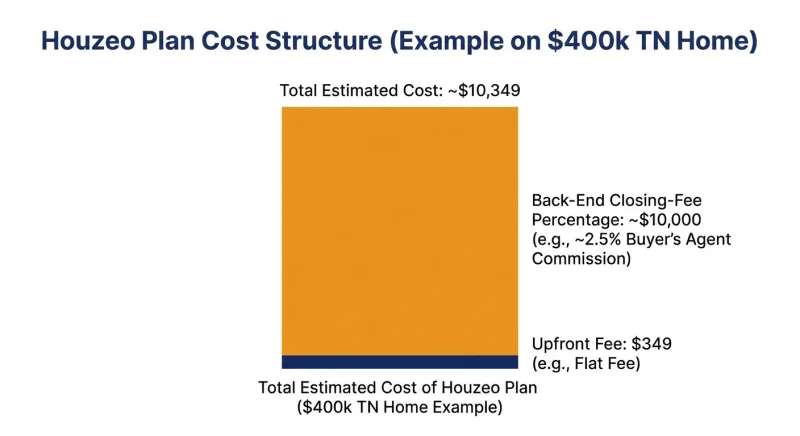
A plan can look cheap on layer one and expensive on layers two through four. On a $400,000 Tennessee home — a representative example, not a claimed average — a 1% closing fee is $4,000. In plain numbers: the $99 plan with a 1% closing fee is the $4,099 plan.
Why the MLS board matters more than the brand
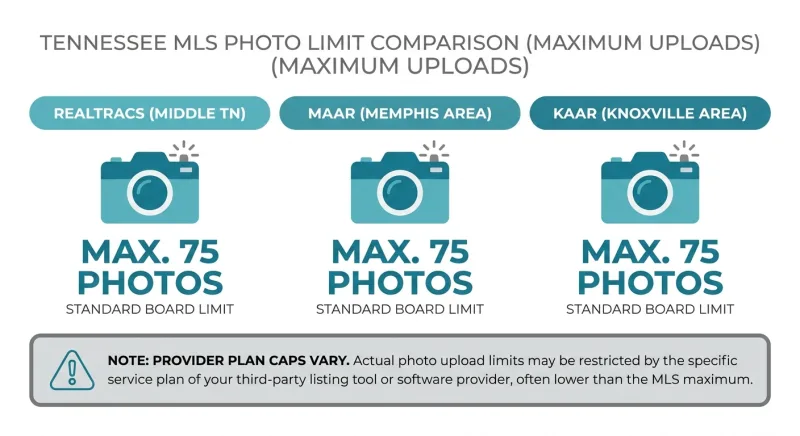
Here's the TN-local piece national pages miss. Your photo cap, your days-on-market rules, and your cumulative-DOM reset policy aren't set by Houzeo or Homecoin — they're set by your local board. RealTracs covers Nashville and Middle Tennessee (Franklin, Murfreesboro, Brentwood, Clarksville). MAAR covers Memphis. KAAR covers Knoxville. River Counties serves the Chattanooga area.
So a "nationwide" plan can promise one photo count on its website while your actual board caps it somewhere else — and whichever number is lower is the one you live with. The provider sets a ceiling; the board sets a ceiling; you get the lower of the two.
Where a Fixed Price Stops Being Fixed
The real money moves happen in the fine print that triggers after you've listed. Understanding the mechanisms below separates a seller who paid $149 from one who wrote a $4,000 check at the closing table on a "flat fee" plan.
The closing-fee percentage
A closing-fee percentage isn't a listing cost. It's a success fee the broker collects from your proceeds on the ALTA settlement statement when the deal funds. Houzeo's higher tiers carry a 0.5%–1.25% closing percentage on some plans. Here's the mechanism that stings: this fee usually scales with sale price, and it often has a floor — a minimum listing commission threshold (frequently cited around $999).
On a $400,000 Middle Tennessee home (representative example):
- A 1% closing fee = $4,000 deducted at funding.
- A 0.5% closing fee = $2,000.
- A $99 "zero-closing-fee" plan deducts $0 at the table.
The lesson isn't "Houzeo bad." It's that upfront price and total cost are two different numbers, and the gap widens as your sale price climbs. Always model your actual price band, not the headline.
The minimum-commission floor
Percentage closing fees hurt expensive homes. Minimum thresholds hurt cheap ones. If a plan charges "0.5% or $999, whichever is greater," a seller closing at $150,000 pays the $999 floor — an effective 0.67%, higher than the headline rate. The structure is regressive at the low end and expensive at the high end. The only band it's genuinely cheap in is the narrow middle, and that's rarely where any single seller lands. Run both the percentage and the floor, take the larger, and compare that to a pure flat plan.
CDOM Mechanics: The Timing Lever Nobody Explains
Days on Market gets mentioned everywhere. Cumulative Days on Market (CDOM) is the number that actually moves buyer psychology — and flat-fee sellers control it more than they realize.
On RealTracs and most TN boards, if you cancel and relist, DOM resets to zero. CDOM does not — it carries forward the accumulated days across the prior listing within a defined window. Buyers' agents see CDOM. So the classic "cancel and relist to look fresh" trick is largely cosmetic on the boards that aggregate it. A buyer's agent pulling 180+ cumulative days reads one word: stale. That costs you leverage.
The genuine reset usually requires the property to be off-market for the full board-defined period (commonly 30, 60, or 90 days) before CDOM zeroes out. That's a real strategic lever — but only if you know your board's specific window.
This is where listing duration and CDOM collide. A 6-month plan that auto-expires can accidentally trigger a CDOM gap that helps you if you were planning a price repositioning anyway. A 12-month plan that stays continuously active keeps CDOM climbing — fine in a hot market, a slow bleed to perceived value in a cold one.
Framework for choosing duration:
- Fast market, confident price: shorter duration, avoid paying for months you won't use.
- Unique or higher-priced property: longer duration, but plan a deliberate price-and-timing strategy around the CDOM window, not a reflexive relist.
- Testing a price: know your board's off-market threshold before you list, so any reset is intentional.
The Add-On Stack: Modeling À-La-Carte Correctly
À-la-carte pricing (Homecoin's structure) isn't inherently more expensive — it's conditionally expensive. The trick is knowing which add-ons are optional versus functionally mandatory for a TN sale.
| Add-on category | Truly optional? | Why it matters in TN |
|---|---|---|
| Extra photos beyond plan cap | Sometimes mandatory | Below-cap photos tank buyer engagement |
| Showing management (ShowingTime / R Showings) | Functionally required | Buyers' agents expect online scheduling |
| TN seller-disclosure handling | Required by practice | T.C.A. §66-5-201 disclosure obligations apply |
| Open-house entry / featured placement | Genuinely optional | Marginal benefit for most listings |
| Price/description changes | Often capped-then-charged | The quiet recurring fee |
The error sellers make is comparing a base à-la-carte price against a bundled flat plan. Build the full stack you'll actually use and compare totals. Model Homecoin's $149 base plus the showing tool plus the photo overage plus two price revisions — then set that against a bundled plan. Sometimes à-la-carte still wins. Often it doesn't.
Price-revision and description-change fees are the line item that erodes cheap plans silently. If a plan includes "2 free changes" then charges per edit, and you reprice three times during a slow stretch, each edit is a small bleed. In a market where repricing is your main lever, a plan with unlimited free changes is worth more than a $20 lower headline. Price the behavior you'll actually exhibit, not the ideal case.
Board-Level Edge Cases That Break National Comparisons
National pages cite one generic photo cap. Tennessee has four boards, each with its own ceiling — and the binding limit is whichever is lower: the board max or your plan's allotment.
Your effective photo count is min(board maximum, plan allotment). A plan advertising "unlimited photos" is still capped at the RealTracs board maximum. A plan capping you at 10 photos pinches you well below what MAAR or KAAR would otherwise allow. The cheap-plan penalty hides here: the headline price is low because the photo allotment is low, and photos drive click-through more than nearly any other listing variable. Often the number in a provider's pricing table is the provider's own throttle, not the board's limit — the board allows a generous count, the $99 plan gives you six. That's not a technical cap. That's an upsell lever.
Each TN board also sets its own CDOM reset policy:
- RealTracs — Nashville, Franklin, Murfreesboro, Brentwood, most of Middle TN.
- MAAR — Memphis / Shelby County.
- KAAR — Knoxville / East TN.
- River Counties — Chattanooga area.
A statewide "best plan" recommendation is structurally incapable of being correct, because the binding constraints differ by board. This is the local depth national aggregators can't match — and the reason one strong page per TN city beats one thin statewide page.
A Decision Framework: Match Structure to Your Sale
Skip the "which is best overall" question. It's the wrong frame. Three inputs decide everything:
- Sale price band — determines whether a percentage closing fee is cheap or brutal.
- Expected time-on-market — determines whether short or long duration (and CDOM exposure) works for you.
- Repricing likelihood — determines how much change-fee policy actually costs you.
Run them against structure:
- High price + fast sale + no repricing: pure flat, zero-closing-fee plan wins decisively. The percentage model would tax your gain for nothing.
- Moderate price + uncertain timeline + likely repricing: bundled flat plan with unlimited changes and longer duration beats à-la-carte once you stack the add-ons.
- Low price + patient timeline: watch the minimum-commission floor; a percentage plan's floor can exceed a flat plan's total.
Where ResultsMLS fits — and where it doesn't: a transparent upfront fee with a direct Tennessee broker of record, an honestly disclosed compliance fee, and unfiltered buyer-lead pass-through suits sellers who want no percentage surprise at closing. Where a competitor can beat us: if you genuinely need zero recurring fees and the absolute lowest sticker for a quick cash-buyer flip, a bare $99 tier may out-price a fuller plan. Honest math beats loyalty every time.
The Buyer-Lead Question National Models Can't Answer
When a buyer clicks "contact agent" on your syndicated listing, where does that lead go? On a direct-broker flat-fee model, it comes to you — raw, immediate, uncut. On some national platforms, that inquiry flows through the aggregator's system first, and how it's handled depends on their business model, not yours. A company that monetizes leads and a company that monetizes listings will treat your buyer inquiries differently — and you should know which one you're hiring before you list. That's not a knock on scale. It's a structural fact.
Frequently Asked Questions
How much does flat fee MLS cost in Tennessee in 2026?
Short answer: roughly $99 to $499+ upfront, depending on provider and tier. Entry plans like Brokerless start near $99, ResultsMLS and Homecoin sit in the $149–$399 range, and premium tiers push past $399. Watch the back end, not just the sticker.
Does Houzeo charge a closing fee in Tennessee?
Short answer: on its higher tiers, yes — a percentage fee at closing, roughly 0.5%–1.25% of the sale price. On a $400,000 home that adds $2,000–$5,000 on top of the low upfront price. The lowest Houzeo tier typically avoids it, so read the plan you actually select.
Houzeo vs Homecoin — which is cheaper in TN?
Short answer: it depends on your price band and how much you reprice. Homecoin's $149 base undercuts Houzeo's upfront number, but once you stack mandatory add-ons — showing tool, photo overage, change fees — the totals converge. Houzeo's higher tiers can add a closing percentage that Homecoin's base doesn't. Model the full stack against your actual sale profile before choosing.
How many photos can you upload to a RealTracs MLS listing?
Short answer: RealTracs allows a high per-listing photo maximum — well above what budget flat-fee tiers often cap you at. The pinch usually comes from the provider's plan, not the board; cheap tiers may limit you to 6–25 photos even when the MLS permits far more. Confirm both the board maximum and your tier's cap before listing.
How long do flat fee MLS listings stay active in Tennessee?
Short answer: most plans run either 6 or 12 months, with 12-month terms common on mid and premium tiers. Renewals often cost extra, and re-listing can carry your Cumulative Days on Market (CDOM) forward depending on board rules. Longer duration matters most in slower price bands.
Which Tennessee flat fee MLS has no hidden closing fee?
Short answer: Brokerless and ResultsMLS publish zero-percentage-at-closing structures, charging their fee upfront instead. That makes total cost predictable regardless of sale price. ResultsMLS does disclose a flat compliance fee, which it lists openly rather than burying it at settlement.
Do I still owe a buyer's agent commission with flat fee MLS?
Short answer: that's negotiable and separate from your listing fee — you decide what, if anything, to offer. Since the August 2024 NAR settlement changed how buyer-agent compensation is handled, any concession is a choice you make per contract. Flat fee MLS only covers getting you listed; commission terms are yours to set.
The Bottom Line
Here's the honest math, stripped down. A low headline price isn't the real cost — the closing fee, the photo cap, and the renewal charge are where cheap plans quietly make up the difference. Houzeo wins on upfront price but can convert a "flat fee" into a partial commission on a higher-priced home. Homecoin's à-la-carte menu rewards sellers who know exactly what they need. Brokerless and ResultsMLS keep the total predictable by charging once, upfront.
Your next move is simple. Pull up the pricing page for any provider on your shortlist, then confirm four numbers before you commit: the upfront fee, the closing fee (percentage or none), the photo limit on your tier, and the listing duration. Every figure in this matrix was drawn from each provider's own published plans and should be verified at checkout — 2026 terms are published-and-subject-to-change.
Match the plan to your Tennessee MLS board, too. RealTracs covers Nashville and Middle TN, MAAR handles Memphis, KAAR serves Knoxville, and River Counties reaches the Chattanooga area — their photo and CDOM rules are the local detail national comparison pages skip.
Compare the plans. Confirm the four numbers. List when you're ready. The sellers who save the most aren't chasing the lowest sticker — they're reading the fee that shows up at closing before they sign, not after.