

You Don't Need a TAR Form to Legally Disclose Your Home in Tennessee
Here's the truth most FSBO guides skip: a Tennessee FSBO disclosure builder without TAR forms produces a document every bit as legally valid as the RF201 sold to Tennessee REALTORS® members. Your disclosure obligation comes from the Tennessee Residential Property Disclosure Act (Tenn. Code Ann. § 66-5-201 et seq.), with the required form content written into statute at § 66-5-210. The state wrote the form. A private trade association did not.
The official RF201 carries a copyright warning restricting its use to authorized members, and that warning scares a lot of self-directed sellers into thinking they're stuck. You're not. Any form containing the state-required content satisfies the law.
This guide is built on the primary sources themselves: the actual statutory language and the real RF201, not a competitor's summary. We'll walk through what the law actually demands, your three legal disclosure paths, the extra disclosures sellers routinely miss, and a step-by-step build.
This is general information, not legal advice.
Quick Answer: Can You Sell FSBO in Tennessee Without TAR Forms?
Yes. Under Tennessee law, the required seller disclosure is defined by statute — T.C.A. § 66-5-210 — not by any private trade association. Any disclosure form that contains the exact content the statute requires is legally compliant. TAR Form RF201 is one convenient version of that content, but it is proprietary, not mandatory.
You need the right content, delivered to the buyer before they accept your offer, signed and kept on file.
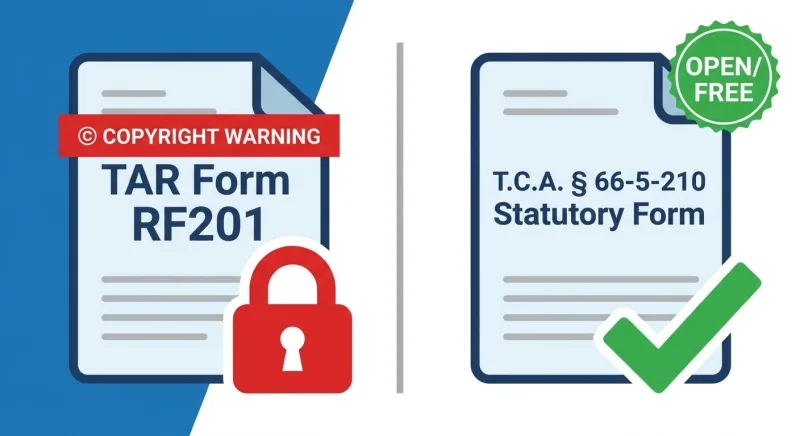
Why TAR Form RF201 Creates Confusion for FSBO Sellers
The RF201 is the "Tennessee Residential Property Condition Disclosure" form published by Tennessee REALTORS® (TAR). It packages the state's statutory disclosure content into a branded, member-facing document that agents use in nearly every listed transaction. That branding is where the anxiety comes from. The RF201 carries a copyright notice restricting reproduction and use to authorized members — a restriction that has nothing to do with what the statute actually requires.
Sellers ask constantly: "Am I even allowed to use this form if I'm not a REALTOR?"
The honest answer is that you're conflating two separate things. One is a private organization's ownership of its specific document layout — a copyright question. The other is Tennessee's legal requirement to disclose the condition of your property — a statute. Only the statute controls whether your sale is compliant. The copyright warning protects TAR's formatting, not your legal right to disclose.
TAR Form RF201 vs. the Statutory Disclosure (T.C.A. § 66-5-210)
The legal requirement lives in the Tennessee Residential Property Disclosure Act, Tenn. Code Ann. § 66-5-201 et seq. The exact disclosure content — the model form language itself — is set out at T.C.A. § 66-5-210. The General Assembly wrote that language. It is public law. You can reproduce it freely.
The RF201 is TAR's private packaging of that same statutory content, plus its own header, footer, branding, and copyright notice.
| TAR Form RF201 | Statutory Form (§ 66-5-210) | |
|---|---|---|
| Source | Tennessee REALTORS® (private trade association) | Tennessee General Assembly (state statute) |
| Satisfies the disclosure law? | Yes | Yes |
| Copyright restriction | Yes — use limited to authorized members | None — public statutory text is free to reproduce |
| Need to be a REALTOR to use legally? | Designed for members | No membership needed |
| Cost to FSBO seller | Access typically tied to membership | Free |
| Contains the state-required content | Yes | Yes (it is the required content) |
A form is legally sufficient in Tennessee because it contains the § 66-5-210 content, not because it has a TAR logo on it.
Is a Seller Disclosure Required for FSBO in Tennessee?
Yes. The Act requires most sellers of residential real property to give the buyer a written disclosure of known material defects. The duty applies whether you list with an agent or sell FSBO.
Timing matters. The disclosure must be delivered to the buyer before they accept your purchase offer — not at closing. A buyer may have remedies if a seller knowingly provides false information (T.C.A. § 66-5-208).
The "actual knowledge" ceiling
Tennessee's disclosure duty is bounded by what you know. You are not a home inspector and are not required to hunt for defects you've never observed. Liability comes from knowing falsity, not innocent silence about something you never saw.
One edge case: constructive knowledge. If you papered over a recurring water stain three times, "I didn't know about the leak" won't survive scrutiny. When you check a box, note why. A seller who writes "roof: no known leaks; replaced shingles 2019, receipt on file" has built a record the honest-disclosure standard rewards.
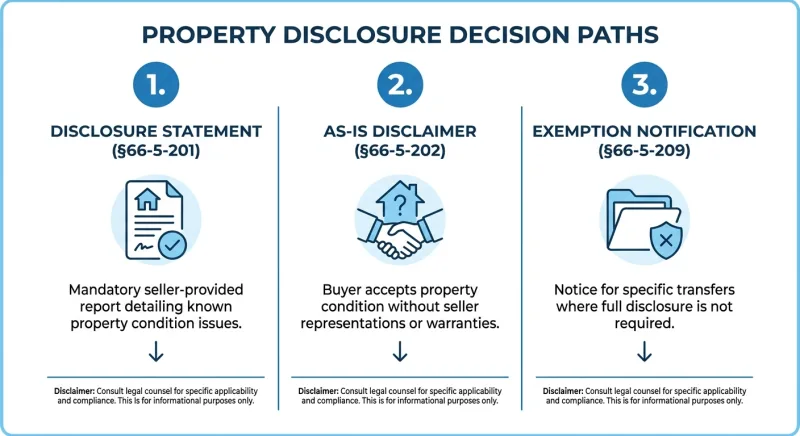
Your Three Legal Disclosure Paths
-
1. The Disclosure Statement (§ 66-5-210). The standard route. You complete the property condition disclosure — roof, foundation, systems, water, known defects — and deliver it to the buyer.
-
2. The As-Is Disclaimer (§ 66-5-202). Tennessee allows sellers, in certain circumstances, to sell using an as-is disclaimer instead of the full condition disclosure. The as-is disclaimer is a different document from the disclosure statement, and using it does not license you to hide or misrepresent a known defect. Sellers regularly confuse "as-is" with "no disclosure needed." They're not the same.
-
3. The Exemption Notification (§ 66-5-209). Some transfers are exempt entirely — certain court-ordered transfers, foreclosures, or transfers between co-owners. These exemptions are narrower than sellers assume, and many still require a written notification rather than pure silence.
Most FSBO sellers of a standard single-family home land on Path 1. If you think you fit an exemption or want to sell under the as-is disclaimer, run it past a Tennessee real estate attorney first.
A decision model
Run these in order. Stop at the first "yes."
- Is your transfer clearly exempt under a specific subsection? Deliver the required notification (§ 66-5-209), not a full condition statement. Confirm the subsection first.
- Are you unwilling to catalog the property's condition and comfortable selling with no condition representations? The As-Is Disclaimer (§ 66-5-202) is your route — but you remain liable for knowing misrepresentation (§ 66-5-208).
- Otherwise — the default for nearly every ordinary FSBO sale — complete the full condition disclosure using § 66-5-210 content.
Then, for every path, layer on federal lead-based paint if the home is pre-1978, and any septic disclosure your property requires.
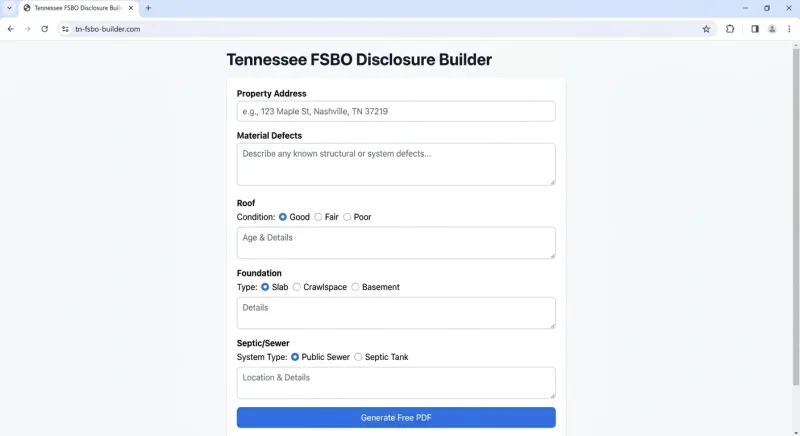
How to Build Your Disclosure With the Free Tennessee Disclosure PDF Builder
The builder turns the § 66-5-210 statutory content into a fill-in web form and generates a clean PDF. No membership, no TAR form, no login gate.
- Enter the property details. Full address and your name as seller.
- Answer the property condition questions. The form walks through state-required categories — structural elements, major systems, water source, sewer or septic, and known material defects.
- Flag known issues in plain language. Vague answers create disputes later; specific ones protect you.
- Add anything unusual. Past repairs, prior water intrusion, boundary questions.
- Generate your free PDF — a copyright-clean alternative to the RF201.
- Print, sign, and date it.
- Deliver it to the buyer before they accept your offer, and keep a signed copy.
The most common mistake: sellers rush the condition answers to look "clean." Don't. An accurate disclosure with honest defects is far safer than a spotless one you can't stand behind.
The Four-Layer Disclosure Stack: What FSBO Sellers Miss
A fully-papered Tennessee FSBO transaction stacks four independent layers. Miss one and the state form won't save you.
Layer 1 — The state condition disclosure (or its lawful substitute). The § 66-5-210 statement, the As-Is Disclaimer, or the Exemption Notification. Both the RF201 and a statutory builder cover only this layer.
Layer 2 — Federal lead-based paint. Federal law mandates a lead-based paint disclosure and the EPA pamphlet for homes built before 1978 (42 U.S.C. § 4852d). It's a separate signed document, not part of the RF201 or § 66-5-210.
Layer 3 — Property-specific mandated disclosures. Septic and subsurface sewage disposal, permitted through TDEC, and the bedroom count a septic permit supports. Advertising a four-bedroom when the permit supports three is a classic FSBO trap. Have your permit records ready.
Layer 4 — Contractual representations. The reps you sign inside the purchase agreement itself.
The state form — TAR's or your own — is Layer 1 only. Neither covers Layers 2 through 4. Attach all applicable disclosures to your disclosure packet so everything travels together to the buyer.
Edge Cases That Break the "Just Use As-Is" Assumption
Sellers love the As-Is Disclaimer because it feels like a shortcut. It removes the obligation to complete the full condition statement — but it does not license fraud.
A buyer may still pursue remedies if a seller knowingly provides false information (§ 66-5-208). As-is governs the duty to catalog condition; it does not immunize an affirmative lie. If a buyer asks directly, "Has the basement ever flooded?" and you say no while sitting on a mold remediation invoice, as-is won't shield that answer. As-is limits your volunteering obligation, not your honesty obligation.
Timing is a mechanism, not a formality. Deliver the disclosure too late and you've created a defect in the process even if the content was perfect. Complete it, sign it, deliver it, then accept. Sellers who accept first and disclose after have inverted the sequence the statute relies on.
How to Write a Legally Binding Seller Disclosure in Tennessee
A disclosure becomes legally binding through content, delivery, and signature — not a particular brand of form. Four things must be true:
- The document contains the property condition content required by § 66-5-210.
- You've answered based on your actual knowledge, without knowingly false statements (§ 66-5-208).
- You've signed and dated it.
- You've delivered it to the buyer before they accept your purchase offer.
No requirement that a licensed agent prepare it, no requirement that it sit on TAR letterhead, no requirement that you pay for a proprietary template. A realtor form alternative built from the statutory language carries the same legal weight as the RF201, because both rely on the same source. What undermines a disclosure isn't the form you chose — it's a seller who knew about a defect and hid it.
The Copyright Question, Resolved at the Source
The RF201's copyright notice restricts reproduction of that document to authorized members. But copyright protects a specific expression — TAR's particular formatting and layout — not the underlying legal facts or statutory language.
Statutory text sits in a different category. The disclosure content prescribed at § 66-5-210 is law, and a private association can't fence off the substance of a state requirement. A form built from the statutory content is your own expression of public-domain legal requirements. That's why a free builder can produce a compliant, non-infringing document.
Honest comparison: REALTOR form vs. building your own statutory form
| Consideration | TAR/REALTOR form | Building your own statutory form |
|---|---|---|
| Legal validity | Valid | Valid when content matches § 66-5-210 |
| Access for non-members | Restricted by copyright | Open — built from public statute |
| Cost | Membership/access required | Free |
| Familiar to buyers' agents | Yes | Yes, once content is complete |
| Best for | Sellers already working with a member agent | Self-directed FSBO sellers |
After Your Disclosure: Getting Your Tennessee Home on the MLS
A flat fee MLS Tennessee listing puts your home on the same local MLS agent-listed homes use and syndicates it to the major search portals for one flat price — no full-service commission. You keep control of the sale and the disclosure you just built, and buyers' agents can find your property.
We offer flat-fee packages across the state, including flat fee MLS Nashville, plus Franklin, Brentwood, Murfreesboro, Knoxville, Memphis, Chattanooga, and Clarksville. Build your disclosure first, then get listed.
Frequently Asked Questions
Do I have to use TAR forms to sell FSBO in Tennessee? No. Tennessee's disclosure requirement is set by statute (§ 66-5-210), not by any trade association. Any form containing the state-required disclosure content is legally sufficient. The RF201 is a proprietary TAR version of that content, not a legal mandate.
Is a FSBO disclosure legally binding in Tennessee without a realtor form? Yes. A disclosure is binding based on what it says and that you signed and delivered it, not on which template it came from. As long as your document contains the § 66-5-210 content and reaches the buyer before offer acceptance, it carries the same legal weight as any REALTOR®-branded version.
What must a Tennessee seller disclosure include? It must disclose the property's condition and known material defects across the statutory categories — structure, roof, foundation, plumbing, electrical, water, sewer or septic, and heating and cooling (§ 66-5-210). You disclose what you actually know; you are not required to inspect or investigate.
When must I give the buyer the disclosure? Before the buyer accepts your purchase offer. Delivering it after acceptance can give the buyer certain remedies, so complete and hand it over early.
Can I sell as-is and skip disclosure in Tennessee? Not automatically. The As-Is Disclaimer (§ 66-5-202) limits certain warranty obligations but does not eliminate the duty to disclose known material defects or shield a seller who knowingly provides false information (§ 66-5-208). Only specific statutory exemptions (§ 66-5-209) remove the disclosure duty entirely.
The Bottom Line
In Tennessee, the law decides what your seller disclosure must contain, and that law lives in the Residential Property Disclosure Act (§ 66-5-201 et seq.), with the required content at Section 210. TAR Form RF201 is one way to meet that standard, but it isn't the standard itself. The copyright warning restricts who can copy the document — it has nothing to do with whether your own compliant form is legal.
Build a disclosure containing the statutory content. Disclose the material defects you actually know about. Sign it, deliver it before you accept an offer, keep a copy. If your situation is unusual — an exemption question, a trust or estate sale, complicated septic history — talk to a Tennessee real estate attorney first. Accuracy protects you more than any template.
Important: This is not legal advice. This article is general information about Tennessee disclosure requirements, not legal advice, and does not create an attorney-client relationship. Statutes are renumbered and amended; confirm current citations and consult a licensed Tennessee real estate attorney for edge cases. Last reviewed: July 2026.