
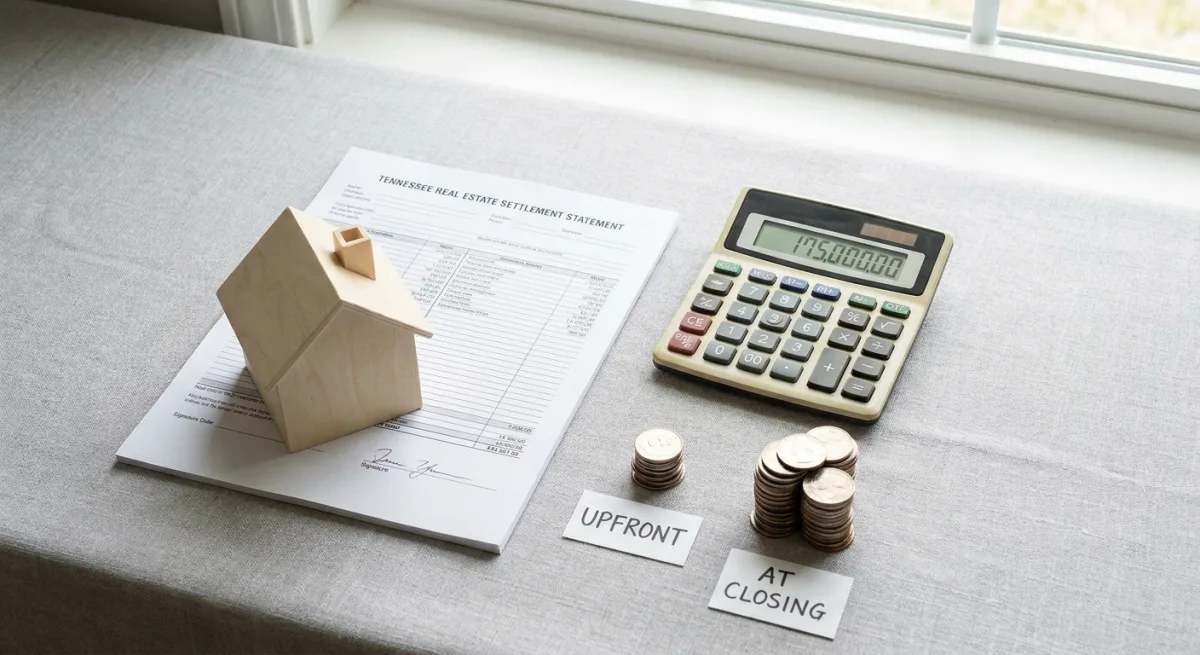
Tennessee Flat-Fee MLS Closing Fees Exposed: Upfront Rates vs. Pay-at-Closing Compliance Charges
A $299 flat-fee listing plan can quietly settle at around $4,099 by the time your Tennessee closing wraps. That's not a typo. It's the hybrid pricing model most national flat-fee companies pivoted to — a cheap sticker price out front, then a percentage-based "compliance" or "transaction" fee pulled from your proceeds at the table. This Tennessee flat fee MLS closing compliance fees comparison exists because almost nobody shows you that second number until you're already listed.
We review the closing statements Tennessee sellers actually sign. Our rankings aren't influenced by referral payouts from any company named here — if a plan charges $0 at closing, we say so; if it siphons a percentage off your equity, we show the math.
Do TN Flat-Fee MLS Companies Charge Hidden Fees at Closing?
Yes — some do. Plenty of Tennessee flat-fee MLS plans advertise a low upfront rate ($89–$399), then collect a second fee at closing: either a flat "compliance" or "transaction" charge ($495–$995) or a percentage of your sale price (0.25%–1.25%). On a typical Tennessee home priced around $360,000–$380,000, a plan advertised at $299 can settle at roughly $3,900–$4,100 once a 1% pay-at-closing fee lands on your settlement statement.
That's not the listing fee. That's a closing surcharge — and it usually lives in the listing agreement, not the pricing page.
Every figure below is checked against each provider's own published listing agreement as of 2026; anything we can't source we label "varies — request full fee disclosure."
How Flat-Fee MLS Pricing Actually Works in TN
A flat-fee MLS service gets your FSBO listing onto the local MLS — RealTracs in Middle Tennessee, MAAR in Memphis, KAAR in Knoxville, the Greater Chattanooga MLS in the southeast — so buyer agents and syndication feeds (Zillow, Realtor.com) can find it. You skip the listing-side commission. That's the savings. But the pricing model splits into two very different shapes.
The upfront flat rate
You pay one published number when you list — say $99, $199, or $399 — and nothing is deducted at closing. Simple. Predictable. What you see is what you pay.
The pay-at-closing model (the hybrid)
A hybrid plan charges a small upfront fee — sometimes as low as $89 — then adds a second charge at the table under various names:
- Closing compliance fee — a flat charge ($495–$995) framed as the cost of document handling.
- Transaction-coordinator fee — a flat administrative charge for tracking the deal to close.
- Percentage-based closing fee — 0.25%–1.25% of your sale price, collected as a settlement-statement deduction.
- Brokerage transfer fee — a flat fee tied to moving the transaction through the broker's books.
Flat backend fees stay the same no matter your price. Percentage fees scale — and on a $380,000 home, they scale fast.

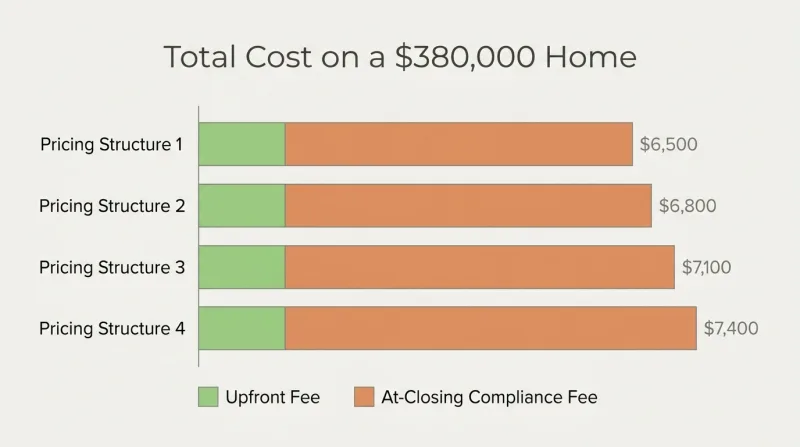
TN Flat-Fee MLS Closing Fees Compared: Total Cost on a $380,000 Home
Every "total cost" column excludes buyer-agent commission and standard title/escrow costs — we're isolating what the flat-fee provider itself takes, upfront plus at closing.
All rates represent typical published ranges verified against provider listing agreements as of 2026. Confirm before you sign.
| Company / Plan | Upfront fee | Pay-at-closing fee | Flat or % | $0 at closing? | Total on $380k |
|---|---|---|---|---|---|
| Houzeo (Gold-tier example) | ~$299 | ~1% (typical on lower tiers) | Percentage | No | ~$4,099 |
| ListWithFreedom | ~$89 | ~0.5% (typical entry tier) | Percentage | No | ~$1,989 |
| HomeRise (compliance-fee plan) | ~$95–$495 | ~$495–$995 flat | Flat | No | ~$590–$1,490 |
| ResultsMLS | Published flat rate | $0 | Flat, upfront only | Yes | = your upfront rate |
| Typical low-upfront hybrid | ~$99–$199 | 0.25%–1.25% | Percentage | No | ~$1,049–$4,949 |
The arithmetic in plain dollars:
- Percentage plan (~$299 + 1%): $299 + $3,800 = $4,099. The $299 got you in the door. The $3,800 got taken at the table.
- Lower-percentage plan (~$89 + 0.5%): $89 + $1,900 = $1,989.
- Flat-compliance plan: ~$590 low end, ~$1,490 higher — same whether your home sells for $200k or $600k.
- Upfront-only flat: closing-side deduction is $0.
The same rough service — get me on RealTracs, syndicate my listing — costs anywhere from a couple hundred dollars to over four thousand, depending entirely on which fee model you signed.
Where These Fees Hide on Your ALTA Settlement Statement
You won't feel a pay-at-closing fee when you list. You feel it weeks later on the ALTA settlement statement. A flat-fee provider's backend charge typically appears:
- Under "Commissions" — a percentage closing fee is often coded where a full commission would normally sit.
- Under "Additional Settlement Charges" or "Miscellaneous" — labeled something like "listing broker compliance fee."
- As a payoff to the listing brokerage — disbursed directly from your proceeds before you see the money.
The practical move: get the ALTA statement 24–48 hours before closing and hunt for any line naming your MLS listing broker. You can't renegotiate a fee you already agreed to in the listing agreement.
Why TN Flat-Fee MLS Companies Charge Compliance Fees
Not every closing fee is a money grab. A licensed Tennessee broker is legally the listing broker of record and carries real responsibilities. TREC requires brokers to maintain transaction records for every listing; local MLS bylaws (RealTracs, MAAR, KAAR, Greater Chattanooga MLS) add additional tracking requirements. A modest, flat transaction or compliance charge can reflect genuine labor.
But charging a percentage at closing defeats the whole reason you went flat-fee. The compliance obligation on a $200,000 home and a $600,000 home is essentially identical — same paperwork, same TREC rules. A flat $200 fee could plausibly cover either. A 1% fee turns that same work into $2,000 on one home and $6,000 on the other. That gap isn't compliance cost. It's a commission wearing a compliance name tag.
Upfront Flat Rate vs. Pay-at-Closing: Which Saves More in TN?
There's a clean break-even you can calculate before you commit. Set the upfront-flat total as F. Set the hybrid as U + (r × P), where U is the small upfront fee, r is the closing-fee rate, and P is your sale price. Break-even: P = (F − U) ÷ r.
With U = $99, r = 0.5%, F = $399: break-even = $60,000. Above that sale price, the flat-upfront plan wins. Since essentially no Tennessee home sells under $60,000, the flat-upfront model wins almost universally against a percentage hybrid.
Real examples comparing a $399 upfront plan vs. a $99 + 1% hybrid:
- Clarksville, ~$300,000: $399 vs. $3,099. Upfront wins by ~$2,700.
- Murfreesboro or Knoxville, ~$400,000: $399 vs. $4,099. Upfront wins by ~$3,700.
- Franklin or Brentwood, ~$750,000: $399 vs. $7,599. Upfront wins by ~$7,200.
The higher your local market, the more a percentage backend punishes you — which is exactly backwards from how it's marketed. Where the low-upfront model can make sense: a flat backend fee on an uncertain listing. A $95-upfront-plus-$495-at-closing plan lets you list cheap and pay the bulk only if you close. The trap is the percentage version.
How a Backend Fee Compounds With the Buyer-Agent Commission
A percentage-based closing fee is almost always calculated on sale price, not equity — so on a $380,000 sale where you owe $310,000, a 1% fee is $3,800, which is over 5% of your actual remaining equity.
Since the 2024 commission-rule changes, buyer-agent compensation in Tennessee is negotiated case by case. Some flat-fee providers quietly tie their compliance-fee tier to whether you offer buyer-agent compensation — a higher backend percentage plus a transaction-coordinator fee that triggers when a co-broke is involved. Two 1% figures that look small individually become a 2%+ combined drag the moment a buyer's agent enters the deal.
Also watch when each fee is calculated. If written as "% of gross sale price," it's computed before any credits. In a seller-concession deal where you credit the buyer $6,000, the provider still bills its percentage on the full $380,000.
Ask before signing: Is your closing fee calculated on gross sale price or net proceeds? Almost every hybrid says gross.
How a Backend Fee Actually Gets Collected
When you sign a hybrid agreement, you typically authorize the broker to deliver payment instructions directly to your title company. That instruction becomes a lien-like debit on the settlement statement. Your title company follows signed escrow directions — they're not a party to any dispute with the provider. By the closing table, the fee isn't negotiable.
The defensive move: request the provider's standard closing-instruction letter before you list. If they won't show you the exact document they'll send your title company, that's a red flag.
The Effective Rate: The Only Number That Actually Compares Plans
The honest comparison is the effective rate — every dollar the plan pulls from your side of the ALTA statement, divided by your sale price.
| Plan style | Upfront | At closing | Effective rate on $380k |
|---|---|---|---|
| True upfront flat | $399 | $0 | ~0.10% |
| Low upfront + 0.5% | $89 | ~$1,900 | ~0.52% |
| Low upfront + 1% | $95 | ~$3,800 | ~1.02% |
| Flat compliance charge | $95 | $495 | ~0.16% |
The plan that looks cheapest at signup ($89) can carry the highest effective rate. The one with the scarier $399 sticker can be the cheapest all-in. Rule of thumb: if a plan's effective rate creeps past roughly 0.3% on a median TN home, you're drifting back toward discount-commission territory.
The Disclosure Audit: Five Points to Check Before You Sign
Run this audit against the listing agreement, not the ad:
- Calculation basis. Is any closing fee flat or a percentage? If percentage — of gross sale price or net proceeds?
- Trigger conditions. Does a higher tier activate if a buyer's agent is involved, if the home sells above a threshold, or if you use their transaction coordinator?
- Escrow-instruction clause. Does the agreement let the broker send disbursement instructions to your title company?
- Cancellation and expiration terms. What happens if you delist, sell to a buyer you found yourself, or the listing expires?
- Total-cost disclosure in writing. Can they state your maximum all-in cost at your expected sale price, in dollars, before you list?
If a provider can't answer #5 in one sentence, you've found your answer about the model.
Frequently Asked Questions
Do Tennessee flat-fee MLS companies charge hidden fees at closing?
Some do. Several national providers advertise a low upfront rate ($89–$399) but collect a percentage-based (0.25%–1.25%) or flat ($495–$995) "compliance" or "transaction" fee on your seller-side settlement statement — always request the full fee disclosure in the listing agreement, not the marketing page, before you sign.
What's the difference between an upfront flat rate and a pay-at-closing fee in Tennessee?
An upfront flat rate is a one-time charge you pay when you list (often $99–$399) with nothing added later. A pay-at-closing fee is deducted from your proceeds by the settlement agent when the sale funds — and if it's a percentage, a higher home value means a bigger bill.
How much is a flat-fee MLS transaction fee in Tennessee?
It varies by provider. Percentage-based closing fees typically run 0.25%–1.25% of sale price (roughly $950–$4,750 on a ~$380,000 home), while flat compliance or transaction fees generally range from $495 to $995. Confirm the exact figure in the provider's current listing agreement before listing.
Where does a closing compliance fee show up on my settlement statement?
On a standard ALTA settlement statement, it appears as a seller-side debit — often labeled "listing broker compliance fee," "transaction fee," or "brokerage administrative fee" — deducted from your net proceeds by the title or escrow company at closing.
Are pay-at-closing flat-fee MLS plans ever cheaper than upfront ones?
They can be for lower-priced homes or sellers who want to risk less before a sale is certain, but on Tennessee's median-priced home a percentage-based closing fee often costs far more than a true upfront flat rate. Run the math at your actual price point to know which wins.
Conclusion
A cheap sticker price doesn't tell you your total cost. A $299 plan that adds a 1% compliance fee settles closer to $3,900–$4,100 on a typical $360,000–$380,000 Tennessee home — a closing surcharge hiding on the seller-side debit line of your ALTA statement.
Your move is simple. Pull the actual listing agreement for every provider you're considering. Search it for "transaction fee," "compliance fee," and "brokerage administrative fee." Ask one blunt question: What comes out of my proceeds at closing? If the answer is anything but zero, do the math at your real sale price. The fee you see upfront should be the fee you pay — with nothing added at settlement.