

If you're selling your house without an agent in Tennessee, Form RF201 — the Tennessee REALTORS® Residential Property Condition Disclosure — is not optional. State law requires most sellers to disclose known material defects in good faith before the buyer accepts your offer (Tenn. Code Ann. § 66-5-201). Fill it out honestly and completely, and it protects you from a post-sale lawsuit. Get it wrong, and you're handing a buyer grounds to come after you months after closing.
The RF201 is a copyrighted form, so grabbing a random PDF off the internet puts you on shaky ground — and an "as-is" clause does not wipe out your legal duty to disclose. Both traps cost Tennessee sellers real money every year.
This guide walks the form the way a flat-fee practitioner would at the kitchen table. Every page. The tricky lines competitors gloss over — septic bedroom limits, sinkholes, "Unknown vs No," the delivery deadline, and how to legally get an authorized copy.
Not legal advice. Confirm the current 2026 RF201 and statute language with Tennessee REALTORS® or a Tennessee real estate attorney before you sign anything.
The Legal Basis: Why Disclosure Protects You
Tennessee's Residential Property Disclosure Act (Tenn. Code Ann. §§ 66-5-201 through 66-5-213) requires the owner of residential real property to furnish the buyer a written disclosure of the property's condition. It's not a REALTOR® formality — it's a statutory obligation that follows the property, whether or not an agent is involved.
Two phrases carry the entire weight of your legal exposure.
Known material defects. You disclose conditions you actually know about that a reasonable buyer would consider significant. You are not required to hire an expert to hunt for problems you don't know exist.
Good faith. The law asks for honesty based on your actual knowledge (§ 66-5-201) — not perfection, not clairvoyance.
The stakes: if you knowingly misrepresent or conceal a material defect, a buyer can pursue remedies under § 66-5-208 — actual damages and, in bad-faith cases, more. A complete, honest RF201 is the cheapest liability insurance you'll ever buy.
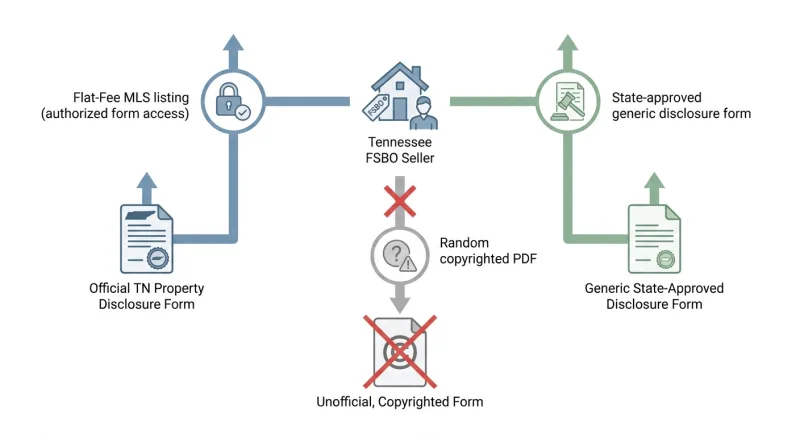
The Copyright Trap: How to Legally Get an Authorized RF201
Form RF201 is copyrighted by Tennessee REALTORS®. It's licensed to authorized users — mainly association members and the brokers who work under them. A PDF from a random blog may be three revisions old and missing a line the current form requires.
You have two clean paths.
Pathway 1 — a flat-fee MLS listing. When you list through a licensed Tennessee flat-fee MLS brokerage, you're working under a licensed broker, and the current official Tennessee REALTORS® forms — including RF201 — become available through that authorized channel. One relationship solves both problems: MLS exposure and legitimate access to the paperwork.
Pathway 2 — a state-approved generic disclosure form. The Act requires the disclosure, not one specific copyrighted document. An independent, statutorily compliant disclosure that captures everything §§ 66-5-201 to 66-5-213 requires satisfies your legal duty. A Tennessee real estate attorney can confirm you're using a version that covers what the law demands.
The "As-Is" Myth: What an As-Is Sale Really Does
An "as-is" clause does NOT waive your statutory duty to disclose known material defects. "As-is" is a contract term about who pays for repairs. The disclosure duty is a statutory obligation under § 66-5-201. A private contract clause doesn't erase a statute.
Only two things change your obligation.
A signed RF204 Property Condition Disclaimer Statement operates as a buyer waiver under § 66-5-202 — a signed document, not a line in the purchase agreement. Even under a disclaimer you can't lie about a known condition. The waiver removes the duty to fill out the form; it does not license fraud.
A statutory exemption (RF203) under § 66-5-209 covers certain transfers — estates, foreclosures, transfers between co-owners — that fall outside the disclosure requirement entirely.
An "as-is" clause is neither of those. "As-is" is a wish. A signed RF204 or qualifying RF203 is a legal fact.
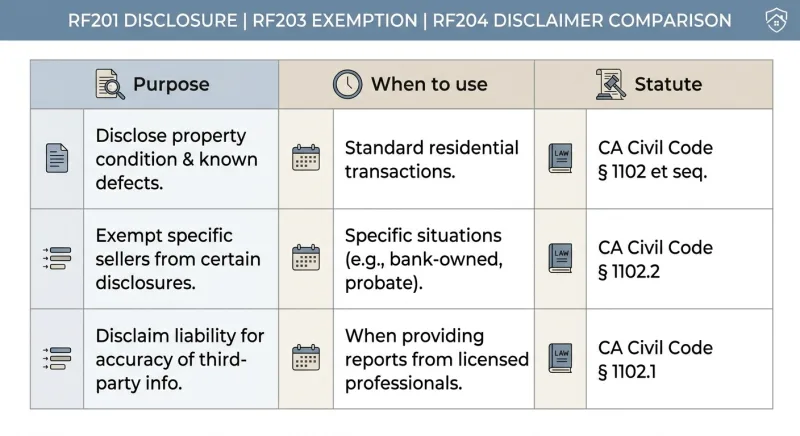
RF201 vs RF203 vs RF204: Which Form Applies to You
| RF201 — Disclosure | RF203 — Exemption | RF204 — Disclaimer | |
|---|---|---|---|
| Purpose | Discloses known material defects | Declares the transfer exempt | Buyer waives the disclosure in writing |
| When to use | Standard residential sale — the default for nearly every FSBO seller | Specific exempt transfers (estate/probate, foreclosure, certain co-owner transfers) | Buyer agrees in writing to accept property without a completed disclosure |
| The trap | Skipping it thinking "as-is" covers you | Assuming you qualify when you don't | Assuming a contract clause equals a signed disclaimer |
| Governing statute | § 66-5-201 | § 66-5-209 | § 66-5-202 |
If you're a typical owner selling your own home, you're on RF201. RF203 and RF204 are narrow exits with conditions — a fifteen-minute question for a Tennessee real estate attorney, not a kitchen-table guess.
RF201 Page 1: Ownership, Occupancy, and Home Type
Page 1 asks for your ownership status, how long you've owned and occupied the property, and what type of structure this is.
Fill in ownership and occupancy honestly. Then indicate whether the home is site-built or non-site-built — manufactured, modular, or mobile — and whether the structure has ever been moved from an existing foundation.
Where sellers go wrong: a modular home on a permanent foundation looks site-built but isn't, and that classification affects financing, appraisal, and the buyer's due diligence. A withheld classification you knew about is exactly the kind of known material fact that comes back around under § 66-5-208.
RF201 Page 2: Septic, Sinkholes, Injection Wells, and PUD Covenants
Page 2 is where the money is for your liability. This is the single densest page for known-defect risk.
Subsurface Sewage / Septic
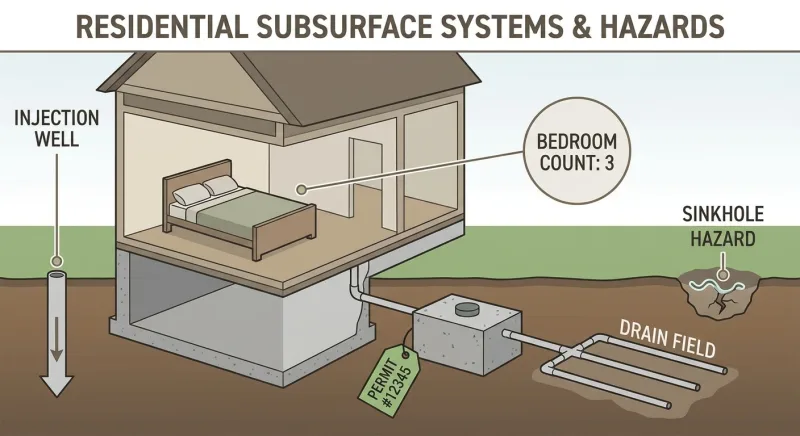
If you're on septic, disclose it — and make your answer match your TDEC subsurface sewage disposal permit. The permit specifies how many bedrooms the system was designed and approved to serve.
Where sellers go wrong: marketing a "4-bedroom home" when the septic permit approves three. Under Tenn. Code Ann. § 47-18-104(b), advertising more bedrooms than the septic permit authorizes is a deceptive practice — independent of RF201. Pull your TDEC permit, confirm the approved bedroom count, and make sure your disclosure and your listing match. This is the single most-skipped verification in septic-served FSBO sales, and it quietly kills closings the week of settlement.
Sinkholes and Exterior Injection Wells
Middle and East Tennessee sit on karst limestone, so sinkholes aren't exotic here. Disclose any you know of with specificity: "Yes, a depression opened in the northeast yard in 2023, filled and monitored since" beats a bare checkbox, because a vague "Yes" invites the buyer to imagine the worst.
Exterior injection wells trip people up because they don't know the term. If it's on your land and you know it's there, you know of it — disclose it.
PUD Covenants and Governing Documents
If your property sits in a planned unit development or association community, RF201 flags PUD covenants under § 66-5-213. Disclose the dues, any special assessments you know about, and point buyers to the governing documents — don't summarize the covenants yourself and risk getting a detail wrong.
RF201 Pages 3–4: Systems, Defects, and "Unknown" vs "No"
Pages 3 and 4 cover structural and foundation issues, roof, water heater and HVAC defects, plumbing, and electrical. For each, you'll choose Yes, No, or Unknown.
Most sellers treat "Unknown" as the safe answer. It isn't — it's a specific legal position. Run every ambiguous line through this:
- "No" — you have actual knowledge the condition is fine. Reserve this for things you've verified or personally maintained. "No" on a defect you never checked is a quiet lie.
- "Unknown" — you have no actual knowledge either way and no paper trail suggesting you should. If you bought the house eight months ago and never accessed the crawlspace, "Unknown" on foundation settlement is honest and correct.
- "Yes" + explanation — you know of the defect, or a symptom that reasonably points to one. Explain it; a bare "Yes" invites a dispute over what you meant.
"Unknown" collapses the moment there's evidence you did know — a repair receipt, a contractor's text, a prior insurance claim. If discovery surfaces any of those after you checked "Unknown," you've converted a good-faith gap into an apparent misrepresentation under § 66-5-208.
Document why you chose "Unknown." Keep a dated note — "No knowledge of X; owned property since [date]; never accessed [area]." You don't submit it; you keep it. If a claim ever lands, that note is the difference between a defensible position and a jury deciding what "good faith" looked like.
One rule of thumb: if you'd be uncomfortable explaining your answer under oath, change it.
RF201 Page 5: Signatures, Lead Paint, and Delivery Timing
The last page is where the form becomes binding — and where timing can undo everything you did right on pages 1 through 4.
Signatures. Sign the seller final property condition disclosure and date it. An undated or unsigned form isn't a completed disclosure.
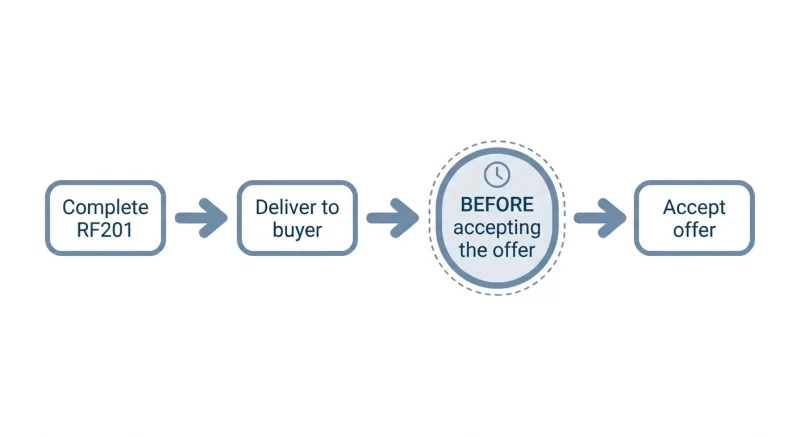
The timing rule that decides everything. You must deliver the completed disclosure to the buyer before acceptance of an offer (principally governed by Tenn. Code Ann. § 66-5-203) — not at closing, not after they're under contract. A late disclosure can give the buyer contractual grounds to terminate precisely when you least want them to have an exit.
Build a delivery record:
- Complete and sign RF201 before the property is under contract.
- Deliver it in a way that timestamps itself — email with PDF attached, an e-sign platform, or a signed acknowledgment of receipt.
- Get the buyer's dated signature acknowledging receipt before they sign.
- Keep the whole chain — delivery proof, receipt, the signed form.
The pre-1978 lead overlay runs on its own clock. If your home was built before 1978, RF201 isn't enough. Federal law adds a separate lead-based paint disclosure under 42 U.S.C. § 4852d: disclose known lead hazards, provide records you have, give the buyer the EPA Protect Your Family from Lead pamphlet, and allow a 10-day inspection window unless the buyer waives it. Two disclosures, two timelines — sellers of older housing stock forget this constantly, and a pristine RF201 won't save you if you miss the federal one.
Frequently Asked Questions
Can I download RF201 for free as a FSBO seller?
Not safely from a random website — the RF201 is a copyrighted Tennessee REALTORS® form licensed to authorized users, and a random PDF may be outdated or unauthorized. Your two clean paths are authorized access through a flat-fee MLS listing or a state-approved generic disclosure that satisfies §§ 66-5-201 to 66-5-213.
Do I legally have to complete a disclosure to sell my house in Tennessee?
Yes — for most residential sales, disclosure is required under Tenn. Code Ann. § 66-5-201, whether or not an agent is involved. Unless your transaction qualifies for a statutory exemption (RF203, § 66-5-209) or the buyer signs a disclaimer waiver (RF204, § 66-5-202), you owe the buyer a written disclosure of known material defects.
Does selling "as-is" exempt me from disclosure?
No — this is the costliest myth in Tennessee FSBO deals. An "as-is" clause means no repairs; it does not cancel your duty to disclose known material defects. Only a signed RF204 disclaimer (§ 66-5-202) or a statutory exemption (§ 66-5-209) changes that obligation — and even then you can't lie about or conceal a known defect.
When exactly do I have to give the disclosure to the buyer?
Before acceptance of an offer (principally governed by Tenn. Code Ann. § 66-5-203). Delivering it late can give the buyer contractual grounds to terminate, so complete RF201 and get a signed acknowledgment before the buyer signs.
What happens if I leave a known defect off the form?
You expose yourself to a misrepresentation claim under § 66-5-208, which can mean damages. When you genuinely don't know a system's condition, mark "Unknown" honestly rather than guessing "No" — the standard is your actual knowledge in good faith under § 66-5-201. An honest, disclosed defect is far cheaper than an undisclosed one that surfaces after closing.
Conclusion
Form RF201 isn't paperwork you file and forget. It's the document that protects you from a post-closing lawsuit, and every field is a chance to either shield yourself or hand a future buyer ammunition.
Get an authorized, current form — through a flat-fee MLS listing or a state-approved generic disclosure satisfying § 66-5-201. Skip the mystery PDF. Work the form with what you actually know, mark "Unknown" honestly where you don't, and pay close attention to the lines sellers blow past — the septic permit and bedroom match, sinkholes and injection wells, PUD covenants, and the pre-1978 lead overlay. Deliver it before the buyer accepts. Sign it. Keep a dated copy.
Whether you're selling in Nashville, Franklin, Murfreesboro, Brentwood, Knoxville, Memphis, Chattanooga, Clarksville, or anywhere else in Tennessee, a flat-fee MLS listing is the one FSBO path that gives you authorized access to the official forms while keeping you in control of the sale.
Reminder: this guide is educational, not legal advice. Confirm the current 2026 RF201 and every statute cited here against the official Tennessee REALTORS® form and Tenn. Code Ann. Title 66, Chapter 5, and consult a Tennessee attorney for your specific situation.
Fill it out like your equity depends on it. Because it does.