
Tennessee Constitutional Amendment 2 (2026): What Rural Land Sellers Must Know About Property Taxes
Information current as of publication. This is general information, not legal or tax advice — confirm any individualized tax question with your county assessor or a tax professional.
If you own acreage in Tennessee and you're planning a sale, the Amendment 2 headlines have probably caught your eye. Here's the trap most land sellers walk into: they read that Amendment 2 deals with property taxes, assume their bill is about to shrink, and price their land accordingly. That assumption can cost you thousands at closing.
Tennessee Amendment 2 is a proposed constitutional amendment on the November 3, 2026 ballot that would permanently ban a statewide property tax. It does not lower the local county property taxes you actually pay, and it does nothing to shield you from the rollback taxes that hit rural land sellers hardest.
This guide separates the vote from your wallet: what Amendment 2 actually does, why your bill still comes from your county assessor, and the one tax most ballot explainers ignore — Greenbelt rollback.
What Is Tennessee Constitutional Amendment 2 (2026)?
Amendment 2 would permanently bar the state government from levying a property tax on real estate. It does not affect the local property taxes counties and cities charge.
The measure was referred to voters by the Tennessee General Assembly through a joint resolution (SJR 1 / HJR 81) and would amend Article II, Section 28 of the Tennessee Constitution. Confirm the exact ballot title on GoVoteTN.gov and cross-check it on Ballotpedia.
- A "yes" vote locks a state-level property tax out of the constitution, so no future legislature could impose one without another amendment.
- A "no" vote leaves the door theoretically open to a future state property tax, though none currently exists.
A constitutional amendment is a preemptive guardrail. The measure changes nothing about the bill sitting in your mailbox. That distinction is where sellers make bad assumptions.
Will Amendment 2 Lower Your Property Taxes?
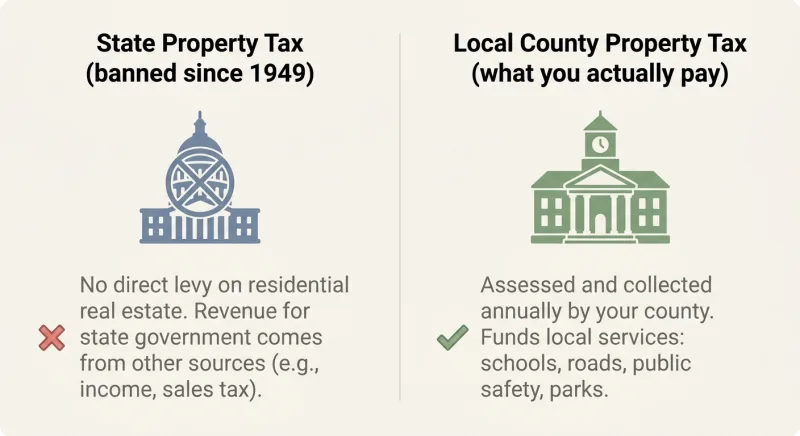
No. Tennessee hasn't levied a statewide property tax in generations, so banning one changes nothing about what you owe. Your bill comes from your county and city — untouched by this amendment.
Think of it as two taxing layers. The state layer — the one Amendment 2 addresses — has been dormant since the mid-20th century; the amendment writes that dormancy into the constitution. The local layer is where all the action is. Every dollar of property tax you pay on your land flows to your county and sometimes your municipality. Amendment 2 doesn't cap those rates, cut your assessment, or touch reappraisal cycles.
What Actually Drives Your Land Taxes
Your Tennessee land tax bill is set by your county Assessor of Property, who determines appraised value, and your county commission, which sets the tax rate. The state's role is oversight — the Tennessee Comptroller's Division of Property Assessments coordinates reappraisal standards, not billing.
When your county reappraises, the assessor updates your land's value to reflect the current market. In fast-growing counties around Nashville, Knoxville, and Chattanooga, values have climbed hard — so your appraised value can jump even though your acreage hasn't changed. Higher value plus a steady rate means a higher bill.
For a seller, this matters two ways. Holding costs: every month your land sits unsold, you're paying property tax on appreciated acreage. Buyer scrutiny: informed buyers ask about the current tax bill and whether the property carries a special classification — which brings us to the part that actually moves your bottom line.
The Greenbelt Rollback Trap: The Tax That Eats Your Proceeds
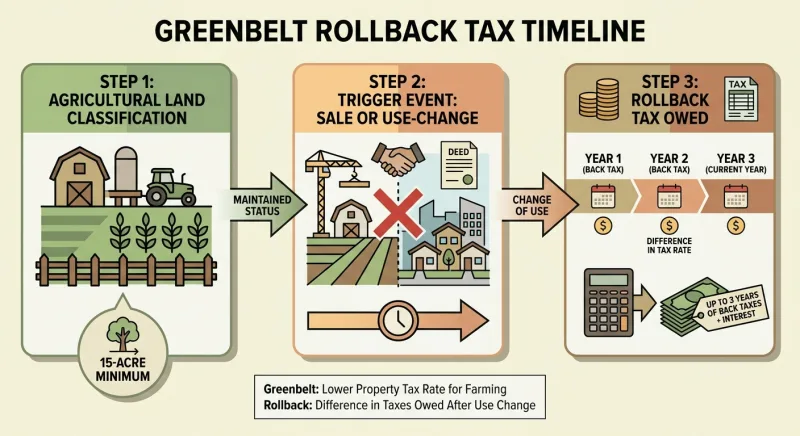
Under Tennessee's Greenbelt Act, qualifying rural land is taxed on its use value rather than full market value — a big discount while you hold. But when land is sold or converted to a non-qualifying use, the county can recapture "rollback taxes": the difference between use-value and market-value assessments, up to three prior years for agricultural and forest land, or up to five years for open-space.
This is the number most voter guides never mention, and it can dwarf anything Amendment 2 touches.
If your acreage is enrolled in Greenbelt, the assessor has been valuing your 40 acres as a working farm, not as future subdivision. To qualify as agricultural, a parcel generally needs at least 15 acres and a bona fide farming use — rules for forest and open-space differ, so verify your class.
Greenbelt is a promise, not a gift. Sell to a buyer who takes the land out of qualifying use and the county recaptures the break.
The math, in order:
- Pull your use-value assessment.
- Ask the assessor what the parcel would assess at without Greenbelt.
- Subtract use-value tax from market-value tax to find the annual gap.
- Multiply across the look-back years (up to three for ag/forest; open-space may differ).
- Ask whether your county adds interest.
A parcel appreciating fast will produce a larger rollback next year than this year — model conservatively and price for the higher figure. (Confirm your specific exposure with your county assessor.)
How rollback liability transfers at closing
The rollback attaches to the land and the triggering event, not to your name. Whether you or the buyer pays depends entirely on what your purchase contract says. Tennessee law does not decide it for you.
If a buyer keeps the land in qualifying use, no rollback fires — enrollment continues under the new owner. The tax event triggers on a change of use, not automatically on deed transfer. But subdivision is a change of use, and that can happen inside a transaction you've already walked away from.
Three ways this goes wrong: silent contracts that never address Greenbelt; assumed continuation where a buyer says they'll farm it but doesn't; and reassessment overlap in growth counties where a pending use change plus a scheduled reappraisal stack the number larger than either party modeled.
The fix: address Greenbelt rollback explicitly in the contract, state who pays if it triggers, and get an assessor estimate before you sign.
Segment Your Buyer Before You Market
The identity of your most likely buyer decides whether rollback ever fires — so segmenting buyer type is a pricing decision, not an afterthought.
- The continuing-use buyer (neighboring farmer, timber operation, conservation-minded owner) keeps the land qualified. No rollback. Market on tillable acreage, road frontage, water rights, fencing, soil class, and existing enrollment.
- The change-of-use buyer (builder, developer) will likely trigger rollback. Contract allocation is everything and your price should reflect the embedded liability.
- The hold-and-wait buyer (investor) may defer the trigger, but the liability stays live. Disclosure still matters.
When you list on a flat-fee MLS, you control the description and fields. You can write the listing to attract buyers who preserve your Greenbelt status — protecting your net for the cost of a flat listing fee rather than a percentage.
Land Disclosures That Do Heavier Lifting Than a House's
Rural land disclosures carry different weight than residential ones because the risks are boundary, access, use, and encumbrance risks — the exact issues that kill land deals in title review.
- Access and easements. Deeded road frontage or easement-dependent access is a material fact and a financing killer.
- Boundary reality. Old fence lines aren't survey lines. If the last survey is decades old, say so.
- Current Greenbelt classification. Disclose enrollment and rollback implications.
- Existing use restrictions. Conservation easements, timber contracts, severed mineral or water rights, recorded restrictions.
- Utility and perc status. Whether the land perc-tested for septic changes the buyer pool entirely.
Stage your survey, deed history, easement documents, and Greenbelt status before you list — land title review is where under-disclosed parcels fall apart.
Timing Your Land Sale Around the 2026 Calendar
Timing hinges on two clocks that have nothing to do with Amendment 2: your county's reappraisal cycle and your Greenbelt trigger date.
A reappraisal in a growth county lifts your assessed value, raising both holding cost and any future rollback gap. If one is imminent, selling before new values lock in may reduce your rollback exposure. Ask your assessor where your county sits.
If a change of use is coming, the timing of that event sets the rollback year — not your listing date. A continuing-use sale defers the whole question.
- Growth-corridor parcel + imminent reappraisal + likely change-of-use buyer = highest exposure. Price it in, or target a continuing-use buyer.
- Stable rural parcel + continuing-use buyer = minimal rollback risk. Compete on clean disclosures and access.
- Any parcel, either Amendment 2 outcome = no change to your near-term county bill.
Other 2026 Property Tax Proposals to Watch
Beyond Amendment 2, lawmakers have floated additional measures — but treat anything not yet signed into law as proposed, not final. HB 2607 is PROPOSED legislation as of publication and has not become law; confirm its status on capitol.tn.gov. Don't let a proposed bill dictate your timeline. Selling decisions built on legislation that might never pass are how landowners miss a good market window.
Selling Rural Land by Owner in Tennessee: Protecting Your Equity
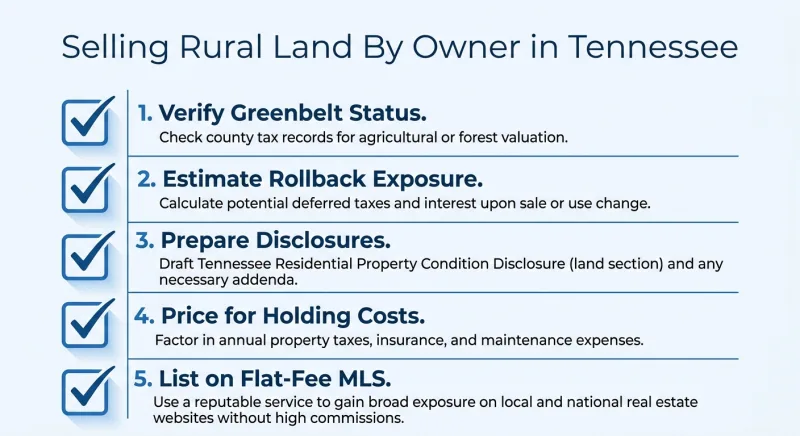
To sell rural land FSBO in Tennessee while protecting your net proceeds, verify Greenbelt status and rollback exposure first, prepare accurate disclosures, price with holding costs in mind, and reach buyers through a flat-fee MLS instead of paying a full commission.
Raw land sells differently than a house. Buyers and their agents search MLS fields homeowners never think about — acreage, road frontage, utilities at the road, zoning, soil, water access. Treating "by owner" as "off-market" is the mistake.
A simple FSBO framework for Tennessee acreage:
- Verify Greenbelt status. Call your county assessor. Know whether your land is classified agricultural, forest, or open-space.
- Estimate rollback exposure. Get the number before you set a price and decide how you'll handle it in the contract.
- Prepare disclosures. Boundaries, easements, access, drainage. Have your survey and deed ready for the title company.
- Price for holding costs. Factor in the tax you pay each month it sits unsold.
- List on a flat-fee MLS. Pay a flat fee to get your land on the same feed buyers' agents search. You set the price, you keep control, and the buyer's agent still gets paid their side.
If you're selling in a specific market — Franklin, Murfreesboro, Brentwood, Knoxville, Memphis, Chattanooga, or Clarksville — check our city-specific flat-fee MLS guides for local costs and steps.
Frequently Asked Questions
Does Tennessee Amendment 2 lower my current property tax bill?
No. Amendment 2 addresses a potential future state property tax; it does not touch the local county tax you actually pay. Confirm the ballot language on GoVoteTN.gov.
Who pays Greenbelt rollback taxes when selling Tennessee land?
Tennessee law does not automatically assign rollback to buyer or seller — the purchase contract does. The tax fires on a change of use or disqualification and can recapture up to three prior years for agricultural and forest land, or up to five for open-space. Negotiate allocation in writing and confirm your exposure with your county assessor.
What is the minimum acreage for Greenbelt in Tennessee?
Agricultural land generally needs at least 15 acres and a bona fide farming use. Requirements differ for forest and open-space classifications — verify with the Tennessee Comptroller's Greenbelt guidance or your local assessor.
Can I sell Greenbelt land without triggering rollback?
Yes — if the buyer keeps the land in qualifying use and above the acreage minimum, enrollment continues and no rollback fires.
What disclosures matter most when selling rural land by owner in Tennessee?
Access and easements, boundary and survey status, current Greenbelt classification, existing use restrictions, and utility or perc status. These surface in title review and cause deals to fall apart when omitted.
How do I list land on the MLS in Tennessee without a full-service agent?
Use a flat-fee MLS service: set the price, complete the acreage and access fields land buyers search, offer a buyer's-agent commission, and pay a flat listing fee instead of a percentage.
When is the vote on Tennessee Amendment 2?
Amendment 2 appears on the November 3, 2026 general election ballot. Verify placement and wording on GoVoteTN.gov or Ballotpedia.
The Bottom Line
Amendment 2 is a headline, not a discount. The money coming out of your pocket is set by your county — a "yes" or "no" vote won't shrink it.
The real lever is Greenbelt rollback. Land enjoying agricultural classification can trigger back taxes when it sells or changes use, quietly erasing thousands at closing. Before you list: confirm your Greenbelt status, ask your county assessor to estimate your rollback exposure, and put known material facts into written disclosures.
Once you know your numbers, selling by owner is a clear path. A flat-fee MLS listing puts your acreage in front of buyers' agents — with acreage, road-frontage, and access details entered where buyers actually search — without a full commission.
This article is general information, not legal or tax advice. Individualized rollback exposure varies — consult your county assessor or a qualified Tennessee tax professional. Information current as of publication and subject to change.