
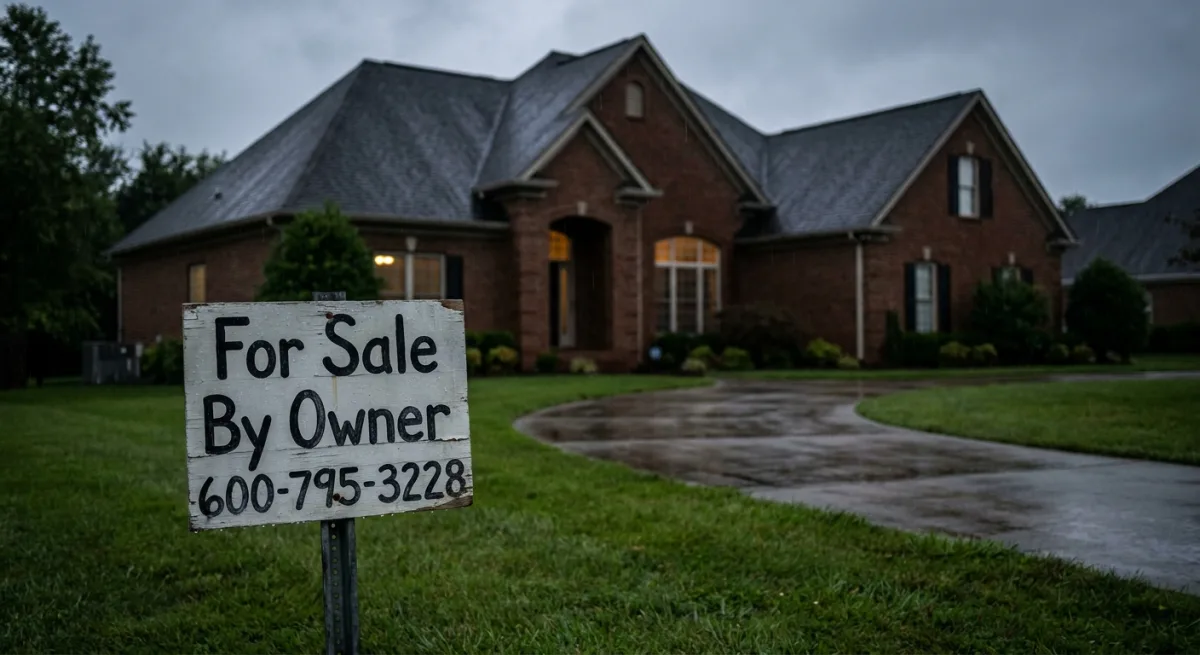
Why Your For Sale By Owner Sign Is Failing in 2026 TN Suburbs
If you're asking why your FSBO isn't selling in Tennessee in 2026, here's the short answer: it's almost never your house, your price, or your effort. It's your distribution. Roughly 9 in 10 buyers start their search inside filtered, MLS-fed portals like Zillow and Realtor.com — and if your Franklin split-level or Brentwood colonial never hit RealTracs, those buyers (and their agents) simply never saw it. A sign in the yard isn't a marketing plan.
Full-service brokerage blogs want you to conclude FSBO is too hard, so hire a 6% agent. Flat-fee directories just want your listing fee. Neither one diagnoses why a motivated seller in a good neighborhood is getting crickets. That's what this guide does. We run flat-fee MLS listings across Middle Tennessee, so we can walk you through the exact mechanics of how homes get onto RealTracs and syndicate out.
You made a smart instinct when you went FSBO. Saving a full commission on a Middle Tennessee home is real money. The mistake isn't the goal — it's the assumption that a sign and a Facebook post can replace the distribution machine that puts homes in front of buyers and their agents.
Data current as of July 2026.
The 2026 Tennessee Suburban Market Has Flipped Toward Buyers
The market that made FSBO easy in 2021 is gone. Middle Tennessee suburbs have swung toward buyers, and that changes everything about how a home has to be marketed. When inventory was scarce, a poorly distributed listing could still sell — desperate buyers found their way to it. That cushion is gone.
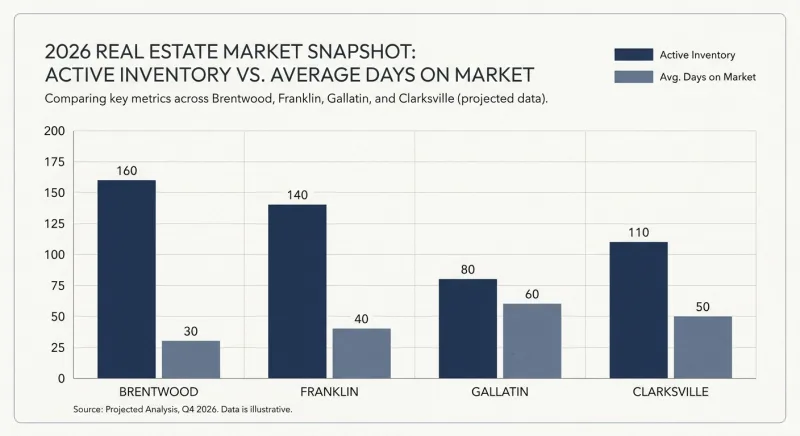
What the numbers look like across Middle TN suburbs
| Suburb | Active inventory trend (2026) | Median days on market |
|---|---|---|
| Brentwood | Rising [VERIFY: RealTracs / GNR, month 2026] | ~54–58 days |
| Franklin | Rising | ~54–58 days |
| Gallatin | Elevated vs. 2024 | ~55 days |
| Clarksville | ~5 months of supply [VERIFY: RealTracs, month 2026] | ~62 days |
Sources: RealTracs and Greater Nashville REALTORS monthly reports . Figures current as of July 2026.
Altos Research uses a market-heat benchmark where homes sitting past roughly 117 days signal a firmly buyer-favored market [VERIFY: Altos Research methodology]. Middle Tennessee isn't fully there — but days on market are trending up, not down.
In a slower market, distribution isn't optional insurance — it's the whole game. Every buyer agent working your zip code needs to see your home the moment it hits, or you lose your first-two-weeks momentum window to the listing across the street that syndicated everywhere. Miss it, and you become the stale listing buyers ask "what's wrong with it?" about.
Reason #1: Buyers Never See an Off-MLS Home
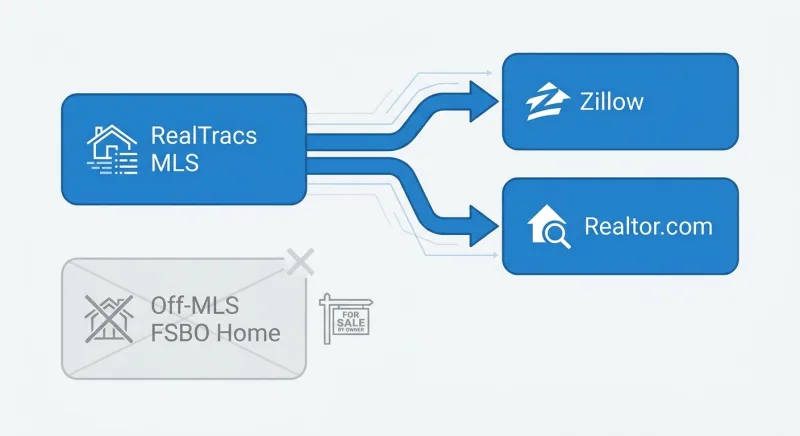
Most buyers find homes inside filtered searches — three beds, under $600K, Williamson County — on Zillow, Realtor.com, and Redfin. Those portals get the overwhelming majority of their listing data from the MLS. In Middle Tennessee, that MLS is RealTracs. List a home on RealTracs and it syndicates automatically to the major portals and into the systems buyer agents use every day [VERIFY: RealTracs syndication coverage]. Leave it off, and none of that happens.
A buyer sets a filter and browses forty homes that match. Your off-MLS Nolensville colonial isn't one of them — it literally cannot appear, because there's no data feed carrying it into their search. An unlisted home doesn't compete with other homes — it's absent from the competition entirely.
Yes, you can post to Zillow's FSBO section and Facebook Marketplace. But Zillow's FSBO listings live in a separate, deprioritized lane from agent-listed inventory. Getting on the MLS, where buyers' agents live, is the distribution you're missing — and it's exactly what flat-fee MLS restores.
Reason #2: Post-NAR Rules Make Buyer Agents Skip Your FSBO
Since the NAR settlement took effect in August 2024, offers of buyer-agent compensation can no longer be advertised on the MLS [VERIFY: NAR "Facts About the NAR Settlement," effective Aug 2024]. Compensation is still allowed and negotiable — it just can't be posted in the field where agents used to check it instantly.
Buyer agents now typically have signed agreements with their clients spelling out how they get paid. When an agent sees a home with no clear path to compensation — and an off-MLS FSBO is the murkiest case — many simply route their buyers toward listings where the terms are obvious. An off-MLS FSBO forces a buyer agent to cold-call a stranger, negotiate their own fee under time pressure, and hope it holds through closing. Most won't bother when there are dozens of clean, MLS-listed alternatives.
The fix isn't paying a full commission. It's structuring a compensation offer correctly and getting your listing into RealTracs so agents can find it and understand the terms. Three legitimate approaches:
Concession stated in remarks. You can't advertise a buyer-broker fee in the compensation field, but you can offer a seller concession toward the buyer's closing costs, which the buyer may apply toward their own agent's fee. Worded carefully, it signals to agents that their client can afford them.
Negotiated at offer. Leave compensation out entirely and handle it deal-by-deal as a line item inside the contract. Maximum flexibility — but it demands you're comfortable negotiating that number under pressure.
Pre-set posture, decided before you list. Buyers sign representation agreements with their agents before touring [VERIFY: written buyer-agreement requirement under NAR settlement], so the buyer already owes a fee. You don't have to cover it — but refusing entirely on a slow suburban listing shrinks your buyer pool to unrepresented buyers and cash investors.
The framework: on a hot micro-market listing, offer nothing and let the market work. On a Gallatin or Clarksville listing sitting past the local median DOM [VERIFY: Clarksville/Gallatin DOM 2026], build in a concession ceiling of 2–2.5% stated buyer-facing. Treat it as a lever, not an afterthought.
Reason #3: Your Price Is Based on a Market That No Longer Exists
Most stalled FSBO sellers priced off the wrong data — what the neighbor got in 2022, or active listings (what other hopeful sellers are asking), not sold comps (what buyers actually paid in the last 60–90 days). In a rising-inventory 2026 market, that gap is real money.
Active asking prices are aspirational. Sold prices are the truth. When the market cools, sold comps reset downward first and asking prices lag — so a price anchored to today's active listings is often already above what the market will bear.
There's a second signal you can't see from outside the MLS: the price cuts and expired listings around you. Agents watch those constantly. Without RealTracs access, you're pricing partly blind while every buyer agent in your zip code prices with full information. Getting on the MLS plugs you into the same sold-comp and price-reduction data professionals use.
Read Your Own Listing Data Like a Pro
Once you're on RealTracs, you get actual signal. There are only two failure modes, with opposite fixes.
Low views, low showings. Buyers aren't finding you — distribution or first-impression failure: bad search placement, weak lead photo, or a price that filters you out of the bracket buyers search. If a Franklin buyer caps at $650K and you're listed at $665K, you're invisible to every search capped at $650K even if you'd happily take $648K. Fix: reposition, don't wait.
High views, low showings. Buyers are finding you and choosing not to come — a price-to-condition mismatch. Fix: condition, staging, or a real price cut.
The number that matters most is view-to-showing conversion, not raw views. And know this: gaming the clock by cancelling and relisting doesn't reset the story. RealTracs carries a visible listing history that buyer agents read immediately.
The Real Cost of Waiting
Every additional week your home sits carries a cost — mortgage interest, taxes, insurance, utilities, and the opportunity cost of frozen capital. On a $600K Brentwood home, a mortgage in the mid-$3,000s per month means roughly $115–120 per day just to hold it, before you count the price erosion a stale listing forces.
- Cost of switching to flat-fee MLS: the flat listing fee plus whatever buyer concession you decide to offer.
- Cost of waiting off-MLS: daily carry × extra days invisible, plus the price cut a stale listing eventually forces anyway.
If invisibility is adding 30–45 days to your timeline, the carry cost alone often exceeds the entire flat listing fee several times over — and you keep the commission savings that made you go FSBO in the first place.
The Middle Path: Distribution Without the Commission
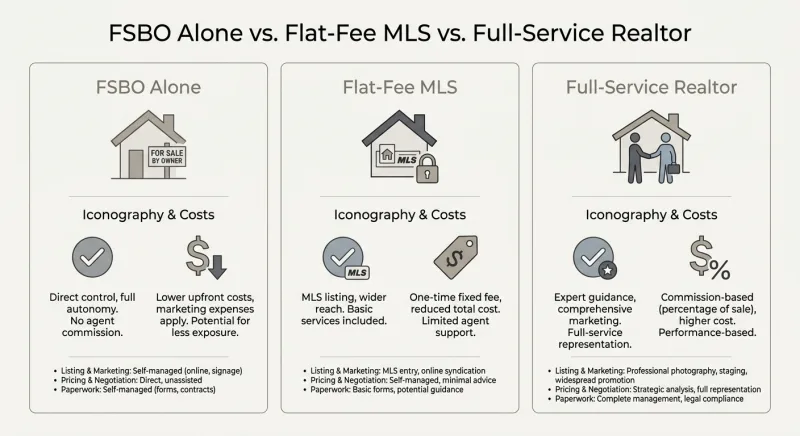
Think of a home sale as two separate products the traditional model bundles together.
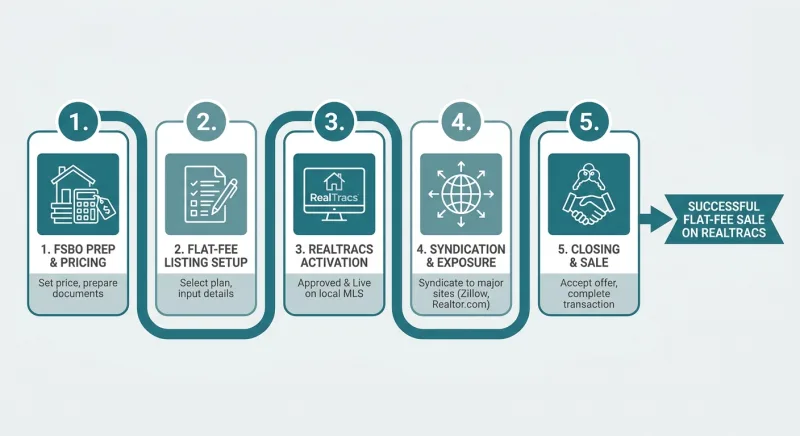
Product A — Distribution. Getting your listing into RealTracs, which feeds Zillow, Realtor.com, and the filters where roughly 9 in 10 buyers shop [VERIFY: NAR Profile of Home Buyers and Sellers]. It's a mechanical syndication function that costs a flat fee to perform once.
Product B — Service. Showings, pricing strategy, negotiation, contract shepherding, closing coordination. This is labor.
A full-service agent sells you A and B welded together at a percentage price. Pure FSBO gives you B and skips A entirely — which is exactly why your sign is fading while nothing happens. Flat-fee MLS unbundles them: you buy Product A for a fixed fee and keep Product B in your own hands. You didn't fail at selling. You skipped Product A.
When FSBO alone still beats flat-fee MLS
Flat-fee MLS isn't the answer for everyone. Three scenarios where staying fully off-MLS is defensible:
- You have a real buyer already lined up — a relative, neighbor, tenant, or committed cash investor.
- You're in a genuinely supply-starved micro-market where any listed home moves in days. Verify it against sold comps in your subdivision from the last 60 days — not a citywide average, not last year's memory.
- You want to test the market privately before committing to a public price and starting your DOM clock.
The trap is assuming you're the exception when the data says otherwise. Rising suburban inventory across Middle TN [VERIFY: 2026 active inventory increase] means the hot-micro-market exception applies to fewer sellers each quarter than it did in 2022.
Flat-fee MLS is the middle path: you gain full MLS distribution while still handling your own showings, negotiation, and closing coordination — upgrading your reach without surrendering control, and without paying 3%.
Frequently Asked Questions
Why isn't my FSBO selling in Tennessee in 2026?
In most cooling Middle Tennessee suburbs, stalled FSBOs aren't failing on price or effort — they're failing on distribution, because they're invisible to the roughly 90% of buyers who shop through MLS-fed sites like Zillow and Realtor.com . Getting your listing onto RealTracs via a flat-fee service typically restores that reach within days.
How long should I wait before switching from FSBO to flat-fee MLS?
If you've had two to three weeks of active marketing with fewer than five showings and zero offers — while comparable MLS-listed homes nearby are still moving — that's your signal to switch. Waiting longer usually just adds days on market, quietly weakening your negotiating position.
Does flat-fee MLS mean I have to pay a buyer's agent commission in Tennessee?
No — you decide whether to offer buyer-agent compensation, and since the August 2024 NAR settlement it can no longer be advertised inside the MLS itself . Many Tennessee sellers still offer a concession or commission privately to keep agent-represented buyers in play, but the choice is yours.
How much does it cost to list on the MLS without an agent in Tennessee?
Flat-fee MLS listings in Tennessee generally run from roughly $99 to $499 depending on the package and add-ons . That's a one-time cost compared to the traditional 5–6% listing-side commission .
Will my home syndicate to Zillow and Realtor.com through a flat-fee listing?
Yes. Once your home is entered into RealTracs, it feeds automatically to Zillow, Realtor.com, and hundreds of partner sites — the exact syndication network an off-MLS FSBO can't tap into.
Can I keep doing my own showings after switching to flat-fee MLS?
Absolutely. Flat-fee MLS is the middle path: you gain full MLS distribution while still handling your own showings, negotiation, and closing coordination.
The Bottom Line
The sign in the yard did its job, but it was never a marketing plan. In 2026's buyer-leaning Tennessee suburbs — Franklin, Brentwood, Gallatin, Clarksville, Murfreesboro and the rest — the homes that sell are the ones agents and their clients can actually find. That means RealTracs, and everything it feeds.
Do three things this week. Pull fresh sold comps and reset your price to the market that exists today. Decide whether you'll offer a buyer-agent concession, structured correctly per current NAR rules . Then get your listing into RealTracs so it syndicates where buyers are looking.
If you've got a cash buyer lined up or you're in a genuinely hot micro-market, FSBO alone can still work. Most stalled sellers aren't in that spot — they're invisible. The house didn't stop being sellable. It just stopped being seen. Fix the reach, and the showings follow.