

The inspection report landed. A day or two later, the buyer's agent sent a list: fourteen line items, two contractor estimates attached, and a polite note asking for your response "at your earliest convenience." A few items are fair. Others read like a wish list.
Selling FSBO, you're the seller and the negotiator at once. Under the standard Tennessee contract, the deadline matters more than the list.
The Short Answer: Do You Have to Make the Repairs?
Under the standard Tennessee purchase and sale agreement (Tennessee REALTORS® form RF401), you usually don't have to fix anything. The buyer's written repair request starts a Resolution Period. During that window you can agree, counter or decline. If both sides haven't signed a written agreement by the deadline, the contract can terminate and the buyer typically gets the earnest money back.
A buyer asking for repairs is making an opening offer, not ruling on your house. For every item, ask: what was asked, what does it really cost, and what happens if you say no.
This is general information, not legal advice. Contract language changes between form editions, so work from the version you signed.
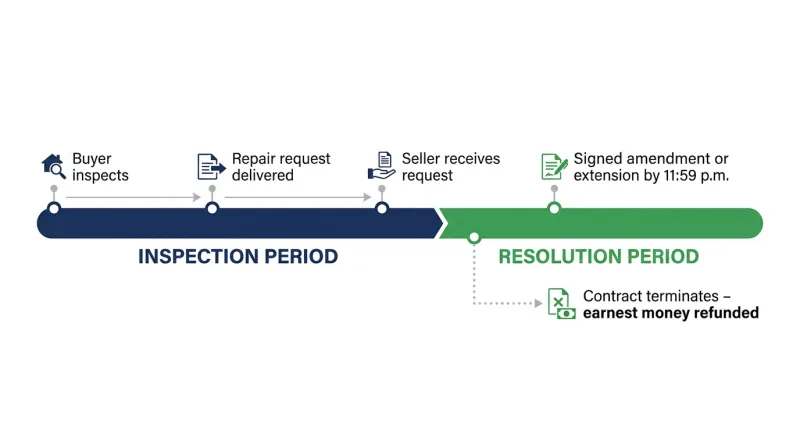
How the Inspection Period Resolution Process Works in Tennessee
Tennessee's process runs on two back-to-back deadlines. The Inspection Period is the buyer's window to inspect and then terminate, accept the property, or send a written repair request. The Resolution Period starts when you receive that request and is the window for both parties to reach a signed agreement.
In the standard Tennessee REALTORS® RF401, the sequence typically runs like this:
- The buyer inspects inside the Inspection Period, which counts calendar days from the Binding Agreement Date.
- Before that period ends, the buyer acts. They terminate, accept the property as is, or deliver a written list of requested repairs or replacements.
- You receive the request. The Resolution Period begins.
- You trade proposals and counters.
- By 11:59 p.m. local time on the last day, one of three things has happened: both sides sign a repair agreement, both sign a written extension, or the contract terminates and the earnest money is refunded.
Two details catch FSBO sellers off guard. The day counts aren't fixed by the form; the parties write them into blanks. And calendar days include weekends. The RF401 has its own rule for deadlines landing on a weekend or holiday, so read the definitions section rather than guessing.
Write down the date and time you received the request and count forward from there.
Repair Proposal (RF654) vs. Repair Amendment (RF655): Which One Binds You?
Two forms with nearly identical names do very different jobs.
The Repair/Replacement Proposal (RF654) is a working document for going back and forth. The Repair/Replacement Amendment (RF655) is the binding agreement that resolves the inspection contingency. A separate form, RF657, handles changes to the closing or possession date, while general amendments such as RF653 cover things like a price change.
| RF654 Proposal | RF655 Amendment | RF657 Amendment | |
|---|---|---|---|
| Purpose | Propose or counter specific repairs | Record the final repair agreement | Change closing or possession date |
| Binding? | Generally no, until accepted as the form directs | Yes, once both parties sign | Yes, once both parties sign |
| Who signs | The party making the proposal | Buyer and seller | Buyer and seller |
| Resolves the contingency? | No | Yes | Only if it addresses repair terms |
Never sign anything you think is "just an estimate" or "just to keep things moving." A signature on an amendment commits you to the work, credit or price change it describes.
These forms are licensed to Tennessee REALTORS® members, so a FSBO seller usually receives them from the buyer's agent. A Tennessee closing attorney can draft equivalent language.

Triage the Request: Must-Fix, Negotiable or Decline
A long list feels like an attack. Usually it's a buyer's agent copying every finding from the report. Sort each line into one of three tiers.
Tier 1: Safety, structural and lender-required items. Exposed wiring, a double-tapped breaker, missing GFCI protection in wet areas, an active roof leak or failed flashing, foundation movement, wood-destroying organism damage, a dead HVAC system, a significant plumbing leak. These are most likely to end the deal or stall the loan. Plan to address them, by repair or fair concession.
Tier 2: Major systems and aging components. Crawl space moisture, a water heater near end of life, an older roof that isn't leaking yet, radon at or above the EPA action level of 4 pCi/L. Radon and crawl space moisture come up often in Middle and East Tennessee. These are negotiation points, usually not deal-breakers.
Tier 3: Cosmetic and routine maintenance. A cracked outlet cover, worn caulking, a sticky closet door. Decline these politely, in writing. Most buyers expect it.
One trap sits between tiers. "Recommend evaluation by a licensed HVAC contractor" means the inspector saw a symptom and couldn't name the cause. Buyers often turn that into "replace HVAC system." Instead, offer a licensed evaluation by a set date and commit only to what it finds, or a credit capped at its estimate.
For Tier 1 and Tier 2 items, get your own licensed bids before replying. Inspectors aren't contractors, and the buyer's estimate is only a starting point.
Repair Credit vs. Fixing It: Your Options Compared
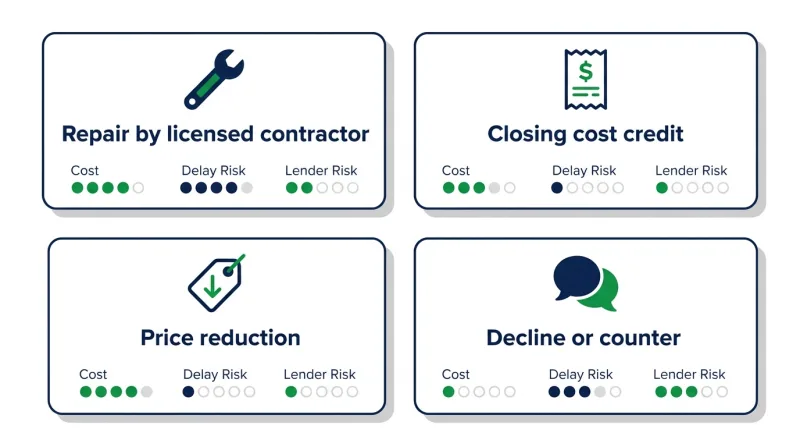
Your three moves: fix it, credit it, or decline it. A price reduction is a fourth option that behaves differently enough to compare separately.
| Option | Your cash and timing | Who controls quality | Risk of delaying closing | Re-inspection friction | Lender/appraisal risk | Risk buyer walks |
|---|---|---|---|---|---|---|
| Repairs by a licensed contractor | You pay now, before closing | You | Moderate to high (contractor scheduling) | High; the buyer may dispute the work | Low; may satisfy FHA/VA required repairs | Low |
| Closing cost credit | Comes out of your proceeds at closing | Buyer | Low | None | Subject to concession caps; can't cure required repairs | Low |
| Price reduction | Lowers your proceeds at closing | Buyer | Low to moderate (new amendment, lender update) | None | Changes the loan amount; lowers the recorded sale price | Low |
| Decline or counter | None | No one | Low, unless talks stall | None | None directly | Highest |
Repairs fit lender-required items or a buyer who won't accept a credit. A credit fits when the loan allows it and you want a clean close. A price reduction fits when the credit would exceed the lender's cap. Declining fits cosmetic items, or a price that already reflected the home's condition.
Hypothetical math: the buyer asks for $4,800 in roof work. Your two licensed bids come in at $3,600 and $4,100. Fixing it costs about $3,600 up front, plus scheduling time and the risk of a walk-through dispute. A $3,600 credit costs the same, comes out at closing, and moves quality risk to the buyer. Count your time, and the credit usually wins, if the lender allows it.
Permits can force the choice. Electrical service upgrades, structural work and some plumbing need city or county permits (Metro Codes, in Nashville), and timelines vary. Don't promise a completion date you can't control. Offer a credit, or if the lender insists the work be done first, move the closing date on the proper amendment form.
Lender Rules: Concession Caps and FHA/VA Required Repairs
Before offering a credit, ask the buyer's agent which loan the buyer is using and how much in seller concessions is already committed.
| Loan type | Typical seller contribution limit |
|---|---|
| Conventional, primary residence, over 90% LTV | 3% of price |
| Conventional, primary residence, 75.01–90% LTV | 6% |
| Conventional, primary residence, 75% LTV or less | 9% |
| Conventional, investment property | 2% |
| FHA | 6% |
| VA | 4% in concessions; normal closing costs excluded |
These limits come from the Fannie Mae Selling Guide, the Freddie Mac Seller/Servicer Guide, HUD Handbook 4000.1, and the VA Lenders Handbook. Closing costs you've already agreed to pay count against the same cap.
FHA and VA loans also carry Minimum Property Requirements for safety, security and soundness. If an appraiser flags peeling paint on a pre-1978 home, a missing handrail or a roof near end of life, a credit won't solve it. The work has to be done.
Signing the repair amendment doesn't protect you from these later conditions. The appraiser can call for repairs afterward, and the buyer's insurer may balk at an older roof or certain panels, such as Federal Pacific Stab-Lok. Hold some budget in reserve for that second round.
Price the Walk-Away Before You Answer
Sellers react to the total. A $6,000 ask feels outrageous; a $900 ask feels like nitpicking. Neither reaction tells you what to do. Your walk-away number does: what losing this buyer would really cost.
| Line | What to estimate | Where the figure comes from |
|---|---|---|
| 1. Carrying cost per month | Mortgage interest, taxes, insurance, utilities, HOA dues | Your own statements |
| 2. Extra months to re-sell | Relist, find a new buyer, reach closing again | An honest guess from recent local sales |
| 3. Disclosed-defect discount | What the next buyer takes off for items now on your disclosure | Licensed bids for those items |
| 4. Relisting friction | Marketing refresh, listing-change fees, extra cleaning | Your flat-fee MLS terms and receipts |
| 5. Market risk | Rates or demand moving against you while you wait | A cautious judgment call |
Multiply line 1 by line 2, then add lines 3, 4 and 5.
Hypothetical math: carrying costs run $2,400 a month and re-selling takes two more months: $4,800. The roof flashing and GFCI items would go on your next disclosure, and the bids total $2,100. Add $300 for relisting. You're at about $7,200 before market risk. If the buyer asked for $4,500, agreeing likely leaves you ahead. A counter at $3,000 to $3,500 still leaves room to talk.
Change one input and the answer changes. A paid-off, empty house can afford to hold firm. A seller carrying two mortgages can't afford to lose a week.
Flat-fee sellers have one extra lever. You've kept money that would traditionally have gone to a listing-side commission, often 2.5% to 3% in many markets, though always negotiable. Set aside part of it, say 0.5% to 1% of the price, as a negotiation reserve before you go under contract. On a $400,000 sale, that's $2,000 to $4,000. If inspection costs $2,500, you spent from a planned budget, and you can decide quickly inside a short window.
Write down your walk-away number and your maximum total concession. Negotiate inside those two figures.
What If the Buyer Walks After Inspection in Tennessee?
If the buyer terminates during the Inspection Period, or the Resolution Period expires without a signed amendment, the standard form typically returns the earnest money to the buyer. You relist, but you don't start clean. What the inspection found now travels with the house.
Tennessee's Residential Property Disclosure Act (Tenn. Code Ann. § 66-5-201 et seq.) requires sellers to disclose known material defects and update the disclosure when information changes. A documented roof leak or failed water heater is no longer something you didn't know about. Revise your RF201 disclosure, or reconsider any RF202 disclaimer, before you relist.
That makes "no" more expensive than it looks. The next buyer reads about the defect before offering and prices it in from the start. So the rule is narrow: the best item to say yes to is usually one you'd have to disclose anyway. Put those first in your counter. Save your "no" for requests that disappear if this buyer leaves.
A disclosure you made before the contract helps in the other direction. If an item was on your RF201 when the buyer offered, you can politely point out it was priced in. Use that to shrink the request, not to refuse it outright; the buyer can usually still terminate during the inspection contingency.
Estate sellers: personal representatives may be exempt from the disclosure form under § 66-5-209, but that exemption doesn't touch the inspection contingency. The buyer can still request repairs and walk. Executors who never lived in the house should lean toward credits.
Putting It in Writing: The Tennessee Repair Amendment
Most walk-through disputes start with vague wording, not bad work. If a sentence can be read two ways, expect the expensive reading.
| Vague wording | Why it causes trouble | Tighter wording |
|---|---|---|
| "Seller to repair roof" | Patch, section or full roof? | "Seller to have a licensed roofing contractor repair the flashing at the rear chimney per the contractor's written scope" |
| "Fix plumbing leak" | Which leak? Drywall included? | "Repair the active leak at the hall bath supply line; drywall replacement excluded" |
| "Service HVAC" | No standard for done | "HVAC to be serviced by a licensed contractor; Seller to provide the paid invoice showing the system in working order" |
| "Treat for termites" | Silent on damage and warranty | "Treatment by a licensed pest control company; Seller to provide treatment certificate; damage repair not included" |
| "Credit for repairs" | Can collide with lender rules | "Seller to contribute $X toward Buyer's closing costs, subject to lender approval" |
Each repair line should name the item, the scope, the licensed trade, and the proof you'll deliver and when. Add one line limiting you to the listed items.
Answer the whole request at once, in writing. A string of "sure, we can do that" texts makes it hard to pull anything back later. And don't use the clock as a tactic; silence near the deadline can end the contract. Get it signed before the clock runs out, and have the closing attorney or title company review the final amendment first.
Frequently Asked Questions
Do sellers in Tennessee have to fix inspection items?
Under the standard Tennessee REALTORS® RF401, you usually don't have to fix anything. The buyer's written request opens a Resolution Period in which you can agree, counter or decline. FHA or VA loans may still require certain safety items to be corrected before closing.
How long does a seller have to respond to a repair request in Tennessee?
As long as the Resolution Period written into your signed contract. It starts when you receive the request and typically ends at 11:59 p.m. local time on the last day. The parties fill in the day count, so check your own RF401.
Is a repair credit better than making repairs?
Often, because a credit avoids contractor scheduling and re-inspection disputes. But the buyer's loan caps it, for example 6% for FHA and 3% to 9% for conventional loans depending on the down payment. A credit also can't satisfy FHA or VA required repairs.
Can a buyer back out after inspection and get earnest money back?
Yes. If the buyer terminates within the Inspection Period, or the Resolution Period expires without a signed amendment, the standard form typically returns the earnest money. Take any deposit dispute to a Tennessee closing attorney or the title company holding the funds.
Do I have to disclose inspection findings if the buyer walks?
Generally, yes. The Tennessee Residential Property Disclosure Act requires you to update your disclosure when you learn of new material defects. Revise your disclosure before you relist.
Can I sell my Tennessee house as-is?
Yes. You can market it as-is and decline repairs, but the buyer keeps the inspection contingency unless they waive it, and you still owe accurate disclosures. As-is lowers your repair exposure. It doesn't remove the buyer's right to walk.
Your Response Checklist
- Log the date and time you received the request, and count the Resolution Period from there.
- Read the request line by line and sort each item into safety, negotiable or cosmetic.
- Get independent licensed bids for Tier 1 and Tier 2 items.
- Ask which loan the buyer is using and what concessions are already committed.
- Run your walk-away number and set your maximum total concession.
- Choose fix, credit or decline for each item, putting disclosable defects first.
- Counter in writing, then sign the RF655 amendment before the deadline.
- Track completion, keep invoices for the buyer's re-inspection, and send copies to the closing attorney or title company the same day.
If a clause confuses you, a short consult with a Tennessee real estate attorney costs less than a terminated contract.
Still pre-listing? A flat fee MLS listing in Tennessee gets you MLS exposure without the full commission, and you keep the negotiating seat. Run the numbers, then answer calmly, on time and on your terms.