
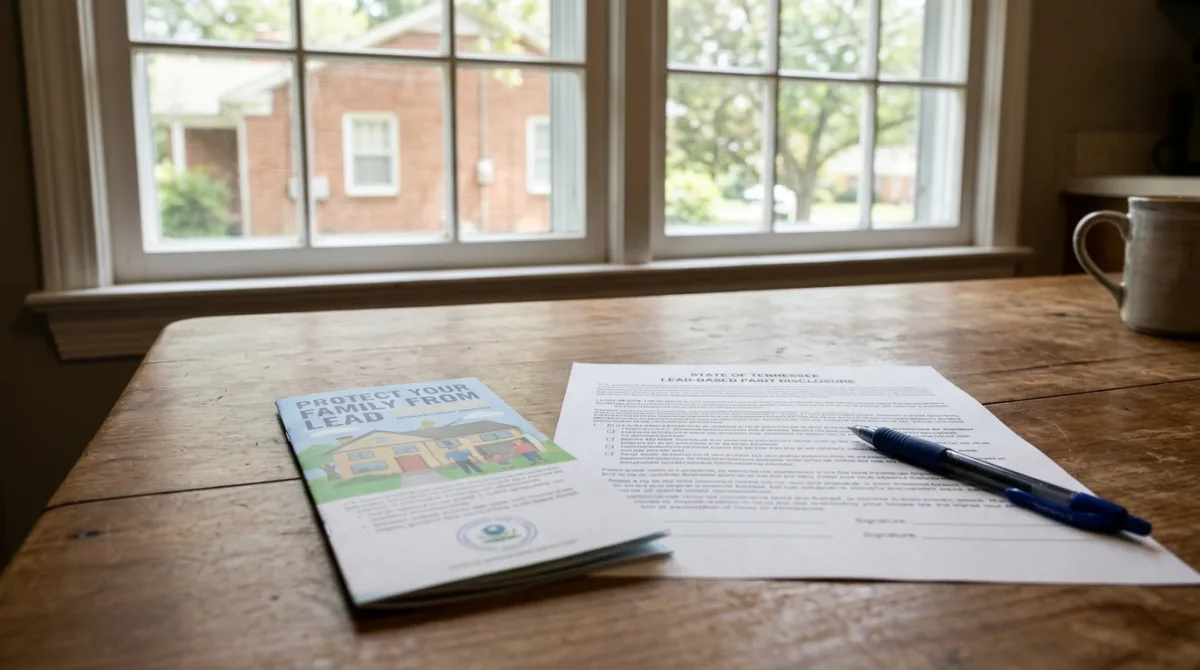
Yes. If your Tennessee home was built before 1978, federal law (42 U.S.C. § 4852d) requires a lead-based paint disclosure even when you sell FSBO. You must give the buyer the EPA pamphlet, disclose known lead paint and reports, include the Lead Warning Statement, offer a 10-day inspection opportunity, and keep signed records for 3 years.
That's the lead based paint disclosure Tennessee FSBO sellers owe, in one breath. This guide covers which homes are exempt, which free form to use, how the 10-day window works, and where FSBO sellers trip up.
This is general information, not legal advice.
Does the Federal Lead Disclosure Apply to FSBO Sellers?
Yes. The federal lead disclosure FSBO sellers face comes from the Residential Lead-Based Paint Hazard Reduction Act of 1992 and the joint EPA/HUD rules at 40 CFR Part 745, Subpart F (mirrored by HUD at 24 CFR Part 35). Selling it yourself doesn't get you out of this one.
The cost is close to zero. You don't have to test the house or fix anything. Lead dust is most dangerous to children under 6, so the rule focuses on making sure buyers know what they're getting.
Before the buyer is bound by a contract:
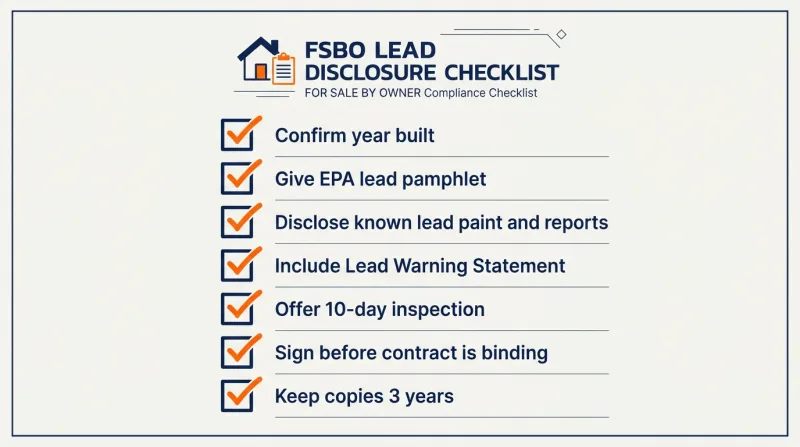
- Give the buyer the EPA pamphlet Protect Your Family From Lead in Your Home.
- Disclose known lead-based paint and hazards, and hand over any reports or records you have.
- Include the Lead Warning Statement in the contract or a signed attachment.
- Offer up to 10 days for a lead inspection or risk assessment.
- Keep signed copies for at least 3 years after closing.
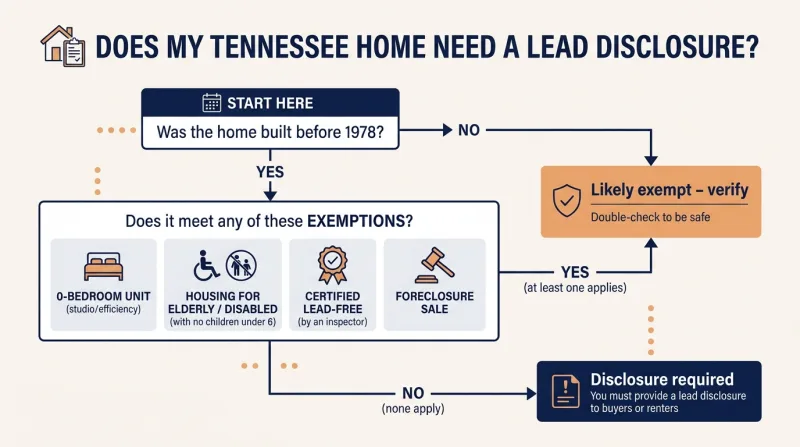
Which Homes Need It? Pre-1978 Home Disclosure in Tennessee
The rule covers "target housing," most housing built before 1978, the year residential lead paint was banned. Most pre 1978 home disclosure Tennessee questions come down to the build date and whether a narrow exemption fits.
| Property type | Federal rule applies? | Notes |
|---|---|---|
| House, condo or townhouse built before 1978 | Yes | Repainting or renovation doesn't change this. |
| Built 1978 or later | No | State disclosure may still apply. |
| 0-bedroom dwelling (studio, efficiency, loft) | No | Excluded under 40 CFR 745.103. |
| Elderly or disability housing | Usually no | Not exempt if a child under 6 lives there or is expected to. |
| Foreclosure sale | No | Exempt under 40 CFR 745.101(a). |
| Certified lead-free by an inspector | Still yes for sales | That exemption covers leases only. |
| Sale exempt under T.C.A. § 66-5-209 | Still yes | A state exemption doesn't remove the federal duty. |
A 1990 addition doesn't modernize a 1948 house, because status depends on when the dwelling was originally built.
To check your build year, look up the parcel at assessment.cot.tn.gov. Davidson, Shelby, Knox and Hamilton counties run their own assessor sites.
Heads up: assessor records for older homes are sometimes estimates. If the year is borderline or unclear, treat the home as pre-1978 and disclose.
Does Selling As-Is or Using Tennessee's Disclaimer Waive It?
No. Tennessee's Residential Property Disclosure Act (T.C.A. § 66-5-201 et seq.) lets some sellers use a disclaimer instead of the state form under § 66-5-202. That only affects the state form. The federal lead rule is a separate layer.
| Federal lead disclosure | Tennessee Residential Property Disclosure | |
|---|---|---|
| Source | 42 U.S.C. § 4852d, enforced by EPA and HUD | T.C.A. § 66-5-201 et seq. |
| Which homes | Pre-1978 target housing | Most 1–4 unit residential sales, with exemptions in § 66-5-209 |
| Form | Disclosure with Lead Warning Statement, plus EPA pamphlet | State disclosure statement or, where allowed, a disclaimer |
| Timing | Before the buyer is bound by the contract | Before the buyer signs the purchase agreement |
| As-is option? | None | Disclaimer may apply under § 66-5-202 |
| Extra buyer rights | Up to 10 days to inspect | None comparable |
| Record keeping | 3 years from completion of sale | No equivalent rule |
| Penalties | Federal civil and criminal enforcement, treble damages | Buyer remedies under state law |
Plain English: you may need both. Make sure your "known / no knowledge" answers agree across the two forms, because contradictions invite honesty questions.
Lead Paint Disclosure Form: Seller Step-by-Step
Finish every step of your lead paint disclosure form before a buyer signs a binding offer. The paperwork takes about 20 minutes. Skipping it can cost five figures.
- Confirm the build year using the assessor sources above.
- Download the free documents from EPA's real estate disclosure page at epa.gov/lead: the current pamphlet and EPA's sample seller disclosure form. The Tennessee REALTORS® forms are licensed to members. EPA's form is free and public.
- Disclose what you know. Note known lead paint or hazards, such as peeling paint on old windows or other friction surfaces, and attach every report you have.
- Include the Lead Warning Statement word for word. The text in 40 CFR 745.113(a)(1) reads:
"Every purchaser of any interest in residential real property on which a residential dwelling was built prior to 1978 is notified that such property may present exposure to lead from lead-based paint that may place young children at risk of developing lead poisoning. Lead poisoning in young children may produce permanent neurological damage, including learning disabilities, reduced intelligence quotient, behavioral problems, and impaired memory. Lead poisoning also poses a particular risk to pregnant women. The seller of any interest in residential real property is required to provide the buyer with any information on lead-based paint hazards from risk assessments or inspections in the seller's possession and notify the buyer of any known lead-based paint hazards. A risk assessment or inspection for possible lead-based paint hazards is recommended prior to purchase."
Copy it from eCFR or EPA's sample form rather than retyping it. 5. Write the 10-day inspection opportunity into the contract or attachment. 6. Collect all signatures and dates before the buyer is bound (40 CFR 745.107(a) and 745.113(a)). 7. Store the signed copies for at least 3 years (40 CFR 745.113(c)). Scan them into a dated folder.
No records? That's common and fine. Check "no knowledge" and "no reports." You only disclose what you actually know.
What Counts as "Known" Lead Information?
You must disclose known lead paint or hazards and hand over all available records and reports (40 CFR 745.107). Sellers often have lead paperwork without thinking of it that way:
- The lead disclosure you received when you bought the home
- Past home inspection reports noting chipping paint
- Invoices from RRP-certified painters or window contractors, which may include test results
- Records from renting the home out, when you had lessor disclosure duties
- Health department follow-ups on a child's elevated blood-lead level
- HOA files covering shared hallways or exteriors
Your disclosure has to reflect what you know now. Say you bought a 1962 brick ranch in Clarksville with a "no knowledge" form, then a painter later found lead on the window sills. That finding and the report both go on your disclosure.
Heads up: testing is optional, but results become known information the moment you have them. Decide before you order a test, not after.
What Is the 10-Day Lead Inspection Period?
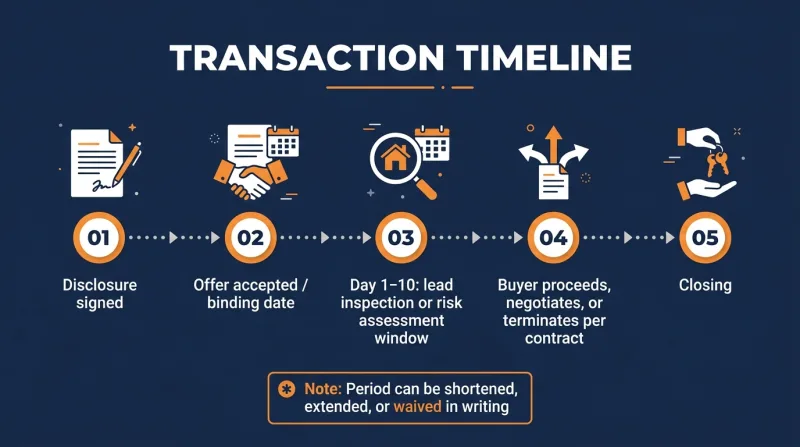
The 10-day lead inspection period gives the buyer up to 10 days to have the home checked for lead before they're locked in. It works like a contingency in the purchase agreement.
Can the buyer waive the 10 days?
Yes, in writing. Under 40 CFR 745.110(a), you and the buyer can also lengthen or shorten it by mutual written agreement.
Who does the inspection, and what if lead turns up?
Only certified professionals can do it (40 CFR 745.226). An inspection finds where lead paint is. A risk assessment is an on-site check for active hazards like lead dust and their sources. The buyer usually arranges and pays, often through EPA's locator or TDEC's Lead-Based Paint Program.
If hazards are found, the contract terms decide what happens next. The buyer might proceed, ask for a credit, or walk. You're not required to fix anything, though you'll need a response to keep the deal.
Where Sellers Tend to Trip Up: Offer Timing
Most FSBO failures come from sequence, not missing paperwork. The buyer must receive the disclosure before they're obligated under a contract.
If a buyer hands you a signed offer first, don't countersign yet. EPA/HUD guidance says to provide the disclosure and let the buyer revise the offer before you accept. Counteroffers can create the same problem, since a buyer who accepts your counter on the spot may be bound at that moment. The simple fix is to attach the completed disclosure to your very first written response.
If a new report surfaces after you're under contract but before closing, tell the buyer in writing and keep proof. Tennessee misrepresentation law doesn't stop at the binding date.
Edge Cases Worth a Second Look
- Estate sales: these aren't foreclosures, so there's no exemption. The executor discloses what the estate knows. "No knowledge" is acceptable when true, but search the decedent's files first.
- Condos: ask your HOA in writing for any common-area lead reports, and keep the reply.
- Rent-to-own: expect lessor disclosure at the lease stage and seller disclosure again at the sale. Treat these as two transactions.
- FHA buyers: FHA requires defective paint in pre-1978 homes to be corrected as a loan condition. Picture a 1955 East Nashville bungalow with peeling trim. The appraisal may call for paint stabilization. That's a lender rule, so negotiate who pays.
- Pre-sale painting: contractors you pay to disturb paint must be EPA RRP-certified. DIY work isn't covered by that rule, but dry-scraping creates exactly the dust the disclosure warns about, and any test results become disclosable.
What Happens If I Don't Disclose?
Violations can bring federal civil penalties that run into five figures per violation, adjusted for inflation each year. Knowing violations can bring criminal penalties. The buyer can also sue for up to three times their actual damages. A missing record isn't a violation. Skipping the pamphlet, the warning statement or the signatures is.
Your Lead Disclosure Packet on a Flat Fee MLS Listing
A flat fee MLS listing in Tennessee puts your home in front of buyer's agents, but the disclosures are still yours to prepare. Assemble this packet before the listing goes live:
- The EPA sample form, completed, signed and dated, with reports attached
- The current EPA pamphlet
- A blank buyer acknowledgment section for the buyer to sign before they're bound
Most Tennessee MLS systems allow document attachments, so buyer's agents can return the signed acknowledgment with the offer.
The gray area: under 40 CFR 745.103 and 745.115, an "agent" who contracts with the seller has separate compliance duties. A flat-fee listing broker may count as one, which could mean an agent certification signature on the form. A buyer's agent paid only by the buyer generally doesn't count. Check your brokerage's policy and the EPA/HUD Interpretive Guidance for the Real Estate Community. If unsure, ask a Tennessee real estate attorney.
Frequently Asked Questions
Is lead-based paint disclosure required for FSBO sales in Tennessee?
Yes, for target housing built before 1978, under 42 U.S.C. § 4852d, with or without an agent.
What lead paint disclosure form should a Tennessee FSBO seller use?
Use EPA's free sample seller disclosure form, and give the buyer the EPA pamphlet along with it.
Do I have to test my home for lead before selling?
No. You disclose what you know, hand over reports you have, and offer the buyer an inspection opportunity.
Can the buyer waive the 10-day lead inspection period?
Yes, in writing. The period can also be shortened or lengthened by mutual written agreement (40 CFR 745.110).
Does selling as-is remove the lead disclosure requirement?
No. Tennessee's disclaimer covers only the state form.
How long do I keep lead disclosure records?
Keep them for at least 3 years from completion of the sale (40 CFR 745.113(c)).
Printable Recap
- Confirm the build year. If it's unclear, treat the home as pre-1978.
- Download the EPA pamphlet and sample seller form.
- Gather every lead-related record you have.
- Complete the form with the exact Lead Warning Statement.
- Offer the 10-day inspection opportunity in writing.
- Get all signatures before the buyer is bound.
- Keep a copy for three years.
Once that's done, lead paint stops being a closing worry. It's one signed page in your folder, finished before the first showing.