
The short answer: hiring an unbundled transaction attorney for your Middle Tennessee FSBO means paying a real estate lawyer only for the legal pieces of your sale — contract review, custom addenda, deed prep — instead of handing a full-service agent a percentage of your home's value.
Tennessee is a title/escrow closing state. No lawyer is legally required to close a residential sale here.
So why hire one at all?
Because a title company is a neutral closer. It issues title insurance, holds earnest money in escrow, and records the deed — but it cannot give you legal advice or draft custom paperwork when a deal gets complicated. That's the gap an unbundled transaction attorney fills.
Here's the setup most FSBO sellers land in: you've listed on RealTracs through a flat-fee broker, priced it, marketed it, maybe already have an offer. Now someone hands you a purchase and sale agreement and you're staring at paragraph 14 wondering what you just agreed to. That's the moment this guide is built for.
Do You Legally Need an Attorney to Sell a House FSBO in Tennessee?
No — Tennessee does not require a licensed attorney to conduct a residential real estate closing. A title and escrow company can legally close your sale, disburse funds, and record the deed without a lawyer in the room.
Here's the catch: a title company works the deal — not you. It verifies clear title, issues title insurance, handles earnest money escrow, and records the deed. What it cannot do is draft a custom contract term, tell you whether to accept a repair credit, or warn you that an addendum shifts risk onto you. Giving legal advice or drafting custom legal documents without a license crosses into the unauthorized practice of law. [VERIFY — Tenn. Code Ann. § 23-3-103] The same limitation binds your flat-fee listing broker.
When you can probably skip it: the buyer uses the standard Tennessee REALTORS residential purchase and sale form unmodified, title comes back clean, and nobody's writing in custom conditions.
When you'll want one: owner financing, a land contract, an estate or divorce sale, a boundary or easement question, an out-of-state buyer, or any contract with handwritten changes you don't fully understand.
What an Unbundled (Transaction-Only) Real Estate Attorney Actually Does
An unbundled transaction attorney provides à-la-carte legal services — you pay for individual tasks rather than a full-representation retainer. For a typical Middle Tennessee seller, that means reviewing the contract, drafting custom language, preparing the deed, and standing by through contract-to-close.
- Contract review. They read the purchase and sale agreement before you sign, flag terms that favor the buyer, and explain your obligations — inspection periods, contingencies, earnest money terms, closing-date triggers.
- Custom legal addenda. If your deal needs something the standard form doesn't cover — a seller rent-back, an as-is clause, owner financing terms — the attorney drafts it. Your title company and flat-fee broker legally can't.
- Deed preparation. They prepare the correct deed for your situation. A warranty deed guarantees clear title to the buyer; a quitclaim deed transfers only whatever interest you hold. Picking the wrong one causes real problems.
- Escrow and closing guidance. They answer questions the neutral title company can't — whether a prorated tax figure looks right, whether a last-minute buyer demand is reasonable.
- Contract-to-close oversight. On complex deals, they monitor deadlines, coordinate with the title company, and troubleshoot problems before they blow up the closing.
You don't have to buy all of it. Some sellers hire the attorney for one hour to read the contract and nothing more. You scope it to your deal and pay only for what you use.
How Much Does an Unbundled Closing Attorney Cost in Middle Tennessee?
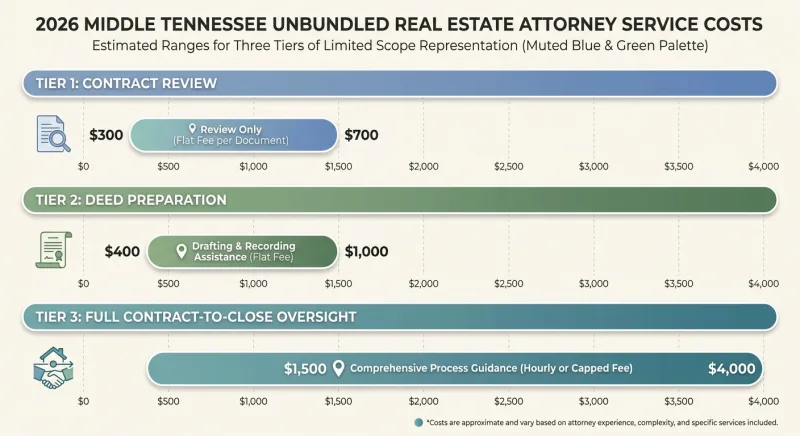
Unbundled attorney fees run roughly $400–$600 for a contract review, $250–$350 for deed preparation, and $1,200–$2,500 for full contract-to-close oversight — estimated 2026 ranges that vary by county and complexity.
| Service | Estimated 2026 Range | Best for |
|---|---|---|
| Contract review (consult) | $400–$600 | Clean deals, standard form, a second set of eyes |
| Deed preparation | $250–$350 | Getting the warranty or quitclaim deed drafted correctly |
| Full contract-to-close | $1,200–$2,500 | Owner financing, estate/divorce, anything with moving parts |
Many attorneys bill a flat fee for defined tasks like deed prep, and an hourly rate (commonly $250–$400) for open-ended work. Recording fees and transfer tax are separate — those go to the county Register of Deeds and the state. [VERIFY — Tenn. Code Title 67, Ch. 4] Always ask for a written quote and written scope before you hire. The exclusions are where surprise invoices live.
For perspective: a full-service listing agent on a $500,000 Middle Tennessee home can cost $12,500–$15,000 on the listing side alone. An unbundled attorney plus a flat-fee MLS listing typically lands at a fraction of that — but the savings aren't free. You do more of the work yourself.
Attorney vs. Flat-Fee Broker vs. Title Company vs. Full-Service Agent
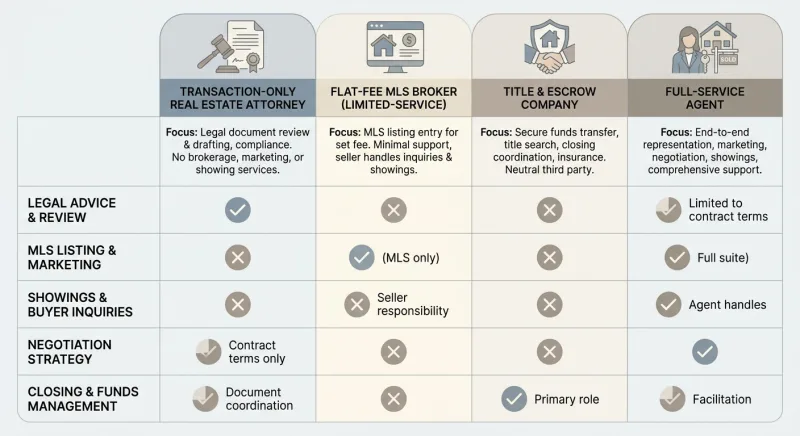
Four players can touch your FSBO sale, and they do not do the same job. Confusing them is the most expensive mistake FSBO sellers make.
| Unbundled Attorney | Flat-Fee MLS Broker | Title & Escrow Company | Full-Service Agent | |
|---|---|---|---|---|
| Primary role | Legal protection, à-la-carte | Gets you on RealTracs/MLS | Neutral closer | Full representation |
| Lists on the MLS | No | Yes | No | Yes |
| Gives legal advice | Yes | No | No | No |
| Drafts custom contract terms | Yes | No | No | No |
| Prepares the deed | Yes | No | Sometimes* | No |
| Handles escrow / closing | Advises only | No | Yes | Coordinates |
| Typical cost | Flat/hourly, task-based | Flat fee | Part of closing costs | % commission |
Some title companies prepare simple deeds; custom legal drafting still requires an attorney.
Only the attorney column has "yes" next to legal advice and custom drafting. The question isn't which one to pick — it's how to combine them. For most Middle Tennessee FSBO sellers, the efficient stack is a flat-fee MLS broker to market the home, an unbundled attorney for the legal pieces, and a title company to close.
How a Flat-Fee MLS Broker and an Unbundled Attorney Work Together
Your flat-fee broker gets the house listed; the attorney takes over at the offer stage. Under Tennessee law, a limited-service broker can place your listing in the MLS and handle certain disclosures without taking on full agency [VERIFY — Tenn. Code Ann. § 62-13-403] — but cannot give legal advice or draft custom contract language. That's not a service limitation; it's a legal line.
Smart FSBO sellers close that gap before listing. Retain the attorney on a contract-review basis up front, so when an offer arrives you can forward it and get a redline within 24–48 hours instead of scrambling while your earnest money clock runs.
Three documents cross the broker-to-attorney seam:
- The purchase and sale agreement — your broker may hand you a blank Tennessee REALTORS form; filling it in with custom terms is where the attorney earns the fee.
- Custom addenda — repair holdbacks, post-closing occupancy, seller-financing riders require drafting from scratch.
- The deed — the title company records it; the attorney determines which deed protects you.
The broker gets you to contract, the attorney gets you through it, the title company moves the money.
Warranty Deed vs. Quitclaim: The Choice That Outlives the Closing
In a normal arm's-length sale, you convey by general warranty deed — guaranteeing clean title through the full chain. A quitclaim conveys only whatever interest you happen to hold, with zero promises.
When does the distinction become real money?
- Inherited property with murky probate. If title passed through an estate never fully administered, a warranty deed exposes you to covenants you can't back up. An attorney may steer you toward a special warranty deed — warranting only against defects arising during your ownership.
- Divorce or co-ownership splits. One spouse quitclaiming to the other before the sale, so a clean warranty deed issues to the buyer. Get the sequence wrong and the closing stalls.
- A gift or family transfer dressed as a sale. Transfer-tax treatment changes [VERIFY — Tenn. Code Ann. Title 67, Ch. 4] and the deed language must match the economic reality.
A title company will record whatever deed is handed to them. They will not tell you a quitclaim just stripped away the buyer's recourse — because that's legal advice they're barred from providing. That silence is the hole the unbundled attorney fills.
When the Unbundled Model Breaks Down
À-la-carte legal work is built for clean transactions. Push it into messy territory and the economics flip.
1. Contested title or a cloud on the chain. A missing heir, an old mechanic's lien, a boundary dispute. Now you're in litigation-adjacent work billed hourly, and the "unbundled" savings evaporate.
2. Seller financing or a land contract. The moment you become the bank, paperwork multiplies — promissory note, deed of trust, default remedies. This is full-scope drafting, not review.
3. Entity or 1031 sales. Selling through an LLC or rolling proceeds into a 1031 exchange pulls in tax counsel and a qualified intermediary. The attorney coordinates but doesn't quarterback alone.
4. An aggressively drafted buyer's offer. Multiple counter-draft cycles can quietly convert a flat review fee into an hourly engagement. Scope the engagement before you sign the retainer.
How Each County Changes the Math
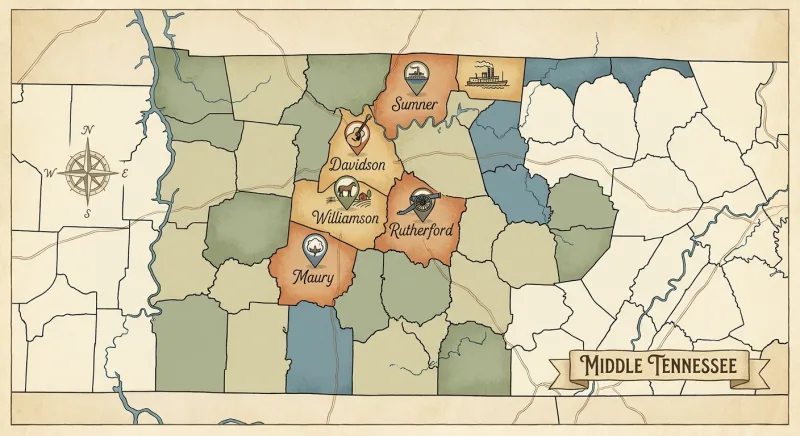
The statewide rules are uniform. The friction is local — it shows up at the Register of Deeds. Hire an attorney who regularly records in your county.
- Davidson (Nashville): highest recording volume; electronic recording is standard, shaving a day off closing. Deed-prep fees cluster at the top of the range.
- Williamson (Franklin, Brentwood): high-value homes mean higher transfer tax and more heavily lawyered buyer offers — plan for a counter-draft round.
- Rutherford (Murfreesboro): fast-turning market with lots of relocation buyers; watch builder-style addenda bleeding into resale offers.
- Sumner & Maury: smaller recording offices with occasionally slower turnaround — build a buffer into your closing date.
FAQ
Do I need a lawyer to sell a house FSBO in Tennessee?
No. Tennessee does not require an attorney for a residential closing — a title and escrow company can handle it. Many FSBO sellers still hire an unbundled attorney for contract review and deed preparation, since the title company can't give legal advice.
Can a title company draft a FSBO purchase agreement in Tennessee?
No. Drafting a custom contract or giving legal advice crosses into the unauthorized practice of law under Tenn. Code Ann. § 23-3-103. They can process a signed agreement and close the file, but writing or negotiating your paperwork requires an attorney.
What's the difference between an unbundled real estate attorney and a closing attorney?
An unbundled (transaction-only) attorney sells discrete, à-la-carte services — contract review, a single addendum, deed prep — rather than full representation. A "closing attorney" typically oversees the entire contract-to-close process. Same license, different scope and price.
How much does an unbundled closing attorney cost in Middle Tennessee?
As of early 2026, expect roughly $400–$600 for a contract review, $250–$350 for deed preparation, and $1,200–$2,500 for full contract-to-close oversight. Always request a written fee agreement; pricing varies by county and complexity.
Can I pair a flat-fee MLS listing with transaction-only legal help?
Yes — that's the point. A flat-fee MLS broker gets your home on RealTracs; an unbundled attorney handles the legal paperwork once an offer lands.
Can a limited-service flat-fee broker give me legal advice on an offer?
No. Under Tenn. Code Ann. § 62-13-403, a limited-service TREC broker can list and help with disclosures but cannot draft custom contracts or give legal advice. That gap is exactly where an unbundled attorney steps in.
Your Next Step
- List on RealTracs through a flat-fee MLS package so buyers and their agents find you.
- Pre-retain an unbundled attorney for contract review before offers arrive — vet one through the Nashville Bar Association referral service or the Tennessee Board of Professional Responsibility.
- Choose your scope: review-only, deed prep, or full contract-to-close. Get the fee in writing.
- Let the title company anchor the close.
Market it yourself. Lawyer the paperwork. Close clean.
This article is general information from a limited-service flat-fee MLS listing and marketing company — not a law firm. Reading it creates no attorney-client relationship. Statutes, forms, fees, and county practices change; confirm specifics with a licensed Tennessee attorney for your transaction. Information current as of 2026.