
 After the 2026 NAR settlement, Tennessee FSBO sellers control how — and whether — they compensate a buyer's agent.
Short answer: no, Tennessee FSBO sellers aren't legally required to offer a buyer's agent commission after the 2026 NAR settlement — but whether you should is a different question, and the math usually decides it. Under the settlement, compensation to a buyer's agent can no longer be advertised on the MLS, and no seller is obligated to pay one.
The settlement changed how buyer-agent pay gets communicated, not whether you're allowed to offer it. You still can. Most Tennessee sellers still do — they just do it off the listing field now, in the purchase contract, where you hold more control than before.
This guide covers what actually shifted, whether a buyer's agent can skip your listing, the two silent ways deals die at the closing table, how compensation flows through the standard Tennessee REALTORS® forms, and why a flat-fee MLS listing gives you portal exposure without surrendering control.
Do FSBO Sellers Have to Pay a Buyer's Agent in Tennessee in 2026?
No. No Tennessee FSBO seller is legally required to compensate a buyer's agent — but the large majority still offer some form of concession because it keeps their home competitive.
Buyers now sign a written representation agreement before touring homes — that agreement spells out what their agent gets paid. If you offer nothing, the buyer has to cover the fee out of pocket or roll it into their offer. On a tight-budget purchase, that pressure is real.
The honest tension:
- The case for offering a concession: you keep your home attractive to the roughly 80–90% of Tennessee buyers who use an agent, and you avoid getting quietly skipped on showing lists.
- The case for offering less (or nothing): you keep more equity at closing, and buyers who love your home will structure their offer around it.
In a slow Murfreesboro or Clarksville submarket with plenty of inventory, a competitive concession does more work. In a hot pocket of Franklin or East Nashville with little supply, you have more room to hold firm.
What Actually Changed vs. What Stayed the Same
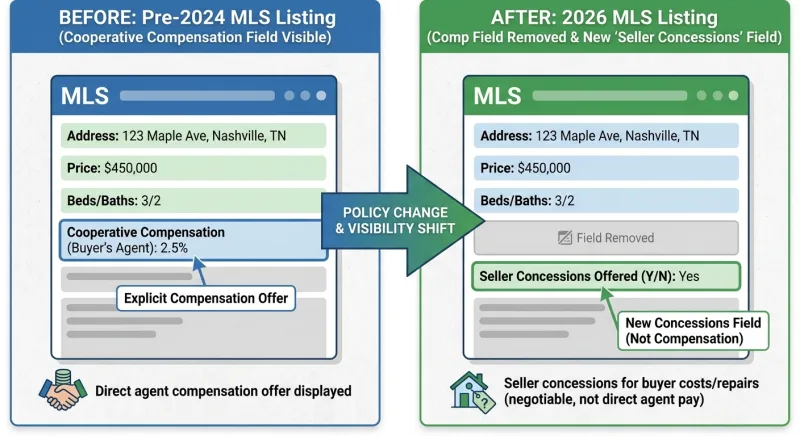
The core change: you can no longer advertise buyer-agent compensation on the MLS, but you can still offer and pay it — the offer just moves off the MLS into private negotiation. The settlement removed the cooperative-compensation field from MLS listings nationwide, including RealTracs in Middle Tennessee.
What changed:
- The MLS field that published "buyer agent commission: X%" is gone.
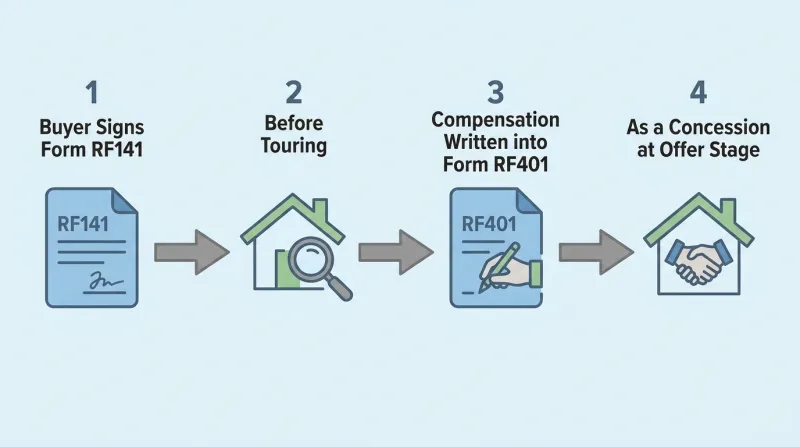
- Buyers sign a written buyer-representation agreement before touring. That contract states what the agent is owed and who pays it.
- Compensation is now "decoupled" — the buyer's agent fee and the listing arrangement are negotiated separately.
What stayed the same:
- Sellers can still offer buyer-agent compensation off the MLS — in the purchase agreement or a private compensation addendum.
- RealTracs added a "Seller Concessions Offered: Y/N" field with a dollar amount, signaling willingness without naming a commission.
- Commissions were always negotiable. The settlement made that explicit; it didn't invent it.

The old system wasn't a rule you had to follow — it was a default you couldn't escape. Every listing broadcast its buyer-side offer to the entire agent pool the moment it hit RealTracs. Now buyer-agent compensation is a negotiable term like price, closing date, or repairs.
Can a Buyer's Agent Refuse to Show My Tennessee FSBO?
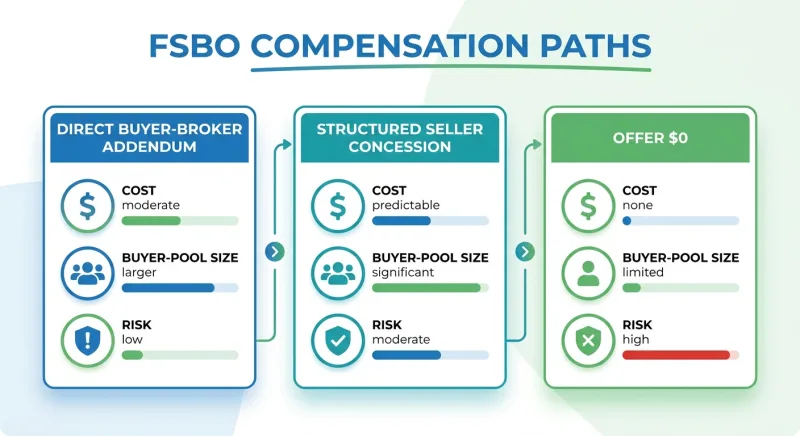
Yes, a buyer's agent can decline — but most won't skip a well-priced home that signals a reasonable concession, because their representation agreement lets them get paid either way. The written agreement obligates the buyer to cover any shortfall between what you offer and what the agent charges.
Before the settlement, the fear was that an agent scanning the MLS would see a low co-op number and steer their client elsewhere. Now compensation isn't even on the MLS to scan. The agent's pay is locked in by their contract with the buyer. Whether you offer 2%, 1%, or zero, that agent still gets paid — the only question is who covers the gap.
When you offer no concession, the buyer must bring cash to cover their agent's fee on top of down payment and closing costs. That friction can nudge a buyer toward a home where the seller did offer help. It's not steering; it's math.
The practical read: showings rarely die over compensation now. Deals stall when a buyer can't make the numbers work. A modest, clearly-signaled concession removes that friction without overpaying.
What Actually Happens to Your Concession Money: The Financing Mechanics Most Sellers Never See
The concession you offer has to survive the buyer's lender underwriting first — and that's where deals quietly fall apart. Once cooperative compensation left the MLS, buyer-agent fees started flowing through the same channel as any other seller-paid closing help: interested party contributions (IPCs). And IPCs are capped.
The Double-Bucket Distinction
Two separate pots of seller money exist in most transactions:
- Bucket one — traditional concessions. Closing costs, prepaids, rate buydowns. These fall under IPC limits set by Fannie Mae, Freddie Mac, FHA, and VA.
- Bucket two — buyer-broker compensation. As guidelines were updated following the settlement, a seller-paid buyer-agent fee may be handled outside that first cap.
If you assumed a 2.5% buyer-agent contribution had to squeeze into the same limited space as the buyer's closing-cost help, you'd either lowball your concession or reject an otherwise strong offer. Understanding the two buckets means you can negotiate a buyer-broker contribution and a closing-cost credit without them cannibalizing each other.
The safe planning assumption: structure matters more than amount. A flat dollar concession labeled generically ("seller to contribute up to $X toward buyer's closing costs") may cause a lender to absorb the buyer-agent fee into the capped bucket. Documented as a direct buyer-broker payment, treatment can differ. The buyer's loan officer — not you — makes the final call. Confirm it in writing before committing anything in the RF401.
Why the Loan Type Sets the Ceiling
- Conventional (Fannie/Freddie): IPC limits scale with down payment — tighter at low down payments, looser above 10% and 25% down.
- FHA: Seller contributions are capped at a fixed percentage of the sale price under HUD Handbook 4000.1.
- VA: Has its own concession framework plus rules on what buyer-agent fees a veteran may pay.
A first-time FHA buyer in Murfreesboro and a 25%-down conventional buyer in Brentwood have very different room under the ceiling. Offer more than the cap allows and the excess gets renegotiated at the eleventh hour or blows the deal.
The Appraisal Gap Nobody Warns FSBO Sellers About
A generous concession is only real if the appraisal supports the contract price plus that concession — and in a soft comp environment, it may not.
Sequence: you agree to $410,000 with a $10,000 buyer-agent concession. The home appraises at $405,000. The lender lends against $405,000 — and the concession must fit under both the appraised value and the IPC cap. The extra $5,000 you effectively financed into the price isn't there.
On paper it's the buyer's problem. In practice it lands on the seller, because the buyer's agent still expects the negotiated fee. The buyer-representation agreement backstops this — the buyer contractually owes their agent the agreed fee, and any gap is the buyer's obligation.
That contractual backstop is your leverage. When a buyer's agent pressures you to guarantee their full fee up front, the honest counter is: your buyer already agreed to cover you. I'll contribute a concession; your agreement covers the rest.
Represented vs. Unrepresented Buyers: Two Playbooks
The Represented Buyer
This buyer signed a written representation agreement before touring. Their agent's fee is already spelled out in their contract. Your decision is how much to offset with a concession — you're negotiating a contribution, not setting the agent's pay.
The overlooked edge: a $400,000 offer asking you to cover a $10,000 buyer-agent fee is functionally a $390,000 net offer. You can accept, counter the price up, counter the contribution down, or split the difference — and the buyer's agent, whose payday depends on the deal closing, becomes a motivated party pushing their client toward the middle. Under the old blanket-offer system that agent had no reason to help you; their fee was locked in at listing. Now you've gained an ally you're paying on your terms.
The Unrepresented Buyer
No agent means no buy-side fee — on a $400,000 sale, that's up to roughly $8,000–$12,000 that stays in the transaction. But unrepresented buyers need what represented buyers get for free: someone to write the contract, manage contingencies, and coordinate closing. Point them toward a neutral closing attorney rather than advising them yourself — it keeps you out of dual-role trouble and keeps the deal clean. Never coach the other side on price or strategy.
Signaling on RealTracs Without Advertising a Commission
You can't post a buyer-agent commission on RealTracs, but you can flip "Seller Concessions Offered" to Yes and populate the dollar field — legally signaling to the agent pool that there's money on the table. Three volume levels:
- Level 1 — Silent. List flat-fee, mark concessions "No," let offers come. Lowest cost, smallest represented-buyer pool. Best when your home is priced sharp and inventory is tight.
- Level 2 — Signal. Mark Seller Concessions Offered: Yes with a dollar figure. The buyer can direct it toward their agent's fee, closing costs, or a rate buydown. Every agent scanning RealTracs sees a green light: this seller will contribute.
- Level 3 — Structured. Signal on the MLS and pre-decide the amount and structure you'll write into the offer — the strongest position, because you control the framing when the offer lands.
The genius of Level 2: it separates willingness from commitment. The old 3% co-op was a binding blanket offer. The concession field signals openness while leaving you free to negotiate the number, recipient, and conditions in the RF401. You're advertising a door, not a blank check.
Edge Cases That Break the Standard Advice
Relocation or corporate buyer. Compensation may need to run as a direct broker-to-broker arrangement outside the concession framework.
Cash buyer with an agent. No lender means no IPC cap and no appraisal gate. You can structure compensation with total freedom — the cleanest scenario there is.
Dual-approval condo or HOA closing. Some association or lender conditions restrict how concessions appear on the settlement statement. Have your title company confirm the language before you sign.
Buyer who switches from unrepresented to represented mid-deal. Your listing terms don't retroactively obligate you to that agent's fee. Any compensation is negotiated fresh at the offer.
Why Flat-Fee MLS Is the Only Structure That Gives You Both Halves
A flat-fee MLS listing hands a Tennessee FSBO seller full RealTracs and portal syndication and complete off-MLS control over buyer-agent compensation — the exact two things the post-settlement market rewards.
- Pure FSBO, no MLS: maximum control, minimum exposure. Invisible to the represented-buyer pool.
- Full-service listing: maximum exposure, minimum control — you've paid a percentage to give away the negotiating position this guide is about.
- Flat-fee MLS: high on both. Your listing shows up everywhere a buyer's agent looks; every compensation decision stays in your hands, negotiated privately in the RF401.
Post-settlement, that combination went from "nice to have" to the whole point. You set your concession posture at listing — silent, signal, or structured — then negotiate the real number deal by deal.
The Bottom Line for Tennessee FSBO Sellers in 2026
You're not required to pay a buyer's agent anything, and that was never the useful question. The useful question is how much control you want over the money — and the settlement handed you all of it. Signal willingness on the MLS without committing. Let the buyer's representation agreement do the heavy lifting. Negotiate the contribution against price at the offer stage, with the buyer's agent motivated to close. Keep your two buckets separate so a fair concession doesn't gut your net.
Before you list, confirm current form editions and MLS field rules with a Tennessee closing attorney or title company — settlement mechanics keep shifting, and getting the paperwork right protects your sale.
The sellers who win in Middle, East, and West TN this year aren't the ones who paid the most or the least. They're the ones who understood that a flat-fee MLS listing buys full exposure while keeping full control — and then used both.
Frequently Asked Questions
Do FSBO sellers legally have to pay a buyer's agent in Tennessee in 2026?
No. There's no law in Tennessee requiring a FSBO seller to compensate a buyer's agent, and the 2026 NAR settlement didn't create one. Whether you offer something is a strategic choice, not a legal obligation.
Can a buyer's agent still show my Tennessee FSBO if I offer no commission?
Yes. Buyer's agents must have a written agreement with their client before touring, so the buyer — not you — is responsible for that agent's fee if you offer nothing. A well-priced FSBO can still attract represented buyers who negotiate the fee into their offer.
How much should a TN FSBO seller offer a buyer's agent in 2026?
Concessions commonly land in the 2%–3% range, fully negotiable and written into the purchase agreement rather than advertised as a blanket commission. On a $400,000 sale, 2.5% works out to $10,000 — offer more in a slow market, less when buyer demand is strong.
Can I advertise a buyer-agent concession on RealTracs after the settlement?
You can't post an explicit cooperative commission, but RealTracs lets you toggle on a "Seller Concessions Offered" flag with a dollar amount — signaling willingness without violating the cooperative compensation ban.
What's the difference between a seller concession and a buyer-agent commission now?
A concession is a flexible dollar credit a buyer can apply toward closing costs, prepaids, or their agent's fee. Post-settlement, buyer-agent pay is negotiated separately from the listing — the concession is simply one tool a buyer can use to cover it.
Does a flat-fee MLS listing let me control buyer-agent compensation?
Yes. A flat-fee MLS listing puts your home on RealTracs and the major portals for full exposure while you decide independently whether, how, and how much to compensate a buyer's agent — negotiated privately through the purchase agreement rather than surrendered to a full-commission brokerage.