
This guide summarizes Tennessee statutory requirements for educational purposes. It is not legal advice. Consult a licensed Tennessee closing attorney before signing anything.
The short answer: yes, you can legally draft your own for sale by owner contract in Tennessee. State law doesn't require any specific template — it requires a written, signed agreement covering the essential terms (Tenn. Code Ann. § 29-2-101, the Statute of Frauds). That single fact is why you don't need — and legally can't use — the copyrighted TAR RF 401 form as an unrepresented seller.
What Is a Tennessee FSBO Purchase Contract?
A Tennessee FSBO purchase contract is a written purchase agreement between a buyer and seller to transfer residential real estate, drafted and signed without a listing agent representing the seller.
To be binding under Tennessee's Statute of Frauds (Tenn. Code Ann. § 29-2-101), the contract must be in writing and signed by the party to be charged, with enough detail to identify the deal: who's buying, who's selling, which property, and for how much.
A purchase agreement is not the deed. The contract governs terms and timeline between offer and closing; the deed transfers title at closing and gets recorded with your county's Register of Deeds. Nothing in Tennessee law names a required template — the state cares about content and signatures, not branding.
Why You Can't Legally Use the TAR RF 401 Form as an Unrepresented Seller
The RF 401 Purchase and Sale Agreement is copyrighted and licensed to Tennessee REALTORS® members only. If you're an unrepresented FSBO seller, you don't hold that license.
It's a copyright issue. The RF-series forms are the intellectual property of Tennessee REALTORS®. Under federal law, the copyright holder holds the exclusive right to reproduce and distribute the work (17 U.S.C. § 106). Reproducing the form — or paraphrasing its language closely enough to copy its expression — is a copyright exposure.
It is not the unauthorized practice of law. Drafting your own contract to sell your own property is a recognized pro se activity. Tennessee's UPL statute (Tenn. Code Ann. § 23-3-103) targets people who prepare legal documents for others for compensation without a license.
The takeaway: build a contract from a generic legal template, or have an attorney draft one. Same enforceability, none of the copyright exposure.
The Core Truth: Tennessee Requires a Contract, Not a Template
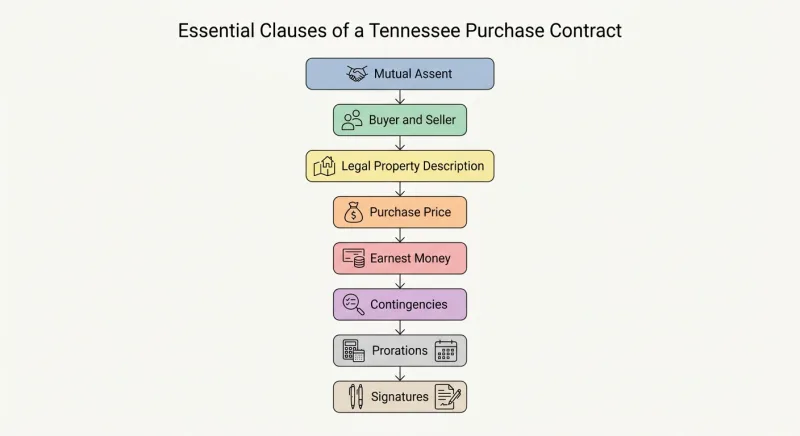
Stop asking "which form do I use?" Ask "does my written agreement contain every term a Tennessee court would need to enforce it?" A purchase agreement survives on:
- Identifiable buyer and seller
- A legal description of the property (not just the street address)
- A definite purchase price
- Mutual assent — offer and acceptance
- Signatures of the parties
Miss the legal description or leave the price open, and the prettiest TAR form in the world won't save you. The form was never the source of legality. The essential terms were.
Your 3 Legal Alternatives to the RF 401 Form
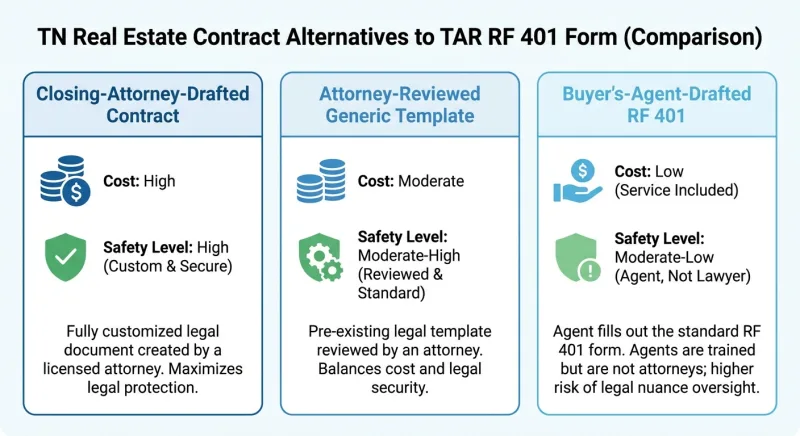
| Path | Who drafts it | Typical cost (2026) | Safety level | Best fit |
|---|---|---|---|---|
| Attorney-drafted contract | A Tennessee closing/real estate attorney | Higher end of flat-fee range | Highest | Complex sale, seller financing, unusual terms |
| Attorney-reviewed generic template | You start from a generic (non-TAR) template; attorney reviews | Mid-range flat fee | High | Standard cash/financed sale, budget-conscious seller |
| Buyer's agent drafts the RF 401 | The buyer's agent (a licensed REALTOR®) prepares the RF 401 | Usually built into buyer-side commission | High | Buyer is already represented |
As of 2026, Tennessee closing attorneys typically charge $400–$800 to draft or review a residential purchase contract — confirm before you engage, as it varies by county and complexity.
If your buyer brings their own agent, that agent can legally draft the RF 401 because they hold the license. You sign it as an unrepresented seller. No copyright issue lands on you.
One risk nobody prices correctly: the "free" template
A generic template pulled off a national forms site is often written for a different state's law. It won't reference Tennessee's Residential Property Disclosure Act. It may skip the sinkhole disclosure required under Tenn. Code Ann. § 66-5-212. It may assume a title-practice model from a state that closes through escrow companies instead of Tennessee's attorney-closing norm. A contract that's technically "signed and written" but omits a mandatory Tennessee disclosure isn't a clean deal — it's a lawsuit on a calendar.
The Drafting Blueprint: Essential Clauses of a Tennessee Purchase Contract
- Mutual assent / offer and acceptance. The legal spine — a definite offer and a matching acceptance.
- Identification of buyer and seller. Full legal names, exactly as they'll appear on the deed. If a married couple owns the property, name both spouses.
- Legal description of the property. The full description from the current deed or Register of Deeds records — not just the street address.
- Purchase price. The exact figure in dollars, how it's paid, and any deposit credited toward it.
- Earnest money. The amount, who holds it, and what happens if the deal falls through.
- Financing terms. If the buyer is borrowing, state the loan type and the deadline to secure it.
- Closing date and location. When and where, and who the closing attorney or title company is.
- Prorations. How property taxes and HOA dues split as of the closing date.
- Possession. When the buyer takes possession.
- Condition / as-is language. Whether the sale is "as-is" and how that interacts with disclosures.
- Contingencies. Financing, appraisal, inspection, and title.
- Signatures. Dated signatures of every buyer and seller (§ 29-2-101).
Write in your own words. Do not copy or closely paraphrase TAR's clause language.
Contingencies — and How You Actually Remove Them
Each contingency needs a deadline and a remedy spelled out. Two removal models exist in Tennessee practice:
Passive (deemed) removal: the contingency is waived automatically if the buyer doesn't object by the deadline. Seller-favorable — good for inspection.
Active (affirmative) removal: the contingency stays alive until the buyer signs off in writing. Buyer-favorable — fairer for financing and appraisal, since a loan denial or low appraisal is outside the buyer's control.
Draft a single "Contingency Removal" section defining the default model, deadline-counting rule, and required form of removal — written notice, delivered how, to whom.
Time Is of the Essence — And the Counting Problem
Without a "time is of the essence" clause, a Tennessee court may treat missed dates as non-fatal and grant a "reasonable time" to perform. Then there's the counting problem: "within 10 days" of what? Calendar vs. business days can swing an inspection window by four days. Define it clearly:
"All references to 'days' mean calendar days. The day of the triggering event is not counted; the last day is counted. If any deadline falls on a Saturday, Sunday, or federal holiday, it extends to the next business day."
Ambiguity here is the single most litigated defect in DIY purchase agreements.
Earnest Money Mechanics: Liquidated Damages vs. Reserved Remedies
| Structure | What Seller keeps on Buyer default | Risk |
|---|---|---|
| Liquidated damages | Only the earnest money | Under-compensates if you lost a better offer |
| All remedies reserved | Earnest money plus right to sue | Slow, expensive; buyer may be judgment-proof |
Tennessee courts won't enforce a liquidated damages clause that operates as a penalty. A 3% earnest money deposit as liquidated damages usually survives scrutiny; a clause trying to keep 20% of the purchase price likely does not.
Never hold the money yourself. A neutral escrow agent or title company holds it under written instructions, with the contract naming who releases it and on what conditions.
Mandatory Tennessee Disclosures — and the Timing Most Sellers Get Backwards
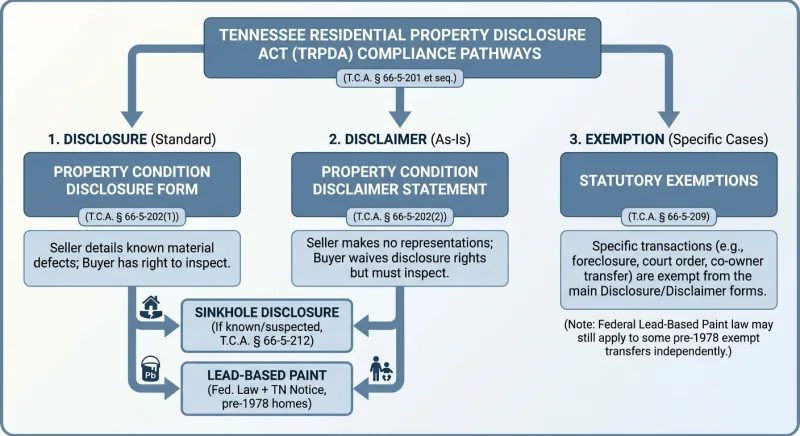
Tennessee's Residential Property Disclosure Act (Tenn. Code Ann. § 66-5-201 et seq.) requires most residential sellers to give the buyer written disclosure before the contract is finalized. You have three compliance pathways: Disclosure (default), Disclaimer (as-is, but known defects must still be disclosed), and Exemption (certain court-ordered or estate transfers).
Two disclosures carry heavier consequences:
- Sinkhole disclosure. Tennessee specifically requires disclosure of known sinkhole activity (Tenn. Code Ann. § 66-5-212) — routinely missed by national templates.
- Lead-based paint disclosure. For any home built before 1978, federal law (42 U.S.C. § 4852d and 40 CFR Part 745) requires disclosure of known hazards, the EPA lead pamphlet, and a 10-day buyer inspection opportunity.
Timing matters. Deliver the disclosure before the buyer makes a binding offer, or the buyer retains a statutory right to rescind. Deliver it late — after signing — and you may face misrepresentation claims under § 66-5-208.
Do this instead: deliver the completed disclosure, get the buyer's dated signature acknowledging receipt, then execute the purchase agreement. Reference the disclosure by date inside the contract so there's a paper trail proving sequence.
When "As-Is" Doesn't Mean As-Is
An as-is disclaimer under § 66-5-202 lets you sell without warranting condition — but it does not immunize you from liability for known material defects you actively conceal or misrepresent. As-is limits implied warranties. It does not cancel the disclosure duty and does not cover fraud.
Pair the clause with an inspection contingency that gives the buyer a real look, and you've built a defensible position. As-is is a shield against warranty claims, not a license to hide.
The Assignability Trap: When Your Buyer Flips the Contract
Unless your contract says otherwise, Tennessee treats a real estate purchase agreement as assignable by default — the buyer who signed can hand their rights to a stranger before closing. You negotiate with a friendly local family, sign the contract, then discover the actual buyer is an LLC that paid the original signer a $10,000–$15,000 assignment fee. Nothing illegal — absent a restricting clause.
Control it with one line:
- Hard bar: "This Agreement may not be assigned by Buyer without the prior written consent of Seller. Any purported assignment without such consent is void."
- Soft leash: permit assignment but keep the original buyer personally liable if the assignee defaults.
The soft leash is usually the smarter play — it preserves your right to enforce against a solvent original signer without killing legitimate transfers (such as a buyer moving the house into a living trust).
Curing Title Defects: "Marketable" vs. "Insurable"
Marketable title is free of reasonable doubt as to ownership. Insurable title means a title company is willing to write a policy, sometimes over a known defect. A satisfied-but-never-released mortgage lien may cloud marketable title, but a Tennessee title company will often insure over it or clear it with a quick payoff-and-release recorded at the county Register of Deeds.
If your contract demands "marketable title free of all exceptions," you've set a standard stricter than what closes deals every day — and handed a cold-feet buyer an exit.
Draft the title clause as "marketable title, insurable at standard rates by a licensed Tennessee title insurer, subject to a cure period." Then add the mechanism: if the commitment shows a defect, Seller gets X days to cure; if uncured, Buyer may accept title as-is, terminate for a full earnest-money refund, or extend closing. That three-option ladder is what a closing attorney builds in automatically — and what a copied template usually botches.
Where ResultsMLS Fits — After the Contract Is Sorted
We don't draft your contract. What we solve is the problem before the contract exists: getting your FSBO in front of enough buyers that you actually get a solid offer to paper. ResultsMLS puts your listing on the same MLS agents use, for a flat fee, and syndicates to the big portals — often producing the exact represented-buyer scenario where a buyer's agent handles your paperwork cleanly.
Attorney sorts the contract. ResultsMLS gets you on the MLS. See our flat-fee listing pages for Nashville, Franklin, Murfreesboro, Brentwood, Knoxville, Memphis, Chattanooga, and Clarksville.
Frequently Asked Questions
Can I legally write my own FSBO purchase contract in Tennessee?
Yes. Tennessee law doesn't require any specific form — it requires a written contract, signed by the party to be charged, with the essential terms (Tenn. Code Ann. § 29-2-101). Drafting your own is legal; having a Tennessee closing attorney review it before signing is the safe move.
Is it illegal to use the TAR RF 401 form as an unrepresented seller?
It's not a crime, but it is a copyright problem. The RF 401 is copyrighted and licensed to Tennessee REALTORS® members only, so using or copying it without a license infringes those rights under 17 U.S.C. § 106 — separate from the unauthorized practice of law (§ 23-3-103).
What disclosures must I attach to a Tennessee FSBO contract?
Most residential sellers owe a Residential Property Disclosure statement (§ 66-5-201 et seq.), plus a sinkhole disclosure (§ 66-5-212) and — for homes built before 1978 — a federal lead-based paint disclosure (42 U.S.C. § 4852d). Some sellers instead use a disclaimer or qualify for an exemption.
Do I have to hire a closing attorney to sell FSBO in Tennessee?
Tennessee doesn't force you to hire an attorney to sell, but drafting a deed and finalizing the transfer are legal work most sellers shouldn't do themselves (see UPL, § 23-3-103). Using a Tennessee closing attorney or title company to finalize the deed and handle escrow is standard practice.
How much does an attorney charge to draft or review a Tennessee FSBO contract?
As of 2026, Tennessee attorneys typically charge a flat fee of roughly $400–$800 to draft or review a purchase agreement — confirm the exact fee before you engage.
Conclusion
Tennessee never asked for a specific template. It asked for a written contract, signed, with the essential terms spelled out — buyer and seller, legal description, purchase price, earnest money, and closing details (§ 29-2-101). That's why you don't need the copyrighted TAR RF 401, and why you can't legally lift it either.
Build the contract on solid footing. Draft the essential clauses in plain English, attach the disclosures Tennessee requires, and don't guess at the parts that carry real risk — assignment, remedy, title, and disclosure timing all bite hard when they're sloppy. Let a licensed Tennessee closing attorney draft or review the agreement and handle the deed.
Get the contract right. Get on the MLS. Keep your equity.
This guide summarizes Tennessee statutory requirements for educational purposes. It is not legal advice — consult a licensed Tennessee closing attorney before you sign anything.