

How to Field and Counter Buyer Offers Yourself in a Tennessee FSBO Sale (No Agent Needed)
An offer just hit your inbox. Your for-sale-by-owner listing worked, a buyer wants your house, and now the pressure's real. So what do you actually do with this thing?
Yes, you can counter a buyer's offer without a realtor in Tennessee — the state has no law forcing a seller to hire an agent to negotiate a home sale. What you cannot do is self-draft the copyrighted Tennessee REALTORS® forms your buyer's agent uses, like the RF401 Purchase and Sale Agreement or the RF651 Counter Offer. Those forms are licensed to authorized users, and an unrepresented seller isn't one.
That single detail trips up more Tennessee FSBO sellers than any pricing question. You get to control the negotiation — the price, the terms, your bottom line — but the actual paperwork has to move through a legal route. There are three, and none require handing 3% of your sale to a listing agent.
This is general information, not legal advice; have a Tennessee real estate attorney review any binding document.
What Happens After You Find a Buyer: Reading the RF401
If the buyer has an agent, they'll almost always send an offer written on Form RF401, the standard Tennessee REALTORS® Purchase and Sale Agreement. Don't skim it. Most sellers stop at the price and think that's the deal. It isn't. The purchase price is one variable in a package of eight or nine that all move against your bottom line. A $415,000 offer on your $429,000 list looks like a $14,000 gap — but add a $9,000 closing-cost credit, a home-warranty line, and a typical repair resolution, and that "$415K offer" nets closer to $402K.
The clauses that quietly move your net
- Closing-cost concessions. A buyer asking you to pay part of their loan costs is a price cut wearing a different hat. Add it back to the real discount before you respond.
- Financing type. Cash, conventional, FHA, VA? Financed offers carry appraisal and loan risk. A full-price cash offer with a 21-day close can beat a higher financed offer that drags to 45 days.
- The inspection contingency. In the current RF401 this typically sits around Subsection 8.D and opens a 7–10 calendar-day window — a second negotiation you haven't had yet.
- Earnest money. More earnest money signals a more committed buyer.
- Special stipulations. This free-text section is where the surprises live: a contingency on the buyer selling their current home, a request to keep your appliances, a rent-back demand.
The sellers who net the most aren't the hardest negotiators on price. They're the ones who counter the whole package — trading a concession they don't care about for a term that protects their walkaway number.
Before You Counter: Tennessee's Property Disclosure Requirement
Tennessee law (Tenn. Code Ann. § 66-5-201) requires most residential sellers to deliver a written Residential Property Disclosure to the buyer before you enter a binding contract. Skip it, and the buyer may have the right to rescind — and you could face liability. All the negotiating you just did evaporates.
The form asks you to report known conditions and defects: roof, foundation, water intrusion, systems, past repairs. Be honest and thorough. A few sale types qualify for the exemption handled on Form RF203, but most standard home sales don't. If you're unsure, ask a Tennessee real estate attorney before assuming.
Deliver the disclosure first. Then negotiate.
The Copyright Trap: Why You Can Decide But Can't Draft
The RF401, RF651, and RF203 are copyrighted works owned by Tennessee REALTORS® and licensed only to authorized users. You are not one. So when you find a buyer, you're in a precise situation: you have every legal right to say yes, say no, or say $9,000 higher — but no legal right to put those words on the official form yourself.
Call it the Draft-vs-Decide split.
Decide (100% yours, no license needed): whether to accept, reject, or counter; the counter price and terms; which contingencies you allow; your walk-away number; deadline responses.
Draft (must route through an authorized channel): writing the counter onto the RF651; modifying binding RF401 terms; executing exemption paperwork.
You keep every ounce of decision power. You just don't hold the pen on the copyrighted form.
The Three-Channel Rule: Who Actually Holds the Pen
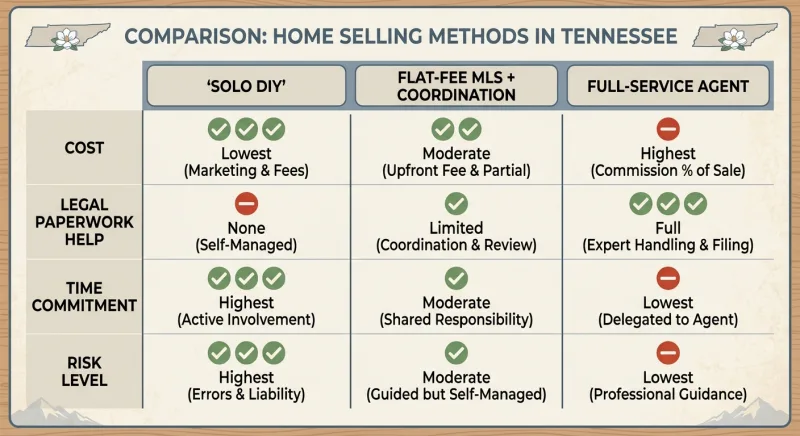
Channel 1 — The buyer's agent drafts it. Most buyers come represented. That agent is an authorized user and can prepare the RF651 to reflect your terms. You dictate; they type. Common, fast, and free to you. The catch: they represent the buyer. Verify every number before you sign.
Channel 2 — A Tennessee real estate attorney. For a flat fee, a TN closing attorney prepares or reviews binding documents. This is the safest route for anything unusual — a lease-back, an odd contingency, a nervous buyer. A few hundred dollars beats a five-figure mistake.
Channel 3 — A flat-fee transactional service. You list on the MLS flat-fee, keep full decision control, and get coordination plus attorney/title support for the binding docs — without a 3% listing commission.
How to Counter a Buyer's Offer Step by Step
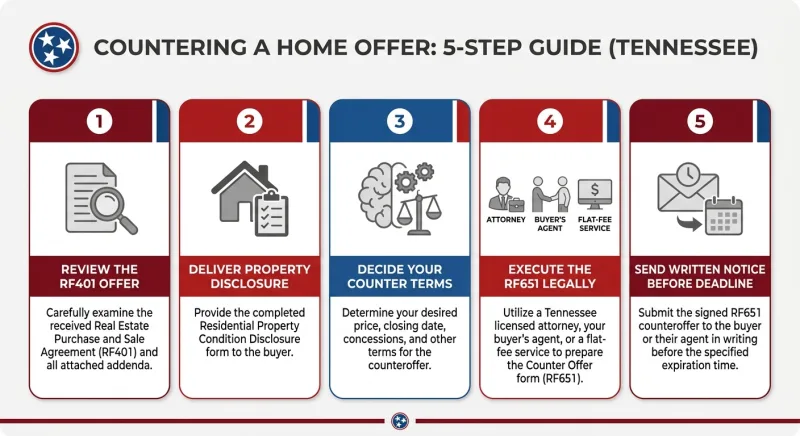
Step 1: Decide your counter terms
Figure out what you want before you touch a form. Counter the whole package. If they offer $415K on your $429K list, financed, with a 10-day inspection window and a $6,000 closing-cost request, firing back "$425K" is a weak move — you've anchored one variable and left three on the table. Instead: hold at $422K, tighten the inspection window to 7 calendar days, cap repair credits, and shorten the close.
Step 2: Confirm your disclosure is delivered
Confirm it's in the buyer's hands before the contract binds.
Step 3: Route the RF651 through a legal channel
Pick the buyer's agent, an attorney, or a flat-fee transactional service. You cannot self-draft the RF651.
Step 4: Put your terms in writing
Verbal doesn't count. In Tennessee, changes need written notice to be enforceable. Every counter, acceptance, and revision goes on paper or through the proper e-signature platform.
Step 5: Send it before the deadline — then hold
The buyer's offer has an expiration. Get your signed RF651 back before it lapses. A same-day frantic counter signals desperation. Respond before the deadline, but not the instant the offer lands.
Defending Your Number in the Inspection Window
The inspection window is where negotiated gains quietly disappear. The buyer comes back with a repair request, and if you can't agree, they can typically terminate and recover their earnest money within that window. The "final" price you negotiated is a ceiling, not a floor.
Anchor the resolution mechanism in your counter, not just the price. When you send the RF651, propose how inspection issues get resolved — capping your repair obligation at a fixed dollar amount, or converting all requests into a single closing credit. Counter the price and stipulate a repair cap in the same RF651. Now the back door's closed.
The Deadlines You Can't Miss
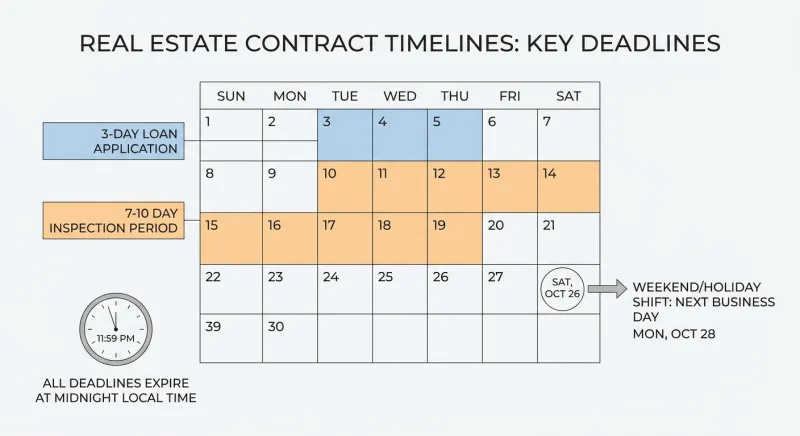
Miss a deadline and you can hand your buyer a free exit. In the standard RF401, deadlines are counted in calendar days and expire at 11:59 PM local time, with a business-day auto-extension when a deadline falls on a weekend or holiday.
Nearly every deadline counts from the binding agreement date — the moment both parties have signed and acceptance is communicated back. Get this date wrong and every downstream deadline is miscalculated.
Two deadlines start the clock immediately:
- The loan application deadline — often around 3 calendar days for a financed buyer to formally apply.
- The inspection window — the 7–10 day period discussed above.
Handling Earnest Money the Right Way
Earnest money in a Tennessee FSBO sale should sit with a neutral escrow agent — usually the closing attorney or title company — not in your personal account. That reflects TREC escrow-handling norms under Title 62, Chapter 13. Holding buyer funds yourself invites disputes and accusations of mishandling.
Amounts vary; in Davidson, Williamson, and Knox counties, typical practice runs roughly 1–2% of the purchase price, or a flat $1,000–$5,000. Line up your title company or closing attorney before you counter.
Managing Multiple Offers and Appraisal Gaps
Multiple offers. You have three moves: accept one outright, counter one and reject the rest, or counter more than one buyer. That last option carries a real trap — counter multiple buyers on identical terms and two accept, and you can end up bound to two contracts on one house. Counter one buyer at a time, or use language that reserves your right to accept another offer until you've signed. This is where a quick attorney review earns its fee several times over.
Appraisal gaps. If the home appraises below the agreed price, the lender won't fund the full amount and the deal wobbles. Ask for an appraisal gap clause — language where the buyer agrees to cover a set shortfall in cash. Counter to $423K, the appraisal comes in at $415K, and a gap clause covering up to $8,000 keeps the deal on your terms. Serious buyers accept it. Tire-kickers don't.
FSBO Isn't a Solo Sport
Sellers who lose money confuse no listing agent with no help. You skip the commission and still route the RF651 through an authorized channel, still have a title company hold earnest money in neutral escrow, still have an attorney review the special stipulations. You own the decisions. Professionals handle the copyrighted paperwork and neutral money custody. You keep the equity that would've gone to a listing commission.
Frequently Asked Questions
Can I counter a buyer's offer without a realtor in Tennessee?
Yes. Tennessee law lets an unrepresented seller negotiate and counter any offer, but you cannot self-draft the copyrighted TN REALTORS® forms (RF401, RF651) — you'll route the paperwork through the buyer's agent, a TN real estate attorney, or a flat-fee transactional service.
Can a FSBO seller fill out the RF401 or RF651 forms themselves?
No. The RF401 and RF651 are copyrighted TN REALTORS® documents restricted to authorized users. A for-sale-by-owner seller must have a licensed party or attorney prepare them — though you decide every term inside them.
What is the binding agreement date in Tennessee?
The binding agreement date is the day the last party signs the final agreed terms and that acceptance is communicated to the other side. In the RF401, this date starts the clock on nearly every deadline in the contract.
Who holds earnest money in a Tennessee FSBO sale?
A neutral escrow custodian — typically the closing attorney or title company — holds earnest money, never the seller personally. Holding buyer funds yourself runs against TREC escrow norms under Title 62, Chapter 13.
How long does a buyer have to do a home inspection in Tennessee?
Inspection windows are negotiable, but Tennessee contracts commonly set a 7-to-14-day period from the binding agreement date. You can counter to shorten it.
How much does it cost to counter an offer using an attorney versus a flat-fee service?
A Tennessee real estate attorney typically charges by the hour or a flat document fee, while a flat-fee MLS service bundles coordination into your listing package — often the cheaper route when managing multiple offers.
Keep the Equity That's Yours
Here's the through-line on how to counter offers FSBO Tennessee sellers should remember: you control the negotiation, but not the paperwork. You decide whether to hold firm at $429K or counter the repair credit instead of the price. You set the deadlines. You just can't self-draft the RF401 or RF651 — those run through your buyer's agent, an attorney, or a flat-fee transactional service. And before any binding agreement, deliver your disclosure under Tenn. Code Ann. § 66-5-201.
Put your disclosure in the buyer's hands. Decide your counter terms. Route the written notice through a legal path before 11:59 PM on the deadline. Let a neutral escrow custodian hold the earnest money. None of this requires a full listing commission.
This guide is information, not legal advice; have a Tennessee attorney review your contract before you sign.