
Here's the short version—no, you don't have to pay a buyer agent commission in Tennessee in 2026. Since the NAR settlement took effect August 17, 2024, that cost is fully negotiable. Many traditional sales still include a buyer-side payment, but Tennessee FSBO sellers can negotiate it down or offer nothing at all. The rules changed; the math didn't disappear.
Most articles stop at "commissions are negotiable now." True—and useless when a buyer's agent calls asking what you're offering. This guide fills that gap: how buyer-broker compensation got decoupled from the MLS, which Tennessee REALTORS® forms govern the conversation (RF 401, RF 141, RF 301), what Tennessee's net-listing ban under Tenn. Code Ann. § 62-13-302(b) means for deal structure, and what's actually at stake in dollars.
Informational only. This is not legal advice.
Do FSBO Sellers in Tennessee Have to Pay Buyer Agent Commission?
No. It was never technically mandatory—and after the NAR settlement, a buyer agent commission in Tennessee is fully negotiable, optional, and no longer advertised on any state MLS.
What existed was a customary offer broadcast through the MLS, which made it feel mandatory. It wasn't. Your options as a Tennessee FSBO seller in 2026:
- Offer $0. The buyer's agent looks to their own client for payment per the buyer's representation agreement.
- Offer a flat amount—say, $5,000—regardless of sale price.
- Offer a percentage—2%, 2.5%, whatever you decide is worth it.
- Negotiate deal-by-deal, offering nothing up front and responding to individual requests.
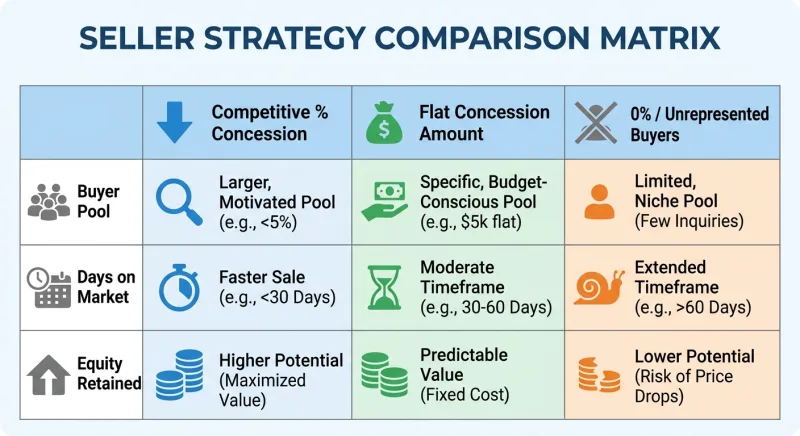
Why offer anything? Leverage math. A large share of buyers still work with agents, and those buyers now owe their agent a fee under a signed agreement. If a buyer has to pay their agent out of pocket, your listing competes against homes where the seller absorbs that cost. A modest concession can widen your buyer pool without touching a full 6%.
For a $450,000 home, the difference between a 3% buyer-side concession and $0 is roughly $13,500. That's what's on the line.
The NAR Settlement in Tennessee: What Actually Changed
Two structural changes hit every Tennessee MLS after August 17, 2024: buyer-broker compensation offers were removed from all MLS listings, and buyers must sign a written representation agreement before touring homes. Neither change forces a seller to pay anything.
Change 1: Compensation is decoupled from the MLS
Before the settlement, a listing broker entered an offer of buyer-agent compensation directly into the MLS. That field is gone. RealTracs (Middle Tennessee—Nashville, Franklin, Murfreesboro, Brentwood, Clarksville), KAAR MLS (Knoxville and East Tennessee), and MAAR MLS (Memphis) each removed the buyer-broker compensation field to comply. You can no longer advertise a buyer-agent payment on the MLS in Tennessee—even if you want to.
The offer now happens off-MLS—in direct conversation, in the purchase and sale agreement, through a seller concession form. That shift actually helps a FSBO seller. Under the old system, a zero-offer listing was quietly filterable; agents could steer buyers away before a showing. Now every listing looks identical in the feed regardless of what you're offering the buyer side. The steering lever got harder to pull because the data isn't there to pull it with.
Change 2: Buyers must sign before touring
An agent working with a buyer must have a signed written buyer representation agreement in place before showing homes. In Tennessee, that's typically Form RF 141. That agreement spells out what the buyer owes their agent. When a buyer's agent contacts you about your FSBO listing, the compensation question is front-and-center for them—their client already agreed to a fee, and they want to know if you'll help cover it.
That's the moment that confuses sellers. An agent calls and asks, "What are you offering the buyer's side?" It sounds like a demand. It isn't. It's a negotiation opener—and you're allowed to say "nothing," "a flat $4,000," or "let's talk in the offer."
How FSBO Sellers Field Off-MLS Compensation Requests
When a buyer's agent asks what you'll pay, treat it as a negotiation—not an obligation. You can decline, counter with a flat amount, or fold a concession into the offer. Everything happens off-MLS and in writing.
There are three moments a compensation question can land.
Moment 1 — Pre-showing
The agent will often ask about compensation before scheduling a showing. "The buyer is welcome to submit an offer that includes a concession request, and I'll consider it like any other term" is a complete, correct response. The request then arrives as part of the offer, not as a precondition to showing your house.
Moment 2 — Inside the written offer
This is where the real number gets set. A buyer who wants help with their agent's fee writes it into the purchase and sale agreement as a seller concession—the same as a request for help with closing costs. You counter it like any other term.
The tactical point competitors miss: a concession and a commission are not the same instrument. A concession is a credit you give the buyer that they can apply wherever they want—their agent's fee, closing costs, a rate buydown. It's flexible and caps at the dollar figure you write. A directly negotiated buyer-broker commission is a separate contract tied to a percentage of a moving target. Frame the money as a concession and you keep it inside a single line item you control.
Moment 3 — At the closing table
Rare, but it happens on rushed deals. If compensation wasn't nailed down in writing, it becomes a settlement-statement scramble. Everything financial should be locked in the signed purchase and sale agreement before closing. A verbal promise to pay a buyer's agent is asking for trouble.
One honest caveat: sellers who offer $0 field more calls from unrepresented buyers and fewer from agents. That's not a problem—it's a different buyer pool.
The Tennessee Forms That Govern Buyer Agent Compensation
A seller concession is written on Form RF 401, the buyer's obligation lives in Form RF 141, agency roles are confirmed on Form RF 301, and Tenn. Code Ann. § 62-13-302(b) prohibits net listings—a backstop that protects sellers.
Form RF 401 — where a seller concession lives
If you decide to offer anything toward the buyer's side, it goes into the purchase and sale agreement as a seller concession on Tennessee REALTORS® Form RF 401. As a FSBO seller, this is your lever: you set the dollar amount, and the buyer applies it to their agent's fee. Write a flat number instead of a percentage, and a $450,000 sale costs you exactly what you put on that line—not 3% of a moving target.
Form RF 141 — the buyer representation agreement
Form RF 141 is the written agreement a buyer signs before touring. It defines what the buyer owes their agent. When an agent asks you for compensation, they're trying to reduce what their client already agreed to on this form. Not your document, not your obligation. Read the question that way and the pressure evaporates.
Form RF 301 — confirmation of agency status
Form RF 301 confirms who represents whom. For a FSBO seller, it makes clear that the agent in your living room represents the buyer, not you. If an agent starts "helping" you price, stage, or fill out disclosures while representing the buyer, you've got a conflict in your kitchen. RF 301 keeps the line clean.
Tenn. Code Ann. § 62-13-302(b) — no net listings
This statute prohibits net listings in Tennessee—arrangements where a broker keeps everything above a set price, historically hiding true commission from sellers. In a decoupled world, you'll hear creative compensation pitches. Knowing there's a statute drawing hard lines tells you which offers are legitimate and which ones a licensee legally can't make.
None of these forms require you to pay a buyer's agent. They govern how compensation is handled when you choose to offer it—and they keep it transparent and in writing.
Consult a Tennessee real estate attorney or TREC for guidance on your specific transaction.
Financing Mechanics: The Concession-vs-Commission Trap
Buyer-agent compensation structured as a concession generally flows through the buyer's loan and closing statement, subject to their lender's interested-party contribution limits. A separately negotiated commission paid outside those limits can create underwriting friction.
In practice:
- If the buyer is financing, structuring your help as a seller concession within their program's contribution cap is usually the cleaner path.
- If you offer more than the cap allows, the excess can get kicked back by the lender, blowing up your timeline.
- Cash buyers sidestep all of this.
Ask any buyer's agent who submits an offer to specify the loan type up front—it tells you exactly how much room you have before you counter.
Edge Cases: When the Standard Playbook Breaks
The dual-timeline squeeze
You're buying and selling at once. If you're a buyer elsewhere, you've signed your own RF 141 and owe your agent a fee. Budget for the side where you're represented, even while you skip paying on the FSBO side.
The relocation-buyer wildcard
Corporate relocation buyers often work under employer-mandated representation contracts with fixed fees. Expect a firm concession ask—it's contractual on their end. Decide in advance whether you'll entertain relocation offers so you don't stall the negotiation.
The all-cash, unrepresented buyer
The cleanest outcome. No buyer's agent, no compensation question, no lender cap. You handle disclosures, the purchase and sale agreement, and closing coordination directly—a title company or closing attorney runs the settlement.
The "phantom" buyer agent
A buyer tours unrepresented, then a "friend who's an agent" appears at the offer stage claiming a commission. Without a signed RF 141 dated before the showing, that claim is weak. Ask for the executed agreement.
The Contrarian Take: A Flat Concession Beats a Percentage
Most sellers still think in percentages. The smarter post-settlement move is a flat dollar concession—it caps your exposure, and it's the only structure the new form stack actually rewards.
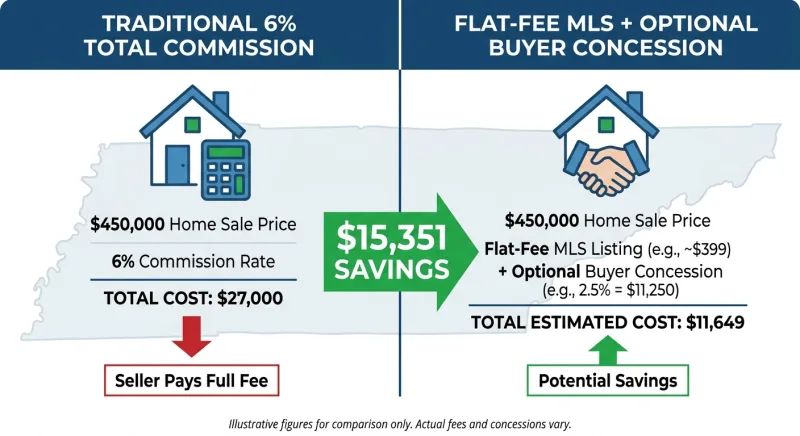
A typical Tennessee sale historically carried roughly 6.05% in total commission—about 2.95% to the listing side and 3.10% to the buyer side. On a $450,000 home, that's roughly $27,000 total.
Go FSBO with a flat fee MLS Tennessee listing. You pay a small flat fee to get on RealTracs. That ~$13,275 listing-side commission stays in your pocket before you've negotiated a single thing. Then instead of advertising a percentage you can't advertise anyway, you wait for offers and respond to concession requests on RF 401. Land at a flat $8,000 concession instead of 3.10% ($13,950), and you just kept another ~$5,900.
| Structure | Buyer-side cost on $450k | Who controls the ceiling |
|---|---|---|
| Old MLS-advertised % | ~$13,950 (3.10%) | The market's default |
| Competitive % concession | ~$11,250–13,500 | Still a moving target |
| Flat concession amount | You decide (e.g., $8,000) | You |
| 0% / unrepresented buyer | $0 | You (smaller buyer pool) |
Percentages scale against you as your home value climbs. A flat concession does the opposite—the more your house is worth, the more a fixed figure protects. In pricier markets like Brentwood, that gap is thousands a percentage habit quietly hands away.
The honest caveat: offering $0 shrinks your buyer pool because some buyer agreements make the buyer cover any shortfall, and not every buyer can. A flexible flat concession is the middle path that keeps the pool wide without defaulting to 3%.
Setting Your Concession Number Before You List
Don't wait to be asked. Decide your buyer-side posture before your listing goes live, and let it drive your list price.
Pick your posture. Zero works in a hot micro-market with cash-heavy demand. A flat dollar credit gives you cost certainty. A competitive 2%–3% suits a slower market with an agent-heavy buyer pool.
Price to your posture, not around it. If you offer zero and price at full market, agent-represented buyers may ask for a concession anyway—build a modest cushion into your list price rather than your walk-away number.
Reserve room to trade. Treat the concession as a negotiating chip. A buyer who wants a $10,000 credit and a $5,000 price reduction has given you a menu. Trade the credit for a firmer price, or vice versa, depending on which protects your net.
Frequently Asked Questions
Do FSBO sellers in Tennessee have to pay a buyer agent commission in 2026?
No. There's no law or rule requiring a Tennessee seller to pay a buyer's agent—the NAR settlement made any buyer-side compensation fully negotiable, and a FSBO seller can offer a competitive concession, a flat dollar amount, or nothing at all.
What is the average buyer agent commission in Tennessee right now?
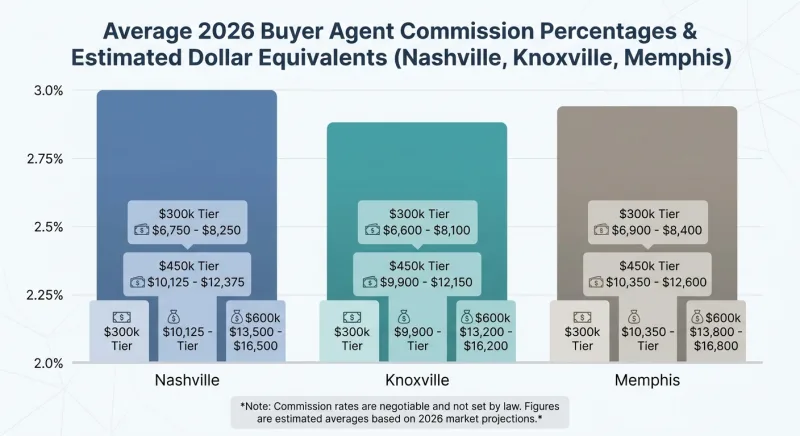
As of 2026, buyer-side compensation typically ranges between 2% and 3% per Redfin data, though Clever Real Estate's survey indicates Tennessee's historic average has sat near 3.10%. On a $450,000 Nashville home, 2.5% is roughly $11,250—money you now control as the seller.
Can buyer agent commission still be advertised on the MLS in Tennessee?
No. Under the NAR settlement effective August 17, 2024, RealTracs, KAAR, and MAAR removed the buyer-broker compensation field, so any offer of buyer-side pay now happens off-MLS through direct negotiation.
Can a Tennessee seller cover the buyer's agent through closing costs instead?
Yes. A seller can offer a concession—written on Tennessee REALTORS® Form RF 401—that the buyer applies toward their agent's fee or other closing costs, keeping the arrangement flexible rather than a fixed MLS-posted rate.
Is flat fee MLS worth it in Tennessee for FSBO sellers?
For most money-conscious sellers, yes. A flat fee MLS listing gets your home on RealTracs (or KAAR/MAAR) for a low one-time cost while you keep full control over whether—and how much—to offer a buyer's agent, often saving thousands versus a traditional 6% total commission.
The Bottom Line
Since the NAR settlement, buyer agent commission in Tennessee is no longer something anyone can post on RealTracs, KAAR, or MAAR—and it was never something a seller was legally required to pay. That hands FSBO sellers real leverage. You decide whether to offer a competitive concession, a flat dollar amount through Form RF 401, or nothing at all.
Know your local buyer pool before you set a concession—zero can work in a hot Franklin or Brentwood market, while a 2%–2.5% offer may widen interest on a slower listing. When a buyer's agent asks about pay, you're negotiating from an informed position. And if you want your home in front of the agents and buyers who search the MLS, a flat fee MLS listing in Tennessee gets you there for a low one-time cost while you keep every dollar of that old 6% you don't choose to give away.
This is educational information, not legal advice from TREC or a Tennessee real estate attorney. Verify current forms, statutes, MLS policies, and lender contribution limits before you sign anything.
The old commission model assumed you had no choice. In 2026, you do.